


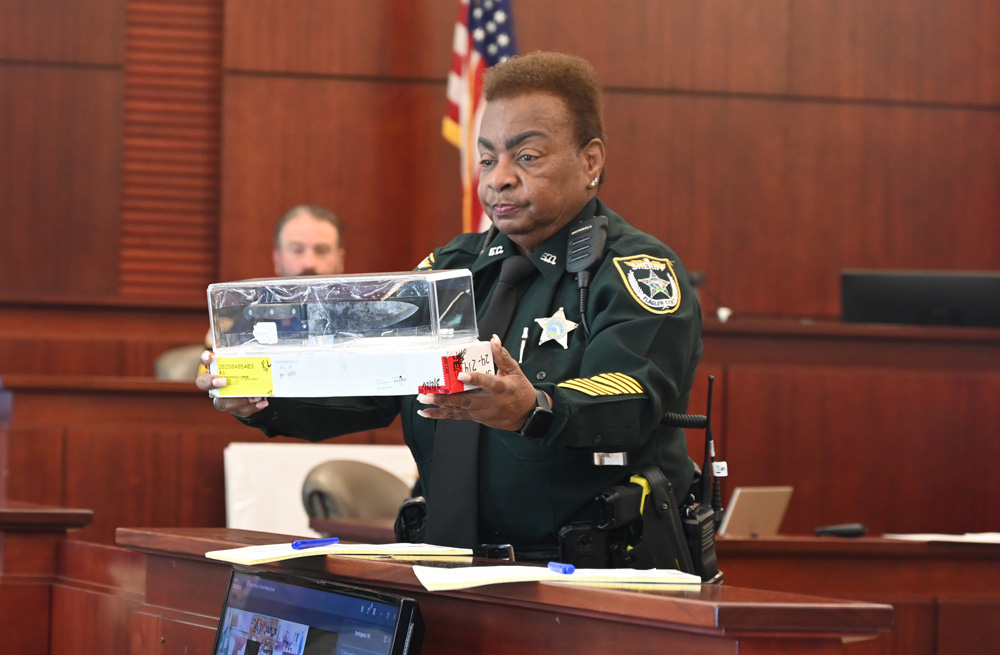
It was a procession of moments this fourth day of Jermaine Williams Sr.’s death penalty trial in a Bunnell courtroom today.
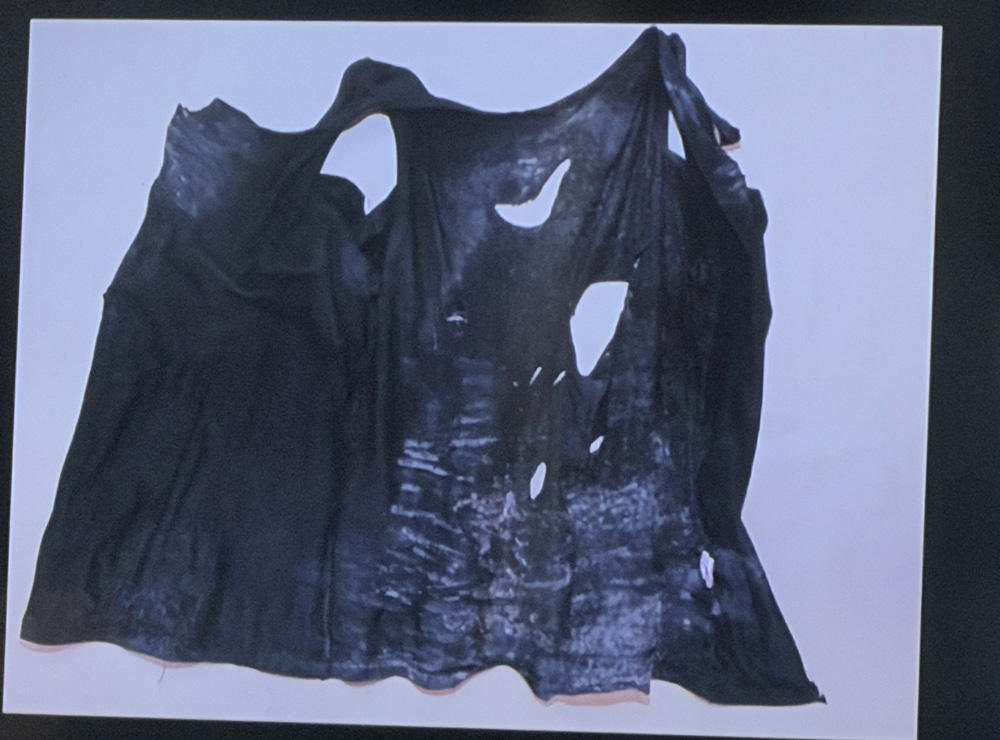
There were the moments when Assistant State Attorney Jason Lewis showed the 15-member jury, walking from one end of the jury box to the other at a minimal pace, the scissored black shirt Yolonda Williams was wearing the morning of Aug. 2, 2024, when her husband Jermaine stabbed her 19 or 20 times. And the shredded bra she was wearing. And the bloodied pants she was wearing, now all as if mummified against Saran-wrapped poster boards for preservation, and for display.
There was the moment when Assistant State Attorney Helen Schwartz showed pictures of Yolonda’s hands after she died, both hands’ nails–which Yolonda cared for religiously–broken as she had tried to fight for her life. Or when Lewis displayed Jermaine’s black “Today I feel” t-shirt he wore as he killed, the t-shirt that claimed he felt “happy,” “playful,” “curious,” the t-shirt that made him out to be a Jedi. One of the feelings was also “worried.”
There was the testimony of Jace Williams, now 16, who had heard his parents arguing that morning, heard his father rummaging in the knife drawer in the kitchen, “like he was pulling something out of the drawer,” heard a scream outside and ran out in his underwear and a blanket to find his father stabbing his mother. “I was yelling at him, cussing at him, trying to get him to stop.” A slight, skinny 14 at the time, Jace tried to intervene only for his father to take a swing at him with the knife.

There were the silent videos. A Bunnell police officer’s body cam. The neighbor’s surveillance video from across the street. The Williamses’ own surveillance video at their doorway at 408 South Pine in Bunnell. A street surveillance video from a block and a half away. Each video showed one or another sequence of Jermaine Williams’s gruesome tenacity, one of them showing him stabbing, grabbing, stabbing, pushing Yolonda down when she got up, gripping her by the hair, stabbing again as she tried to defend herself with her feet.
The jury saw what Schwartz said it would see in her opening argument, “see Yolanda struggling from the ground, fighting for her life, reaching up, reaching her knees up and her hands, even grabbing the [blade] of the chef’s knife herself, cutting her fingers, anything to fight off her attacker, the defendant, her own husband.”
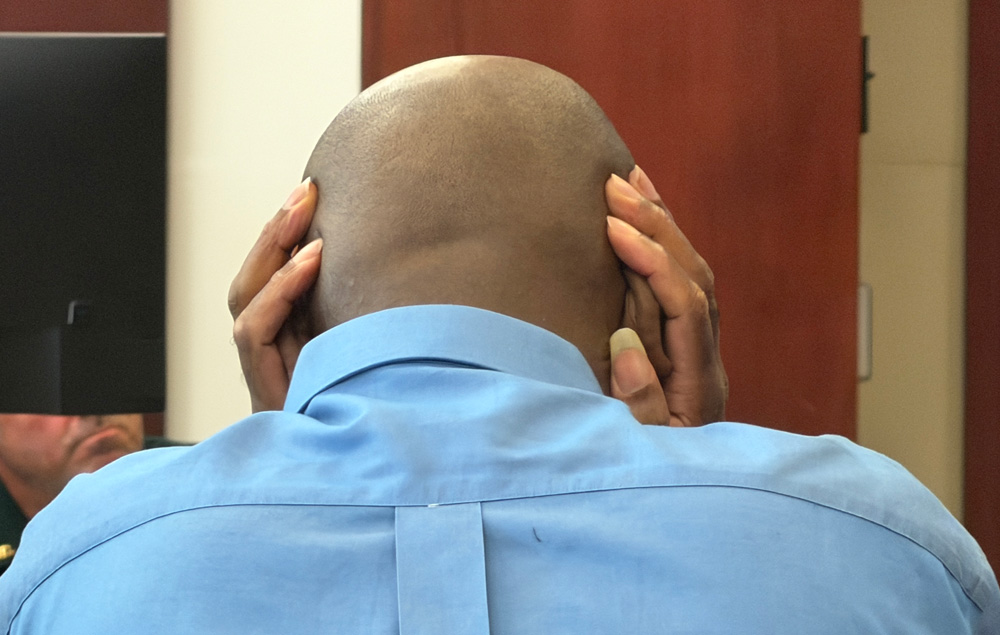
When that video was played for the jury, with one of the giant overhead screens just to the right and above Jermaine Williams, he repeatedly clasped his head in his hands and appeared to cry, wiping his eyes and in one instance letting out a quiet sob. At least one juror, the young teacher, stole a glance his way at that moment. In the audience, a few of the Yolonda entourage of three dozen walked out from the pain of the video. The judge before the jury had walked in at the start of the day had asked audience members to do just that if they could not control their emotions.

The video from the city surveillance camera on South Pine, played twice in the afternoon (with a zoomed-in version), showed the entirety of the incident from further away, without as much up-close, graphic detail, but giving the incident’s full context. It showed how Yolonda was standing by her car door with Jermaine for a long moment; how Jermaine disappeared into the house at a walking pace—when he was rummaging through the drawer for that knife—then returned almost running, rushing at Yolonda as she tried to get away from him by stepping toward the street, where Jermaine grabbed her and started stabbing, knocking her down and continuing to stab for 60 seconds until his son appeared, running and getting threatened by his father just as Jermaine’s own father drove up in his lawn care truck, stepped out, went back to his truck, and grabbed his gun.
There was the testimony of Williams’s father, David, who routinely drove by his son’s house on his way to work every morning and did so that morning, only to see his son attacking his daughter-in-law, “and he had blood on him, she had blood on her, and I said, ‘This must be a dream or a joke.’” David watched his son stab Yolonda twice as he was pulling up. He grabbed his Glock and pointed him at his son. “I told him to back away from her right now.”
“Did you tell him you were going to shoot him if he didn’t?” Lewis asked David Williams.
“I didn’t have to tell him.”
Jermaine had told his father one thing: “You’re going to let my son see his mom suffer.” It wasn’t a question. It was a command, the sort of command that, according to Yolonda herself, who’d written of it four years ago in a petition for an injunction against her husband’s violence, Jermaine had leveled at her when he would beat her in front of their young children, forcing the children to watch.
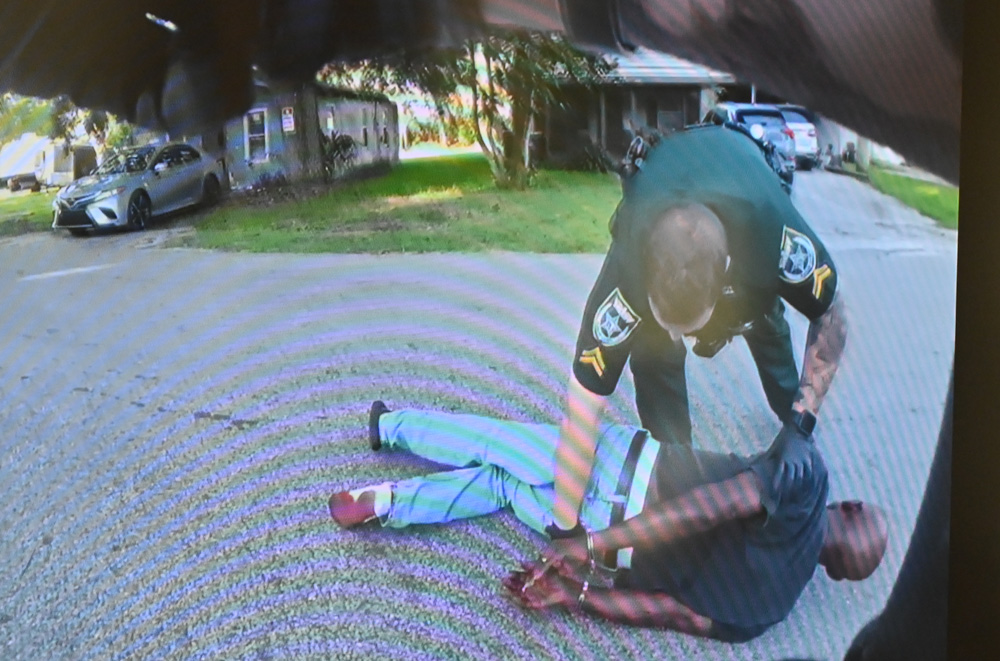
And another video, moments afterward–the body cam–showing Yolonda almost lifeless, on her side, in a pool of her own blood as Jermaine Williams surrendered to police down the street, and like a man who knows exactly how to surrender to police–flat on his stomach, hands behind his back, ready for the handcuffs.
The jury does not know what Jermaine and Yolonda talked and argued about before he went into the house. Evidence by then had only established that Yolonda’s silver Honda had not started that morning and that she was trying to get to work, that a neighbor had seen Jermaine under the hood of the car at one point, and Yolonda in the driver’s side, before the neighbor went into his house. Yolonda’s mother testified that her daughter had called her to come take her to work.
But there was also one other moment when Jermaine’s brother, Daryl Williams, testified that he’d called his brother in jail and asked him what was wrong with Yolonda’s Honda that it wouldn’t start that morning. Jermaine, his brother testified, “was disabling the car so it wouldn’t start.”
Before the rummaging in the drawer for that knife, before those minutes captured on video that the prosecution is using to establish premeditation, Jermaine, who was known around town as a handy mechanic, had intentionally disabled his wife’s car to keep her from driving away.
It doesn’t establish premeditation for murder. But it is an especially sinister, calculated way to immobilize his wife. Combined with Jermaine’s slow-paced walk away from Yolonda in the Pine Street video, the invisible rummaging in the kitchen that his son testified to, and Jermaine’s rushing back to stab, it may well make the prosecution’s case for premeditation.
Schwartz, the prosecutor, had dramatized the minute and 10 seconds it had taken Jermaine to walk into the house and back out by holding her iPhone in one hand and ticking off the 70 seconds, making the point that it was ample time to meditate a killing. The rest of the day was building the evidence of the next minute and 50 seconds–the last minute and 50 seconds of Yolonda’s life, before she collapsed almost lifeless, and died at the hospital that morning.
The prosecution’s procession ended with Chief Medical Examiner Wendolyn Sneed’s testimony about her autopsy of Yolonda. The testimony included an explanation of a series of autopsy photographs. It was less a testimony of moments than of a literal post-mortem, including pictures of stab wounds–four stab wounds and lacerations on the throat, clavicle and upper chest alone, 10 stab wounds to the back, and so on. Sneed clinically explained each wound’s depth and damage. “This one cut through to the lung,” she said as the close-up of a wound that made it look like a rouged pair of lips appeared on the screens. With a deep would on the forearm, the examiner could not tell if it was one stab or two: the stab may have pierced through the forearm.
Williams looked at the screen near him throughout.
The medical examiner’s testimony only seemed clinical. As Lewis questioned her, the responses he elicited formed another reel of the stabbing, describing in physiological details the violence of the killing, how each stab wound contributed to demolishing Yolonda’s life as her lung collapsed, as a protective layer around her heart was pierced, as the soft tissue of her back was pierced and her diaphragm cut, potentially making it the fatal wound. But there were others that could have been the fatal wounds.
Yolonda was alert when paramedics arrived at 8:33 that morning. The paramedics had to intervene with critical measures at 8:38. She became unresponsive at 8:40.
If the jury convicts on the premeditated murder charge, Jermaine Williams will then go on to the second phase of the trial–the penalty phase when the same jury will decide whether to recommend the death penalty. Only eight of the 12 jurors need to vote for death. (There are 12 jurors and three alternates.) It will then be up to Circuit Judge Dawn Nichols, who is presiding over the trial, to impose death.
The jury will also have the option to convict on lesser charges, starting with second degree murder, down to manslaughter (or a not guilty verdict). The defense is aiming for second degree murder. It would still result in a life in prison term without parole. But it would moot the penalty phase, since the death penalty would be off the table. Williams is a four-time convicted felon who was on probation at the time of the killing.
The defense–Junior Barrett and Anthony Eric Leonard–was subdued today, perhaps strategically so. Barrett “reserved” his opening statement, meaning that he did not deliver one. Leonard on occasion cross-examined some witnesses, clearly to attempt to cast doubt on premeditation. Based on today’s testimonies, the defense did not dent the prosecution’s case. But Barrett has already indicated that he intends to put on a case.

If you or a person you know is a victim of domestic or sexual violence or abuse, contact the Family Life Center in Flagler County, confidentially, at 386-437-3505 or go its website.





JimboXYZ says
As more details emerge, I have no problem with a death penalty in this case for a guilty verdict from a jury. Why would anyone want to have the execution date drag out 30-40 years from this ? All female jury or not, diversity or not. I get the appeals process for those wrongfully accused. This one is a slam dunk & I don’t want to pay for lodging, healthcare, nourishment for any longer than necessary for this level of heinously evil. Put the guilty down ASAP, like the aggressive animal that attacks, even kills. Do him that favor, the 12-15 minutes is quite humane vs sitting on death row as a DRI for another 30-40 years. Dude is 54ish, this was the best he could come up with for 5.5 decades of a lifetime ?
Mr. Bill says
Knife violence!
Ban sharp knives now!
Clearly the proximity of the weapon was the cause.
Anonymous says
Measure your words before you speak.