



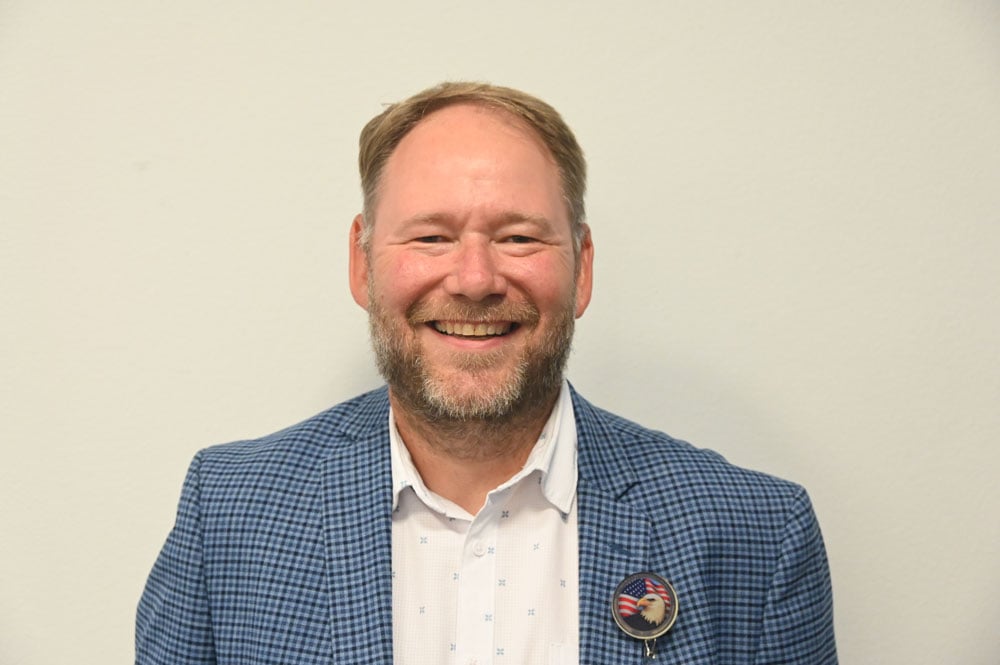
Rob Wood is one of two candidates for Flagler County School Board, District 2, running against first-term incumbent Will Furry. Furry has declined to participate in the Live Interview.
It is a non-partisan race: all registered voters regardless of party affiliation or non-party status may vote in the Aug. 18 primary, which will decide the winner, who will be sworn-in in November.
Three seats are up on the School Board in this election cycle. District 1 is an open seat, and has been an open seat since Derek Barrs, appointed to fill out the erm Sally Hunt did not complete, left for a job in the Trump administration last fall. Cathy Moon faces Jill Woolbright in that race.
In District 2, Wood is challenging Furry, who had originally declared he was running for a congressional seat. He abandoned that effort after his campaign struggled, and announced he would run again for the School Board.
In District 4, former School Board member Trevor Tucker and Ron Long are challenging first-term incumbent Christy Chong. If any of the three candidates garners more than a 50 percent majority in the Aug. 18 primary, that candidate will be the winner. If none of the candidates clear the 50-percent threshold, the top two vote-getters will contest the seat in the Nov. 3 general election.
Furry, Chong and Woolbright have declined to answer the Live Interview’s questions. They alone, among the 19 candidates running in the three major local elections in the primary, have declined.
Flagler County School Board members serve four years. They’re paid $44,152 a year, an amount that will likely go up by a few thousand dollars by next year.
The Live Interview format changed this year. Since 2010, FlaglerLive had submitted identical questions to all candidates, enabling them to answer in writing. There typically were a round or two of follow-up questions, also in writing. Artificial intelligence has made that approach obsolete now that candidates can run the questions through AI and spit out prefab answers. To get around that, candidates were invited to a video interview. The video and the transcript are provided below.
The candidates were provided the same basic question within half an hour or less of the scheduled interview, but obviously not the follow-ups, which all differed. The questions to county commissioners are here.
Following the interview and before publication, the interview transcript went through two rounds of editing at this end, once by AI (yes, the irony is inescapable) for spell checks, copy editing and to smooth out verbal tics or repetitive words, and once by me for the same purpose. The candidates were then provided with the interview transcript and the video to review–not to make substantial changes, but to verify transcription accuracy, and, if they so chose, to add a postscript: if they felt they may have misspoken, or not clarified a point, or preferred to revise an answer, they were given that chance in the postscript, without changing the original text in the transcript. The postscript window is remaining open for subsequent additions, until the election.
The interviews can be quite long–not a surprise for a site pathologically incapable of brevity, but the county is awash in candidat quickies. We offer a little more depth, seeking to draw a profile rather than check off boxes: an election is not a speed date but a four-year commitment. The Live Interview’s aim is to elicit as much candor and transparency as possible, and to learn about the candidate beyond the basics in what amounts to extended conversations about the person, the character and temperament behind the candidate, the candidate’s seriousness, and the issues.
The rest is in the voters’ hands.
–Pierre Tristam

Flagler County Commission Greg Feldman (Dis. 2, R) Theresa Pontieri (Dist. 2, R) Anna Jones (Dist. 4, R) Drew Moss (Dist. 4, R) Leann Pennington (Dist. 4, R) Flagler County School Board Cathy Moon (Dist. 1) Jill Woolbright (Dist. 1) Will Furry (Dist. 2) Rob Wood (Dist. 2) Christy Chong (Dist 4) Ron Long (Dist. 4) Trevor Tucker (Dist. 4) Palm Coast City Council Tony Amaral Jr. (Dist. 2) Jeani Duarte (Dist 2.) Jimmy Hengy (Dist. 2) Dylana Dee Galery (Dist. 4) John Kvederis (Dist. 4) Ramon Marrero (Dist. 4) Darlene Shelley (Dist. 4) The candidates' interviews will be live-linked the day their interview publishes. |
The Interview Themes in Summary: Quick Links
- Basics
- Preparation and Character
- Vision
- Evaluating the current board
- The YMCA
- Arming school staff
- IB and Cambridge AICE
- Enrollment’s flatline, vouchers
- A rating vs. national standards
- DEI
- Funding loss from U.S. Department of Education
- Prayer in schools
- Rap sheet
- Postscript
The Video:
See Rob Wood’s resume and financial disclosure.
FlaglerLive: Good afternoon, Mr. Wood, and thank you for doing the live interview.
Rob Wood: Thanks for having me. I appreciate it.
FlaglerLive: We’re going to start right from the beginning. Tell us your place and date of birth.
Rob Wood: I was born in Glens Falls, New York, August 13, 1976.
FlaglerLive: What brought you to Florida, and then to Palm Coast?
Rob Wood: So, Florida. My mother-in-law lived here first. She was here for years, and my wife wanted to move closer. She was really her only living family that was close, and so we moved here to be close to her. And she lived in Bulow Plantation, just down the street. And we came down looking for houses and fell in love with Palm Coast. The canal communities are kind of what drew us here.
FlaglerLive: Was that around 2000?
Rob Wood: 2010 is when we made the move here. Before that, we were in North Carolina for years. That’s where I met my wife, actually, was North Carolina, and then we moved here in 2010.
FlaglerLive: What is your profession? What have been your professions?
Rob Wood: I’ve had a lot of them over the years. I began in public service as an advanced EMT in upstate New York, so right out of high school, I worked on ambulances for a couple of years. And I was from a really small milling town, and had lots of brothers and sisters. I come from a really big family, and I felt like I needed a change. I needed to change the direction of my life, so I enlisted in the Air Force in December of ’96, and that led me to be an F-15 crew chief working on fighter jets for a number of years, about 11 years. But while I was in the military, none of my family members, none of my brothers and sisters went to college. They all stopped at high school, and when I joined the military, I got the GI Bill, and I thought, you know, I really want to take this opportunity to get educated first. And I met and fell in love with my wife, and we had a baby on the way. And the decision was to become a police officer and leave the military, or there was an opportunity to become a trainer in the Air Force on a controlled tour, and that controlled tour took us to Sheppard Air Force Base in Texas, and that’s where my education journey began. A requirement of the job was to get an associate’s degree, so I got my associate’s degree, I got a couple of those, and then I went on and got a Bachelor of Science in Occupational Education with a specialization in business, and I taught technical training for the Air Force for four years. And then after I left Sheppard Air Force Base, we went back to North Carolina where we kind of dug some roots, and we worked in real estate and were entrepreneurs there, and I left the military in 2007. And when we left the military, I had this goal. I loved teaching, and I had this goal of just working in higher ed. I wanted to help to change the lives of others through education, and it changed my life. And I was like, “Well, let’s make a goal of doing that.” So I enrolled in an MBA in finance, and my wife said, “I’m not going to be left behind.” And she enrolled in the same program, so we both walked with an MBA in finance at the same time in 2011. So we went back to school together.
FlaglerLive: Where were you enrolled?
Rob Wood: We were both at Capella University, that is where we got our MBAs. So it was an all-online school. So we worked it around our busy adult lives. I was working in real estate. I owned an erosion control business. My wife was in mortgages. We were just busy, and when the market fell apart in 2008, I had to go figure out how to earn a living and get a real job again. So I was going to school online, and I managed a food distribution warehouse for a year, and then I got picked up by Target Corporation to be a logistics executive. And I would love to tell you that I loved that job, but I really didn’t. And it was during that time frame, we were coming here on vacation. I applied for a job at Daytona State to teach GED at a maximum-security prison, and I called them and I said, “Hey, I’m coming to town. If you want an interview, this is your opportunity.” And they said, “We didn’t think you were serious. Like we didn’t think this was even an option that you would come from North Carolina.” And I came down. I interviewed Tuesday morning at 10:00, and at 10:05, they brought out I-9 paperwork, and we moved here 10 days later and relocated our family. Our kids started school here, and we were kind of off to the races. So I taught there for a year, but the state government or the State Department of Corrections decided that they were going to internalize that training instead of paying for contracts to the colleges to support it. They were going to internalize it, so that contract was just not renewed.
FlaglerLive: You were teaching at Tomoka Prison.
Rob Wood: I was, right here in Daytona. And then, as luck would have it, I was like, I needed to figure out my next chapter and what I was going to do, and I interviewed for a position with a federal contracting firm. I started as a professional facilitator on the road, teaching leadership and organizational development training to the federal government. I eventually got my coaching certifications and then became the program manager over the directorate in Ormond Beach.
FlaglerLive: This was in what federal department?
Rob Wood: The Department of Homeland Security, TSA, the Army, and the Department of Justice were our major contracts. We also had some training contracts with the Department of the Navy, where we provided training materials, instructional systems design, things like that.
FlaglerLive: So you were a private contractor for those agencies.
Rob Wood: That’s correct. We were subject matter experts that would go in and deliver leadership and organizational development training, and then professional facilitation services as well, things like that.
FlaglerLive: What was the private company that you worked for?
Rob Wood: It was American Systems. They’re an employee-owned company out of Virginia, like every other big contractor in the Beltway. Their major industry was actually telecommunications on ships and submarines and things like that. We were a small directorate that did leadership and organizational development. So that’s the job where I figured out, there were lots of moments along the way where I figured out where I was terrible in leadership. That was the job that helped me to figure out how to do it right and how to build culture and how to shift a culture. I worked for someone that was toxic, and it was a rough environment. And when we were able to move that person out of the organization, we were able to build a culture from the ground up that I was really proud of. And then those contracts were kind of winding down. TSA decided to move their training in-house to save money, and they built an academy. Those contracts were winding down, and I kind of saw the writing on the wall. And so I wrote myself out of the budget so that the other employees could keep their jobs. And several of them kept their jobs right up to a couple of years ago. I went back to school to Daytona State. I was going to go drive an ambulance again. I was like, “Look, I had this passion for helping people.”
FlaglerLive: This was about what period? What year?
Rob Wood: 2015. I enrolled in the EMT program at Daytona State, and I was going through the process. And I got to the final week, and I did all my preceptorship. I was ready to go to work, and I got a call from a really good friend of mine here, and he said, “Hey, let’s have coffee.” And Western Governors University was hiring for a manager of program faculty in the School of Business for a new program, an undergraduate healthcare management program, and asked me if I would be interested in WGU the week I was graduating from EMT school. It just brought me right back to education again, and I started as a manager. I was leading a team of 10 to start, and then 18, and then 20, and then I was in that role for two and a half years, and I was promoted to being a senior manager. Where then my scope kind of increased, and I picked up a team. At first, it was a team of a couple hundred or so, working primarily with graduate programs, MBA programs in healthcare management, IT management, and a regular MBA, and then for the last few years, I’ve taken care of a mixture of undergraduate programs and graduate programs. So, WGU, and I know we’re here to talk about other things, but WGU is hands down the best place I’ve ever worked, and it’s because when you go to their website and you read about us, 100% of it is true. They care about students. They care about expanding access. They care about keeping costs low. They care about reducing friction, and it’s not lip service. Every person in that organization is in the same boat, rowing in the same direction, and cares more about student outcomes than they do about their paychecks. Because to be honest, working for a nonprofit university—I mean, okay, money—but you’re not in it for the money. You’re in it to be intrinsically motivated by what you’re doing, and that’s what keeps us. We have employees that have been at WGU, I think the organization’s 26 years old, we have employees that have been there virtually from the beginning, and are just a testament to the mission.
FlaglerLive: Their beginning was when?
Rob Wood: About 26 years ago, I think, is when.
FlaglerLive: And are you still with them?
Rob Wood: That’s a great question. I am not. Kind of. So when I decided, I was running a small business here in town. I own an exterior cleaning business, and it was doing really well, and still doing well. And I got to the point where I needed to make some value decisions. Do I want to continue to grow roots locally? Do I want to invest in our local economy? I’m currently the president of our local BNI group, and I love that. I’ve got 60 small businesses that I work with every day.
FlaglerLive: Explain what BNI is, though, just for the majority.
Rob Wood: Yeah, BNI is Business Networking International, and it’s a group of like-minded business professionals. Some are small business owners. Some are representatives of bigger businesses. We had a meeting this morning. I lead the group through meetings every Thursday where we help to share information about our businesses and become each person’s kind of sales team. So we help each other grow business. This year our goal is eight million dollars, to trade eight million dollars in revenue in that group of 55 or 60 businesses this year. So I was already doing those things and I was running out of bandwidth, and I already had a plan to leave the university later in the summer.
FlaglerLive: The best job you’ve ever had.
Rob Wood: Yeah, and it’s because I felt like there are a couple of reasons, right? So there’s the job itself. For me to grow into the next-level executive role, I would have needed to move to Salt Lake City, and I don’t want to move to Salt Lake, and I don’t want to stop growing. I want to keep growing personally and professionally, and my wife works for the same university as a manager right now in the School of Education. She leads a team there, and a move to Salt Lake is not in the best interest of us or our family or anything. And I felt like there was this glass ceiling that kind of inhibited me a little bit, so I poured my energy into building roots. We’ve been here going on 16 years, and I think until I started my business, I didn’t start it with this goal of being a millionaire paying off my house. I started it because I needed something to pour myself into so I could continue to grow. I also felt like I was just a user of our system sometimes, like I use our Publix, I go to our parks, I go to our beaches, I participate locally. But I didn’t feel like we had deep roots, and I always had this dream of kind of becoming a pillar of our society, someone that gives back, somebody that’s involved in philanthropy, somebody that is helping to build other people up, so I built the business with the goal of digging roots. So I started slow. Or I have to give it up because I can’t do all things well. Something had to give. I had to focus on quality somewhere, and then the school board run kind of came up. I’ve talked about it for years. This isn’t like a flash-in-the-pan kind of thing. And I thought, well, if I’m going to do the school board well, I have to create margin. And so the margin was I’m going to leave the college earlier, so I left the college on June 12 was my last day as a full-time employee, and I was unemployed by them for two days, and they called me and said, “Hey, would you be a subject matter expert to help design an entrepreneurship program at our undergrad business school?” So I’m currently a contractor for them, but I’m not an employee. I’m building a program.
FlaglerLive: But you’re still involved with your company.
Rob Wood: I am. And it’s continuing to grow. We’re doing really well. We got a nice award today with a local HOA right here in town, and I’m working that opposite of this. So, I’ve been using Free to Focus by Michael Hyatt. It’s a great book, but I’ve been using the tools that are in that book for the last 10 years or so to manage my time and energy, and it serves me really well. So I designate special important things and important days, and then I work around it. So I’m able to focus on my business when I’m working on my business, and I’m able to focus currently on my school board campaign. But when it’s all said and done, my goal would be that I’m a school board member, and I’m able to focus my attention there where it needs to be.
FlaglerLive: Well, with all that going on, how have you been able to prepare yourself to be ready to succeed on the board from day one?
Rob Wood: My background is so unique. I kind of grew up as an educator in the military. I’ve got an undergrad in education. Working in the federal government in procurement on the side of being a contractor, I understand contract law and I understand procurement at a deeper level in working with the government. So I’ve kind of worked in the public sector as a government employee and in the private sector as a contractor. And then personally owning my business, I’ve worked for the government as a contractor, as the person getting the check directly from the government, so I understand procurement and procurement law and best practices kind of on all facets of the procurement process.

FlaglerLive: But a lot of that is going to be handled by the operations side of the district. You’re going to be looking at policy and overview, and in terms of preparation, how much have you been able to delve into things like the budget, their policies, the day-to-day workings of the board? Have you attended board meetings? That sort of thing.
Rob Wood: I’ve attended board meetings and I’ve attended workshops and I’ve watched some online, and things that I see out of the board—I mean, there’s largely a lot of things that the board does. There’s a lot of unanimous votes, and they move things along, right? There’s budget amendments month to month. They approve expenditures going to contractors. They get a list of contractors, and then they get a list of amounts. But what I don’t hear is people digging in and asking about those amounts. Now I’m not saying we need to dig into the day-to-day operations, but we certainly should understand the contracts and the money that’s leaving the school. So I’m not saying that I want to dig into the day-to-day operations and micromanage as a board member. But my first job is to learn the role and to learn the school and learn the processes and learn what happens so that I can ask educated, informed questions, especially when it comes to fiscal responsibility. We’re in a time where things are a little bit uncertain due to declining or flat enrollments, and then what’s going to happen with property taxes? There’s so much uncertainty. I think it’s in our best interest if we dig in and really understand where our money is going and why it’s going there.
FlaglerLive: Have you had a chance to meet with department directors and to study the budget?
Rob Wood: Not at the level that I would like, to be honest. I’ve pulled the budget numbers. I’ve looked at the budget amendments. I’ve seen where they’ve shifted money between charge codes and things like that. But I don’t believe that I’ve dug in enough at this point to satisfy that. And that’s just being honest. I feel like a lot of this you need to learn in the role, and you need to be in the seat. You need to ask tough questions. And so far, I’ve met with the superintendent, and I’ve met with some sitting board members, and I’ve asked some questions. But I’m really focused on kind of where I am today, and I’ve been doing a lot of observing, and that’s just being honest, kind of where I’m at now.
FlaglerLive: How do you arrive at a decision?
Rob Wood: Well, pragmatically first, I feel like you have to gather all the information, ask really great questions, and you have to totally understand the situation that you’re dealing with before you get there. I’m going to be working on a board with four other people, and I’m going to be a single vote. So, my decision is going to be based on facts and data and how it affects people. And I’m not here to toe a party line. This is a nonpartisan role. It’s a nonpartisan race. It doesn’t mean that I don’t have my own convictions or my own thoughts or feelings about things. But at the end of the day, we need to answer the question: Is this in the best interest of our students? Is this in the best interest of our faculty and staff? And are we being good stewards of our taxpayers’ money? I mean, that’s what it really comes down to. So, I need to be able to vote and feel in my conscience that I’m doing the right thing for our students, faculty, staff, and budget. But on the way to getting there, you have to have a way of operating that honors the people that are in front of you. When you’re making a decision on something, it’s not like you’re going to battle. It’s not like I have four adversaries on the board and we have to duke it out or we have to fight it out. We should share dissidence. We should share things that we don’t have in common because that’s the beauty of being on a board with people that think differently than you do. But I think what I bring to this role is the ability to bring people together and to work together towards common goals. There’s a book by—oh, I forgot the author—it’s called Silos, Politics, and Turf Wars. And in that book, they talk about how do you work as an executive team and work for a singular purpose, like a rallying cry, and get everyone around that and bring them together, regardless of the role that you bring to it, or regardless of your background. Like, how do you get everybody on board to get that one thing done? And if you don’t get that one thing done, it could be detrimental to your organization. I feel like I have a skill set that brings people together, but bringing people together doesn’t mean we certainly all get along all the time, it means that we have the ability to work through things and honor each other along the way.
FlaglerLive: Along those lines, what would be a character flaw that might interfere with precisely what you’re describing, and how do you handle your misjudgments or mistakes?
Rob Wood: I’m a terribly direct communicator, and that can get me into trouble sometimes. I’m a Myers-Briggs practitioner. I don’t know if you’re familiar with Myers-Briggs.
FlaglerLive: No.
Rob Wood: So the feeling part of my personality is a little underdeveloped, to be honest, and it’s an introverted trait. And what happens is, if I get really emotional about something, it doesn’t come out as a nice, sweet message. Sometimes it comes out very direct, and it can be very curt, and it can cut to the bone. And I’m certainly aware of that. That awareness over the years at WGU—I’ve made lots of mistakes as a leader. So in one instance, I was working with an employee that I was working through performance management things, and our interaction was seemingly going fine. And I was going to put this guy on a warning, and he decided he was going to complain to our HR department and to my boss, and raise a big stink. And there were two ways that I could have dealt with that. I could have dealt with it from the standpoint of I’m right, he’s wrong, and we’re going to push through this, and I could stand my ground, or I could take the feedback and understand that he had a different perspective than I did, and that it was my responsibility to flex to him. It was my responsibility to over-explain and make sure expectations were really clear. It was my responsibility to preserve that relationship over the outcome. It was my responsibility to build commitment in him and not just demand compliance. It’s my responsibility to do no harm along the way. Those three things you see on my website and the things you see on my palm card about my leadership brand and what I want to be held accountable to are the three things that I need to be held accountable to because they’re my three biggest weaknesses. But by putting them out into the world, it makes me accountable to them. So, those are just real-world examples of who I am. I’m a direct communicator. When things get heated, sometimes my mouth gets ahead of my brain, and I understand it. But I also have tools, and I understand how I work, and how I’ve matured over the years, and I don’t step in that much anymore. I could probably count on one hand how many times in the last five years I’ve gotten myself into a position where I was overly emotional inside of a business context. It just doesn’t happen.
FlaglerLive: You were describing situations which I assume happened in private between you and colleagues, but you’re going to be in the public glare all the time, on the board, on TV, on video, and that setting intensifies anybody’s sense. It can be very difficult and it can be very challenging to control at least the sort of emotions you’re describing. In other words, what you’ve described here might push your tendency to dig in more than give in because you’re in the public glare. Have you been on a board before in that sort of glare and seen how you might react?
Rob Wood: Well, sure. I push back just slightly only because I feel like when the spotlight is on me, I tend to slow down a little bit. I tend to think a little clearer before I act or before I speak. Working at WGU, I worked on a team of senior managers, and that team of senior managers reported through vice presidents and directors, and that sort of thing. And in my performance review at WGU, I think on one or two occasions, it’s actually explicit in my review. It said Rob is comfortable being the lone voice of dissent, and that wasn’t written in there because I was emotional and went off the cuff or went off the deep end because I disagreed. It was in there as praise that I was willing to stand up for what I believed in, even if I was the only person that was willing to say the thing in the moment, but did it in a way that was constructive, and I feel like I operated that way for the last 10 years for sure, as kind of my norm. Being in the public eye tends to make me slow down a little bit, be a little more metered in my communication, probably more apt to ask more questions and to ask for more time.
FlaglerLive: You’re certainly deliberate in everything that you’ve handled in our interactions. I’ve seen it. Even now you’re very deliberate in the way you approach a question or a challenge. So there’s no question that you go through that process, and it’s interesting to see. What I’m just wondering is like when you’re going to be in a situation and it’s 10 p.m. or 11 p.m. at the end of a day where you had three meetings, all in the public eye, and then these tensions flare and all this. I hate to put you on the spot because everybody has those weaknesses. This happens to public officials, and we punish them sometimes quite a bit for their foibles. I certainly do it, and sometimes it’s not fair, but those things are going to happen, and it’ll be obviously interesting to see how you react. But who in public office today do you admire in Flagler County? Not just on the school board, but anywhere in office in our county. Who’s your model of leadership?
Rob Wood: It’s a really great question. That’s a really hard question because you’re asking the question as an absolute, like who is my model, like who would I base my leadership on, and I find that difficult to answer, to be honest.
FlaglerLive: Well, I would rather you not take it as an absolute, but more as some guide, and it doesn’t necessarily have to be a single person, but a combination. Some candidates I’ve spoken to have mentioned a couple of people for different reasons that they appreciate. I like this in that person, I like that in that person.
Rob Wood: I feel ill-prepared for that. It’s not a cop-out to say that I appreciate Sheriff Staly. He serves in a role that he doesn’t necessarily need to be in. He serves in a role that he takes very seriously. He sets really high standards. He does everything he can to protect not only the citizens but the people that are in his command, the people that he takes care of. It’s clear to me that he is a people-first person in what he does. I’ve actually got his book on my desk here, and I’ve been reading a little bit of that at a time. And I believe that he does exhibit transformational leadership traits in what he does.
FlaglerLive: You’re right, it is a bit of an easy choice in the sense that he’s his own constitutional officer. I’m very curious about a governing board where you actually have to deal with people who have to deal with each other, which he does not. So on a governing board, who might be anywhere close to that?
Rob Wood: Well, that’s tough. There are a few people that come to mind that I really admire for different reasons. One is a previous school board member that I feel does a good job, and I’ll get to that one in a second. I’ve appreciated [Palm Coast City Council member] Teresa Pontieri in some of her leadership, especially when she speaks about kind of the westward expansion and standing up for people and standing up for our taxpayers, and she absolutely knows who she is as a person more than she does as a politician, and that rings true. You’re getting the same person on the dais as the same person you’re going to walk up to on the street, and there are not two versions that you see in her. And I really do appreciate that.
I may not agree with every piece of policy or everything that she’s ever done, but I appreciate who she is as a leader. I believe that she’s not going to lie to you. She’s not going to sugarcoat it. She’s going to tell you what she thinks and why she thinks it, and she’s going to stand up for what she believes in. I believe those are important traits. I’d like a caveat, though, is I don’t feel—I’ve heard people in office say things like, “I stand up for what I believe in and I don’t back down,” and I feel like that’s a trap. If you’re not willing to negotiate or you’re not willing to compromise in areas or you’re not willing to rethink your position because you’ve matured as an adult, I think that’s a trap that politicians can fall into, that “Hey, I’m just going to stand my ground because this is what I’m supposed to do.” I feel like that’s a trap. But that’s just a little caveat. Trevor Tucker, I’ve got to know him over the last few months well.
FlaglerLive: He’s the former school board member.
Rob Wood: Yeah, we’re kind of on the campaign trail, you get to know people. I’m not endorsing Trevor, that’s not what I’m talking about. But when I talk to him about his role on the school board and his understanding of the role, and I talk to him about finances and how student counts are affected, and how the school has to hold back funds to make payroll, and how the end-of-the-year count can really have a really big impact—and I don’t understand or pretend to know all of those nuances right now, I just won’t—but every time that I’ve talked to him, he’s come back to a pragmatic response about this is what the board does and what the board has control over and what we can do as a governing body and this is what we can’t do. So he just has a lot of knowledge serving on the board, and I felt like that pragmatic approach, where he really understands the nuances of being on the school board, I think is helpful. I really appreciate that about him. I don’t believe he’s the guy that is going to be overly emotional. I think that he is the guy that is just pragmatic in what he does, and I appreciate that a lot.
FlaglerLive: He’s also mastered the art of brevity. You can probably collect his complete works of what he said on a board on five sheets of paper in the entirety of his tenure there. But when he speaks, he speaks his mind very quickly, very sharply, and then he moves on. I could learn a couple of things from that kind of brevity.
Rob Wood: I think so too because we’ve been talking for a while. I think we’ve gotten through a question or two. I apologize if I’m just dragging this out.
FlaglerLive: We’re going to move on beyond the essentials and the clichés like Flagler Forward. What is your vision for public education in Flagler County, and how are you uniquely qualified to help enact that within the limitations of your job? And there are a lot of limits.
Rob Wood: There are lots of limitations. That’s a complex question. So if I don’t answer something, I’m sure you’ll hold me accountable. But I think if I’m a dreamer and I’m thinking about what I believe our school is capable of, I think every graduate leaves with a plan, or every graduate leaves with an opportunity that they can take advantage of when they leave. Whether it’s going to college, or going to a trade school, or they’re leaving with a certification already, or they’re going into the military, or they’re an entrepreneur and they have started a business while they’re in high school and they’re going to get out and they’re going to grow their own business. I want every one of our graduates to get plugged in and have a plan for themselves as to where they want to go and have the opportunity to do it. I feel like our diploma-plus programs are great. I feel like when the majority of the students can leave with college credit, or they can leave with a certification, or they can leave with skills that they can readily apply and get into our workforce, I think that’s the optimal environment for us. But in order to get there with every student ready, I think we have to back up, and we have to look at third-grade literacy rates as kind of—if I was establishing a rallying cry for us, and I know that students that go to VPK programs are significantly better off when it comes to third-grade literacy, I would be sinking my money into those early education programs to set these students up for success in third grade. The metric is just a benchmark about previous behavior. The metric is not the be-all and end-all, and the metric doesn’t tell the entire story, but if we can tell without a shadow of a doubt that third-grade literacy has a really big impact on graduation rates, or has a really big impact on whether a student is ready to enter the workforce, then I think we should back up and put some attention earlier, upstream. I think we need some upstream attention, and there are things that get in the way of our VPK programs. VPK is not K through 12, and I understand some of those guardrails, probably not in their entirety. I need to get smart about a lot of things, but what I do know is there are friction points. And if you talk to families that aren’t taking advantage of VPK programs, it’s the cost of wraparound care, or it’s transportation, or it’s convenience, or there’s a myriad of reasons. We probably could get creative and figure out how we can reduce friction there, and if we only improved our VPK attendance rates by 5%, what kind of an impact is that going to have in third grade, or what kind of impact is that going to have at graduation? Unfortunately, when you’re working in education, the small changes that you’re making year over year, you don’t get to see the effects of those changes for years sometimes, and it’s very difficult to stay the course or understand what you’re doing today and what the impact is going to be tomorrow.
FlaglerLive: But that’s the key. It is not for lack of VPK. It’s sometimes lack of opportunity for the families to be able to bring their kids to VPK. But it’s in that sense that the district is limited in making that possible. They’re making the offerings available, but they can’t really force anyone, or they certainly can’t expend money or resources outside of VPK in order to facilitate somebody getting to VPK. So how do you bridge that?
Rob Wood: Well, I mean, I think as a school board member, you’re not just a member of the school board and the governing body. You’re also a person that gets to go to legislative days, and you’re a person that gets to go lobby and figure out where grant money is. You get to be a positive influence in your community. And if our community decided that VPK was a really important program in our community, and we decided to rally around it, we worked with the city, or we worked with the county, or we worked with nonprofits, there are ways that we can tackle friction points to help get kids the education that they deserve. I just feel like sometimes we look at the school board as we show up, we go to a planning meeting, and we go through the process and we vote and we go home. But I think the role of the school board member—I’m not just a school board member for the kids that are attending our public school. I’m a school board member for the kids that are not attending our schools, that are the kids that are in homeschool programs or the kids that are in charter schools. The decisions that we make as a school board will affect every child that is in our county or the offerings and opportunities for those children. So, I don’t look at this job as sitting in a box. I feel like we have other opportunities to lobby and to leverage. And if we decided it was important and it was really that important, why wouldn’t we figure out other ways outside of our bubble?
FlaglerLive: Our demographics might make that even more challenging because with our demographics, you’ve got a majority of people who might be more likely to approve more spending on the Lehigh Trail than on VPK.
Rob Wood: Absolutely. But we also know that if we have really great school systems, crime rates are lower. If we have really great school systems, we tend to have better economies. Our school, especially in Flagler, is the largest employer in our county. It has such a profound impact on everybody that’s around it or everybody that’s close to it. So I agree with you, but that doesn’t mean we don’t try. It doesn’t mean that we don’t put ourselves out there and come up with other options or other opportunities. Part of the reason that the schools started bringing VPK into the schools at all was a lack of providers out there doing it on their own. So the school brought that in, and maybe it’s an opportunity thing too.
FlaglerLive: It seems you’re comfortable in a lot of settings. You’d be comfortable relating to other people, regardless of their backgrounds. You do like engaging with people, but the question in your case is more like considering your commitments between, let’s assume you are on the school board, between the school board, your private business, and your college work, not to mention your involvement with the business group. When would you have time to spend time in the schools or beyond the schools, connecting with the school-related community or the people you think should be involved?
Rob Wood: Yeah, well, it’s a fair question. My college contract ends in a couple of weeks. It was a six-week subject matter expert contract for me to help to establish and build this. So that’ll be gone right at the beginning of August, I think that’ll be done. So that won’t be anything for me to worry about. I mentioned Free to Focus to you earlier, and there are a few books that are on my shelf that I turn to and I’m like, this book literally changed the trajectory of my life in some way. Free to Focus is one of those things. Understanding my energy, understanding when I work the best, understanding where to flex my time—I just understand it, and I’ve been doing it a long time. Matter of fact, my first day not being in the college setting, I sat down and rewrote what my ideal work week looks like to see what that looks and feels like. I’ve been successfully running my full-time business, and a full-time college gig, and working in church, and volunteering, and all the other things for the last eight years or so. So I can fit those things in, and time isn’t really going to be my issue. It’s going to be making sure that I have the structures in place so that when I’m doing that work, I’m 100% committed, all in doing that work. So when there are legislative days, we set aside everything else and we go attend legislative days. Or when there’s training that we need to go to every year to make sure that we’re up to date on the latest laws and the latest best practices as a school board member, you make that a priority and you show up and you do the work.
FlaglerLive: Without mentioning their names, because you also have children, right?
Rob Wood: I do.
FlaglerLive: Without mentioning their names or their schools, how old are they, or what grades are they in, and are they in the schools?
Rob Wood: No, they both successfully graduated from Flagler County Schools. My son’s 25; he works locally, and my daughter is 23. She also works locally. Flagler County Schools, I can’t say enough about arts programs and how much they help. I was a band kid, and the arts kind of got me through school. My daughter graduated from Matanzas High School, went to Daytona State, was in their honors program, was a theater major, left their honors program, and got a full ride to Stetson through the honors college, and graduated from Stetson. So she was a product of Matanzas High School, Bright Futures Scholarship. Went to Daytona, got another scholarship, and went through her undergrad because Flagler County Schools set her up for success from the very beginning. So, yeah, two kids, both graduated, both work locally.
FlaglerLive: Evaluate the current school board’s performance. What have been a couple of weaknesses, and what have been a couple of strengths about this school board over the last two years?
Rob Wood: You want a letter grade, or do you just—
FlaglerLive: You could do a letter grade, yes.
Rob Wood: I would say they’re a solid C.
FlaglerLive: Unless you’re David Letterman, I’m not so sure that a solid C is anything to brag about.
Rob Wood: There’s a couple of things that stick out to me. And this isn’t going to become a character-bashing session or any of those kinds of things. But there’s a couple of things that really stick out to me. First, the board’s had four people for the last bit. Right. So they’ve not tackled real issues out of fear of deadlock, I think.
FlaglerLive: You’re right. It’s not of their doing.
Rob Wood: Yeah. So I don’t know that they’ve tackled some harder things or made better decisions because they just didn’t have the ability to duke it out without a deadlock, and I feel like that has held them back as a group. I feel like they’ve made some decisions that I probably would have pushed on or made differently if they would have been able to vote to a majority. The nine-hour board meeting with 100-plus votes for a vice chair position, that sticks out to me as a cultural problem, right? You’ve got people vying for positional power or for a title, and when you’re doing that, you’ve lost sight of what the goal is and the reason you are there for, and that is to take care of students, take care of teachers. It’s the health of the organization, and it’s not about any one sitting board member that’s there. And I think that behavior is not exceptional, and I don’t think it’s the type of example that I would want for our kids that are going through our schools, and that’s just one kind of crowning example. But there are other examples where I feel like, in the nuance and in smaller ways, I don’t think that they treat each other well sometimes.
FlaglerLive: That has nothing to do with a 2-2 split. That has to do with personalities.
Rob Wood: That’s correct. So, I think that’s two different things, right? The two-two split thing, I feel like they just have not dug in because of fear of that. If you can’t vote in a vice chair and it takes you 104 votes over something like that, what if you have to really dig in about a benefits package or about a pay raise or about taking care of support staff or about any other really hard decision that you probably should be making or digging into? I don’t think they dug in. I feel like they made some decisions that were okay, but I think there’s things that they might have been able to do differently if they were able to work together at a deeper level, and we just saw it. There was training for board members. Half the board went to training and was dedicated to making sure that they were getting up to date in the most current continuing education, and the other didn’t.
FlaglerLive: Janie Ruddy and Lauren Ramirez went.
Rob Wood: They did, and to me, that’s the floor, like that’s the job description. Do the job. Do the job that you were hired to do. Take care of yourself. My team at WGU, when you’re new, you come in. The first thing you do is we do book studies together. We learn about common language. We have to figure out who we are as leaders and how we’re going to communicate. And we take them through a book called Monday Morning Leadership by David Cottrell, a really quick read. But we spend a week talking about it, not 40 hours, but an hour a day. And then the second book we do is Free to Focus, and the reason we do Free to Focus is because we want people to have permission to develop themselves first, to give yourself the best of yourself, not what’s left over. If you need to prioritize your exercise, how does that work into your ideal workday so that you are taken care of? Your development and taking care of yourself should be your primary responsibility because if you’re taking care of yourself, then you can pour into others. If your cup is full, then it can overflow and you can take care of other people. So a development opportunity—you should never turn down the chance to go to a development opportunity if it’s going to make you better in your current role. So I feel like that’s the floor. That’s the minimum. You just show up and do the job. I hope I’m not coming off as curt, but that’s just how I feel.
FlaglerLive: I hope you’re getting royalties from Free to Focus, from their publishers.
Rob Wood: I’m not.
FlaglerLive: But speak about where they have excelled as a board in the last couple of years, and remember, Lashakia Moore does not count as a board member.
Rob Wood: There’s a lot of routine things that they got done. I feel like they have looked at policies and changed policies and did some procedural things that they needed to do. I felt like their most recent benefits package that they passed that reduced cost for their employees, I thought that that was a step in the right direction. I still feel like there’s more work to do there, but I feel like that is a step in the right direction.
FlaglerLive: The school employees are paying incredibly expensive—
Rob Wood: Yeah, and it comes from a limited risk profile, right? You’ve got 1,500 employees, and if you’re only looking at those 1,500 employees and diversifying your risk there, then you’re never going to drive your premiums down because it’s so finite. You have to have the law of large numbers. That’s what the actuaries want to see if they’re going to establish and set rates. So there’s probably some other opportunities to diversify that risk profile, and it’s harder to do it, and it may cost more money upfront in the district, and we may have to budget differently, or you may have to figure out where that’s going to come from, but there are ways to improve it even more. Now, I’m very thankful for the work that they did, but I feel like we could take it a step further too.
FlaglerLive: How come local governments as a whole, like the four, five, six different governments that we have, can’t collectively have the same insurance and improve that pool?
Rob Wood: They could. They could do an interlocal agreement, and they could pool those resources. Where it gets hairy is you’ve got firefighters and police officers that are in different categories of risk, so it’s—yes, the answer is you could, but how many employees do we have total in the county? Maybe you look at the superintendent’s trust instead of looking at spreading your risk in one school district of 1,500 employees. There are massive school districts that we could be partnering with where you could get that to 15,000 or 20,000. Now all of a sudden you can reduce your premiums by 7% to 13%, which is very large. Just make the numbers bigger, and I’m not trying to oversimplify it, but that’s the thought process. Like, spread your risk out the best they possibly can, provide the most amount of relief for your employees, because our teachers already are some of the worst-paid teachers in the nation. So how can we alleviate that to the best of our ability?
FlaglerLive: So to complete this theme, this question: Imagine yourself on that board, but on a two-two board, okay, not on a three-two board. What would you do differently in order to bring consensus to a very difficult issue?
Rob Wood: Well, I think I just showed you part of it, right? You have to do the research, and you have to come up with options, and you have to have a position, and you have to understand how it’s going to impact your stakeholders. And if you’re answering the question, “Is it better for our students? Is it better for our faculty? Is it fiscally responsible? And is it defensible to our taxpayers?” and you have a better option for your employees that will positively impact them day-to-day and put money back in their pocket, I think you bring that case and then you discuss. I’m not going to win all the time. This isn’t a “I win, you lose” scenario. That’s not how we enter these things. We enter these things going, “Okay, look, what do we want to do? What’s the endgame here? What are we trying to accomplish? How is this better? How is it worse?” There are nuances. Some are going to be really close, some are going to be very far apart. Well, how do we work on that together? And if it is deadlocked at two-two, and we are having a hard time finding consensus because of some ideological difference or because of a nuance, then we’ll just have to work through it. Hopefully, we have five members of the board, and there’s a tiebreaker, and we can move on and come up with a really great decision.
FlaglerLive: So this is a little more concrete now. The YMCA has asked the district for three million dollars in a contribution for its future site in Town Center. You’re familiar with that, right?
Rob Wood: Vaguely familiar with it.
FlaglerLive: The YMCA made the same ask and received $3 million dollars from Palm Coast. So it came to the school board and said, “We would like you to contribute three million dollars,” and in exchange, they want to have an arrangement with the school district where obviously the district would have use of the YMCA, the pool especially. And one of the arrangements, the one that the superintendent, Ms. Moore, presented in skeletal form to the school board several weeks ago, was a memorandum of understanding that would have the school district and Palm Coast actually be the owners of the pool, which would then give them control and scheduling and use of that pool ahead of everybody else, and that would be part of the $3 million. In other words, the school district could donate that money, but then they would get the pool in exchange, and they no longer would have to worry about what to do with Belle Terre Swim and Racquet Club and where to have their students train and all of those things. Same thing for the city, because they’re having trouble with their municipal pool. That memorandum of understanding has been sitting out there. It seemed that the superintendent had high hopes for it, the city certainly had high hopes for it, but the board members were divided on it, and they even talked about a couple of them having a new swimming pool built by the district and owned by the district. So my question to you is: Where are you on this $3 million dollar ask by the YMCA, which is still hanging out there, and on this potential memorandum of understanding that would come back to you soon after your election, assuming you’re elected? And absent those two things, what is the solution if you don’t have that relationship with the YMCA and you don’t really have an Olympic pool that you could train in?
Rob Wood: Look at you bringing the complicated questions. Well, first of all, I feel like if the school owns the property and has the ability to schedule and has priority over it, and it’s a primary asset for the school, and we’re willing to take that on in the ongoing expense, and it fits into our budget, and we’re able to do it, then why wouldn’t I be for a memorandum of understanding that would allow us to do that? Especially if we already have a partnership with the city and there are more people on board with it, I don’t know that I’d be in a position to shut it down.
FlaglerLive: From my understanding, I’m not even sure that you would be on the hook for the maintenance, by the way.
Rob Wood: Yeah, I mean, that would be my concern—not the building, right? Not the initial outlay. My concern would be how we are going to maintain it over time, and what if we weren’t able to meet those financial requirements? So those would be questions that I would have. If we weren’t on the hook for the ongoing maintenance, and that was part of the memorandum of understanding, that makes that decision a little bit easier for me. Especially but if we own the pool and we own the facility and we are on the hook for all of the maintenance and the building and the grounds—oh no.
FlaglerLive: You actually don’t own the facility, it’s only the pool. The facility is still a YMCA facility. It’s sort of a combination, a partnership.
Rob Wood: Sorry, I wasn’t as prepared for this. But no, I feel like if the school has the budget and we have a sound memorandum of understanding, and there’s a partnership with Palm Coast, and our students are better off for it, and we have a facility for them, I don’t know that I would have a problem with a memorandum of understanding to allow us to do that, as long as the budget would support it, and we would meet our financial obligations of reserves. As long as we could do all those things, I wouldn’t have a problem.
FlaglerLive: Alternately, would you favor building a new swimming pool at the sole expense of the district?
Rob Wood: No, I don’t think so. For all the reasons that I just talked to you about, I feel like we would be fighting a battle three, four, or five years from now about the ongoing expense. And if enrollment is still flat or still declining, and we’re still fighting the same budget, I don’t know that I’d be willing to take something on that is certainly an ongoing expense that we may regret later.
FlaglerLive: Where are you on—and it’s odd to go from the YMCA to guns—but where are you on arming school personnel?
Rob Wood: Well, first of all, I feel Flagler County Schools is a really small district, and I feel like school resource officers do a really great job. They’re not here just to protect our students, but sometimes it’s the first interaction our students have with law enforcement personnel that’s positive, and they build relationships within the community. I got stopped by an SRO that was at a board meeting last month. I went to the board meeting and we were just chit-chatting, and I said, “Well, what are you doing?” He said, “Well, I’m an SRO, and I’m over at Matanzas.” And we were talking, and he said to me, “This is the best assignment that I’ve ever had.” He said, “I absolutely love it.” He said, “I go to work every day, and I get to make a difference in the lives of these kids. I build great relationships, I help to keep people safe, and I feel like I get more out, more intrinsically”—those weren’t his words, those are my words, but that’s how he described it, right? “I get more out of this job than I did out working the streets. Like, I feel like I really enjoy the work.” So I believe in our SROs. I’m for our Guardian program if we were to ever need one or want to expand our security presence on our campuses, if we were concerned about response rates or specific threat things like that. I feel like a well-trained guardian program that meets all the most stringent requirements could be a good idea, but not to replace our school resource officers.
FlaglerLive: Do you consider the school resource officers insufficient right now in the district?
Rob Wood: No, no, no, I do not. I believe that what they’re doing is sufficient now. I don’t believe there’s anything that would tell me that they’re not. What I’m saying is, if the board decided that they were pushing for a guardian program and it was tabled and it was something we were discussing, it’s not something that I’m just going to shoot down. It’s something that I would certainly consider. School safety is really important, and making sure that our students are taken care of is really important to me. I don’t know that I want faculty to be walking around with guns. I feel like non-teaching support positions, things like that, probably make more sense. But it’s not something that I would immediately shy away from. I had to do some research on this to see how I felt about it, to be honest, because I think my initial inclination was I don’t want citizens with guns in our schools. I think I was a little ill-informed about the amount of training and about responsibility and expectations, and I felt like I probably was a little behind the curve on that. And I feel like now that I’ve done some research and I have thought about it—I talked to the sheriff about it a little bit too and just said, “Give me some ideas how you feel about this”—and I asked subject matter experts that are just smarter than me, and that’s kind of how I landed here. I feel like it’s something that we could entertain, but I don’t know that it’s something we need today.
FlaglerLive: If I were to look at the SRO that you spoke with at Matanzas High School—and that goes for all of them—I could actually look up his or her record. I could find out exactly what his schedule is, when he’s posted, where he’s posted. I can find out what weaponry he has. The only thing I can’t find out is where he keeps his AR-15, and that’s okay. But other than on school property, elsewhere, we can know. I can find out everything about his profile. I can find out about his use-of-force history, and every disciplinary issue he’s ever had, and every commendation he’s ever had—I can know his entire history. A guardian, I would know none of that, not one thing. I wouldn’t know who the guardian is. I wouldn’t know what weaponry they have. I wouldn’t know any of their history or their issues. Why should we feel safer, or as safe, if not less safe, knowing that somebody is armed on our campuses without any of that transparency that we demand and receive from our professional police officers?
Rob Wood: That’s a really great question. First of all, I trust Sheriff Staly. Let me just throw it out there—I trust him, and I trust his judgment. And he was someone I asked specifically about this, “How do you feel about it?” And he said that he was in favor of a program that would supplement our deputies, and that his department would be facilitating the training. Those people would go through background checks, and they would go through all of the necessary procedures to be fully trained and to be fully ready to assume those responsibilities. I have to be honest, I hadn’t thought about it from a transparency perspective. I didn’t think about it through that lens.
FlaglerLive: Once the sheriff is done training them, they are no longer under his control. They are under civilian control, basically under the superintendent and her designee. Beyond that, the sheriff does not have—any of those standards that he expects of his troops cannot be applied to the guardians. So it’s two different standards that are on the same campus, and I’m just curious about how you square the contradictions between the two, precisely for the reason that you trust the sheriff, but you trust him because of the standards he has in place and expectations of his troops, which would not exist elsewhere.
Rob Wood: Also, in Flagler, we’re dealing with a really small school system, and we have enough SROs to cover our schools, right? My first line of defense would be to add additional sheriff’s deputies, not to add a guardian program. Let me just be clear that my decision would be to put a sworn officer in our schools when we have the opportunity to do that. I think that’s the right answer for us. But on the flip side of it, the districts in Florida that have taken advantage of the guardian programs, some of them have massive numbers of schools. There’s not enough budget for them to put a sworn law enforcement officer in every one of those schools, and they rely on a guardian program to help to keep their students safe. It’s one of the programs that’s the backbone of their safety and security programs. So, I don’t believe we’re in the position now that we have to have a guardian program. I just feel like school safety is that important that we have to have options. And if we got to the place where we couldn’t afford sheriff’s deputies, I feel like we should have the best option available, and if that’s a high-quality guardian program, then I would back that. I understand your concerns about transparency and about training and about all of those things, I really do, but on the flip side of it, I feel like school safety is that important that it’s something that I certainly would entertain.
FlaglerLive: And we may not be far from the scenario you’re describing, because even in one of the last county commission meetings, a couple of commissioners, including Greg Hansen, mentioned, “We are paying half the school resource deputies bill, they should be paying all of it.” So this is one of those things that may arise because of the amendment that might pass in November that could force the hand of the county and say, “You know, we can’t really help you with this anymore. It’s on you.” And at that point, I guess—
Rob Wood: I brought that up at the FCAR forum. That was actually one of my talking points. I said, look, I’ve not heard any of our current board members discuss the fact that we’re going to have a financial shortfall if the county and city decided to pull funds out of the schools. We would have to fund all of the Flagler Technical Academy, we would have to fund our SROs in their entirety, and so we’d probably be looking at about a million dollars a year in shortfall and ongoing revenue that’s going out the door. More than that, yeah. But we would have to come up with a solution. We would have to be proactive in this and not reactive. Right now, I think a lot of people have had this sigh of relief that the homestead tax implications are not touching the schools, and that’s just not the truth. So I’ve already talked about that in FCAR, that it’s something that we need to think about now versus waiting.
FlaglerLive: Can you explain the IB and the Cambridge AICE program and the role they play in the two high schools’ annual grading profile?
Rob Wood: I think the IB program, I believe, is at Flagler Palm Coast High School, and the Cambridge program is at Matanzas. I think I have that correct. Yes, and those are accelerated programs, and they lead to direct connect for those students coming out of high school. And I’m not sure about how they affect our school grades, to be honest. I don’t know.
FlaglerLive: Generally speaking, I think they’re one of the nine criteria that if you have students succeeding in those programs, it helps push your grades. But if it came down to a choice between funding either of those programs or an athletic program, what would you choose?
Rob Wood: I don’t know that I would choose either. I don’t think either are good choices. I think our sports programs are really important, and I think our accelerated college programs are important too. You’re at two ends of the spectrum, and I don’t think you give up either program. And I know that seems like a cop-out, but I would rather look at things like outside consulting fees, or stale software, or what else is in our budget that we can attack that is non-programmatic, that has nothing to do with academics, before cutting a sports program because I think both are pretty vitally important. I don’t know that I would be able to choose to cut one of those programs, but I do believe that there are ways that we can look at our budget, and there are ways that we can look at procurement, and there are ways that we can look at things a little differently. It’s true that the bulk of our budget goes to wages, goes to employees, and so our fixed costs are pretty high in that regard. But there are ways that we can look at other things, and if it came down to trying to cut an academic program or a sports program, I think we’re in pretty bad shape, and we’re probably making other decisions at the same time to reduce our fixed costs, so I don’t know that I would make the determination to cut either.
FlaglerLive: Do you think we’re heading there?
Rob Wood: I don’t think so.
Rob Wood: I think where you’re getting to is kind of the decline or the flattening of our enrollment. The enrollment discussion is interesting. Part of it is demographics, part of it is the median age of our population, and they don’t have school-age kids and they’re not migrating here. And part of it is charter schools and vouchers and homeschooling and those kinds of things. I think a lot of it has to do with the way that the voucher program is being managed at the state level and the fact that we’ve kind of opened things up and taken the financial portion of that away and opened it up to more people. Now, I’m in support of school choice. I’m in support of funds moving with students, and I come at this from a different perspective, and maybe it’s not different, maybe I just hear it differently. But I grew up in a really small town in upstate New York, and we had a public school, and there were no private schools in my town. But one town over, there was a set of private schools, and I remember kids being plucked out of my school, a very good public school I’m very proud of, and going to private schools. And those kids that left us were not the kids that were with families that were struggling. They were the affluent families that happened to be living in our community, and they plucked their kids out of our school and they sent them to private schools. Private school and other options were only available to the affluent. I feel as though this equalizes some of that playing field. It gives options to parents that want other options, and I feel like if you want to send your kid to private school or to a charter school or to homeschool, you should have the option to do that. But we also have to understand that a lot of those kids end up coming back to our high schools, and I feel like we’re treating this as though this is going to be a problem that’s going to continue to escalate, and we’re going to continue to lose students year over year. This was the first full cycle of the new rules for allowing more vouchers to go out, so I would believe that we would see a normalization of that. I think the majority of our residents that have school-age kids find our schools to be exceptional. I know I did. I know that my kids did really well, and they were set up for success. So I think it’s a false narrative to say that the school system needs to compete with homeschooling, or they need to compete with charter schools, or compete with private schools. It’s not the same, it’s not apples to apples. We’re not in competition. We should be in the business of helping kids where they are, meeting them where they are, providing opportunity for them to excel, and if they choose another path or their family chooses another path, and that means that we lose state dollars for funding, then we have to come up with other ways to become more agile in our budgeting and our fixed costs. We have to come up with other ways to lobby Tallahassee to change rules or to change laws to help us. I feel like so much of what we deal with is at the local level. We feel like it’s just being done to us, and I don’t know that we’re doing a lot to get outside of our bubble to try to affect change. That’s just my perception.
FlaglerLive: What laws would you change?
Rob Wood: Well, I feel like—I don’t know if it’s specific laws. How schools are funded, I think, is just crazy to me that it comes down to student counts several times a year, and the budget is changed throughout the entire year. I feel like when a student or a family accepts voucher money, and they choose not to continue with that—so let’s say they decide they’re going to homeschool, they get to September, they decide they’re going to move their kid back into public school, and they put them back in public school, and now they need to return that money—that money doesn’t get returned to the state and come back to our school, that money gets returned to the state. There are just things that we could fix that would help our schools because not every student that starts a year in homeschool or in private school or charter school stays in that position, and we should be getting those funds for the students that are there. You can argue, “Okay, well, your headcount went up in the next count.” Well, our fixed costs didn’t go down as a result of that student in that time frame. So I think we just need to—I feel like some of our systems are just antiquated. That’s all, and I feel like those antiquated systems should be looked at.
FlaglerLive: They attempted to fix the law to some extent in the last session. It didn’t work, it didn’t go through. So the decline, or at least the flattening out, has been remarkable, though, because it’s been going on for 20 years. It flattened out 20 years ago, well before the 2023 law that brought in vouchers. And it’s not as if the population hasn’t continued to increase somewhere in the range of 60% in the last 20 years, 50% since 2007. So how do you explain, though, the fact that the population has increased 50%? And of course, a good deal of that is older people who don’t have children. But there were still, and we know that from the numbers that the district itself has produced, several thousand students who came in as well, and who have chosen not to go into the public school system. They already were going to homeschool, private school, and other choices, and what happened since ’23 only accelerated that. How do you explain that happening in a district that is touted as so good?
Rob Wood: Well, I mean, is the connotation that you’re saying that the quality of the school is having a direct impact on the number of students that are attending?
FlaglerLive: When we see those numbers and we see the flattening out starting in 2007, how can we not reach a conclusion that the school district has lost its appeal to some extent? Because all the increase in students, all the net increase since 2007, has not gone to the district. The district has maintained, but it has not gained, and yet we know that there’s been obviously an increase in students in Flagler County, in several thousand.
Rob Wood: People are taking advantage of other options for sure. I don’t think I blame the flattening on the quality of our school system. I just don’t think that’s the reason. If you go back to 2007, what was the precipitating factor specifically in 2007? What was the demographic of the people that were moving into Flagler County? What is the number of families that were school-age families that graduated, and those families decided to migrate out of Flagler County and move somewhere else? I feel like there are so many other variables here that I don’t know that I can just pin it on the quality of our schools. I just don’t believe that. Public schools in general across the country have struggled, and I just don’t know. Maybe I’m naive, but I feel like I had a really good experience with Flagler County Schools when we moved here starting in 2010. They were welcoming to us. The instruction was exceptional. My kids went through Old Kings. We had bumps in the road, we had things that we dealt with, it wasn’t perfectly smooth along the way. But in the almost 16 years since I’ve been here, and that’s just three years off from where you’re at, I had a really great experience here with exceptional teachers and faculty and staff that took great care of my kids. So I don’t think that the school system is the cause of that flattening or declining enrollment. I feel like there are other things. We lost industry too, right? I mean, boat manufacturing went away. I don’t know that we’re drawing families due to industry, due to the demographic of our county. We’re a bed-and-breakfast kind of county. We don’t have large industry that’s pulling growing families here that would accentuate that. What’s the difference in St. Johns County? Does St. Johns have perceptibly more industry and things that they’re hanging their hat on? I don’t know that. So I’m not trying to be combative or to dodge it, I just don’t think those two things are linked.
A rating v. national standards
FlaglerLive: The district is now A-rated again. But school board member Janie Ruddy made an interesting comment. She said that she congratulated everyone, and she’s very happy about it, there’s no question. But she also said she wants to be focused on making sure that we don’t lose sight of national standards. And in comparison with national standards, it’s true that Flagler County Schools particularly, and Florida schools in general, are near the bottom nationally. So should the focus not be on those standards rather than on Florida’s? And to some extent, Florida’s are sort of self-centered, bogus standards when they’re not matching up with national standards. Should we be so self-satisfied with what we achieve in Florida?
Rob Wood: Well, I think bogus is a sharp word, right? The standard is the standard. If we have standards across the state, and that’s our measuring stick for this year’s success, and our students worked really hard, and our teachers worked really hard, and our administrators, and we saw improvements in our schools across the board, and our students are better off, I think we celebrate the win that we achieved something together. I understand your point. Your point is that the national standard is higher. But when I was looking at performance management across my programs at the college and we were setting annual goals, we set those annual goals based on ourselves, based on our own benchmark. We didn’t set it based on a standard that may or may not be achievable that’s out in front of us. I didn’t say, “Okay, well, last year you were a 2.5, and next year I want you to be at 2.0.” That’s arbitrary. What I wanted from you was continuous improvement. I wanted you to beat yourself against last year’s baseline and continue to get better. At some point, the data normalizes. At some point, improvement is just not going to be exponential year over year, and I totally understand that. But we should be benchmarking ourselves against ourselves. Are literacy rates going up? Are our students performing better? Are our faculty and staff proud of the work that they’re doing? Do we have a leader in Lashakia Moore that we can all trust with the vision for the school district? And I think the answer to all those things is yes. So, I understand the question, but the Florida standard is the Florida standard, and we should be competing against ourselves to be better year over year. I feel like our students and our faculty and our current administrators are doing the absolute best they can for our students, and I think that’s what matters.
FlaglerLive: The legislature banned DEI initiatives, as you know. What are your thoughts on diversity and equity?
Rob Wood: Well, I think we have to follow the law, right? Title I and Title IX—those are funding for low-income students. Title IX is anti-discrimination. I think we just have to make sure we’re following the law and taking care of people where they are.
FlaglerLive: I understand we have to follow the law, there’s no question. But what are your thoughts about this?
Rob Wood: Well, I feel like that’s my thought. My thought is we shouldn’t discriminate, and we should follow the law plainly. As a sitting board member, I don’t have the luxury of another thought. I think we follow the law and we follow through. I don’t think we put a child or a faculty member or anybody else in a position to feel unwelcome or unwanted in our schools for any reason.
FlaglerLive: Is there no contradiction between the Title system, Title I and so on, and the fact that these initiatives are banned here, since Title I and so forth are essentially equity-based principles?
Rob Wood: Yeah, Title IX is definitely an anti-discrimination law. If there is a contradiction and it’s in our law, that’s not my realm of expertise. I’m coming out of the college system, and the university system was a little different, and it was very different for a long time, and then the state of Utah put the same laws into effect. You’re not allowed to have a DEI department in your schools any longer, and that didn’t mean that we stopped taking care of people, or treating them with respect, or hearing their concerns, or that we weren’t doing the right thing for people where they were. It just meant that we didn’t have a DEI office anymore. And I’m not playing the middle on that. I believe that this is a nonpartisan role. I’m going to be sitting in a chair and I’m going to be asking the question: Is this right for our students, faculty, and staff? And I’m not in a position to violate the law, and I’m not in a position to hurt people along the way. I’m going to be a board member that’s here to support every child and every staff member and every school kid that’s not in our schools in our county, because I’m here to serve them and how they identify and those things. I don’t want to get mired in that. I want to follow the law and I want to take good care of people.
Funding loss from U.S. Department of Education
FlaglerLive: The district here had a sort of rehearsal of what it might be like without a federal Department of Education, because for a few months their federal funds were frozen, so they had no access to them, and they had to make do. They scrambled, and they made it work until the funds were released. What if the funds are eliminated because the department is on its way out? What if the funds, which I think here amount to about a million dollars out of a general fund budget of 163 million, are lost? What do you do if you don’t want to lose what those dollars were supporting?
Rob Wood: You work hard. You work hard. That’s what you do.
FlaglerLive: That sounds nice, but—
Rob Wood: I said some stuff earlier, right? We pay outside consulting, that’s part of our budget. I think as part of our benefits package, we paid over $100,000 to a consulting firm when it came to how we were putting our benefits together for our faculty. So there are consulting fees and things we can get rid of. We can look at—I believe in our one-to-one with technology. I feel like our kids having a leg up and having technology in the classroom is a good thing, I don’t feel like that’s bad in any way. But I also know that we have scores of computers that sit unused, and we have technology things that are sitting where we probably could manage assets and things a little bit better. We probably could look at our procurement systems and see how we can structure contracts to not just be best value or time and materials, but how do we structure our contracts to be lowest price technically acceptable when there’s an opportunity to do that and it doesn’t hurt anybody on the output side? So I feel like there are some real, tangible ways that we can get there, but none of it is glamorous. It’s line by line, it’s project by project, and it’s how do we get the best bang for our buck.
FlaglerLive: You have the authority as a school board for a little extra levy on the property tax. There’s still some room for a local levy. We used to have it, it went away, and I think there was an attempt to restore some of it, and it failed seven, eight, or nine years ago. In fact, when it was tied to SROs to some extent, would you be in favor of looking at that possibility again to expand your local money?
Rob Wood: I don’t think anything is off the table. I think first we look inside our house and see what we can trim and what we can do without or where we’re overspending, and I think we make—sometimes we have to make hard decisions. Sometimes we look at things through the lens of it’s what we’ve always done, and this is the way we’ve done it, and these are the people that have done it, and we get really stuck and we don’t look at things from a fresh perspective. So first, I would look at our current budget, and I would start asking questions and see where some opportunities are. But if it came down to it, we need to fund our school, and the levy is an opportunity for us to do that, and it’s what we have to do to take care of our kids and to make sure that we’re still providing high-quality education, it’s something that I would certainly look at. I’m not opposed. Anybody that tells you, “I’m absolutely never going to raise taxes,” they’re lying to you because at the end of the day, we have to balance a budget. A budget is not a wish list. A budget is not something nice that we just throw together. A budget is something that we’re supposed to adhere to and be accountable to. And let me be perfectly transparent, there are things in this that I just don’t understand yet because I’m not in the role and I haven’t been privy to it yet. But I don’t understand why we have budget amendments monthly. I don’t understand that process fully yet. Why are we amending a budget and moving things from cost code to cost code? I want to understand those things because to me, if you set a budget, you should be looking at that budget quarter over quarter and looking at your variances and where you are spending and where you are not spending. And if you need to move something for the sake of an operational decision, by all means, do what we have to do, but we should be learning from that and not just approving a budget amendment blindly, saying these are the cost codes we’re going to move money to. I feel like that’s a skill set that I bring to this role that I’ll be able to help with. So at the end of the day, I’m not opposed, but I would absolutely look at other options before I ever decided to do that.
FlaglerLive: There are things in your budget that your own finance department doesn’t understand, so you wouldn’t be alone.
FlaglerLive: The current Supreme Court is headed toward a different view of religion, and it could be a matter of time before the 1962 decision outlawing religion in public schools is challenged. Let’s assume it is, and it happens in the next four years, and you have a chance while that case is pending to write an amicus brief your own way. You know what those are—you just tell the court this is how I think you should rule. What would you say?
Rob Wood: I feel like I would follow the law as it stands. I feel like I would protect our students’ independent religious expression in times when they’re not in instruction. I would keep our moment of silence. I think I would maintain the course that we’re on. It’s not saying that my faith isn’t important to me, because it is. But I believe that our students have the opportunity to demonstrate their faith in the manner that they choose now, and I believe that is something that I would continue to support.
FlaglerLive: The last question is the standard question about if you’ve ever been charged with a felony or a misdemeanor anywhere in Florida, in Flagler, or in the United States, other than speeding tickets, or faced a civil action other than a divorce, but including bankruptcies and civil litigation.
Rob Wood: I have lived a really clean life for a long time. The 11 years I was in the military, I had a secret security clearance working on nuclear-capable aircraft. When I was working as a federal contractor, I received a top-secret security clearance for the work that we did with the Army. That just ran out recently, like in the last few months. So I had none of those issues, criminal misdemeanors, none of those. I do have one civil action that’s hanging out. A former business partner and I were in business and were winding down a business, and he didn’t agree with the way things were winding down, and he filed a civil lawsuit, which is public record. That happened. The civil lawsuit was filed before I decided to run for the school board, it’s not something I’m hiding. It’s just something that’s out there. My attorney is dealing with it, and we have returned our affirmative defense and our disclosures, and I’m just letting our attorneys work it through the process at this point.
FlaglerLive: If we were to read the civil lawsuit, is there anything concerning, any red flags, anything that would say, well, raising questions, or is it just a dispute between two former partners?
Rob Wood: Yeah, it’s just more of a dispute. I am trying to be very careful, not because of the lawsuit, but because I don’t want to damage—even though the guy sued me, I’m not trying to damage him.
FlaglerLive: But mutually speaking, what is the essence, the one-phrase essence of the dispute?
Rob Wood: The essence is that he was removed from the business without his consent, and that it was unjust enrichment, that I was enriched unjustly, which is not the case. But we’re going through the process. I trust our legal system. Everything’s going to come out just fine.
FlaglerLive: That’s pending.
Rob Wood: Yeah, it is, and everything is public, and there’s nothing to shy away from there.
FlaglerLive: Professionally, has there ever been things like professional board sanctions, demotions, any disciplinary actions in your private professional life from associations, from anything like that, any internal investigations, things of that nature?
Rob Wood: Just one. When I was in the federal contracting firm, I was—I want to be careful with this one, just to give you context because I said the name of the firm earlier. The person I was working for—I talked about the culture being bad—that person was also misappropriating funds, not stealing them, but misappropriating funds through charge codes. In a federal contract, every dollar gets tracked to every project, and that accounting is month to month. And they were misappropriating the funds between charge codes, which is not something you’re supposed to do, and I was the whistleblower in that. And when I brought it up, the question was, why did you not say something sooner? It was a terrible culture. I needed a living. There were a lot of things going on during that time, and I risked being let go from that role as a result of it. So they went through an internal investigation. I didn’t do anything wrong other than not say something sooner, and I ultimately received a reprimand, and they were going to not give me a raise or a bonus that year. But after they removed this person, I took over that directorate, and in a matter of a few months, I returned several hundred thousand dollars to profit and revenue, changed the culture of the organization, and not only was the reprimand thrown away, but I received my raise and my bonus that year due to my performance. So it was a blip on the radar, and it was a reprimand that was given to me, and it was something that I owned. If I had gotten fired, I would have gotten fired. But I did the right thing in the moment, and then it turned out okay. But that’s the only time.
FlaglerLive: I’m certainly sorry to end the interview on a blip like this because it’s certainly not reflective of the rest of the interview, which was very pleasurable and very informative. So I appreciate it very much. You’re very kind with your time and with your answers. Thank you very much, and best of luck in the weeks ahead. I’m sure we’ll speak again.
Rob Wood: Thank you, sir. I appreciate it.




























JD says
Rob is definitely the right choice in this race. His background as an educator speaks for itself. Not to mention he’s an Air Force veteran who served our country. His experience as a leader is something our school board needs. Plus, Furry is a blowhard.
Judith G. Michaud says
Non-partisan! Give me a break! In 30 years, that I have been here, it never has been non-partisan! I look up every candidate, and I will not vote for a Republican for any office ever again! Good luck my fellow Democrats!
NJ says
The 1st time I heard Fury speak at the FREC , I knew he had “SHIT4BRAINS”
Jim says
This interview is a breath of fresh air! I liked almost all his answers and I’m comfortable about his reasoning in making the responses. This is a man who gives all indications of being a team player and willing to work with all stake holders for the improvement of the school system. What a change from the poison “team” we have now (Furry and Chong). I believe he’ll run away with this election and I hope that’s the case. Furry, Chong and their ilk need to receive a strong rebuke every time the opportunity arises!
Justbob says
Honest sincere and straightforward with credentials that far exceed his opponent Will Furry.
Joe D says
Experience with administration of people, educational experience as a teacher…definitely a TEAM PLAYER, and clearly a WELL EDUCATED MAN.
As with my prior comments after the interview with Ms Moon…it’s too bad he can’t be put to work BEFORE the November election.
The School Board is in DEFINITE need of some ADULT MATURITY as opposed to the behavior of some of its current members.
Another definite indication of lack of concern for voters by other current and former Board members seeking re-election in their decision NOT TO PARTICIPATE in this highly detailed interview process.
Bravo again FlaglerLive for the time it too to bring these interviews to voters!
Barbara Battelle says
Thank you, Mr. Wood, for participating in this important interview process. It communicates to me that you respect the voters of Flagler County. Clearly, your opponent does not.