



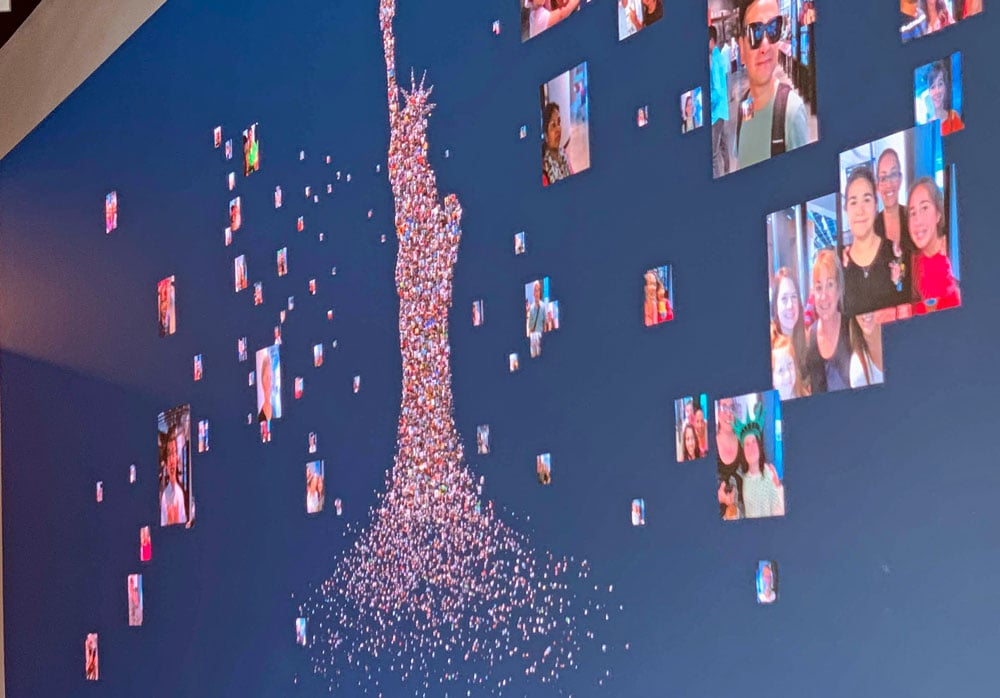
A few years after American Independence a French aristocrat called Crèvecœur who’d settled in New York published a book called Letters from An American Farmer. It was the first European bestseller from the American continent. Its most quoted line: “What then is the American, this new man?”
 Thankfully, the Crèvecœur-in-Wonderland question continues to be asked 250 years later. It has always been more important than the answer. The clue is in the asking. It doesn’t preclude all sorts of possibilities. The more the better in an e pluribus unum sort of way, with more emphasis on “out of the many” than on the “one.” Pluralism before doctrine, unless by “one” we mean union out of pluralism. That’s the originalist meaning of the motto, though it’s just as often misinterpreted as a backdoor to Leviathan: my unum or the highway, that sort of thing.
So what is the American, this eternal adolescent? There is no single answer to what cannot be defined, what should not be defined. The moment we answer the question with any kind of finality, the moment we say an American is this, that or the other, we are asking an un-American question, because the assertion bears the exclusionary gruff of the border guard and the supremacist whiff of the purity test.
We’ve been there, to be sure. Our entire history starting from colonial days has been an eyegouging match between xenophobia and pluralism. Philadelphia mayor and slave-owner Isaac Norris in 1724 called Germans “the very scum of mankind.” Our beloved Benjamin Franklin, lightning rod of the American Enlightenment, called our less beloved current president’s ancestors “Palatine Boors” whose women were so ugly “that it wou’d require great Portions [money] to induce Englishmen to marry them.”
I’d say it went downhill from there, but by then we’d long been raking blood and bones by the mass grave from the bottom of the Middle Passage’s ships. Neither July 4 nor the 1788 Constitution improved matters, instead enshrining slavery in law, disenfranchising three-quarters of the population, then tolerating immigrants as subservient labor only to turn them over to Know-Nothing campaigns–the first magazoids–anti-Catholicism, and a variety of migration bans against “Orientals” to the near-total immigration ban between the 1920s and 1960s to today’s ICE-picking pogroms of Browns and Muslims.
On the other hand, the people who want the question answered about what makes an American never quite win, never fully get the answer they demand, even if it may seem so in periodic binges of xenophobic bacchanals. The more the question is asked, the more Americans there are to defy any one-size-fits-all response. An American is an Old Faithful of paradoxes, of diversity, of definition-defying multinational characters. An American is whatever an American chooses to be, whatever an American identifies as, because that, too, is our ultimate freedom.
Yes, that includes women identifying as men or as nothing at all, Shintos identifying as Jews, Blacks identifying as whites and vice versa, and yes, Christy, Nebraskans identifying as Chinese. If you can pull it off, who am I, who is anyone, to presume to deny you the freedom? None of it is any less bizarre than, say, an Arab identifying as an American, as in my case. Biology, you say? Sure. No one disputes the absurdities of those who “identify” differently as performative wokism, in which case it’s nothing less obscene than blackface. But I’m referring to the sincere, the biological iconoclast, the genuinely dysphoric or even the confused. Their ambiguity–their difference, as that is all it is–is not ours to judge, ridicule or punish. They are ambiguous only in our eyes, not theirs, and it is theirs that matter. With liberty and justice for all, y’all.
So you do not get to define me, and I have no interest in defining you. This goes for race, ethnicity, political party, gender, and of course religion. As Jefferson put it, “it does me no injury for my neighbour to say there are twenty gods, or no god.” I apply the same math to chromosomes. But the moment you start wanting to answer the question, as for example when you claim that America is a Christian nation founded on the belief in one God sanctifying only marriages between one man and one woman (ye gods!), you’ve not only lost me, you’ve lost America. You’ve missed the point.
We are not a nation that judges identity and belonging by a political test any more than by a racial or religious test, as–unfortunately–do Israel and Saudi Arabia, to take two nations where regressive sectarian laws still prevail (though it is easy peasy to become a Muslim. Not so with Judaism, or Catholicism for that matter, assuming you want to be a gainfully employed citizen of the Vatican). But millions among us want to take us back to exactly that, not just with religious tests. They want to diminish us to a narrow definition of what and who we ought to be. They want to melt us into an identity not necessarily of our choosing or making.
Which is why when Crèvecœur first described the “melting” of identities and Israel Zangwill coined the image of a melting pot with his 1908 play of the same name, they, too, were missing the point. One of Zangwill’s characters describes it as “the great Alchemist” melting and fusing migrants “with his purging flame.” Henry Ford literally recreated the pot in his Ford English School graduation ceremonies where he had migrant workers in their colorful diversities descend into a giant cauldron from one end and emerge uniformed as “Americans” from the other. All that is to me a creepy form of ethnic bleaching in the name of social conformism. It is identity communism blackfaced as unum in the Leviathan sense.
The melting pot cogs us into human widgets. It makes us means to an end no longer our own. It assumes with double-sided paternalism that there is a definable, definite American identity, and that the more established migrants of former generations get to define it for new migrants–as it never was for them. It erases the open-ended frontier of identity, which Frederick Jackson Turner never closed, replacing it with that unacceptable oxymoron: the boundaries of American possibilities. There’s a reason that, Philip Roth’s bloop single aside, the great American novel has never been written. It cannot be.
What, then, is the American? She/he/they are the pluribus–the many–within everyone’s reach, the pluralism of Walt Whitman’s Leaves of Grass, the scintillas across Gatsby’s bay, the tragedies of Dreiser and the paradoxes of James Baldwin’s mountain, they are the exuberance of Augie March, the “Wondrous Life of Oscar Wao” and the undefined and star-spangled alienation of Don DeLillo. What enriches us from all these American gospels is that there is no unum, because like all things sanctified and deified it is unattainable, and it would be dull as hell.
No. The American is not so dull, nor so fearful of embracing the only thing that defines us: the unanswered question. And as long as there is no answer, those who aspire to Americanism will always have a chance.

Pierre Tristam is the editor of FlaglerLive. A version of this piece airs on WNZF.



























Atwp says
An American are the descendants of Native Americans that were slaughtered by the white man.
Manny says
Even Native Americans were not Native to this land as they crossed the long-gone land bridge. America had no native people. Everyone is here because someone in their genealogical history was an immigrant.
Jake From State Farm says
I was watching a documentary about our founding awhile ago.
They asked the same question and I liked it so much I wrote it down…… The answer given was
“An American is not defined primarily by blood, language, religion, or geography, but by a commitment to a shared civic experiment: the belief that free individuals, possessing equal dignity, can govern themselves through law, reason, and mutual responsibility while preserving the liberty of others. To be American is to inherit both the promise and the unfinished work of that experiment.”
Not as long winded as your article but says the same thing without all the BS and your slanted view of politics.
The dude says
I guess by your own definition you, the orange shit stain, and the rest of the MAGA morons are not very American then.
Jake From State Farm says
So Dudy, by your definition, supporting the people’s choice makes us un-American? How quaint. The Founding Fathers didn’t risk their lives, fortunes, and sacred honor so that future generations could call their fellow citizens “morons”, “shit stains”, “Nazis”, “Facists”….. for disagreeing with you. They gave us a Republic to protect the rights of the unpopular opinion, even ones who thought it was the “Best Biden Ever”, or were looking forward to being Unburdened by what has been”. Maybe read Federalist 10 before you excommunicate half the country.
The dude says
The irony of MAGA snowflakes whining and crying about name calling and demonizing simply cannot be understated…
Gina Weiss says
Your right Jake from State Farm, it was the “people’s choice” who
voted for a draft dodger insurrectionist who was indicted multiple times and had
34 felon counts, maybe it’s time for reflection of how far this country has fallen.
Gina Weiss says
You were doing good Jake up until your last sentence which is a contradiction
of your above comment. What Pierre wrote is also about his 1st amendment rights,
freedom of choice, and what shapes him as a human into the person he is today by
not being defined by someone like you. What makes you think that your politics
are not slanted or better?
Jake From State Farm says
You were doing good right up until you decided free speech only flows one direction. Pierre’s 1st Amendment rights don’t include a force field protecting him from pushback — that’s not how this works. I’m not defining him, I’m simply not going to pretend his choices exist in a vacuum immune to criticism though FL seems to be an echo chamber for those who though it was “The Best Biden Ever”.
What makes me think my politics aren’t automatically better? The same thing that should make you ask the same question. Our Founders designed this whole chaotic experiment so we could argue about it instead of demanding everyone just agree and go along. Funny how freedom of choice suddenly sounds a lot like freedom from disagreement when the mirror gets turned around.
Gina Weiss says
Why do you call yourself Jake from State Farm? Just curious.
Pogo says
It’s what passes for a KKK sense of humor
Get it?
https://www.google.com/search?q=jake+from+state+farm
An earnest human being with a sense of humor, humility, and a modicum of a desire for — everyone — to be, and do, better is what is too rare in this country — and the world.
And so it goes.
Sherry says
Yet “again”. . . only the lowest of the low spit on the eye of their host!
Jake From State Farm says
Trust me Sherry, Pierre does not need you popping out from under his skirt to defend him. He is a big boy and can handle himself.
Deborah Coffey says
OMG! Pierre, you just made my 4th of July a happy one. This piece is brilliant. For one thing, what it shouts out to me is “Long live DEI” because America should be for anyone who sincerely wants it to be a “place to call home.” Thank you.
Stephen Jan Playe says
Thank you for, as always, making us think.
Happy 4th, Pierre.
Brad W says
Being an American is a shared citizenry, but it goes infinitely deeper than a legal status or superficial displays of patriotism. Waving a flag or demanding strict cultural conformity isn’t true Americanism; our identity is anchored in a revolutionary, living idea.
As the Declaration of Independence states, we hold it as a self-evident truth that all people are created equal, endowed with “certain unalienable Rights, that among these are Life, Liberty and the pursuit of Happiness.” This is the core value of being an American: a radical, unyielding love of freedom for all people, not just those who look, think, or pray like us.
When we recite the Pledge of Allegiance, the ultimate weight lies not in the physical symbol of the flag itself, but in the final promise of “liberty and justice for all.” Likewise, the preamble of the Constitution explicitly frames our union to “secure the Blessings of Liberty to ourselves and our Posterity.”
To be an American is to bear the responsibility of that unfinished promise. It means recognizing, as your piece notes, that our strength is found in our pluralism—not in a forced “melting pot” designed to bleach out our differences. An American is defined by an ongoing commitment to human dignity and the sacred freedom of the individual to chart their own course. The moment we try to restrict American identity to a rigid purity test, we destroy the very essence of what makes this country a beautiful, breathing ideal
Atwp says
Happy 4th to everyone. Be careful in the heat and be safe.
John Stove says
I am proud to be an American and I love my country…..however I am NOT proud of our current President and/or those that keep him in power.
You can be both
MAGGIE MINUTAGLIO says
AN AMERICAN IS EVERYTHING THE OPPOSITE OF TRUMP AND HIS LOYALISTS REGIME.
DustyBoots says
One approaches this article with appreciation for its literary ambition and its evident affection for liberty. One departs, however, with the suspicion that Flaglerlive has mistaken the absence of boundaries for the presence of freedom.
The central proposition—that America is defined precisely because it cannot be defined—is not merely paradoxical. It is self-defeating.
Mr. Crèvecœur asked, “What then is the American?” because he recognized that something historically unprecedented had emerged upon these shores. He did not ask what an American might whimsically imagine himself to be on any given Tuesday morning. He asked what distinguished this new people from every other nation that had preceded them.
The answer was never “anything at all.”
America was not founded upon ethnic identity. It was not founded upon bloodlines, language, or inherited aristocracy. This much the article rightly celebrates. But from that undeniable premise it leaps to the extraordinary conclusion that America therefore possesses no defining principles whatsoever beyond radical self-definition.
That is not liberty. It is relativism masquerading as freedom.
The Declaration of Independence did not proclaim that all truths are negotiable. Quite the contrary. It appealed to “the Laws of Nature and of Nature’s God.” It asserted that certain truths are self-evident—not self-invented. Rights exist because human nature exists. Government exists to secure those rights, not to redefine reality according to prevailing cultural fashions.
One need not believe America is a theocracy to acknowledge that the Republic was founded upon a moral consensus inherited from the Judeo-Christian tradition, classical philosophy, and English common law. Remove that foundation and liberty becomes untethered from responsibility, eventually dissolving into the tyranny of appetite.
The article spends considerable energy cataloguing America’s historical sins. Fair enough. Conservatives have never argued that America has been morally perfect. Slavery was an abomination precisely because it contradicted the principles announced in Philadelphia in 1776. Segregation was defeated not because America abandoned its founding ideals, but because Americans finally insisted upon living up to them.
This distinction is crucial.
If America were merely another tribal nation built upon power and prejudice, there would have been no moral vocabulary by which Frederick Douglass, Abraham Lincoln, or Martin Luther King Jr. could condemn its injustices. They appealed repeatedly—not to postmodern identity—but to the Constitution and the Declaration.
Flaglerlive dismisses concerns about national identity as little more than xenophobia wearing respectable clothing. That accusation may satisfy contemporary editorial fashions, but it collapses upon examination.
Every nation possesses a civic culture.
Japan has one.
France has one.
Israel has one.
Even Flaglerlive’s preferred examples of pluralism possess expectations regarding language, civic loyalty, constitutional order, and public norms.
Why, then, should only America be forbidden from asking newcomers to embrace the political traditions that made immigration desirable in the first place?
Assimilation is not ethnic bleaching. It is civic education.
To ask immigrants to learn English, understand constitutional government, respect equal justice, and participate in American institutions is not oppression. It is precisely what transformed millions of Irish, Italians, Jews, Poles, Greeks, Cubans, Vietnamese, Indians, Nigerians, and countless others into fellow citizens rather than permanent strangers.
Indeed, the greatest compliment one can pay America is that people willingly leave nations organized around tribe, sect, and inherited grievance to become part of something larger than themselves.
The article’s most revealing claim arrives when it suggests that an American is simply whatever an American chooses to identify as. At that point the discussion quietly abandons citizenship altogether and enters the realm of subjective metaphysics.
Nations cannot endure upon subjective identity alone.
Laws require objective meaning.
Constitutions require stable language.
Citizenship requires reciprocal obligation.
If every defining characteristic becomes merely optional, then eventually the nation itself becomes optional.
The American experiment has always welcomed extraordinary diversity. It has never required philosophical uniformity. But diversity flourishes only inside a constitutional framework sustained by shared assumptions about ordered liberty, equal justice, limited government, and personal responsibility.
Laurel says
Ah, yes. Conformity is comforting to some, isn’t it?
There is a huge difference between “asking immigrants” and demanding immigrants.
Sherry says
The “empty void” of trump’s fairgrounds says it all when it comes to how the vast majority of Americans feel about him.
Ron says
If the vast majority of Anericans feel so negative about the President then how did he ever get elected? Conservatives didn’t shun, boycott and spew hate during the last administration. Grow up and become adults. It is the nations 250th birthday for all Americans! Show some respect for the flag and the country. It isn’t Republican or Democrat or independent, it id American.
Sherry says
@ ron. . . trump was elected because an entitled/lazy populace “assumed” our democracy would always survive without lifting a finger to protect it. An uprising of brainwashed, fear and hate filled “cult members” put a “convicted felon, sexual assaulter” in office.
Taking office is NOT the “end all, be all” of the responsibilities for any position! That is merely when the work “begins”. Your lord and master has done nothing in office but corruptly add to his BILLIONS while getting us into a BILLION dollar a day ridiculous war he is losing! He is causing prices to rise for us “ALL”due to outrageous tariffs! He is separating refugee families and locking up innocent women and young children in inhumane “concentration camps”! His gestapo ICE force has blatantly murdered TWO American citizens. . . with seemly ZERO accountability!
I could go on and on with a long list of why trump is unfit for office, however I doubt that you would even bother to read those “FACTS”.
BTW. . . trump was NOT elected by Maga to be “Emperor/King/Dictator” !
Jake From State Farm says
Sherry – Trump was elected as President because the other option who when through a coronation as a queen to run against him was a complete joke. Everyone wanted to be “unburdened by what had been” with the previous admin, didn’t get has excited about Ven diagrams as much has her “I love Venn diagrams. I really do, I love Venn diagrams. It’s just something about those three circles and the analysis about where there is the intersection, right?” or don’t like yellow school busses as much as her…. “Who doesn’t love a yellow school bus, right?”. You will have to insert your own Kamala cackles in those quotes. I could go on and on with more “Facts” But you thought it was the “Best Biden Ever”, Believe that he called Nazis “good and fine people”… again I could go on and on but there is not much hope for you believing facts,
Ed P says
Hello Sherry,
Sourpusses deserve inclusion along with the curmudgeons.
PaulT says
We were contentedly sharing the celebration of our independence, our country’s 250th birtday. In a nation of individuals who rarely agree but cherish this place as our home we looked forward to this weekend for the chance to abandon our divisions, to find temporary unity..
Then along came Trump, hijacking the podium and spewed hatred in pusuit of his determination to keep this nation divided for his own ends, not for ours.
Dare I say Damn You Donald Trump, this is our day, not your.
BIG Neighbor says
To self-identify with, not on-site of all others…period. Dignity is painful, and has nothing to do with boundaries. To be the very best you can be to others feeds yourself while touching the hand of the almighty …that’s the home of the free and the brave.
DustyBoots says
• Individualism and Self-Reliance: Americans prioritize personal freedom, achievement, and autonomy more than most collectivist societies (common in Asia, Latin America, Africa, and parts of Europe). This shows up in expectations of independence, direct communication, and personal responsibility.
• Optimism and Belief in Mobility: A cultural faith that hard work and reinvention can lead to success sets the US apart. Americans are more likely to believe in meritocratic opportunity than people in many other countries, even when real outcomes vary. This fosters openness to changing careers, moving long distances, or starting over—less common where family/regional ties dominate.
• Civic/Propositional Identity: “American” is defined more by shared ideals (liberty, Constitution, opportunity, rule of law) than by ethnicity, ancestry, or long history. This contrasts with nations where nationality ties closely to blood or cultural homogeneity. It enables broad assimilation but requires continual renewal.
• Diversity Under One System: The US integrates extraordinary ethnic, religious, racial, and cultural variety—via immigration and internal scale—within a single national framework and identity. Few large countries combine this pluralism with strong overarching cohesion
The dude says
Patriot Front, who marched across DC in masks on the fourth, would disagree with most of what you posted here.
kola says
German World Cup fan breaks down in tears after being blown away by kindness of Americans
Sebastian Krause admitted he was scared to travel to the US but left declaring ‘America is great.’
This post probably won’t make it through the “left” censorious filter. However, I really enjoyed myself on July 4th. We live in an incredible country. Please don’t tell that to the “left” they unfortunately don’t want to be “right.”
Pierre Tristam says
kola, I wonder how you square your first paragraph with the contempt of your second.
Laurel says
Through his own “censorious filter.”
Sherry says
Just a Reminder:
President Trump Job Approval
Rasmussen Reports
Approve 40, Disapprove 58
DISAPPROVE of trump: +18
DustyBoots says
What does this have to do with Trump?
Sherry says
Just “open your eyes” to everything trump is trying to do to “redefine” what it is to be an American! If you cannot do that, you are lost and blind to the truth.
CH says
I think of it in the geographic sense. North America, Central America, South America. We are all Americans. I even like the change of Gulf of Mexico to Gulf of America. It’s more inclusive.
Greg O'Grady says
This column is an impressive exercise in arguing that America cannot be defined, while spending several thousand words defining America exactly the way the author prefers.
The claim is that asking what an American is becomes dangerous the moment anyone gives a serious answer. Apparently, the only acceptable answer is that there is no answer. America is everything, nothing, whatever anyone says it is, and any attempt to identify common principles carries the ominous smell of border guards, supremacy, and exclusion.
That is convenient.
It allows the author to impose a very specific definition of America while pretending he opposes definitions. In his version, a real American rejects fixed categories, distrusts assimilation, treats identity as a matter of personal declaration, views national cohesion with suspicion, and considers traditional religious or cultural claims inherently threatening.
That is not neutrality. That is a political doctrine.
The author is not objecting to definitions. He is objecting to definitions other than his own.
The column begins with “e pluribus unum,” but quietly discards half of it. The phrase means “out of many, one.” It does not mean “out of many, many,” nor does it mean that unity is a sinister authoritarian project.
The entire point is that people from different backgrounds become part of a common political community.
The many remain real. So does the one.
A country cannot function on pluralism alone. It needs common laws, common institutions, common citizenship, mutual obligations, and some basic loyalty to the constitutional order. Otherwise, it is not a nation. It is a hotel.
People may eat different foods, practice different religions, preserve different traditions, and speak different languages at home. But they still need a shared public framework. The First Amendment, due process, equal protection, elections, property rights, and constitutional limits on government are not products of unlimited personal identity. They are part of a particular American political tradition.
The author wants all the protections created by the unum while insisting that the unum must not exist.
That is not a small problem.
The history section is mostly a sequence of moral accusations. Benjamin Franklin said offensive things about Germans. Early Americans owned slaves. Nativists opposed Catholics. Immigration restrictions targeted Asians. Therefore, apparently, defining America is inherently suspicious.
But none of those examples proves that America has no identity. They prove that Americans have often violated their own ideals.
You cannot accuse a nation of hypocrisy unless the nation has some standard against which its conduct can be judged.
Slavery was wrong because it contradicted the claim that human beings possess natural rights. Religious persecution was wrong because liberty of conscience was an American principle. Racial discrimination was wrong because equal citizenship was an American ideal, even when the country failed to honor it.
The author wants to condemn America for betraying its principles while denying that those principles can be identified.
He cannot have both arguments.
The discussion of the Constitution is similarly careless. The Constitution did not invent slavery or introduce it to North America. Slavery already existed under colonial and state law. The Constitution accommodated it through compromises, which was a profound failure, but it also created the political system through which slavery was eventually abolished.
The Thirteenth Amendment ended slavery. The Fourteenth established equal protection and national citizenship. The Fifteenth prohibited racial discrimination in voting.
Those changes did not emerge from the belief that America means nothing. They came from arguments about what America was supposed to mean.
Then we arrive at the claim that modern immigration enforcement amounts to “pogroms” against brown people and Muslims.
This is the kind of language people use when ordinary criticism is not emotionally dramatic enough.
A pogrom refers to organized mass violence directed against an ethnic or religious population. Immigration enforcement concerns whether a person has legal authorization to enter or remain in a country. Policies may be wise, foolish, humane, cruel, efficient, or abusive. They may deserve intense criticism.
But deportation is not automatically ethnic massacre.
Using the word “pogrom” does not strengthen the argument. It merely announces that the author would rather provoke than distinguish.
The identity argument is where the column becomes genuinely incoherent.
The author says an American is whatever an American chooses to be. This allegedly includes women identifying as men, Shintos identifying as Jews, black people identifying as white, white people identifying as black, and Nebraskans identifying as Chinese.
The argument treats nationality, race, religion, ancestry, and biological sex as though they were interchangeable categories.
They are not.
An Arab can become an American because Arab identity and American citizenship are not mutually exclusive. Arab generally describes an ethnic, cultural, or linguistic background. American describes a nationality and political membership.
A person can be both.
That tells us nothing about whether a Nebraskan becomes ethnically Chinese by declaration. It tells us nothing about whether biological sex changes through personal identification. It tells us nothing about whether a person becomes Jewish merely by saying so.
Different categories have different criteria.
Citizenship is acquired through birth or naturalization. Religion may involve belief, practice, conversion, and community recognition. Ancestry concerns descent. Biological sex concerns physical organization related to reproduction. Residency concerns where someone lives.
Collapsing all of these into the single category of “identity” is not sophistication. It is category confusion.
The author says nobody should judge or ridicule confused or dysphoric people. Fair enough. Human beings should be treated with dignity.
But dignity does not require everyone else to surrender the distinction between compassion and truth.
A person may sincerely believe something that is inaccurate. Sincerity does not settle reality. Freedom protects people from persecution. It does not require the public to affirm every claim they make about themselves.
The Jefferson quotation does not help the author either.
Jefferson said that his neighbor believing in many gods or no god caused him no injury. That is an argument for religious liberty. It means the government should not punish people for their beliefs.
It does not mean every religious claim is true.
Jefferson was defending the right to believe wrongly, not abolishing the distinction between truth and falsehood.
The same principle applies here. People should be free from unjust harassment and discrimination. That does not mean every private declaration becomes socially mandatory or factually correct.
Tolerance means allowing disagreement.
The modern progressive version of tolerance often means requiring agreement and calling disagreement violence.
Those are not the same thing.
The column also treats assimilation as though it were a form of cultural sterilization. The image of immigrants entering a giant melting pot and emerging in identical clothing is certainly strange. Nobody needs to defend Henry Ford’s corporate pageantry.
But assimilation does not require ethnic erasure.
It can mean learning English, understanding American law, respecting constitutional rights, participating in civic life, and developing loyalty to the country.
An immigrant does not need to abandon his food, music, religion, family customs, or ancestral memory. He does need to recognize that citizenship is more than living within a particular tax jurisdiction.
Every society transmits norms. The author’s preferred society would do the same. It would teach that fixed identities are oppressive, assimilation is suspicious, traditional religion is dangerous, national unity is potentially authoritarian, and self definition should override inherited categories.
That is still social conformity.
It is simply conformity to his beliefs.
The treatment of Christianity is equally shallow. America does not have an established national church. The Constitution prohibits religious tests for federal office. Americans of every faith and no faith possess equal citizenship.
But none of that requires pretending Christianity had no major influence on American political culture.
Christian theology, biblical language, natural law, Protestant political thought, and English common law all shaped the country. Recognizing that history is not the same as demanding conversion.
The author appears to think that acknowledging Christian influence is itself exclusionary. By that standard, acknowledging Greek influence on philosophy or Roman influence on law would also be oppressive.
History does not become false merely because someone finds it politically inconvenient.
Citizens are also allowed to argue about marriage. Some believe marriage is intrinsically connected to sexual complementarity, procreation, and the needs of children. Others disagree.
Having that debate does not mean America has been lost. Debate is part of America.
The author’s real complaint is not that people are imposing political tests. His complaint is that they refuse his political conclusions.
Near the end, he finally says there is no unum.
At least that part is honest.
But once there is no unum, the entire argument falls apart. There is no “our history,” “our freedom,” “our responsibility,” or “our country.” The word “our” already implies a shared identity.
If America is nothing but endlessly self defined individuals, then there is no common basis for citizenship and no reason anyone owes anything to anyone else.
Rights do not enforce themselves. Institutions do not preserve themselves. Constitutional government depends upon a population that recognizes some common political inheritance.
America does not need to be defined by race, blood, or denomination. It should remain open to people of every ancestry.
But openness is not emptiness.
An American is a citizen of a particular constitutional republic. That citizenship includes rights, duties, legal equality, political participation, and loyalty to the common order.
America is pluralistic, but pluralism is not the whole definition.
The many are protected because there is a one.
Remove the one, and eventually there is no nation left to protect the many.
Pierre Tristam says
I would be more inclined to take the above seriously and even engage with a few of its unumatopeic points had it not been spewed by AI. Alas, not the case. Certainly not compared to the imminent indignation by “Greg O’Grady” for being called out for having his Grocky Claudes pinch-hit.