



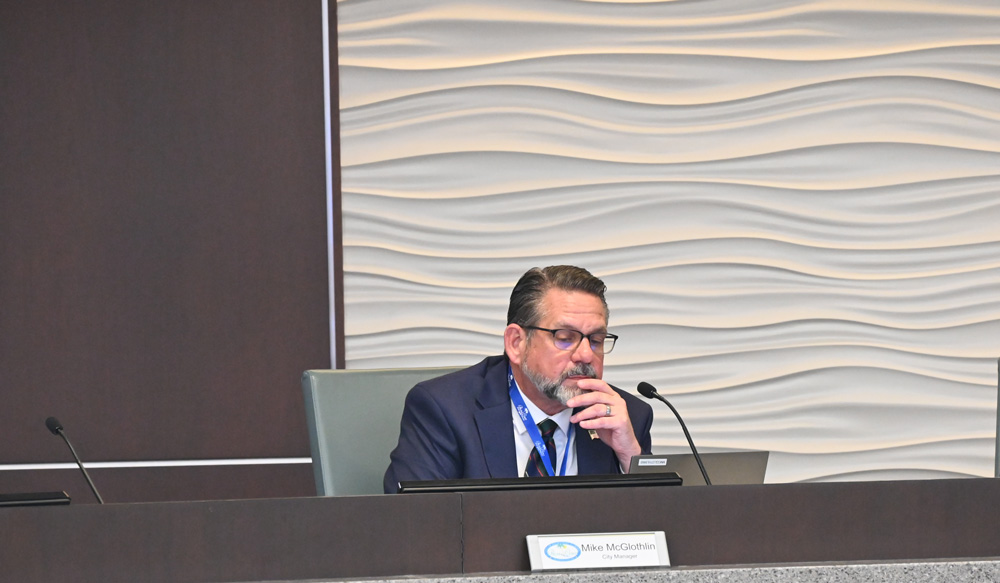
The Palm Coast City Council meeting Tuesday turned into a slaying of sacred cows as politics and realism clashed.
The council is reconsidering its commitment to the School Board with the possible elimination of a school resource deputy it has funded for a decade and a half. It is considering cutting the sheriff’s request for nine more deputies down to five. It is questioning whether to even have a supplemental contract with the sheriff. It is considering reducing its code enforcement officers’ ranks by half and recalibrating raises. It is considering cutting its contribution to the Flagler Humane Society. And it is leaving the way open for further, surprise cuts.
This is what happens as the upending of local government budgets looms with the possible voter approval this fall of the homestead amendment that would sharply reduce tax revenue.
None of those initiatives are yet approved, and some may not be as the council works toward a budget for the next fiscal year that starts Oct. 1. But the framework the council approved Tuesday means that some of those initiatives may have to be approved, if at a heavy price and through tensions that became apparent between the council and the administration Tuesday evening.
“We will just need to know additional cuts that may need to be made by service level expectation reductions,” City Manager Mike McGlothlin said, “as well as we may have to revisit SAP and remove some of those projects.” SAP is the council’s Strategic Action Plan, its annual goals and expectations.
City Council member Theresa Pontieri immediately put that burden on the manager and the administration, saying she’d already laid out suggestions last week. “To say that we need to adjust our service levels,” she said, “I think that staff and you, city manager, need to go back and look at the budget and say, okay, this is what we can propose to do, and then come back to City Council and make some of those proposals.”
“I just want to make sure that all the expectations are realistic,” McGlothlin retorted. “There is no money to find. We have not misplaced any funds. So that’s where we need the policy of the service level reductions if we’re going to go deeper than what we’re already talking about.”
The council voted 4-1 to adopt a maximum allowable property tax rate for next year of $4.2296 per $1,000 in taxable value, or $1,057 for a $300,000 house with a $50,000 homestead exemption. Pontieri, who wants no increase in the tax rate, was opposed.
The rate is provisional. By September, when the council adopts the final rate in a pair of hearings, it has the option of lowering it, but not raising it.
The current tax rate is $4.0893 per $1,000 in taxable value. The rollback rate is the rate at which the city government would take in the same amount of revenue next year as it did this year, excluding revenue generated by new construction. Because property values declined for the first time in 14 years, the rolledback rate would actually be a rolled-up rate of 4.1389. Even at that increased rate, the city would have to cut $1 million from the proposed budget. If the council were to maintain the existing rate of 4.0893, it would have to cut $1.6 million from the proposed budget.
That proposed budget does not include $3.3 million in needs, including the nine deputies, a cost-of-living raise for all employees, and several additional positions scattered through the city’s departments. The city has a $2 million carry-over balance from unspent money in this year’s budget. That money may only be used for one-time expenditures.
“Let’s give ourselves decision space,” Council member Charles Gambaro said, “to see if we can get to the 4.0893. I think it’s important to preserve that decision space, because some of the ideas that we’ve discussed here, they may not be feasible. And then, what if they’re not? Do we lock ourselves into a certain millage rate that’s really going to reduce service levels to a point? I think we still need to have those continued discussions.”
The proposed general fund budget for fiscal year 2027 is $72 million, an increase of $4.6 million, or 6.8 percent, compared to this year, with the largest increases in public safety at 48 percent and public works street maintenance at 20 percent. The public safety increase does not include the sheriff’s request for an additional nine deputies at a cost of a little over $1 million.
Last week Pontieri suggested that code enforcement go from a patrol-based system where 75 percent of complaints are generated by code enforcement officers to a system where code enforcement would only respond to residents’ complaints, which currently account for 25 percent of the workload. Community Development Director John Zobler said if the city took that approach, it could reduce code enforcement employees by half, or 12 employees.
“I can’t justify cutting that many people from code enforcement. I think it should be across-the-board cuts,” Mayor Mike Norris said. He favored a reduction in the tax rate to 4.0893 and cutting $1.6 million from the proposed budget.
Gambaro questioned why the city has been paying for a school resource deputy. “ I don’t understand why we’re paying for that position,” he said. He wants to end that funding now. (The city started paying for deputy under City Manager Jim Landon, reasoning that when the deputy was not in school, the deputy would be an additional patrol on Palm Coast streets. In 2015, then-Council member Bill McGuire wanted to end that funding. (See: “Palm Coast Council Member Bill McGuire Wants End to City Funding of School Deputy.”)
Pontieri said if the proposed amendment to raise the homestead exemption passes, “I would advocate that they should pick up that last deputy,” because the schools won’t be directly affected by the amendment.
“I don’t think this is necessarily our responsibility,” Council member Ty Miller said. “I think we have separate budgets, and we’re dipping into our budget to pay for something that’s somebody else’s budgetary line item.”
The discussion shifted to the sheriff’s request for nine additional deputies as part of the Palm Coast contract.
“We have to understand that these nine deputies-that’s not a one-year expense,” Council member Dave Sullivan said. “Next year, those nine deputies will be there, and so that expense will continue. And we do have the threat of this amendment coming. I don’t know what to do, but I’m just saying that as far as the money we have, if we’re going to support this cause for the nine deputies, we have to do something about the millage rate to handle that.”
Sullivan raised a further possibility: to end Palm Coast’s paying for policing separately from the county.
“That’s certainly something that the city and the county boards can get together and discuss with the sheriff’s office,” Pontieri said.
Remarkably, Sullivan dismissed Miller’s correct assertion that “this city has chosen a specific service level above and beyond.”
“I don’t think that’s true,” Sullivan said. “I think that’s a comment that was made. I don’t think that’s in hard fact.” But the annual contract is the hard fact: it’s in writing (“Whereas, the city desires that sheriff furnish additional law enforcement services to its citizens within the jurisdictional boundaries of the city…”)
“No. The sheriff is responsible to provide police support for the city. Period,” Sullivan said. “And he has to do that at a point where we’re not going to have an increase in crime. Because he touts the fact that we have a 40 percent reduction in crime, but we still need more deputies. So I support the police totally, and so forth. But I think as this contract with the sheriff gets bigger and bigger, I really think we need to carefully look at it.”
“I agree with you on that point,” Miller said. “There’s a point where the ROI on it doesn’t make sense.” (ROI is return on investment.) “We pumped in, what, 18 new deputies in the last two years? And so I think it’s appropriate to look at some of the deputies that we’re also funding that maybe we shouldn’t be.” He was referring to the school deputy.
Pontieri said the city was at the end of a three-year agreement to add nine deputies each year, based on a needs study. She was for funding five deputies now, rather than nine. “They said that they’re going to do another study, a follow-up study next year,” she said. “Let them do that study. Look at where our current population is and see do they in fact still need the [additional] four, or do we not need to fund any deputies for a few years? I understand, Councilman Sullivan, what you’re saying about the contract. Perhaps at one point–where does it stop or does it end, right? But it ends with this, according to what we agreed to with them.”
That would still cost the city $820,000–or $660,000 if the city ended its support for the school deputy, something Pontieri would not support.
In other budgetary changes, the city projects reducing its allocation to the Flagler Humane Society by $140,000, which would be a severe blow to the society, which is seeking an increased contribution from the city. The city pays $156 per animal the society handles on its behalf. The society is requesting $392 per animal. Cutting $140,000 would cover the city’s need for two additional employees in public works (a $133,200 cost, not including needed vehicles).
“I will not vote to increase the millage,” Pontieri said. “The state of Florida is telling us to reduce government spending, and what do we do? We turn around and we increase the millage, and I’m not going to get on board with that.” She again pointed to a different code enforcement approach as one way to cut costs, saying it would not be a reduction in service since residents would control where code enforcement officers are sent. The sheriff, too, could also pick up some of the code enforcement duties, she said. Pontieri is running for a County Commission seat in a Republican primary that will draw on the most conservative, anti-tax voters in the county.
“I don’t like the idea of cutting 12 employees ever. In an ideal world, we wouldn’t have to cut employees. But this isn’t an ideal world. We don’t have an endless budget,” Pontieri said. “My point is, there’s money to be found. We just have to make adjustments to the budget to get there.”
She had the mayor’s–and the council’s–support. “I do not feel comfortable raising the millage rate at all,” Norris said. “I’m perfectly happy with leaving the max millage at what we set it at last week, and that’s our max mill. All negotiations and all budget maneuvers to get where we need to be to get it as low as possible will be coming forward, but that would be our max.”




























Marci says
Other revenue sources need to be found and cuts to unnecessary spending like raises. Other states don’t rely heavily on taxes from homes why not see what they do. Since we are tourism driven how about a new tax for them to come visit our wonderful state
Joe D says
For Marci:
Unfortunately MOST other states have INCREASED their property taxes AND they have STATE INCOME TAXES TOO.
So, I must admit, the no state income taxes was a large draw ORIGINALLY for
me to decide to retire to Florida. However, when I really saw what my PRIOR state’s taxes were going to cost me after retirement in State tax, it was almost nothing.
Now to add this MASSIVE rollback of local property tax income based on such a large increase of the HOMESTEAD EXEMPTION, I’m fairly sure that local and county services are going to SERIOUSLY suffer if these property homestead cuts take effect…and the taxpayers are not going to be happy then either!
Yes, Florida has been blessed with wonderful natural resources ( if we don’t stop DAMAGING them by over developing), and we have a LARGE amount of tourists vacationing here every year, but the tourists are not going to make up for all the revenue loss by these severe increases in the HOMESTEAD tax exclusion. You already have no State income tax, how much more do you think you can cut and not lose VITAL SERVICES ( unfortunately EVERYONE has their own idea of what services are VITAL). Tourists ALREADY pay an add on HOTEL TAX. They already pay a tax on home/condo rentals of “less than 6 months and a day.” Tourism is a great source of income, but we can’t kill the golden goose ( or golden flamingo as the case may be).
I think the council should START looking at an INITIAL 5% cut ACROSS departments (with the idea of SEEING what that would do to budgeting and services), not that “across the board” should be the final answer to budget cuts. Then a HIRING FREEZE (no filling of vacant positions unless a 1 by 1 review of each hire by an upper level guidance committee). You can’t expect employees to remain without a cost of living raise of at least 2.5% -3% currently (?). In my former life I was a Nursing Division Chief in a State run Hospital. Budgets were ALWAYS tight, there were frequent hiring freezes. There were frequent limits put on cost of living raises, so I’m not new to this process.
I don’t think the starting salary of new police recruits is the problem. We have increased starting salaries to competitive levels. However, our police/sheriff departments have equipment and resources of a MUCH LARGER CITY. I would like to see an external review of all these intermediate commanders, deputy supervisors, Assistant Captain positions ( or whatever titles that have been created) that have appeared over the last few years with extremely high salaries …is there ANY accountability as to what they all ACTUALLY DO? Are these position duplicated in other police agencies elsewhere in the state ( or outside the state)… or JUST in Flagler County?
This belt tightening exercise is not pleasant, and although I wholeheartedly agree that some funds have been WASTED in the past by lack of efficiency. I think within 3 years of such a HOMESTEAD PROGRAM increase going into effect…people are NOT going to be happy with the long term results…but reversing the process to correct the MISTAKE, could take a decade or more, if ever.
Lois says
Wow, someone who actually has brains. Your ideas are great, but are actually falling upon deaf ears. This city has lost its way many years ago.
TR says
How about making deep cuts to the higher up department heads and their assistance, then work from there.
T says
This is insane where is all taxpayers money going to really need a audit and people to protest this they allow building destroying palm coast to make more money now its oh well new council new people
Samuel L. Bronkowitz says
Requiring police to be individually bonded and insured at their own cost, like other professionals are, would prevent future lawsuit fallout from draining budgets. Considering the amount of bad faith and kids getting shot in the neck it might be a good preventative measure
Neighbor says
How much has flagler county paid in law suites for this to even be an issue?? Havent heard of any in the last 10 years….seems like a non issue for no reason other than cop bashing.
And law enforcement isnt “like other professionals” not even close to a single profession anywhere in the country.
beach house says
code enforcement….what a joke….cut cut cut
TR says
Sure and in less then a year the entire city will look like a neighborhood with front yards full of abandon cars, grass three feet tall, junk all over the place and houses falling apart. Just to mention a few things. The only people that do not like CE are the ones who want to have the city look like what I described. Every city that I know of has a CE department, so good luck finding one that doesn’t.
bill says
so you wanna cut: enforcement go ahead it’s not going to bother me because I don’t live where all the violations are, you’re going to have a shit show neighborhood if you get rid of cold enforcement
Dennis C Rathsam says
With all those code officers driving by cars, parked in the swales over night. 2 deputies live right on the streets & drive buy them too! Why is there a code if no one enforces it? Its the same homes & the same cars, same boats, same jet skis!!!!!! When will they stop an issue a warning, then if doesn’t stop a ticket. Seems no one uses their eyes, while driving around wasting gas. Give me $5.00 for every violation I find…..Id work for free. CODE PEOPLE do your job
Just the facts, please. says
Can someone explain why they send a huge Costly Fire pumper With every ambulance caolls. I have lived all over this country and this IS the only place I’ve seen done. Called 911 for my wife’s AFIB attack and soon theres 6 guys and one lady in my living room. Just needed a paramed and a driver. Can we waste anymore? Diesel fuel over 5 bucks gallon.Who’s bright idea is this?
bill says
I agree what a waste of equipment I was told there’s a paramedic on board well other states where I worked the paramedic had their own vehicle and they responded to accidents medical calls. You did not have to drag out a two to $300,000 fire truck to go to a medical call put the paramedics in their own vehicle.
celia says
This is why our Fire Dept. Is the costlier item in the city of Palm Coast budget! You are correct I have notice that every time there is an emergency call. Ambulance, fire engines, in one case in Cooper Lane saw two fire engines and also sheriff cars was just for a small smoke fire caused by electrical failure.
Don F. says
Increasing the population of Palm Coast exponentially and and decreasing the Officers in the schools, not a good combination.
Waste not want not says
We don’t currently have code enforcement
We have (sometimes) code compliance.
Nothing gets attention until after a complaint is filed.
Thereby creating a city of complainers.
Is anybody happy with the job code enforcement does ?
If the major are unhappy with the current code enforcement job CUT IT !
There is not 1 street in town without a violation on it somewhere
Then grow a set and tell the overinflated ego we call a sheriff NO MORE
He is over funded as is with a lot of waste
Third start with an automatic 15 percent cut for all departments
This proposed state amendment only affects 25% of property’s state wide.
The sky will not fall BUT hopefully frivolous spending will stop
slipshod says
I think Mrs. Pontieri forgets she doesn’t work for the state of Florida. She works for the citizens of Palm Coast. What do they want her to do as their representative in LOCAL government?
Do we need code enforcement? Unfortunately, yes.
Do we need roads to be maintained. Yes, and it needs to be properly funded.
Do we need nine more deputies? Where’s the evidence to support it or a plausible justification?
Does the City need to pay additional for “enhanced policing? Since it is a County service, why are we paying for it at all through the City taxes?
Do public employees deserve at least a cost of living increase? Of course. Every retiree that lives in this community will get an increase in social security.
Do public employees deserve a performance pay increase? If you don’t reward performance, you encourage the opposite. Employee turnover costs money. Part of the problem with government spending is that housing has gotten very expensive from all the new residents as well as inflation. At some point, workers can’t afford to live here- especially low-paid government workers. Highly paid government workers – engineers, technical experts – people who know things and can do things the City needs- can leave and take jobs elsewhere. This hurts the City and costs more eventually.
Linda Lester says
Flagler Humane Society has been subsidizing the cost of Palm Coast strays for years and now PC is proposing a cut of $140,000 in funding, increasing the deficit on this service to an unsustainable amount.
Ed Danko, former Vice-Mayor PC says
The Flagler Humane Society is the primary benefactor of my family trust. I won’t say how much that is here, but if you look at my last state financial filing when I ran for county commissioner, it’s a large substantial amount. While I’m in favor of cutting waste in our city budget, and I always have been, this is not a place to make a cut. Shame on Pontieri! Maybe she could help our city financially a little bit if she actually paid for a license for her dog, like the rest of us!
DMFinFlorida says
@Ed D …. I can’t believe I actually agree with you for once!
Ed Danko, former Vice-mayor, PC says
Glad to know we can agree. Flagler Humane Society is amazing, and I encourage everyone to financially support them if you can. All of my pets have been rescued, they have rescued me! I can not believe that Pontieri would be so heartless to cut their funding.
FedUp says
Cutting law enforcement services is a recipe for disaster. Again, Palm Coast is living up to its cesspool status, and it’s about to get worse if they go through with this proposal. The criminals are salivating.
Ed Danko, former Vice-Mayor PC says
Now, all of a sudden (TRANSLATION: Running For Office) “Tax & Spend Pontieri” wants to make budget cuts, and doesn’t want to raise taxes! Is this the same Pontieri that year after year screamed that there was no place to make budget cuts? Is this the same Pontieri who claims to have lower your taxes every year, while in fact your taxes have increased every year since she has been in office? Don’t be fooled by “The Tax Queen of Palm Coast!” The moment she’s elected again she’ll be pushing for that sales tax increase and a 6% FPL Franchise fee! (TRANSLATION: If Her Lips Are Moving, She Is Lying!)
JustGoAway says
Not that I support either of you, but I’m curious, Ed: why do you have “former Vice-Mayor PC” after your name? It would appear you had your chance to make a difference, but maybe the voters felt differently? Does being censured have anything to do with it?
Callmeishmael says
I think he does it to remind us that he’s among those who got our city in its current predicament.
Protect our animals says
Most residents may not be aware, but city of palm coast animal control services fall under code enforcement. If anything, we need MORE animal control officers as our population has grown, so too has the population of animals. Many times, people become frustrated due to the lack of response from animal control and/ or the lack of follow up! Residents are required to complete a signed affidavit in order for animal control to respond and even if they do, oftentimes the animals owner is given a warning or “ educated” about the proper care for the animal. Then no follow up unless another complaint is submitted. The two “ hoarding” cases along with the recent case where the two dogs died in a storage facility exemplifies the need for better animal control services in our community ! So in that respect, we shouldn’t cut animal control services which falls under code enforcement but should be expanding them to better serve the needs of the community and most importantly, to protect animals from negligent owners! Perhaps move the money from those code enforcement officers whose main job is to respond to complaints about parking in swales, uncovered air conditioner units, trash cans left out , etc and instead, add more animal control officers! Reports of animal neglect, abuse and cruelty deserve more attention than someone’s air conditioner not being “ properly hidden” ! I certainly hope that animal control services is not on the chopping block during this critical time!
Fleeing Flagler says
Can anyone say **cheap political stunt?**
With the City approving thousands of new single family homes, apartment units, and major commercial developments, does the Palm Coast City Council really believe cutting police officers and Code Enforcement is a smart, long -term solution to budget challenges?
Growth brings increased demands for public safety, traffic enforcement, code enforcement, and other essential city services. Reducing those services while continuing to approve large\-scale development seems counterproductive..
If the goal is to maintain a safe, attractive, and well\-managed community, cutting the very departments responsible for protecting public safety and neighborhood standards sends the wrong message.
I’m surprised to hear this proposal from the Palm Coast City Council\. Frankly, it sounds more like the draconian kind of budget rhetoric we’ve heard from Flagler County Commissioners Kim Carney and Leann Pennington than from city leaders.
Taxpayer says
I think it is time to elect individuals they aren’t going to rip off taxpayers because City Officials are clueless how to handle the city finances so their solution is to cut taxpayers services. This is not how you run a City Government.
And when they haven’t done enough damage now, they want to move on to a county commissioners’ job and see how they can ruin the county’s finances. Get these people out office for good, stop voting them in office.
Connie says
I believe we finally got a great City Manager that’s a start. And they are starting to realize cut backs are needed. Wasteful spending. Things are starting to look up for a change. Getting new people on Council will help also. Whatever the Mayor said for the last two years everyone was against him. Vote them out of everything! We are tired of the nonsense and lies!!
Jeffery Cortland Seib says
The state of Florida has not treated it’s city’s nicely. Code enforcement is an example of that. Used to be a resident could call in a code violation anonymously and the code enforcement officer would check it out and, if a violation, write them up. Now, because of a recent state regulation callers have to give their name and the violator gets the name if they ask. But even in this environment we need the codes to be enforced. Regarding the Sheriff’s office needs law enforcement has recommendations from agencies as to the number of officers needed per unit of population. For some time that measure has bee around 2.4 officers per one thousand residents. Palm Coast has grown by 8,000 residents for the past two years. That about 18 new deputies needed. We need the best and most modern equipped and trained officers. If anyone thinks they can cut funds from the Humane Society they are way wrong. That place is packed all the time and veterinary services ain’t cheap. Nobody’s over inflating services there. Parks, recreation, and nature, a thriving city has all those right near the top of the list. There are other places for budget cuts that won’t hurt current residents, that’s the group the city council should be prioritizing right now.
Deborah Coffey says
We tried to tell you all this before it came into being a reality. Most of you voted for all the things you’re complaining about. And yes, you’re getting exactly what you voted for. I can’t say I’m enjoying your misery but, it’s good to know that the universe does serve up justice.
John Stove says
Most of the work done by city staff can be contracted out. Get rid of our overpaid staff and write contracts for swale maintenance, street repair, utility maintenance code enforcement etc etc
Just keep some key city staff to manage and oversee the contracts.
We save:
No payouts for health benefits, retirements, merit raises
No vehicles, maintenance fuel costs
No staff payroll
We gain:
Competitive prices by bidding for services
Ability to force contractor to perform work in a timely manner
Quicker task completion as outlined in the contract
Joe D says
To John Stove:
As a retired Nursing Division Chief in an out of State Public Hospital, I can tell you from experience:
Switching to all outside contractor services can seem like a money saving step, BUT…
Initially “low ball” contract offers just to get the outside contractor don’t usually STAY THAT WAY…and there is a PROFIT MARGIN, the outside contractor has to add on, and they should be providing health insurance (etc) benefits, or you’re going to see even MORE desperate families with no medical coverage
If you don’t like the performance of the specific contractor you CAN try to find a better one at contract renewal, but EVENTUALLY you may run out of contractors…and their price will go up.
You have little DISCIPLINARY control over contractor behavior.
If you think outside contractor use is going to get projects or maintenance done more quickly, you haven’t gotten much contractor work done locally in the past 3 years…scheduling delays, coordination with other departments, accountability for quality work ?!?
Short term/specialty contract work can get you through an EMERGENCY, but in MY experience, it can only be used in SELECTIVE areas.
It is NOT a long term money saving process.
Pig Farmer says
The Sheriff won’t be happy until half the population works for the Sheriff’s office. 40% reduction in crime but we need 9 more officers?
bill says
well, let’s look at the salaries to begin with of the people on the first floor the director of community development let’s say 160 or 170 and then the manager of code enforcement I’ve been told by my sources she’s making around $130,000 and she’s never in the office. thats around 300,000 Then you move up to the second floor of the of City Hall , the Taj Mahaland look at their salaries I’ve worked for the city over 20 years and I have seen the money go out and the salaries go up and the positions created by pulling them down from the ceiling tiles a joke and then they had assistant director to the director of community development was a bullshit position check out the higher-ups in City Hall and their salaries. They’ve been putting their hands in the cookie jar for many many years. There was one year I received a $.40 increase per hour it was a slap in the face a disgrace now the city‘s lawyer Pontier wants to get rid of code enforcement. It’s always the low people on the ladder. too many big pay raises and too many BS positions were created over the years that I’ve seen and witnessed, and there are lawsuits. I know of that are presently going on with the city at least four. and now our intelligent city lawyer wants to cut code , it’s like taking police officers off the street where there’s a lot of problems cut animal control you’re gonna raise the price up to 300 350 to drop off a dog well be prepared to look on the sides of our roadways that’s where you’ll find the abandoned dogs and cats that are going to bed dropped off because of the fee was too much , very very smart people running the city with their college certificates on their desk. If that’s intelligence, I’d rather be stupid and have common sense. this crap city give it couple of years , maybe sooner and it will start looking like Holly Hill And Bunnell
Anonymous Servant says
As our local governments continue debating budget reductions and finding ways to “spend less,” there is one reality that cannot be ignored: the cost of living in our community has changed dramatically, while compensation for many public servants has not kept pace.
Consider Palm Coast. In 2018, a family could purchase a nice starter home for under $200,000. Today, that same type of home—a 20-year-old, 1,200-square-foot, three-bedroom, two-bath house that may need a new roof and other repairs—can easily cost around $300,000 or more. Housing alone has increased by well over one-third in less than a decade.
Housing is not the only part of the equation. Medical care, health insurance premiums, groceries, fuel, utilities, and everyday necessities have all become significantly more expensive. Simply put, Florida is no longer the affordable place it once was.
At the same time, Palm Coast and Flagler County have experienced tremendous growth. Thousands of new residents have moved here. New subdivisions and apartment complexes continue to be built. More people inevitably require more teachers, more firefighters, more deputies, more police officers, and greater public services across the board.
Yet the discussion today is centered on budget cuts.
That should concern every resident.
The City’s and County’s roads and infrastructure were already struggling to keep pace with growth. Now we are discussing reducing services in law enforcement while continuing to add population. It is difficult to understand how fewer resources will adequately serve a community that continues to expand.
To their credit, our teachers, firefighters, paramedics, deputies, police officers, and other public servants continue to provide exceptional service despite these challenges. They consistently accomplish remarkable work with limited resources. Their dedication deserves recognition.
However, dedication alone does not pay a mortgage.
The fundamental issue is simple. It is no longer 2018. It is not even 2024. It is 2026.
The cost of living has risen dramatically. In many categories, families are paying 30 to 40 percent—or more—than they were just a few years ago. Yet salaries for many public service careers have not kept pace with these increases. One could argue that the pay has barely seen an 8 or 10 % increase in the past decade.
This is not simply about comparing Flagler County to neighboring counties or asking whether another agency pays slightly more or less. Even if surrounding jurisdictions are behind, that does not change the underlying reality. Public servants should be able to afford to live in the communities they serve.
If a beginning teacher, firefighter, deputy sheriff, police officer, or paramedic cannot reasonably afford a modest starter home in the very community they protect, educate, or serve, then the compensation system is fundamentally out of balance.
Communities benefit when their public servants have a stake in the places they serve. They become neighbors, volunteers, coaches, and active members of the community. They develop long-term relationships and institutional knowledge that cannot be replaced by constant turnover.
If local governments truly want to recruit and retain qualified professionals, then compensation must reflect today’s economic reality—not yesterdays.
The question should not simply be, “Where can we cut?”
It should also be, “How do we ensure that the people who educate our children, protect our neighborhoods, and respond when we dial 911 can afford to build a life here?”
Because if they cannot afford to live here, eventually they will choose to serve somewhere else.
That is not just a workforce issue. It is a community issue.
Investing in public servants is not merely an expense—it is an investment in the safety, education, and long-term quality of life of every resident in Palm Coast and Flagler County.
There is another side to this discussion—another part of the elephant in the room that often goes unaddressed.
Many public agencies have invested significant amounts of money in technology, specialized equipment, and new vehicles. Some of those investments are absolutely necessary. Modern law enforcement, fire rescue, and education all depend on technology that improves safety and efficiency.
However, not every purchase is beyond debate.
When public servants watch agencies spend millions on new technology, equipment, or specialized projects while salaries and benefits continue to lag behind the rising cost of living, it can send an unintended message: that equipment is a higher priority than the people expected to use it.
The result is predictable. Morale suffers.
Teachers, firefighters, deputies, police officers, and other public servants are not blind to where resources are being allocated. They are the very people struggling with higher housing costs, rising insurance premiums, increasing grocery bills, and everyday expenses. When compensation fails to keep pace, yet agencies continue to announce new equipment purchases, many employees naturally begin to wonder whether leadership truly understands the challenges they face.
This concern extends beyond city and county administrators. It is a question that should also be asked of school board members, sheriffs, police chiefs, fire chiefs, and every elected or appointed leader responsible for managing public agencies.
What is the long-term vision?
Are agencies investing enough in the people behind the badge, the classroom, or the fire engine? Are they building careers, or merely filling vacancies?
Perhaps the most important investment any organization can make is not in technology, but in its people.
That means competitive pay, meaningful benefits, quality training, professional development, and incentives that encourage experienced employees to remain with the organization long enough to mentor the next generation.
Across many professions today, there is growing concern that we have “new employees training newer employees.” When experienced professionals leave because compensation, retirement, or working conditions no longer justify staying, valuable institutional knowledge leaves with them.
The next generation loses mentors.
The organization loses experience.
The community loses the benefit of seasoned professionals who have spent years refining their judgment and developing the skills that cannot be taught in a classroom.
Technology can certainly improve efficiency, but it cannot replace experience.
A new classroom technology platform cannot replace an experienced teacher who understands how to reach students with diverse learning needs.
The real question is not whether agencies should invest in technology—they should.
The question is whether those investments are balanced with an equally strong commitment to the people who make those organizations successful.
Every agency should ask itself:
• Are we creating careers or simply filling positions?
• Are we retaining experienced professionals or watching them leave for better opportunities?
• Are we investing enough in training and mentoring the next generation?
• Will today’s employees look back after thirty years and say they built a meaningful career, or simply held a job?
Budgets are more than financial documents. They are statements of priorities.
Every dollar spent communicates what an organization values most.
If we genuinely want stronger schools, safer communities, and better emergency services, then our greatest investment should be the people who deliver those services every single day.
In summary, are we beginning to expect our schools, fire departments, and law enforcement agencies to operate like low-cost, high-turnover fast-food businesses? Have we reached a point where the priority is investing in buildings, technology, and equipment while accepting minimal staffing levels, stagnant wages, and declining experience?
If that is the model, what are the long-term consequences? What happens when agencies struggle to attract and retain experienced teachers, firefighters, deputies, correctional officers, dispatchers, and other public servants? What happens when institutional knowledge is lost, mentorship disappears, and experience is replaced by constant turnover?
Communities ultimately receive the workforce they are willing to invest in. If compensation and benefits continue to lag behind the cost of living, experienced professionals will leave for better opportunities, while fewer qualified candidates will choose these careers in the first place. The result is not merely a staffing shortage—it is a gradual erosion of experience, leadership, continuity, and public confidence.
Citizens should ask themselves a simple question: Who do they want teaching their children? Who do they want responding when their home is on fire? Who do they want arriving when they dial 911 on the worst day of their lives?
Should those professionals be compensated at levels comparable to entry-level retail, fast-food, or convenience store positions? Or should their pay and benefits reflect the responsibility, training, risk, and trust that society places upon them?
These are not just budget decisions—they are decisions about the future of our communities. Every budget reflects a set of priorities. Every compensation decision sends a message about what—and who—is valued.
The question for our city and county leaders, school boards, sheriffs, fire chiefs, and agency administrators is straightforward: What kind of workforce are you trying to build? What foundation are you leaving for the next generation of public servants? And what level of professionalism, experience, and service do you believe your citizens deserve?
Lastly, another ignored or overlooked truth as most industries are all experiencing a struggle to actually “hire” people as it would seem that there are a lot of employment opportunities out there the struggle is much like fishing. The fishing part is easy, but the actual catching fish is another story. As you read in the articles the talk of request for additional teachers, firefighters, and deputies; aka request for “additional positions”. These are positions for anticipated growth as they say.
The real question I think that should be asked it what about current actual positions that exist? Are all the allotted (budgeted) positions filled? I think the surprising and shocking truth to be revealed would be that most agencies and schools are struggling to fill their current allotment for positions. So much that not only do we have instances of “babies” training the new babies, but there also exist such a need for a “warm body” to fill the position and simply just show up on time for work.
Then when it comes to the “bad apples”, people may have ethical, moral, or just plain bad attitude issue that ultimately should not have a job in the first place. In these instances, agencies and schools are in a tough position as they can’t afford to fire or let go of the poor employees. Again, this is all result of being understaffed. This paradigm only compounds the issues regarding lack of incentives, not completive pay, and no compensation\incentives for quality trainers. It also impacts on the morale and retention of the good employees. Ultimately this only creates the conditions for the perfect storm to occur, and for circumstances to take a turn for the worse.
Again, what investments in people and quality training programs with people that have actual life experience and more than even 5 years working in the industry? I think if one was to look at how long such people have been employed with the agency? How many years in the industry? I think those stats might actually surprise the community.
The community and the media might do good to ask some of these questions and look at the existing employee satisfaction at these agencies.
JC says
Good points but waaaayy too long without any paragraphs and spaces.
Joe D says
To Anonymous:
GREAT detailed and comprehensive analysis of the current local financial state of affairs….
Exactly why voting “YES” to the Increased Homestead tax credit legislation in its current form, as a RESOLUTION proposed for this year’s MID term elections is going to result in widespread cuts in services, infrastructure maintenance, public safety standards and quality of life!
This council proposal for deep budget cuts is a tentative proposal to adjust government spending to anticipated loss of tax income if the proposed Homestead tax credit increase referendum gets passed by voters. Budgeting bodies cannot wait with crossed fingers, HOPING voters see the reality of this proposal and vote “NO.” Budgets need to be prepared NOW …anticipating a “worst case scenario.” If voters educate themselves to the TRUE results of voting “YES,” on this referendum, budget spending can reasonably be adjusted accordingly. But at the moment …they need to plan an AUSTERITY BUDGET, and hope that the fallout of the referendum doesn’t require the possible AUSTERITY BUDGET to become the FINAL BUDGET.
I’m convinced that’s not going to result in ANYONE being happy in the long run!
Mike C says
I think the suggestion of a tourist tax is a great idea. Don’t count on Deputies becoming code enforcement officers, it won’t happen. Cutting code enforcement officers would be a mistake, research the “Broken Windows Theory.”
celia says
In the last council meeting Mr. Sullivan lied under oath regarding his intended permanence in his council seat till November, when he said elected councilman Ray Steven told him, agrees with him. Man, what a desperate lie maybe because all these developers projects come up for approval in Seminole Woods or the Westward Expansion and he wants to vote yes on them? Hope not. Why is that council refuse to hear and abide by Palmcoasters pleads to sworn in August 19th elected councilman Ray Stevens?