



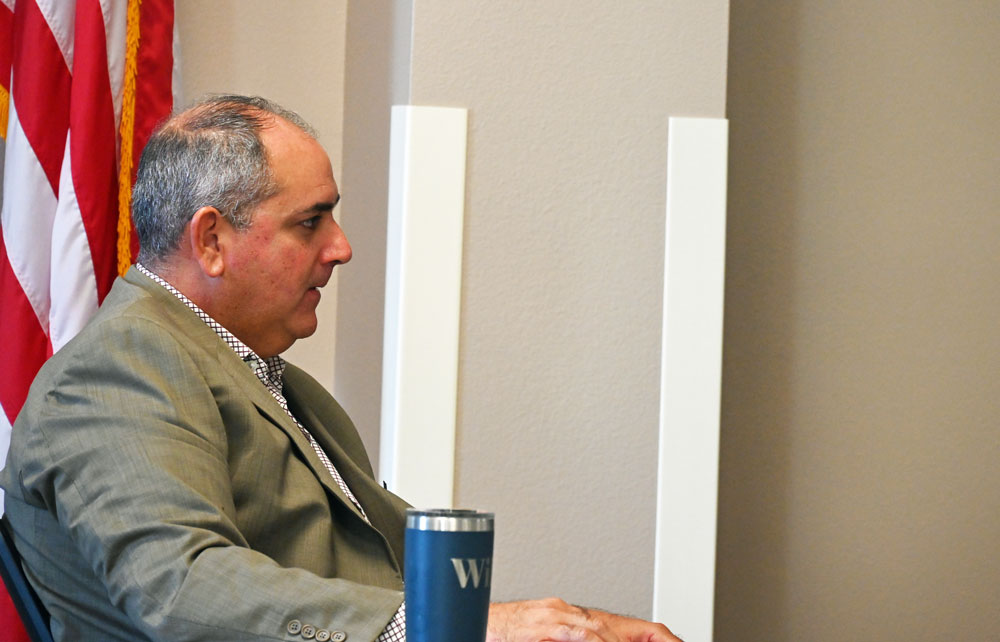
Will Furry, chairing a workshop of the Flagler County School Board last week in place of an absent Christy Chong, abruptly and arbitrarily ended discussion on a proposed policy even after two board members asked to continue the discussion, and the board attorney proposed extending the discussion for five minutes.
“We’re done with this agenda item and we’re moving on,” he said, without anyone else’s approval.
The autocratic silencing of his two colleagues stunned Board members Janie Ruddy and Lauren Ramirez. Both have been at the receiving end of Furry’s gavel before. In this case, Furry, as vice chair–a role he clawed for during a nine-hour filibuster last fall–was sitting in as chair for Chong. But he was doing so at a workshop, where parliamentary rules are much looser so board members are freer to work through issues.
It is unheard of in recent memory on any local board at a workshop where the person chairing a meeting arbitrarily–and against a majority–ends discussion. Chairs have ended arguments between board members, or ended discussions that have gotten out of hand. The policy discussion at the School Board was neither angry nor confrontational but inquisitive. Superintendent LaShakia Moore had just invited skeptical board members to offer their own ideas. Clearly–for two of the three sitting board members–the discussion was not yet ripe to end.
“Five more minutes,” the board attorney told Furry. “Are you willing to give them five more minutes?”
Furry was not, and said he was moving to the next item. (A pair of political forums were scheduled for later that evening. Furry is running for reelection.)
“We were brainstorming something new, and it was swiftly cut off,” Ruddy said. The item was to go before the board for a vote later this month. Ruddy says she’s not ready for it to go that far yet, now that discussions were scuttled.
Ruddy is also concerned about the consequences of a precedent. “If you’re allowed to do this as a chair, that means you’re allowed to shut off debate or end debate at any point,” she said. That also means the chair could use that power to silence discussions that could sway one or another board member ahead of a vote.
“Thoughtfully reviewing our policies requires time for meaningful discussion,” Ramirez said. “Workshops are intended to allow the board to ask questions, deliberate, and work through policy language before taking action. We were wrapping up the topic and just needed a few more minutes.”
The discussion took place with the workshop entering its third hour: a long meeting, but by no means the longest. The discussion was about a policy. Ruddy describes policy-writing as “the number one job” of governing boards.
In this case, it was a proposed policy controlling “school support organizations” or SSOs, such as booster clubs, school clubs, PTOs and PTAs. The district had received a model policy drafted by the North East Ohio Learning Associates (NEOLA) about SSOs and “direct support organizations” (DSO), or nonprofits such as the Flagler Education Foundation and the Flagler Auditorium, or the Fitzgerald Center for the Performing Arts. The NEOLA draft addressed both organizations under one policy. The district opted to split the policy into two, so school support organizations would have their own policy.
There was a two-minute discussion about clerical errors in the draft first, then Ramirez asked why under the new, split versions, SSOs like PTOs must now buy liability insurance. “Do our PTOs know that they now need to purchase insurance from their PTO account and booster account?” Ramirez said. “It does make sense. “Insurance is very important. Anything can happen, but we’ve never had it. So, what’s the change?”
Superintendent LaShakia Moore said there would be time to inform the organizations before they have to be in compliance.
Ramirez and Ruddy are also concerned about the cost hurting small organizations like PTOs and high school band or football booster clubs. “To me, an SSO is an extension of the school district and thus protected under our insurance, whereas we’re now treating it like a separate entity,” Ruddy said.
The discussion underscored a lack of clarity in the proposed policy about who and what events would require insurance coverage. “I feel like we have to rein this in and shape it a little bit more,” Ruddy said.
Fifteen minutes into the discussion, Furry, who had said nothing until then, moved to the next policy, the one on direct support organizations (DSOs), which are coveted by the district’s insurance policies. Ramirez pressed for clear communication to organizations so they are aware of the pending policy change, though the discussion returned to the burden on smaller organizations and the two policies were compared. “This is going to crush the very few PTA, PTO organizations we have,” Ruddy said.
“These are your policies,” Moore said. “We’re bringing forward a recommendation. If it does not align with the vision that the board has, then please provide us with some ideas, some different direction, so that we can ensure that the policy really reflects this board.”
To that end, Ruddy suggested that when SSOs hold events on school property, where they are already covered by the district’s liability insurance, they should not be required to carry their own insurance. “If they’re going to have activities that are off property, like they want to throw a carnival in Town Center, that’s completely separate,” Ruddy said. “To me, I feel like I would be more comfortable with that distinguished for the SSO, because the DSO is not required to have insurance.”
Furry interrupted. “We’re just repeating the same things over and over again,” he said. “I’m closing the conversation on this one here.” He said Ruddy could email further “items” to the administration.
Ruddy objected. “Then we’ll vote without having talked to each other,” she said. Ruddy in her nearly two years on the bard has made a point of holding discussion in open meetings, for transparency.
“We’ve talked on this matter for a long time, and you’re bringing up the same things over and over,” Furry said. (The “we” did not include him, as he had not contributed to the discussion.)
“No, I’m not,” Ruddy said. “I am specifically trying to outline a way where we can protect ourselves.” Ruddy had not objected when, earlier in the meeting, Furry had himself circled back to questions Ruddy had asked and heard answers to, in a discussion on school resource deputies.
Ryan Hudak, the board attorney (he was a stand-in for the usual board attorney, David Delaney), suggested something different than what Moore had just advised: since it’s a NEOLA-drafted policy, NEOLA might not go along with local edits, and if the organization did not do so, “then I would suggest against it,” Hudak said–which brought up a whole different set of issues and another obscuring matter: was this a policy the board could write as it wills, or not? “NEOLA will work with you and write the policy how you want it, but as long as they’ll be willing to warrant it or not,” Hudak said.
“If you can give us five more minutes to just talk through it,” Ramirez asked Furry.
“I think we’ve had enough talk on this here,” Furry said.
Ramirez and Ruddy objected again, saying they both still wanted to discuss the policy.
“We’re moving on to public comment,” Furry said.
Ruddy raised a point of order with Hudak on “when one school board member, who’s the vice chair, wants to move on, even though the majority of the school board members still wish to discuss the issue.”
“I think the vice chair has the authority,” Hudak said, not quite correctly.
Under Robert’s Rules, and in a formal business meeting, the chair–or vice chair, in this case–has the authority to end discussion, but after asking whether there is any further discussion (as even Chong does when she chairs meetings). In business meetings, or meetings where votes are taken–as they are not in workshops–another board member could also “call the question,” or call for an end to debate, which would require a majority vote to do so.
The meeting in question was a workshop, where the rules–established by former Board member Trevor Tucker–have always been more relaxed to allow board members the time to workshop issues with fewer formalities. It’s why they’re called workshops.
Hudak also asked Ruddy why she would not bring back the matter at a subsequent meeting or send her ideas between meetings by email. “Are you trying to change the policy now?” he asked, in essence circumventing the purpose of a public board’s workshop: to hash out policy discussions in public, rather than behind closed doors.
“What we’re trying to do is give guidance to the team, who would then need to craft a revised version and bring it forth,” Ruddy said. “Because otherwise, they would have to listen to us individually and try to come up with something cohesive.”
That’s when Hudak asked Furry if he was willing to give Ruddy and Ramirez five more minutes.
Furry was not.
The entire segment on both new proposed policies that the board members had never seen before, including the debate for more time, had lasted 21 minutes.




























Gene Lopes says
We have the opportunity to rid ourselves of Furry and Chong this election cycle. Do the right thing Flagler!
justbob says
Does not bode well if Will Furry is reelected.
Jim says
Hey, Furry, great timing! There’s an election coming up and I’ve heard you’re running for re-election (I guess because when God told you to run for Congress, he was just kidding…). So, now we all have a little tidbit more information about Furry as we finalize our voting choices.
Should we vote for Furry, who along with his already long list of mis-steps, brew ups, whining, buffoonery. childishness and ignorance for another term???
Or should we vote for Rob Wood who seems genuinely interested in improving our school system for the students and administration?
For me, Furry’s time is past. He has shown himself to be only interested in himself and the school system is only a tool for him to be seen. He’s very much in the mold of Ed Danko, former city council member and some of the other nuts we’ve endured over the years. I’ll just add this little incident to that list of reasons not to vote for him.
And, to Mr. Wood, in Furry’s last election run, he put out a flyer about his opponent which was full of lies and half-truths right before the election where she did not have time to respond. A word of caution, Furry is a “Christian” in name only. Keep your eyes on him!
Mort says
Looks to me like some new leadership might be a good idea. Furry needs a rest along with a reminder that he is just one of five. Robb Wood will be a nice replacement.
Concerned community member says
Furry needs to go! He definitely thinks of himself as the King of the School Board.
Waste not want not says
Another reason to vote him out
PaulT says
Correct me if I’m wrong but didn’t Furry claim he was ‘choen by God’ just like Trump.
Delusions do strange things to minds but shouldn’t it disqualify the deluded as not competent to stand let alone serve in civics office…
Callmeishmael says
Everyone in favor of abruptly silencing this Furry chump come election day raise your hand!
Linda says
Furry looks furious!! ha ha What a waste of time this guy is. He and Chong are beyond ridiculous!
You know who says
Definitely time to get rid of this road block. He flip flops for whatever serves him best and never works well with others. Talk about a huge narcissist.
Sull says
Furry is a disgrace. He shouldn’t be anywhere near an elected office. Cant wait to send this idiot packing. Hopefully, Rob Wood gets 70+% of the vote and ends this idiots political career…forever.
Concerned in Flagler says
It’s funny. He cut the meeting short so he wouldn’t be late to a campaign event. Tells you everything. He’s more focused on the job he’s running for than the one he already has and doesn’t want to do.
Sparks says
Furry needs to GO. He is a bully and no one gets along with him except Chong.. his puppet.
He showed his true colors. Vote them both out on Election Day.
GW says
I think Furry suffers from Trump “enrichment syndrome “.
Tired of it says
Well, Republicans you got what you voted for. He ran against a well qualified candidate who wasn’t a Republican.
Dennis C Rathsam says
Furry & Chong, are a 2 headed monster! Furrys a useless bully!!!! P/C Its time for change! They remind me of ABOTT & COSTELLO
FollowUpWithThis says
As a former third-floor district employee, I don’t live in Flagler County anymore, but I implore voters to do the right thing and vote Will out. He needs to go. If he wanted to run for Congress, let him—this is clearly just a “stepping stone” for his bigger ambitions. Though honestly, maybe think about city or county council… actually, never mind. Just give up on politics altogether, you’re no good at it.
Chong may have softened her tactics, but she has to go, too—she just sits quietly. Don’t let either of them take credit for any accomplishments. The last few years have been a nightmare, from the witch hunt against Cathy to Peacock pulling strings with his puppet. Derek Barrs should have been the choice from day one. Let’s get Trevor back in office, and I’d like to see what Rob Wood can do.
celia says
He is also with Chong, Hunt and Albright and the green flag of school administrators, the one that closed the Belle Terre Swim Club pool to 1.100 Palmcoaster’s families with children, elderly and ADA members. Never forget that. They rather have those kids loitering in the streets in our long hot summers. Wood, Tucker and Moon for school board and absent of partisanship!
Lap swimmer says
Once Furry and Chong are gone and Jill Woolbright has been sent packing back to where she really lives full-time (Tennessee), PLEASE can we have the Belle Terre Swim Club swimming pool opened to the public again? PLEASE!!