



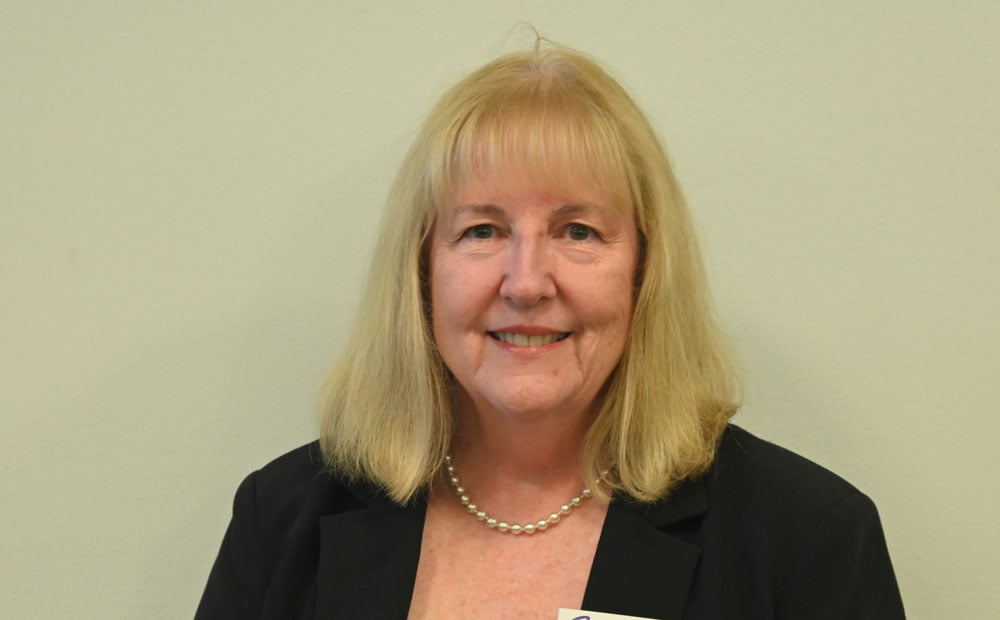
Cathy Moon is one of two candidates for the Flagler County School Board, District 1, running against Jill Woolbright. Woolbright has declined to participate in the Live Interview.
It is a non-partisan race: all registered voters regardless of party affiliation or non-party status may vote in the Aug. 18 primary, which will decide the winner, who will be sworn-in in November.
Three seats are up on the School Board in this election cycle. District 1 is an open seat, and has been an open seat since Derek Barrs, appointed to fill out the erm Sally Hunt did not complete, left for a job in the Trump administration last fall.
In District 2, Rob Wood is challenging first-term incumbent Will Furry, who had originally declared he was running for a congressional seat. He abandoned that effort after his campaign struggled, and announced he would run again for the School Board.
In District 4, former School Board member Trevor Tucker and Ron Long are challenging first-term incumbent Christy Chong. If any of the three candidates garners more than a 50 percent majority in the Aug. 18 primary, that candidate will be the winner. If none of the candidates clear the 50-percent threshold, the top two vote-getters will contest the seat in the Nov. 3 general election.
Furry, Chong, like Woolbright, have declined to answer the Live Interview’s questions. They alone, among the 19 candidates running in the three major local elections in the primary, have declined.
Flagler County School Board members serve four years. They’re paid $44,152 a year, an amount that will likely go up by a few thousand dollars by next year.
The Live Interview format changed this year. Since 2010, FlaglerLive had submitted identical questions to all candidates, enabling them to answer in writing. There typically were a round or two of follow-up questions, also in writing. Artificial intelligence has made that approach obsolete now that candidates can run the questions through AI and spit out prefab answers. To get around that, candidates were invited to a video interview. The video and the transcript are provided below.
The candidates were provided the same basic question within half an hour or less of the scheduled interview, but obviously not the follow-ups, which all differed. The questions to county commissioners are here.
Following the interview and before publication, the interview transcript went through two rounds of editing at this end, once by AI (yes, the irony is inescapable) for spell checks, copy editing and to smooth out verbal tics or repetitive words, and once by me for the same purpose. The candidates were then provided with the interview transcript and the video to review–not to make substantial changes, but to verify transcription accuracy, and, if they so chose, to add a postscript: if they felt they may have misspoken, or not clarified a point, or preferred to revise an answer, they were given that chance in the postscript, without changing the original text in the transcript. The postscript window is remaining open for subsequent additions, until the election.
The interviews can be quite long–not a surprise for a site pathologically incapable of brevity, but the county is awash in candidat quickies. We offer a little more depth, seeking to draw a profile rather than check off boxes: an election is not a speed date but a four-year commitment. The Live Interview’s aim is to elicit as much candor and transparency as possible, and to learn about the candidate beyond the basics in what amounts to extended conversations about the person, the character and temperament behind the candidate, the candidate’s seriousness, and the issues.
The rest is in the voters’ hands.
–Pierre Tristam

Flagler County Commission Greg Feldman (Dis. 2, R) Theresa Pontieri (Dist. 2, R) Anna Jones (Dist. 4, R) Drew Moss (Dist. 4, R) Leann Pennington (Dist. 4, R) Flagler County School Board Cathy Moon (Dist. 1) Jill Woolbright (Dist. 1) Will Furry (Dist. 2) Rob Wood (Dist. 2) Christy Chong (Dist 4) Ron Long (Dist. 4) Trevor Tucker (Dist. 4) Palm Coast City Council Tony Amaral Jr. (Dist. 2) Jeani Duarte (Dist 2.) Jimmy Hengy (Dist. 2) Dylana Dee Galery (Dist. 4) John Kvederis (Dist. 4) Ramon Marrero (Dist. 4) Darlene Shelley (Dist. 4) The candidates' interviews will be live-linked the day their interview publishes. |
The Interview Themes in Summary: Quick Links
- Basics
- Preparation and Character
- Vision
- Evaluating the current board
- The YMCA
- Arming school staff
- IB and Cambridge AICE
- Enrollment’s flatline, vouchers
- A rating vs. national standards
- DEI
- Funding loss from U.S. Department of Education
- Prayer in schools
- Rap sheet
- Postscript
See Cathy Moon’s bio or resume here, and her financial disclosure here.
The Video:
FlaglerLive: Good morning, Miss Moon, and thank you very much for taking part in the live interview. I’m going to start at the very beginning. Your date and place of birth.
Cathy Moon: June 6, 1958, Charleston, West Virginia.
FlaglerLive: What brought you to Flagler County?
Cathy Moon: It was a bit of a convoluted path. I was born in West Virginia, lived in Virginia, moved to South Dakota for seven years, moved back to Virginia, and because I was working for the federal government, it’s a central point there around Washington D.C. But when I retired in 2017, we chose Flagler County because our only grandchild lives in Jacksonville, and we wanted to be close to her because the opportunity to watch her grow up is priceless. We had considered retiring internationally, but she won our hearts over, and we needed to be right here. And as we looked for a community near Jacksonville, we started in Jacksonville looking, and then dropped down to Ponte Vedra and Saint Augustine, and when we got to Flagler County and came to Palm Coast, we just felt like we had found our home, so we settled here.
FlaglerLive: This was what year?
Cathy Moon: 2017
FlaglerLive: How much time did you spend in West Virginia?
Cathy Moon: The first 26 years of my life, I believe.
FlaglerLive: All in Charleston.
Cathy Moon: Well, I was born in Charleston, but I lived in a small–no, you can’t even call it a town. It’s called Elkview. It’s just an area. There was no mayor.
FlaglerLive: I spent the first five and a half years of my career in West Virginia, in Beckley, so that’s why I’m asking.
Cathy Moon: Beckley’s only about an hour away.
FlaglerLive: Right, yes. So I’ve been through Elkview, and I know what you mean by that feel. You said something interesting. You thought about actually retiring internationally. Where would that have been if you had?
Cathy Moon: We actually visited 10 countries. We were seriously considering doing this. I know many people say, “Oh, Europe,” and yes, we would love to live in Europe. But because of the time to travel back and forth, we did not consider something like that. We considered Belize, Panama, Mexico, the Dominican Republic. We actually became permanent residents of the country of Panama. We got that close, but then we decided we can’t do it. We need to be here.
FlaglerLive: And Palm Coast won out.
Cathy Moon: Yes.
FlaglerLive: Talk about your career. What were you involved in, and if you’re still involved in anything, talk about that as well.
Cathy Moon: I was intending to be a teacher. I was in Future Teachers of America in high school. Off to college I go. My degree is in health and safety education, my bachelor’s degree. But while in college, like many people, I worked part-time to help pay the expenses, and I happened to work for the post office, and I ended up starting a career with the Postal Service, which I ultimately worked for multiple federal agencies. And I started as an hourly worker, moved to a district office, an area office, to headquarters, and then all the way to an executive role at the headquarters in Washington D.C.
FlaglerLive: You started as what kind of worker?
Cathy Moon: An hourly worker. Literally a letter carrier, delivering mail like the one that comes past your home.
FlaglerLive: What was the highest level you reached? What was your responsibility?
Cathy Moon: As an executive, I had a couple of different roles. The first one was called mail transport equipment. It’s kind of a boring title and a boring job, but it’s one of those jobs that if nobody does it, the whole agency falls into crisis, so I was responsible for buying and managing all the equipment that moves the mail. The trays we see, the flat tub you might have gotten some mail in if you had your mail on hold and had a bigger amount to pick up, the rolling stock that moves it through facilities. So as long as there’s plenty of that, the mail moves fine. If suddenly we don’t have enough, then the mail stops. So that was one of my roles. The next one was called Operation Integrations and Support. So I was the individual at the top of operations who liaisoned with all of the largest mailers in the country to hear their concerns and how we could help them grow their businesses and how we could make their operations easier as long as it would also dovetail into our operations. So I had to work very closely with both sides and try to find compromises and solutions that would move everyone forward.
FlaglerLive: Did you work in other fields other than the Postal Service?
Cathy Moon: I did, and even in the Postal Service, I worked in delivery, retail, marketing, operations, and logistics, but yes. Then I also went on to work for the Department of Commerce. So I moved from one of the largest federal agencies, the Postal Service, to one of the tiniest ones, which is NIST, the National Institute of Standards and Technology. We always just referred to it as NIST, but yes, a shocking difference. It was less than 100 employees.
FlaglerLive: What was your responsibility there?
Cathy Moon: I was a supervisory business and industry specialist, and the role we had was interesting. That agency has a special law that allows it to work with the agencies and with private industry and to find solutions and simplify and streamline the process. Government processes can be very bureaucratic and slow. So sometimes an agency has a need for very rapid change and needs to get not a contract, but a solution developed for something. So we were the intermediary, the liaison there. We had a group of large contractors that you’re familiar with that we worked with, and we would pair them with the agency to quickly accomplish whatever their task was.
FlaglerLive: How do you think that career prepares you for the school board?
Cathy Moon: I think a combination of my having a degree in education, of course, I completed a semester of student teaching. I think here they call it something else, like a senior internship, along with the skills that I picked up there. We had a deep budget experience. I managed a $280 million budget for the postal service. I led teams as large as 50. We did a tremendous amount of work in cross-functional teams, and high-energy, high-performing teams, and the school board, in essence, is a team, and we need to work together. And then the district staff is part of the team. The educators are part of the team. The parents are part of the team. You have to be able to set aside whatever your title or role is, and just be part of the team that comes up with the best solution.
FlaglerLive: When you’ve been here almost 10 years, if not 10 years, what led you to think, after following the school board–I’m sure whether you wanted to or not, you’d hear about the school board at times–knowing what you’ve learned about the school board, what led you to jump into this race?
Cathy Moon: We initially retired in 2017, and we moved here. And then in 2018, I said I’d like to dabble in having a small business. I’ve always wanted to do it, but couldn’t step away. My career was so intense and busy, so we began a small business, which we shut down in 2024, and said, “Okay, now we’re actually going to retire. We’re going to start traveling more and have the opportunity to be retirees.” But I felt a yearning to do something to give back to my community, and I ended up looking around at a variety of things and trying to decide where could I be a volunteer? Could I lead some volunteer organization? And happened in that period when I was looking for my opportunity, I attended a presentation by Superintendent Lashakia Moore, and she talked about our schools. I ought to say, she sold our schools. She is so energetic and has so much passion for this work and for the children. And when she was done with that presentation, I literally followed her out the door to talk with her and tell her how impressed I was by her, and by the number of programs offered in the schools here compared to the schools where I attended and where my children attended, and just the vision she had and the energy she brought to it, and so I’m like, “I think this is where I want to be a part of something.” So I started attending the school board meetings. This was last fall, and I was beginning to really engage in what was going on.
FlaglerLive: You did not have any apprehension about the recent history of the school board?
Cathy Moon: I can’t say that’s a no. I feel like enough time has passed between the greatest upheaval on the Flagler County School Board and now, that I was willing to bring my skill set to it and see if I can’t engage and make a difference. I am not about politics or division. I’m about how can we work together for what is best for these students. How can we make a difference here? Throughout my entire career, I’ve always made a difference wherever I worked, and I always go into everything believing that I can. Something may eventually prove me wrong, but I hope that’s not true. I hope I can.
FlaglerLive: When you refer to the “greatest upheaval,” what do you have in mind?
Cathy Moon: The period when there was upheaval on the board, school board members attacking the superintendent, filing criminal charges, and disharmony among the board members, to where it made it difficult for the real work to move forward.
FlaglerLive: You’ve seen Jill Woolbright in office before because you were living here, so how would you be a better candidate or school board member than Ms. Woolbright?
Cathy Moon: She taught for 28 years, and that’s honorable, and I admire that deeply. It’s critically important to our families and our communities to have excellent educators, but the role of leadership is different. And she sort of leapt over all the other roles like assistant principal, principal, district office, leapt over all those straight onto the school board, and leadership requires a different skill set than the classroom requires. I bring a fundamentally different set of skills. I have risen through the ranks. I have learned the different roles. I bring a master’s level degree, which my opponent does not have, and a graduate certificate in human resources, which can also be helpful on the board because we deal with human resource issues and looking at postings and things like that. I bring nearly 30 years of program and project management, and that’s more relevant to what a school board member is looking at. I made some notes here because I thought someone might ask me after that recent thing in the newspaper.
FlaglerLive: The recent thing in the newspaper, in the Observer. What are you referring to?
Cathy Moon: Someone wrote an op-ed and Ms. Woolbright responded to that op-ed, so I thought I might get a question today about that. So I took the time to write out a response because it’s a bit sensitive.
FlaglerLive: But if you could give the context to that to explain what you’re referring to, and then explain your response.
Cathy Moon: Someone wrote in and they brought up the incidents that occurred between 2020 and 2022 in detail, and the paper gave Ms. Woolbright the opportunity to respond to that, so they’d be printed together. And she stressed in there that she’s the only one who has had experience, alone in this race, both in the classroom and on a school board. And those are true statements. Although I would say I had some experience in the classroom because I did a semester as a student teacher, but I’ve had experiences that she has not had. I bring a background she does not have, and an educational level that she does not have.
See how Jill Woolbright answered

FlaglerLive: How have you prepared specifically for that seat since you decided to run?
Cathy Moon: Initially, before I decided to run, I started attending the school board meetings because I wanted to understand their process and just what types of things are they working on, and I found that helpful and advantageous. But I also met with some of the school board members, past and present. I delved into the materials that they provided, there’s a system, BoardDocs, where everything is posted in advance, or you can go back through history. So, for example, when they spoke about the properties, that we had an offer on a property here in Palm Coast, then I went back to find when they previously talked about properties, so I could see all the properties the school board currently holds and what they deem those to be potentially for down the road. I try to do my homework. I like to do research. I like to come prepared. So I’ve spoken with many people in the community, not only many residents, thousands of residents, but also teachers. I have a group of teachers who are retired, who are like an unofficial advisory board to me. So I can turn to them when I have questions and ask them, “Historically, how has this worked?” or “What are your thoughts on that?” So it’s been very helpful to me to have that grassroots, deeper understanding into the classrooms, into the teachers’ experience, and I feel like those things have really helped me grow and learn and be prepared. And I will never assume. I don’t come to this with preconceived notions of how things work here, or how things should work here. I come to them with an open mind that sometimes can ask a question that those who are already entrenched in a system don’t think to ask because they’re like, “Well, these are the boundaries,” but I sometimes ask beyond the boundaries, and sometimes that means I’m asking about something that is not possible, but it may still cause us to have a new perspective and take a step further than we would have otherwise, towards what is not legally possible, but is possible to consider.
FlaglerLive: Typically, with candidates, we ask them when they’re running for county commission, city council, “Have you studied the budget?” The question with school board members is more like, “Do you understand how limited you are in affecting the budget?” Because most of it is set, and the tax rate is set. You have no control over it. Most of the spending, you have no control over it. Do you know those limits that you are getting into as far as the budget is concerned?
Cathy Moon: Yes, but here’s what I believe I bring. We were trained in Lean Six Sigma and continuous improvement at the Postal Service. I led a high-performing team of four people, and we drove $400 million worth of costs out of the organization over about a three-year period, and the way you do that, I believe some of that translates. In fact, I wanted to stand and salute. I was in one of the school board meetings when they began a discussion about improving operational efficiency. That’s what I did. That’s what we do. And I believe in any organization there are always opportunities to improve this continuous improvement pathway. So I believe that there are opportunities where the existing budget, the expense in that department, can be driven down without eliminating services. Let’s just take an example. There was discussion not long ago about buying some new vehicles, and I was surprised to learn in some of the discussion that they don’t necessarily track each individual vehicle’s use by day. In the organizations I worked for, if I used one of the fleet vehicles, I had to log that vehicle out under my name, the time that I was going out. If I had to buy fuel, that was logged, and then when it was returned, how many miles I went, what was the purpose of the trip, so that it was evaluated to see whether we specifically need all of those vehicles. Is it possible to operate with fewer vehicles because maybe they tend to be used in the morning for this, but they’re used in the afternoon for that? Well, that could be the same vehicle. So there are always opportunities to drive costs down, and when we do that, that should free up some money to do some of the other things. Or, if funds are cut, and they probably will be, then it gives us an opportunity to survive within the new realm of financial reality.
FlaglerLive: How is all this efficiency work that you did? How does that compare to the moronic atrocity known as “Doge”?
Cathy Moon: In my perspective, Doge did not do any analysis or research. They simply looked at line items, and if that didn’t make sense to them or they thought it referenced something, they simply eliminated it. Our process was not to go in to look to eliminate things, but to improve things, to improve efficiencies, to improve the levels of service, to improve throughput on machines. We would rearrange the workflow in a building so that it was more efficient and it wasn’t so cumbersome to move the mail out. So, I’m very data-driven. I like to look at the information, find the story there. Where is the opportunity to do something different? And often, what we would do, we built cross-functional teams, but we would go directly to the people who were doing that work. Let’s just talk about a delivery employee, and we would look for the employee who’s the most efficient, considered one of the best. And we’re watching how that employee does the work as compared to the normal or average employee. And we would pick up on tips and things. We would talk to that employee, and many times they’d say things like, “I was taught to do A B C, but that really never made sense to me, and I think X Y Z works better,” and we would observe that and realize that practice is in fact better and saves across the repetitive day as they’re doing that task 25 times, 100 times. In some cases, if you could save a little bit of time, [multiplied by] 200,000 carriers across the country, then you’ve made a huge difference. And I realize the scale here is vastly different, but I believe the concepts still apply. There is always opportunity.
FlaglerLive: Can you tell us about a character flaw that you deal with, and that might be a challenge for you on the school board?
Cathy Moon: I would say a character flaw I have is a strong tendency towards perfectionism, and I know no one is perfect, and I will never be perfect. But I push myself sometimes to the point where I do too much analysis, too much research into a topic, and it can exhaust myself in the process, and one thing I’ve had to curb is to try to make sure that while I seek to do the absolute best, hinting at perfection, I don’t expect perfection from those around me. We are all flawed humans, and we all do the best that we can. But it was a lesson I had to learn.
FlaglerLive: I don’t typically associate perfectionism with a character flaw.
Cathy Moon: Oh, really? Okay.
FlaglerLive: Generally speaking, especially in public office, it’s more of a quality. People would want you to be as perfectionist as possible. Analysis is what you had just described in what you were doing before, in order for efficiencies to be realized, so you need that.
Cathy Moon: But it can go into what they refer to as analysis paralysis. Spend so much time studying the problem that you never have a solution, and that’s one thing. The continuous improvement says: don’t wait for the perfect answer; implement better and better and better, and keep laddering that up.
FlaglerLive: Is there something temperamentally that you might describe as a flaw?
Cathy Moon: Early in my career, I was quick to think, especially when the headquarters folks would come out to the area or the district and share something that we’d already tried and we already knew wouldn’t work. I might even say, “That won’t work, and here’s why,” or “That’s crazy, and here’s why.” And I had to learn that is not the way to approach anyone. When they’ve come with an idea they believe is valid and important, then we need to hear them. We need to listen. We need to look at what they’re saying. It may not be exactly identical to what we tried before, and it was a change for me that really allowed my career to move forward because when I would say or have the appearance on my face that I thought they were crazy or that this was stupid, then I’ve shut them down and the conversation doesn’t go any further. But when you begin to listen to people, you do find value in what they’re saying, and you can find opportunities to move something forward, or you can say, “That’s very interesting. But we did try something similar before and we ran into this issue. Do you think that’s going to be a roadblock for us in your effort that you’re proposing?” Much better received.
FlaglerLive: Who do you consider a model of leadership that’s serving on a governing board today in Flagler County, any of the local governments?
Cathy Moon: I’m not super familiar with a lot of the people who are serving. I see your kitty.
FlaglerLive: Yes, she’s our moderator.
Cathy Moon: Very good. I’m glad she’s joined the conversation. I’ve never been to a county commission meeting. I have been to city council. So I’ve not seen a lot other than the clips we see online or the outtakes that are printed somewhere. The one I’ve had the most exposure to, and I’m sure everyone in the county can point to, is Sheriff Staly and see him as someone they know as a public figure here, who has made our community safer, who’s out in the community. You also see him everywhere you go. I’ve been attending a lot more events and things since I’ve been running for office, and out there meeting people, and he’s everywhere.
FlaglerLive: The sheriff mentioned several times by other candidates, and I tell them that’s fair. But I’m really interested in how you see leadership on a governing board where you have to deal with other elected officials. Who would you consider to be, “This is how I might model myself after,” or “This is what I really respect in leadership.”
Cathy Moon: I noticed very quickly as I started attending school board meetings and watching, following them on Facebook and other social media, that some of our school board members seem more engaged with our schools. They’re literally there. We see pictures of them there, engaging with the teachers, with the SAC meeting, the school advisory council meetings, the parent-teacher organization meetings—they’re fully engaged in what is going on, and they’re listening. Those are opportunities for parents to approach them to express a concern or ask a question or just put a face with a name.
FlaglerLive: You’re referring to Janie Ruddy and Lauren Ramirez.
Cathy Moon: I am. Yes, they are very engaged, and I would model myself after that. I want to be engaged. I also had the opportunity, there’s a new EPAC chair, Dianne Santamaria, and I already had the opportunity to meet with her. We exchanged some great ideas. She’s bringing so much energy and enthusiasm to her new role, and I’m looking forward to an opportunity to engage with her in that community and understand how we can serve them better. And I think the only way that school board members can really serve the community is to be out in the community and be hearing from them.
FlaglerLive: So people know, EPAC is the ESE Parent Advisory Council for students with special needs.
Cathy Moon: I understand that all four current sitting school board members, they either work or have a business, and I salute them for committing to the additional work of serving their community while they do that. I, on the other hand, am fully retired at this point, so I won’t have a job or a boss or a business that’s trying to draw my attention away and divide me during the day. And I’m fully committed to being at these meetings at the schools. I attended a PTO meeting at one of our elementary schools, who said they have never had a board member, even though they’ve written multiple times and requested an attendee. No one had ever come.
FlaglerLive: What school was that?
Cathy Moon: I don’t want to say that because I’m sure somewhere there’s a chart that will say who that is, pointing a finger at.
FlaglerLive: Well, that’s why I’m asking because they do have responsibilities to attend those meetings. They’re the liaison. You’re going to have committee assignments. You’re going to be responsible for attending your share of meetings, and I think it’s important for the public to know whether board members are attending meetings or not.
Cathy Moon: Do I have to answer?
FlaglerLive: Just the school where you were.
Cathy Moon: Wadsworth Elementary. [The liaison assignment is School Board member Christy Chong’s.–FL]
Also, there are a broader set of things that school board members should be attending, such as the trainings that are offered by the state organization for school board association, and not all of them are attending those sessions, and not even everyone went to Tallahassee to meet with our elected officials. That is our opportunity to express our needs here, how we are unique. Every school system from Jacksonville to Miami is not the same. We need to express what we need here. This is our opportunity to fight for fair funding for the students of Flagler County, but not everyone goes. And I just want it to be clear, I have no other job or business that I’m running, and I’ll be at these events and these meetings, and I’ll be standing up for Flagler County.
FlaglerLive: Do you intend to get that Florida School Board Association certification that Lauren Ramirez just got, where you fulfill a certain number of training hours, like continuing education, but for school board members?
Cathy Moon: Absolutely.
See how Jill Woolbright answered
FlaglerLive: Beyond the essentials, the slogans “Flagler Forward” and so on, what is your realistic vision for the public school system here that you could enact as a school board member?
Cathy Moon: In Miss Moore’s presentation that she gave that I attended, she shared a statistic that stayed with me, haunted me really. She mentioned that in this past school year, only 37% of our kindergarten students were tested to be kindergarten ready upon arrival. So that means more than two-thirds of our kindergartners were not ready. They started out behind before they’ve ever even cracked a textbook. They are already behind. And she shared that information is important. Some people might think, “So what? They don’t know their colors.” No, it’s very important. It’s directly tied to being in third grade when they test for reading literacy. To that, they can tie back to the kids who were not ready for kindergarten are more likely to not do well in third grade, and the kids who were not ready were more likely not to have participated in the voluntary pre-kindergarten, which we normally call VPK. And I’ve been talking to a lot of parents about why is that, why would people not send their child to a free program that makes such a difference in starting them off on a great educational career? And one of the biggest issues is there’s no transportation to that program because it’s a part day. And then also some of the parents might be able to get the child there, but they can’t. There’s no after school. You can pay for after-school care, but it’s $80 a week, and for all families, that’s not affordable. It’s a multi-layered issue, but that’s my biggest passion: these youngest learners starting off on the right foot. And I believe, talked to a lot of people. I just talked Saturday morning with Teresa Rizzo from the Education Foundation. They were sponsoring an event to try to get more parents to know about VPK and enroll their children. They were down at the Carver Gym, and we spent some time chatting, and even about transportation. And I said there has to be a solution. I know it’s an issue. Other school board members have told me that we don’t get funding for that. There’s no state funding to transport VPK kids, only full-day kids. Okay, but I asked her, could we maybe consider looking for grants so we could test providing transportation to just one of our schools and see if that makes a difference if we can boost the enrollment? Because here’s what we do know: I think we’re asking the wrong question when we ask, “Can we afford to provide transportation for these kids?” Can we afford not to? Because what we’re doing now is they arrive not ready. Two-thirds of the kids last year arrived not ready, and we pour resources into them for 13 years, and the district’s own data tells us 75% of them will never catch up. So that is heartbreaking, and it doesn’t have to be our story. There is a solution, and I believe working as a community because it’s going to take a community to make it all happen. How do we make sure parents knew? Lashakia shared a statistic that one-quarter of our students moved here in the last four years. So the family may have moved from a state where VPK is not free, so they don’t have an understanding it’s free here. We have to do better at communication. We have to find families when they’re first moving here, and then we have to work on transportation and we have to work on the cost of after-school care. It’s a multi-layered thing, and it can be done in stages. But that is my passion. This is the issue we have to solve.
FlaglerLive: So it’s not a lack of VPK. There are programs, plenty of programs which we see, but it’s lack of access.
Cathy Moon: It is an access issue. If a family doesn’t have transportation, I volunteered at Rymfire, the school that’s closest to me, in a kindergarten classroom this past year, and the teacher shared with me that there are three families in that one classroom that did not have functional transportation at that point. So if their child missed the bus, they’re missing school for the day because they don’t have a way to bring them. But also, the schools do not have enough slots for all of the students for VPK. At least that’s what’s been shared with me. I think they’ve upped that number for this coming school year, but still probably not enough. So we’re also talking about the private VPK providers need to be part of this solution, and that also provides resources closer to more homes, where maybe they could walk their student in the mornings and then pick them up at noon. So it’s all part of looking at the whole situation: where are the families? Where are the providers? What would it take to get students there? How do we get them back home at noon or care for them for the remainder of the day?
FlaglerLive: Why isn’t county transportation involved in this equation?
Cathy Moon: According to what some of the sitting school board said at a forum, it came up in depth at the forum at the NAACP sponsored last week, and the seven candidates discussed it, and the people who are insiders who know how the funding flows said we don’t get funding, except for full-day students, so there’s no funding for transporting of VPK kids.
FlaglerLive: The county has its own public transportation system. A lot of its fleet is on-demand, but they are not used at a very high level. The question is why couldn’t there be some sort of partnership between the county and the school district, when they do have the means, they have the buses. They also have the capacity. So, talking about efficiency, how come the county has never been considered as part of the system to improve access to VPK?
Cathy Moon: Well, I certainly can’t speak to why it’s never been considered, but I can say I have written it down. It will be part of what we look at going forward. I know one challenge that was brought up for transporting four-year-olds, I was initially told they had to be in a car seat, but I researched that they can be in a booster seat. Booster seats are easier to provide than car seats, but it is another layer of complication. But it doesn’t mean it’s not solvable.
Churches have buses. Some of them do. Could we, I don’t know, pay some fee to the churches that they transport, and obviously bringing in liability questions, insurance, but that doesn’t mean we can’t lay everything on the table and figure out what the best solution is.
FlaglerLive: Of course, county buses are not equipped for children, and they don’t have supervision, so it sort of defeats my own question. What is your level of comfort with interacting with every possible kind of community out there, all backgrounds, all races, everybody? How comfortable are you with interaction, being in the community, being visible, not just in the schools, but in the different communities and some of the less visible communities?
Cathy Moon: I’m very comfortable. I feel like working for a large government agency was a gift in a way, as far as being introduced to people. We had people from all over the world. I worked in the engineering building for about four years, so engineers had been hired from all parts of the world. The U.S. Postal Service is one of the most diverse entities in America, and we are exposed to people from all races, all backgrounds, people from huge cities, people from rural areas. Very comfortable, and in fact, I welcome that. I intentionally sought out a diverse neighborhood in Virginia to live in, because I enjoy the diversity, the foods, the culture. I’m very comfortable.
See how Jill Woolbright answered
FlaglerLive: How would you evaluate the current board’s performance in the last two years, and what grade would you give it?
Cathy Moon: I really wasn’t paying close attention two years ago, more so, started to engage about a year ago, and they are part of
FlaglerLive: That’s good enough if you want to just look at the last year.
Cathy Moon: Certainly, the board is part of the success that we’ve recently seen celebrated, where the Flagler schools have risen to an A. I put most of the credit towards our superintendent and the teachers and the district staff and everyone who’s interacting with those students every day, but the board is part of that. So I cannot say they are not a successful board. It would help had they had five seats filled the entire two years because one meeting that I gave up on and left was, I think, stretched nine hours simply trying to select the chair and vice chair for this year. That was a pretty dysfunctional display there. But most of the time, they seem to be working together. Some are more engaged than others, even at the board meetings. Some have more to offer, ask more questions. As the district staff will come forward and they make a presentation about something that they’re proposing to move forward, it appears that some have reviewed the materials in advance. They have questions. They ask specific questions: “Can you explain in more detail here? I’m not familiar with this.” Others don’t engage as much over those type of issues. It would be nice to see the full board engaging every issue.
FlaglerLive: Are there other than that meeting, the epic nine-hour meeting, is there something else where you see that they’ve—I mean, you mentioned engagements—is there something else where you’ve seen a lack of quality on this board? And we’re going to get to the better side, where they’ve excelled. But just one other example, maybe where they’ve lacked.
Cathy Moon: This one goes back a little further. So when I told you I looked up the presentations from previously when they talked about the landownings that they hold and what they might do with those. I believe that meeting was in 2023, maybe a year back from that, and they said at that meeting that they wanted to look at selling some of their landholdings because they’ve already deemed them not to be appropriate for educational purposes, and they simply don’t need some of those parcels of land, and yet when they were discussing it just in the last few months, the landholdings are identical.
FlaglerLive: I think you’re talking about Corporate One, which is on Palm Coast Parkway, where they used to have their headquarters actually way in the past, where they had the ITT building that was demolished, and now it’s just vacant land, and they’ve had a couple of offers on that, right? That’s the land you’re referring to.
Cathy Moon: Offering it for sale, they’ve received some unsolicited proposals. I thought they made the right decision on the offer that came in just recently because they only wanted to buy a portion of the land. I want to say it was four of the seven acres, and if you sell that off, you’ve devalued the remaining three acres because you’ve limited who can use just three acres, so I thought they made a right decision there. But that’s when the discussion came up to say we need to look at all of our landholdings, and then they mentioned that they would revive a presentation they had given. So I went back and got that presentation, and that’s when I saw and listened to the meeting and learned that they said then that they would sell. So I don’t know why this current board didn’t move forward with—not that all of them were on in 2023—but why did they not revisit it? Why did they not move to sell some of those lands? They can’t turn around and say, “Well, let’s give teachers raises with that money.” It doesn’t work that way. It’s a different pocket, but still, that money could be utilized in the community instead of sitting in landholdings.
FlaglerLive: There is a question that goes exactly to that and to that money when we’re going to get to the YMCA. But to finish with the functionality of the board, where have you seen them excel in the last year or so?
Cathy Moon: The jury is still out on this one, but I hope it turns out to be a big step forward. When they looked at the health insurance costs, they self-insured here, so what they found is that each year there’ll be a few employees, not even a handful, maybe two or three employees who have catastrophic illnesses, and those drive up the cost to where it bankrupts the fund for the year. So they were trying to find a better solution going forward for how to handle employee healthcare. Here’s a real success: they created a clinic, a wellness clinic for employees, so they can go there for a lot of basic things like their regular prescriptions, get blood pressure checks, strep throat, all those kinds of things. They can take care of those there, and the employee pays nothing. And it also helps control the costs for the organization. That is a huge win.
FlaglerLive: Is it the same clinic as the county’s, or a separate clinic?
Cathy Moon: As far as I know, it’s for the schools. I believe it’s housed at the Wadsworth Complex. So then looking ahead to the coming year, they realize that based on their past history, which is how actuaries look at insurance, it was going to cost a fortune. They were really going to have to raise the employee contribution by a tremendous amount this coming year, and they didn’t feel like that was a solution for the staff, for the employees. So they have taken a step in a different direction. There were still increases, at least from the employees I’ve heard from, but not dramatic increases. And the individual employee will need to work with their providers to ask if they will accept this rate that is deemed to be the average rate for a particular visit or service, and if they will, then the insurance will be covering that. If not, then the employee will have to pay the difference. So the jury’s still out because they’re just now making their choices on which program they want for the coming year, and they have like gold and platinum and an HSA plan, so they have some options, and we’ll have to see how it works out. But I salute them for trying something different. The thing I don’t understand about insurance, though, is why do not all counties participate in a statewide program? Because you only have about 2,500 employees here, and that’s a small pool. But with greater numbers, you achieve greater efficiencies, and you’re spreading those catastrophic illnesses across a broader premium base, and it can save everyone money. So that would be something I’d want to talk to our elected officials in Tallahassee to say, “Why can the schools across all the counties not join the state’s programs, the state’s insurance?” I understand they’ve approached the county about joining theirs before, and that wasn’t a successful approach. But we have to look at it because it’s a huge cost still.
FlaglerLive: Any other success that you see this board has achieved, aside from the A, obviously, and you’ve given the credit to the staff and the superintendent on that?
Cathy Moon: They did a complete review of the code of conduct and updated those, and I think that’s important to periodically do that. And now that they’ve done the heavy lift of doing all of them at once, then each year they can plan a cycle of reviewing so many, so it’s not a heavy burden in each of the years going forward. I think it’s important that we take a top-down look at everything. We need to look at staffing. Of course, the schools believe the district is overstaffed. I’m not sure what the district staff believes, but everyone always wants to point to someone else and say, “You need to take a look.” So the only realistic thing to do is to take a look at everything and say, “Do we have our staffing right?” Or, the schools believe that more positions have been added at the district than have been added at schools over the last couple of years, so I just think we have to look at all those things as we move forward.
FlaglerLive: What quality would you bring to the board when you have a difficult issue and you need consensus? If you had been sitting on that board and it was two-two during the epic nine-hour meeting, what quality would you have brought forth that might have broken the stalemate and led to a good resolution?
Cathy Moon: I felt like some of the people on the existing board made the right offers, made the right comments. One had nominated herself and then removed herself from the nomination to try to move forward. It was discussed that one person on the board was still at that time running for a higher level office and wouldn’t even be here after November, and so, why not let someone else step up into the role and begin to grow that experience on the people who would be remaining on the board? Of course, that situation has changed. I think they did many of the right things, and I do believe that we have to work collaboratively. We need to. I like to do research. I like to hear from different voices. But in that particular situation, there was no opportunity to do anything but deal with the four people sitting at the front of the room, and I felt like some of the people were doing the exact right thing to try to bring it to a resolution, but it wasn’t working.
FlaglerLive: You’ve dealt with dogmatic people in your career in meeting situations where you simply could not get to a resolution on issues.
Cathy Moon: Absolutely. Sometimes you simply have to agree to disagree with that individual. Try to reach consensus with the others who are in the room. Table it for another time. So many times, if you can step away from the heat of the moment, people will rethink their own behavior. Everyone has an opportunity to think of maybe another way to approach the discussion, another way to make a point, and you can come back together. In that case, they could not. I believe they were statutorily required to select their leadership positions that night, so that made it particularly stressful. I assume.
See how Jill Woolbright answered
FlaglerLive: The YMCA. I take it you’re familiar with it. They’re going in Town Center, but they have made a $3 million ask from the school district, the same as from Palm Coast. So far, Palm Coast has contributed it. The district has not. But one of the proposals that Miss Moore had brought forth in skeletal form is a memorandum of understanding between the district, the city, and the YMCA that would have you become part-owner of the YMCA facility, where you’d actually own the pool with the city, and that would give you priority for your students, your athletes, and a good deal of control over an Olympic-sized pool for the students, which you currently don’t have. In exchange, you would have given the $3 million to the YMCA, and as far as I understood it, the YMCA would still be in charge of the facility as a whole, so it would take care of maintenance and those things. But the district and the city would still have a good deal of control over the pool. When that was brought up at the school board, a couple of board members were saying, “Well, we might want to build our own swimming pool, and not partner with the YMCA,” and they were very reluctant to give $3 million to the facility. But the reason that came up is precisely because Moore had said, “We could sell that land that you mentioned a minute ago at Corporate One on Palm Coast Parkway and use that money as our contribution.” It ended there because the memorandum of understanding is not completed. But from what I heard from the city this week is that it might be coming back in September, and by then your election will have been decided, so I’m curious about what your thoughts are on that whole process.
Cathy Moon: I would first like to say that on looking at any issue, I like to find the information that’s available, all the information that’s available, and review that to see what questions does this answer, and what questions do we still have, and can we get that information before we’re making a decision? But to provide an answer here, even though I don’t have all the information, I will say when they were talking about the Corporate One property, they were saying they might hold that property and put a pool there. That was one item that was discussed in the meeting because it’s somewhat centrally located between the two high schools, so that’s another option that they did mention. I am familiar with the discussion vaguely around the YMCA that’s gone on for several years. I would like to see a YMCA here. I think it’s a good addition to the community. In my time running here, people have raised questions about why Belle Terre is not open to the public more, and the other issues that the Y would solve would bring value to the whole community, but that doesn’t mean that it’s necessarily the best option for partnering with the schools. I don’t know the solution because I haven’t seen any pricing other than $3 million. I don’t know what it would cost us to build a pool. What is the insurance and liability that we take on by owning a pool, especially if we open that up beyond our students, which the community would definitely call upon us to do? We have to weigh all of that. There are so many factors. I think the community could use another pool. We don’t have a lot of public access to pools here. Of course, a huge number of homes do have pools, but not everyone does, and others are seeking an opportunity for access to a pool. So I can’t make a decision on which is better for us: to build a pool or buy into the YMCA. Sometimes you’d want a strong agreement there, though, so that the schools, if they’re going to help fund it getting started, are never shut out because the students need access to the pools to practice. I’d love for our students to have a new Olympic-sized swimming pool to practice in, so that they can be competitive.
FlaglerLive: But do you see the YMCA as one of those possibilities instead of building?
Cathy Moon: I do, but I need to see a lot more data on both options to really know what the best answer is, and hear from the community, from the Y, from the other board members. What is their perspective? I’d like to hear from the coaches for the athletic teams. Do they have any thoughts on what would be a better option for us? But we have to weigh heavily the cost of ownership, true ownership of a pool and maintenance. We maintain a small pool out here in the backyard. That’s nothing, but the cost of maintaining a massive pool is a big undertaking. And again, always we have to consider the liability.
See how Jill Woolbright answered
FlaglerLive: Where do you stand on arming school personnel?
Cathy Moon: Let me first say that I believe in our Second Amendment rights. My husband’s a member of the Flagler Gun Club. He likes to go out there and shoot trap and skeet. So I believe in Second Amendment rights. I’m not trying to take that away from anyone. However, we’ve spent a lot of money hardening our schools, securing the campuses, and I’m not really in favor of the idea of introducing more weapons inside of that situation, inside of that protected space. I’m all for safety and anything that the sheriff would come to us that he feels is a better support for our school resource deputies. Then I want to take a serious look at that. I’m just not thinking that weapons in the school system is the best answer. Right at Deltona High School, the state of Florida is testing some new technology. I believe it’s in three high schools, but I do know for sure Deltona High School is one of them, and it’s drone technology. I happened to catch a clip on the news, and was very interested to see this. So the drones were housed somewhere in the building central, and I’m going to say there were four, there might have been six, and on an alert, they are released into the building. I believe the company is in Texas that is behind these drones, so they’ll be operating them. They’re the same people that if you’ve ever caught one of those competitions on a Saturday where they’re competing with these drones, those same level of expertise will be operating these drones that’ll be going in the schools.
FlaglerLive: Inside the buildings?
Cathy Moon: Inside the building, and they can be anywhere in the building in 15 seconds. And what they provide for our school resource officers—our campuses are big, they’re not small. No matter where they are, the issue might break out in another area, and it’s going to take them time to get over there. And they’re going in basically blind. So, having these drones, which provide vision, allows the officer to see what the drone can see. The drone can literally fly into the person at 70 miles an hour and potentially disable the attacker. It can spray like some sort of spray into their eyes to try to disable the individual. It does not carry any kind of bullets, but it is a level of protection and eyes so that our sheriff’s deputy doesn’t come around the corner into open fire. He instead knows what is around the corner. He knows this corner is safe, but that next one’s where I have to be careful. It gives him those eyes. I thought it was a phenomenal use of advanced technology. Is it inexpensive? No. They said it was about $120,000 per school, but we have to consider that’s outfitting three prototypes or tests.
FlaglerLive: Incidentally, $120,000 per school is less than the cost of one deputy.
Cathy Moon: So there you have it. And I’m not advocating removing any of our deputies. I believe the deputies are a great part of the solution to keeping our schools safe. But if there were situations where we were weighing: “Should we add another deputy? Should we consider this technology?” we would weigh heavily on what Sheriff Staly would be advocating for. But I think this has potential, and we have it. It’s very close by. We can go check it out, see the technology in action, and better understand it.
FlaglerLive: By my mention of the cost of the $120,000, I wasn’t suggesting that it would be a replacement. But what we are talking about often when we talk about the so-called guardian program, which is an awful name for it, is a supplement to the existing core of deputies. So you consider the current number of deputies in the schools sufficient?
Cathy Moon: I don’t have the data that tells me that it is or it isn’t. I do know we have one everywhere, but we have more than one on some of the campuses, which are bigger and more active, more students. So I would look to the sheriff to tell us if there’s an issue that we need to look to resolve. The concern with—interestingly, their own program is also called a guardian program, so we have two guardian programs under consideration. There was an incident a couple of years ago, in I believe Matanzas, where a student attacked a paraprofessional, and I believe the paraprofessional was rendered unconscious. What if they had had a weapon? So I just think we have to think this all the way through, and I know someone mentioned at the forum this week that more than half the counties in Florida have adopted the guardian program, so it’s something we should take a look at. I haven’t looked at all the data around it, but my initial stance would be let’s not bring guns into a school environment that we’ve worked so hard to secure, and let’s look at other technology. Let’s listen to the sheriff. What does he feel would be the best solution going forward?
FlaglerLive: He’s never opposed a supplement with the guardian system. He’s just opposed a replacement. He would not want to be part of that. But he’s certainly been willing to train and prepare the civilians if they were to take part in that program. What I was getting at with all of this, though, is that you’re going to be affected by the amendment that might raise the homestead exemption. That’s going to reduce the budgets of cities and counties, and therefore it might affect how the county, contributing a million dollars to the school district for half the share of those school resource deputies, might affect their decisions in the future. Not currently, the county commission right now does not have the vote to change that approach. But who knows down the line, in a couple of years, if the severity of the cuts are such, they might say, “Well, we just can’t do it anymore.” So at that point, how would the school district make up for that? And that’s when the question would arise: “Could we make it up by having civilians armed instead of some of the deputies, or something to that effect?” If you lose the county’s money, what would you do?
Cathy Moon: I hope we would get a little bit of notice that they were, “We think this will be the last year we can contribute,” so that we have some time to look at our options. So I would look to: could we, in the ones where we have more than one school deputy, look to maybe only having one there but having the drone system or something like that? And I’m assuming since the state of Florida is testing this in three schools, it’s something they like this program or felt it had enough value to test, and maybe it’ll be something they’ll be contributing some money towards being able to do. And again, I’m not looking to eliminate school resource officers, but as budgets get tighter and tighter, you have to find creative solutions.
FlaglerLive: But the bottom line is, you favor the SRDs, the professional officers first and foremost. And since we’re talking about the loss of funding, there are other programs that the county might stop or has been asking questions about, and one of them you mentioned, Carver Gym. They’re having second thoughts, or they would like some help from the school district with Carver Gym. They’re not necessarily saying, “We just want to stop.” I was just speaking with Leanne Pennington, the chair of the county commission. She had brought up Carver Gym on the commission, and she’s not about cutting funding. She’s about: “We need to have conversations with the school district to maybe assume a bit of a larger burden because we’re paying for so much of this, so much of that. Maybe the school district could pay for maintenance. Maybe it could take on a little bit more cost at Carver Gym.” So where are you on that? Because the alternative is, as it was in 2010, there was a consideration of just ending funding and shutting down what is a community asset, a community center over there. What is your approach to the Carver Center?
Cathy Moon: This actually came up at the forum this week as well. A specific question came from the audience about whether we would support keeping open the Carver Center and providing financial support. All seven candidates sitting that are running for office were there, and all seven committed to working to keep it open and to keep funding it. So we would have to find some solutions. Again, we may have to get creative in how we do that. And I don’t know how things are currently, so that makes it hard. Do we currently contract for maintenance at that building? Could we do some more maintenance with some of our staff? Not saying the building is not important. We want to keep it maintained fully. I’m just saying, not have dedicated staff. We have to look at ways to compromise and to save funding everywhere that we can, but I’m not an advocate for pulling the support away from the community. That’s a critical asset. We were just there yesterday.
FlaglerLive: Where would you pull the money from to support it? To increase the support.
Cathy Moon: Again, I don’t know how much support we’re offering today. I don’t know how much the county’s offering. I don’t know how much they’re willing to offer going forward. She said we should have a discussion. I’m open for the discussion, and then we look at how we make things happen. And the way we were taught to do things is we do not eliminate programs unless some program had truly served its useful purpose. Like, for example, at the postal service, we had some automated equipment that reached the end of its useful life, so you get rid of that, and then you bring in some new technology that should be more efficient and effective. But in this case, we are looking at how do we make everything more effective and efficient, so we drive down costs everywhere, so that we have the money to do the things that we believe are the most important uses. I’m not looking to eliminate programs. I believe I said that at the forum with FCAR and the Chamber.
FlaglerLive: The district pays for two full-time positions and one part-time position at Carver Gym, and the county is contributing $90,000 toward those costs, plus about $120,000 in maintenance. It’s the maintenance that they felt was really getting to be a heavy burden, $120,000 this year alone. Plus, Pennington was mentioning that they’re wanting to repave the parking lot, and the county had also contributed with help from the board at Carver–the Carver board is not without contributions here–they built a new addition to Carver Center a couple of years ago, so those are the costs that they’re trying to shift. When we talk about $120,000 for the county share that they’re feeling is burdensome, that’s in the range of the amount of money that led the school district to stop public access to Belle Terre Swim and Racquet Club. So it’s not as if they have money to pull from one place in order to provide to another, like Carver. They would be in the same situation, like: “Where are we going to get that money from?” So when they all say, “Yes, we’re in support of this,” that’s great, but the question is, you weren’t in support of maintaining the Belle Terre Swim and Racquet Club open for that same amount of money, so what are you saying? I don’t mean just you, but I mean all of you collectively.
Cathy Moon: Right, and if we need a top-down approach, we need to look at everything. We need to look at staffing. We need to look at budgeting. Some of the schools feel like they’re not getting the same staffing and budgeting that the neighboring school is getting, or in another part of town. So everything has to be looked at. But we don’t come into it with a preconceived notion that: “That’s the program I have to cut if something has to be cut.” I don’t have the data that would tell me that, and I prefer not to operate that way. Often we would approach it more of a “everything has to take a 3% cut.” Sometimes we protect certain programs, like here, the first thing we have to protect is the money that’s being spent on directly educating students. So we have to make sure we’re serving our students. But everywhere else, you might give a 3% cut. The first thing you do is you freeze hiring, so that you have time to take a look at them. Although right now we’re probably hiring bus drivers for the coming year, we couldn’t freeze that. But in general, you say, “Well, don’t fill any other positions until we have a chance to look at everything to figure out how we can make all of this work.” I simply don’t have the data that would be required. I saw in one of the later questions, it’s going to come up saying, “Would you cut this or would you cut that?” My answer is no.
See how Jill Woolbright answered
FlaglerLive: IB and AICE, the Cambridge program at Matanzas and the IB at FPC. Can you explain those two programs?
Cathy Moon: I don’t have in-depth knowledge of them. I’ve heard more about the IB program that’s at FPC than I have about the AICE program at Matanzas. But they serve a similar role. The students compete for an opportunity to be part of that group, and they are selected. And if they complete the program and pass the testing, then my understanding is they receive a free-ride scholarship to college, which is an enormous benefit to a family. So I support those programs. I think those are very important. Those, in essence, are our best and brightest, or should be. I hope the people that are being selected are, in fact, the best and brightest students that we have, and we want to give them the support to be all that they can possibly be. These are our future leaders, entrepreneurs. These are the people that we hope will stay here in Flagler County. We’ve had a great brain drain here of our young people population, that they have to go somewhere else to work. They go to Jacksonville, to St. Augustine, to Daytona. I participated in the Palm Coast Citizens Academy, and I was excited to see that we’re trying to attract real jobs here, not just more retail or restaurants, but real jobs with higher salaries, which is vital to our schools, too. Because families who don’t have to commute an hour each way to work and back have more time to spend with their students. They can come to after-school activities. They have time to read to their child more so than the very compressed day that’s caused by long commutes.
FlaglerLive: Just to be clear, it is a selective process, but it’s also a very open selective process. I don’t think you have to initially be among the best and brightest in order to qualify. You can actually become part of that program, which itself makes you a much stronger student. In other words, I don’t want people to get the impression that you’re cut off if you don’t have a certain quality. They’re very open to pre-IB, for instance. If you enroll in pre-IB, they sort of prepare you for that, and then you get into the harder part of the program later on, and it’s an extremely valuable program, like you said, because of the scholarships, but also because of the way that they train the students into becoming whole thinkers. Now the question would be, because the Senate at one point considered cutting that program in Florida, cutting funding to the schools for that program—and I’m not sure if Cambridge was part of it, but probably was—if that happens again, as it might from the legislature, and then it would be up to the schools to decide how to handle that sort of cut. If it came down to deciding between these advanced programs versus athletic programs, what would you do?
Cathy Moon: I don’t even like the question. I have no idea what either of these programs cost us or what athletics cost us. So again, as outsiders, we’re in a bit more of a disadvantage of not knowing. I know we have huge support in our community for our athletics, and they are raising some funds and doing some things that help support our athletes. But I don’t have the comparison. Both benefit students, perhaps a largely different group of students, but the ability to be part of a team, to accomplish something together, to work hard, that brings tremendous value to that individual, that team of people. It creates lifelong friendships. So I’m not an advocate for cutting our athletics, either.
FlaglerLive: Are there a couple of programs that you could see as candidates for cuts?
Cathy Moon: No, I do not have the information that would allow me to answer that question. I would have to be able to understand the budget of each, understand where money’s coming from somewhere else that’s helping support that. Just as we’ve talked about, the county providing help here, I believe the city of Palm Coast does also, right, on the school resource officers? The city pays for one school resource officer. So we have to understand all of that, and that’s why it’s very difficult from outside, over here at the side, trying to learn the system and understand things, to say, “Oh, I would cut that program.” The moment you start making a declaration like that, you’re making an uninformed announcement because you don’t have the information needed to truly evaluate everything and to look for alternatives. We are tremendously fortunate to have the Flagler Education Foundation, which is a source of funding and resources for schools, for our individual teachers, for small grants, for amazing scholarships, just an amazing array of support to our schools, so I have to understand all of the pieces to the puzzle before I could begin to say, “Well, that whole program needs to go away.” I don’t know that I will find a program that I would say that about.
FlaglerLive: But if you were hearing Blaise Ingoglia, the state senator, saying, “Oh, there’s waste here, there’s waste there,” is there anything that you know of in the school district that you would consider waste? And you’re an efficiency expert, so it’s a fair question to you in particular.
Cathy Moon: Yes. So is that the individual who declared that Flagler County was wasting $59 million over the past five years?
FlaglerLive: Yes, over five years.
Cathy Moon: I felt like the methodology seemed weak, just because you can’t go back to a given year—I believe it was 2019—and say, “Compared to 2019, the budget has increased by this amount, and the population has only increased by that amount, so this is all waste.” You can’t back that up. You would have to assume that everything was running perfectly in 2019, and it probably wasn’t. And how many Tallahassee mandates have come down that were unfunded, that they had to support here, so they had to have money to cover the cost of what they were mandated to do? You cannot just look at that bucket of money and say that’s complete waste. There’s no data there to support that, is what I’m saying. I believe in looking at the data and drilling down.
FlaglerLive: The school district budget actually, when you look at just the numbers, has not experienced the same increases that the other local governments have. And in fact, I remember writing a story a couple of years ago, and I compared between 10 years ago to until then, and in inflation-adjusted dollars, I think their general fund has actually less purchasing power today than it did 10 years ago, even though it has about the same number of students. Which gets us to the next question, and that is the fact that since 2007, the enrollment in the district has stalled.
Cathy Moon: Can we back up to the last question for just a moment? So the district does have someone who focuses on operational efficiency, and they got up and shared at one meeting where they were talking about how they’re trying to—Flagler receives funding for feeding the children lunch, breakfast and lunch, and it’s based on the number of students who take advantage of those programs. And they found that too many of the students don’t want to come and get something for lunch because they want that social time with their friends. So they creatively decided to look at could they offer some grab-and-go items that the kids could just grab, scan, and go. So they grabbed something to eat, but they still had social time with their friends. And I was thrilled to learn that there were people focused on operational efficiency, and they were looking at ways to make the line more efficient so that kids could get a full lunch, eat the lunch, and still have some time. And that’s the type of things that I am looking to be involved in. How do we improve every single program we have? I believe there’s opportunity everywhere. There always is, so that’s the operational efficiency that I’m talking about when I say I want to look at where we can drive down costs or boost revenue. The program they were looking at would boost revenue because they’d be serving more students the meals and they would get more revenue for the program.
See how Jill Woolbright answered
FlaglerLive: Food services in the district has been sort of an unsung hero generally, and they’ve been very innovative. They’ve come up with all sorts of ways to address problems like the one you spoke about, which I wasn’t familiar with, but that’s one of them. So to talk about the school district population, which stalled in 2007 and hasn’t increased since—there’s been ups and downs in the hundreds, but it’s been in the same band of about 12,500 or so in that range, and in the last year or so, it’s actually experienced a net decrease because of the erosion from the voucher program. The stall started way before that, even though the county has experienced a vast increase in population, including students. So, setting aside the voucher effect, since this started way before, how do you explain the fact that the district stopped growing way before the vouchers, and how do you explain the fact that it’s getting worse because of vouchers, and what would you do about sort of reversing those trends?
Cathy Moon: So I did some looking at the demographics, and only about 22% to 25% of the households here have school-age children. We still seem to attract a fair number of retirees here, some of whom are wealthier retirees. Some are wealthy people who have a second home here. They may spend a portion of the school year here, and they may bring students with them. Perhaps they automatically turn to a private solution for their children. Perhaps they don’t even consider the public schools. There are lower birth rates all across America. We have declining birth rates. That’s contributing to the issue. There are more options than there ever were for parents, and I celebrate those options. People should have choices for their students. Not everyone thrives in any one environment, and students should be able to be where they thrive. I don’t think we can or should try to fix the demographics we are handed. We can encourage, we can market better. Lashakia Moore, the presentation that I’ve mentioned a couple times that I attended that she gave, people in the room were stunned. They had no idea because what we see all the time is what’s said on these devices on social media, where people are always saying negative things about our schools, and yet when you heard what was truly happening, and the increasing graduation rates, and the stellar programs, and the opportunities for trades, and career paths—they work with a local hospital, they work with other electrical companies here, so that they can move right into apprenticeships. These are amazing things, but the public doesn’t know it. So we need to do better.
FlaglerLive: Why not? Why doesn’t it know it?
Cathy Moon: I don’t know. We need to do a better job of educating the public, and I’m sure that’s part of why she was going out and doing some community presentations, to sing the praises of what they have accomplished, what her vision is. Obviously, some of her vision has just been proven to be correct. She has moved the schools to an A, and there’s still work to be done. We still have individual schools who are B’s, but nonetheless. And 90% graduation is an improvement, but there’s still further room to improve. We’d like to see virtually all of our kids successfully ending their school careers. So, I think we need to do more of an information campaign. I’ve noticed that many times they tend to put something on their website or put it on their social media. The schools and others will pick it up. The foundation often picks it up. A few others will pick it up, but there are a lot of big social media groups here in the county and in the city, and they should be sharing their information into those automatically, so that 20,000 and 30,000 people who belong to those groups have an opportunity to see it. I do appreciate the coverage, like organizations like yours and our print media, that they do celebrate our schools a lot. They talk a lot about athletic success. They share about our graduates. They share about special programs like the fire academy. We’re the only one in Florida who has an academy at that level. So I think we’re trying to get the word out, but more needs to be done. I’d like to have whoever does social media for the sheriff. That’s who I’d like to have. I think they do a phenomenal job.
FlaglerLive: He has quite a staff there. I mean, they have a staff of four as opposed to one at the district. And the sheriff has a hard time keeping his public information officers because he works them so hard. But as far as you mentioned the vouchers, you said everybody should have a choice. Should my tax dollars be subsidizing your private school tuition?
Cathy Moon: I believe that we need to have options for our parents. Again, no child should be trapped somewhere where they cannot thrive. So I support that there are options. That is outside of my scope of what I can control. The state has decided that the vouchers are available to all families. I personally would look more to a system that is assisting low-income families in attaining that, if that’s what they feel their child needs, as opposed to providing vouchers to families that already had their children in private schools and were already paying those out of their own funds because it’s taking money away from the public schools. And yes, I actually support the idea of money following a student, but here’s some complications. Part of that per student money that we receive is for food service. It’s for transportation. So if I run bus route A—I have no idea how long our bus routes are. Let’s just make up a number and say I run the 10 miles of bus route A, and last year I was picking up full capacity. I don’t even know what the capacity of the buses is. We’re going to use 30 here as our example, and in the new year I have to still run bus route A because I still have students in all those areas, but now I am only picking up 20 students. It still costs me the same amount of money to run the bus route, and many private schools don’t provide transportation. So why should they get our transportation dollars? The same for food service. Most private schools do not provide meals. Some may, but most don’t. So why should they get that? Because there’s a certain base institutional cost of doing something that doesn’t go away. Whether 800 students are choosing to take advantage of food service today or 500, there’s still a base cost of having the equipment in place, the people in place to prepare the food that doesn’t go away, and it doesn’t shift with the number of students who are coming. So to have the money go to another entity who is not providing food anyway doesn’t seem fair. I’m sure there are other examples, those two I’m aware of. I do feel they should be accountable, though. There’s something like 1,000 pages of law that govern school boards and their transparency and their accountability and all the programs that the public schools offer. And then for charter schools, it’s a very small stack of pages that govern them, and maybe 10 pages for private schools. And so I just think if parents are going to be able to make informed choices about where to send their students, then they need to have a grade system that lets them do that. I understand faith-based decisions. I totally understand that. That can be a sole reason why someone’s putting their child in a particular private school. But otherwise, if I’m trying to judge the public school, the charter school, and this private school, I need to have some data that crosses over them that’s universal. Some kind of testing. I need to understand the finances. And you talked about should your tax dollars be supporting private schools, so somewhere between 75% and 80% of our households here do not have children of school age. So we talk about parents’ choice, and I’ve already said, and I’ll say again, I support parents having choices, but they’re making a choice for their student that is also spending the tax dollars for the other 80% who don’t have any choice in the process. So I think it’s only fair that in the public schools we show our finances, we hold public meetings, we allow people to come in and look at curriculum. We do all of this to try to provide accountability and transparency. And the private schools are not required to do the same, but you are funding them whether you want to or not. So I think we do have to take into consideration the 80% of the public that’s being taken down a path, whether they want to or not, and they deserve the same thing we expect on all of our other tax dollars. What we expect from our city council and from our county commissioners: we want to know where my tax dollars are being spent, and am I getting the value I thought I was paying for with those tax dollars? So, if they don’t have any standardized testing in the schools, how do we know if those students are actually learning? That’s what we want. We want every child to thrive and to be educated wherever they are.
FlaglerLive: So, apples to apples comparisons, as they say, right?
Cathy Moon: Yes.
FlaglerLive: Which, interestingly enough, and I totally agree, and I think most people instinctively would agree with that, even though when it comes down to it, they are happy with—if you’re a proponent of vouchers, they consider the freedom of vouchers to also be the freedom from standards that the school district imposes, or that the state imposes, and I think that’s convenient, but it’s not fair.
See how Jill Woolbright answered
A rating v. national standards
FlaglerLive: But what I was getting at was that the school district itself is somewhat at fault in not applying apples to apples comparisons in an even more crucial area, and that is we’re getting to the question about the A-rated school district. And when I asked school board member Janie Ruddy about it, she noted that, “I’m very proud of what they’ve achieved, and I congratulate everybody. And it’s very important.” She gave full credit to the achievement, but at the same time, she said, “I’m focused on national standards that we should be reaching for.” She raised a very important point, and that is that Florida has created itself a sort of hothouse atmosphere where it creates its own standards that might be attained over time as it has, and I think even former school board member Colleen Conklin has noted that we’ve basically lowered standards in order to reach them and make it seem like we’re improving, but when you compare those standards to the national standards, the National Report Card, the SAT, the ACT, then it’s dismal. It’s pretty far down. And Ruddy’s point was we need to be aiming higher. We need to be aiming for the national standards. What do you think about that approach? If we’re going to be applying the same standards across the board, then the school district should start with its own results and apply them with nationally normed standards. And in that sense, what do we make of this A? And how do we get to much better improvements than we’ve seen?
Cathy Moon: Certainly, Janie Ruddy raised valid points there. We do need to be looking beyond the horizon towards the national programs to better understand how we up our game. This coming school year will be the first time that we’ve introduced a new course that’s kind of an alternative to the AP courses, which are used across the country, universally recognized, accepted to colleges everywhere, but we’re going to offer an alternative history advanced course that is not an AP course, which your student can take. But your student had better be planning on staying here in Florida to go to college because they will have wasted their time and effort if they go across the state line into Georgia to go to college.
FlaglerLive: That’s a different issue. We’re getting into the state’s problem, this governor’s problem with the AP and that whole system. But what I was referring to was specifically our standards and our approach to what standards we meet, which are entirely focused on the Florida standards, but we’re not even at the top as a county of even Florida’s standards, let alone national standards. So we’re part of the, I think, 33% of school districts that have A’s, but how do we get beyond that?
Cathy Moon: And you’re 100% correct. We need to be measuring ourselves to national standards as well. We have to participate in Florida programs. We are part of the Florida programs, obviously, and we will take the grade that we’ve earned, and we will celebrate that because it is an improvement. But we have to be continuously striving, reaching, going further, and I know that is Superintendent Moore’s plan as well because I’ve seen her in the meetings, and they discuss their strategic goals and how they’re looking to advance things, and you have to start where you are. Where she walked into day one, that’s where she had to start, and they have definitely shown improvement. But we need to set the bar higher. I totally agree. We have to work towards national standards and being more competitive nationally, keeping our universities someplace that students from other states would want to come to. I believe that we have to further up the game on literacy, and my emphasis on these VPK kids, the kids who miss VPK, is the first start because if we can bring them in on the right foot, then we’ve launched that group of kids to a much more successful path. They’ll be better prepared in the third grade when we measure literacy. They’ll be better students all through the system, and it will save us money. I can’t remember if I made this point before, so forgive me if I did. They were saying, “Well, we can’t afford to do the transportation because it’s not state-funded,” and I would say we’re asking the wrong question. What is it costing us today? Because we don’t help get them into this program, removing whatever the barriers are—transportation, after-school care, whatever it is—because we are spending 13 years of additional resources and remedial work. Of course we want to help those students that have arrived behind, we need to do that and we will do that, but what is the cost for that compared to the cost of transportation? My guess is we’d be better off to bring them in. And also the teachers—if we have less students who are moving through the grade levels at a deficit because they came in behind, then that frees those teachers to spend more time with the students who most need extra help instead of having half her class needing extra help. If that makes sense.
See how Jill Woolbright answered
FlaglerLive: What are your thoughts on diversity and equity initiatives?
Cathy Moon: I believe the state of Florida has eliminated those words from the vocabulary, but that doesn’t mean that when I look out at the classrooms, when I watch the graduations, I see a diverse group of students, and I see students who have special needs. That’s why I wanted to meet with Dianne Santamaria to talk about the EPAC program. The students still exist in their individuality, whether we want to have programs that recognize that or not. And I believe that we have to—I want us to have a welcoming and accepting environment for every student who comes through our doors. I think we need to do more about kindness because too many parents have told me that the reason they pull their students out of Flagler schools was because of what they perceived as bullying. The state has a very defined, specific legal definition of what bullying is, and it might not have met that definition, but from that parent’s perspective, it was bullying. It was certainly, in their opinion, harassment to their student. So we need to do more to get our students to be more accepting. And I understand there’s a Florida curriculum for that, and they talk about having like a respect week where everybody’s really focusing on being very respectful to everyone, and there are some other curriculums and things that blend into the natural curriculum, but help boost our treating each other as a family when we’re at school. We’re like a giant family or a small neighborhood, however you want to look at it, and we need to all get along and try to lift each other up and move forward. And I think that’s something we absolutely need to be focused on.
FlaglerLive: How has the state’s ban on DEI initiatives not made it easier to bully?
Cathy Moon: I believe that the Flagler schools’ code of conduct still prohibits that type of behavior. It was explained to me that while it might not meet the state definition of bullying, it still can violate the code of conduct, and the aggressive student can still be dealt with using the code of conduct, so there are some attempts to try to deal with bullying. I just don’t think it’s enough. The parents are voting with their feet; they’re taking their child elsewhere. It’s probably a contributor to why the numbers we discussed earlier, that they feel like they are not being heard, and that their student is not being protected. Or one parent expressed that they’d had a particular issue with their daughter with another student, and they moved them into separate classes. And then the next year they ended up back in class together. How can this happen? This has already been deemed an issue. So I think we can do a better job of trying to reduce the bullying, improve the behavior, to have curriculum around it, weaving it into the curriculum we already have, and talking about respect and courtesy and kindness. And one of the schools has a program—I don’t remember the name of it, I believe it’s FPC—that buddies up a special needs child with a typical student. The new chair of EPAC had mentioned that too, and I think that’s an awesome program where students begin to—maybe they’ve never spent time with someone who is nonverbal or who struggles to control their emotions at times. So by having them be in a social setting where they are spending time with people with different abilities and different needs, then we become more accepting. So I would encourage more of that type of thing.
See how Jill Woolbright answered
Funding loss from U.S. Department of Education
FlaglerLive: The federal Department of Education is ostensibly on its way out, and if that happens, we in Flagler schools receive about a million dollars in federal funding. We have a general fund of $163 million, but a million dollars is a considerable sum. And in the past year, the district did have to scramble for a little while to make up the money because it was frozen for a few weeks or a few months, you might recall, and then it was released. But in that time, they had to really be very creative about how to make up for the missing money. Thankfully, they did have reserves, they did various things, and nobody went lacking for what that money was doing. And a lot of that money actually is for equity programs. So, with the disappearance of the Department of Education, which is going to happen on your watch, let’s say that million dollars disappears. How do you make up that loss on a very limited budget?
Cathy Moon: I’m not paying a ton of attention to national politics and decisions, but my understanding was that when they were doing away with the Department of Education, they were shifting some of that work and some of that staff and that work into other agencies. If that’s no longer true, then that’s a bigger issue. If that is true, then there is still money that will be—I believe their intent, though, was to allocate it to the state, who would then decide how to allocate it—that might not be correct. And there will be budget challenges no matter what. They’re going to come from somewhere. They’re going to come from our property values declined here for the first time in I think 14 years or something like that. So there will be budget challenges that come regardless, and I believe that’s what makes strong, experienced leadership on the board so important, more critical than ever. My whole career has been around doing more with less. You want to talk about an agency that was in a financial crisis? That’s the U.S. Postal Service because they don’t receive tax dollars; they’re funded totally by the sale of stamps. How many Christmas cards did you receive last year compared to 20 years ago? How many letters do you write? And maybe you’re an exception and you write letters, but for most people, the exchange of mail has declined dramatically. So I worked in that type of environment. I led a small team that drove down the costs by hundreds of millions of dollars, of course, the scope there is very different, but that was not luck. That was strategic planning and creative problem-solving and relentless focus on the priorities. So those are the skills that will transfer right into the board. And as I’ve tried to say several times, I can’t say what you might cut, or how you might make this work, because I haven’t seen the data. I’m not an insider. We see two, three public meetings a month, two workshops, and an evening school board. But there are meetings that go on behind closed doors that we don’t see and don’t have.
FlaglerLive: Hopefully the board members are not meeting behind closed doors.
Cathy Moon: They have closed board meetings.
FlaglerLive: Well, they have legally allowable closed meetings.
Cathy Moon: So, but those we as outsiders can’t see and hear everything they see and hear.
FlaglerLive: Just to be very clear about this, the only legally allowable closed-door meetings have to do with sometimes student discipline when they have to expel a student, safety issues that can’t be broadcast to the public because you don’t want other people to know what safety plans you have, and then if they’re involved in litigation and they want to do strategy for litigation, they’re allowed to close the meeting. But those are very specific reasons, plus collective bargaining. Other than that, they can’t discuss what we’ve been talking about. None of the things I think that we’ve been talking about, other than to some extent security, are allowable behind closed doors. Those are all things that have to be talked about, including the budget. They can’t talk about personnel. They can’t talk about the budget. None of that can be talked about behind closed doors, and if they do, they’re breaking the law.
See how Jill Woolbright answered
FlaglerLive: The current Supreme Court has been trending toward—I don’t want to say liberalizing because that’s sort of contradictory with what this court has been all about—but they have been much friendlier to religion in public spaces, and it might be a matter of time before the 1962 decision on prayer in public schools is challenged, because that’s where we’re headed. If that is the case, if that happens, and you have a chance to write an amicus brief, what would that say?
Cathy Moon: Well, I’m no attorney. I’d say that first, so I can’t write an effective amicus brief, though I’m familiar with what they are.
FlaglerLive: You’re writing a column in Flagler Live. What would you say?
Cathy Moon: Okay, that I feel more comfortable with. There is an opportunity for children to pray in school today. They can drop their head, say their prayer. There’s an opportunity to pray in school, but we’re talking about public prayer, correct?
FlaglerLive: Yes.
Cathy Moon: So the difficulty with mixing our public schools and religion is the diversity of religions that are out there. So we cannot foster religion in the public schools because how do we bring all religions into the public schools? How do we accommodate all of the diverse beliefs, faiths? So, obviously, if mandated by law to allow prayer in school, we will follow the law. But my concern is that even the places where they’ve tried to bring prayer into board meetings, it’s become an issue. So they got applications for different faith leaders to come and do a prayer. First, it was fine, and then it moved into some fringe things that everyone became uncomfortable with. So they stopped doing that, and they do a moment of silence and reflection. And it’s going to be complicated if that happens because how do you accommodate all religions? And what about the people who choose no religion at all? They choose not to believe in a higher power of any kind. It will be a very difficult time.
See how Jill Woolbright answered
FlaglerLive: The last question is about your legal past. If you’ve ever been charged with any felonies, misdemeanors anywhere in the state, in West Virginia, in the country, other than a speeding ticket, or faced a civil action other than a divorce.
Cathy Moon: The answer is no, and I have completed a background check for a concealed carry permit. So obviously, that would have come up if there was anything there. There is nothing there.
FlaglerLive: You have your own concealed carry permit, or you did because you don’t have to do that anymore, right?
Cathy Moon: But it’s still active. I still have one.
FlaglerLive: In your professional life, has there ever been a demotion?
Cathy Moon: No, I had steady progression, an hourly worker all the way to an executive.
FlaglerLive: Any professional disciplinary issues, a professional board, or anything where you might have been disciplined professionally for whatever reason?
Cathy Moon: No, very good.
FlaglerLive: Well, that brings you to the end of all the questions. So, thank you very much for making it through, and for taking the time and being very forthcoming with your answers.
Cathy Moon: I was happy to do it. I think it’s important for—I don’t know how many people will watch a lengthy interview, but at least six.
FlaglerLive: At least six.
Cathy Moon: You’re probably right. But I think it’s important that we are here and available. I want to, throughout, if elected, throughout my time on the board, be available to engage with our media, with our residents, with our teachers, with our parents, to anyone who wants to. In fact, I wish there were more people trying to engage with our public schools and what we’re doing.
FlaglerLive: Well, thank you very much, and best of luck in the weeks ahead.
See how Jill Woolbright answered



























Joe D says
Too bad we have to wait until AFTER November to put her to work…
Administrative/Managerial Experience from entry level to upper management
Human Resources specialist
Master’s Degree in related field
Basic Education with small teaching experience background
More notably 3 other current/past Board Member candidates chose NOT to participate in this detailed interview process, either they felt it wasn’t important to let the voters know their thoughts/concerns/ plans for the Board, or they felt SO CONFIDENT in winning the election, they didn’t HAVE to participate in this detailed interview process. That alone should tell voters all they need to KNOW before making a ballot choice!
Would I like to see a few more thoughts on the Board Goals and funding/curriculum development support…possibly yes, but given the DISMAL past performance ( in my opinion) of some of the other candidates on the ballot, I would like to see a confident new face…she certainly would have to go VERY FAR, to be any WORSE!
Deborah Coffey says
Impressive! One can see from the interview that Cathy Moon really wants this job and looks forward to doing the work…not for the money but for all of the students and all of the community. Her personality and willingness to find data and examine it before drawing a conclusion is exactly what this School Board needs. She’s got my vote and I wish her all the best.
Callmeishmael says
This race shouldn’t even be close. Candidate Moon certainly has the qualifications for the job. But more important, she has clearly demonstrated her critical thinking skills in this interview, as well as a level-headed temperament so critical to fostering a collaborative and scholarly board focus.
Her opponent is still fighting shadows. She and the other candidates who declined these interviews think they’re sticking it to that liberal hack who runs FlaglerLive. (No offense, Mr. T.) But what they’re really doing is disrespecting the publication’s readership, which is a significant part of the county’s voting public.
Just remember on election day, the candidates that declined these interviews are not interested in representing ALL families and their children.
Barbara Battelle says
I guess I was one of the 6 people predicted to view/read this interview from beginning to end. Impressive. I was very disappointed that Ms. Woolbright was not similarly forthcoming.
Ms. Moon has my vote!
Gail says
She has my vote. Thank you for participating, I did not watch your interview, I read it to fit my time frame available. Good luck!