



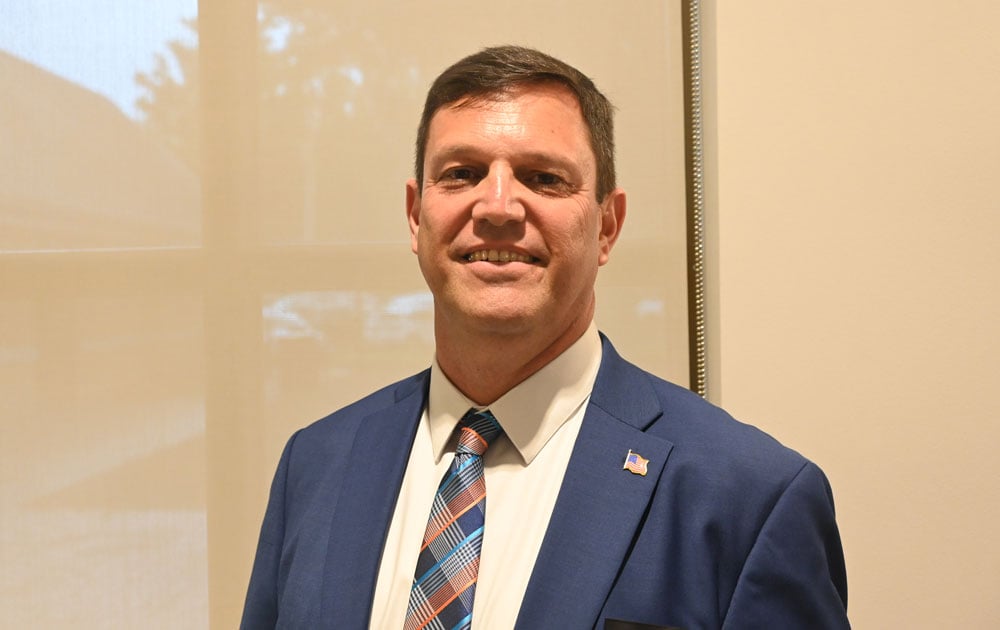
Tony Amaral Jr. is one of three candidates for the Palm Coast City Council, District 2. He faces Jeani Duarte and Jimmy Hengy. This is a non-partisan race. All registered voters in Palm Coast may cast a ballot in the Aug. 18 primary. If none of the candidates get a majority of more than 50 percent, the top two vote-getters will go on to the runoff in the Nov. 3 general election, when again all registered voters in Palm Coast are eligible to vote.
Three seats were up on the Council in this election. District 3 was to have a special election for a two-year term. Ray Stevens was elected to that seat in 2024. He resigned soon after for health reasons. Dave Sullivan was appointed. Sullivan opted not to run for it. Stevens recovered, filed to run and was unopposed, thus winning the seat outright. He will be seated in November. The seat will be up again in 2028.
The District 2 and District 4 races are for open seats. Four candidates are contesting the District 4 seat: Dylana Dee Galery, John Kvederis, Ramon Marrero and Darlene Shelley. Charles Gambaro was appointed to that seat in 2024 after Cathy Heighter resigned. Gambaro is running for the congressional seat that represents Flagler County, and will vacate the council seat in November.
City Council members serve four-year terms, except in the case of the District 3 seat for the next two years. Council members are paid $24,097 a year plus a $1,200 car allowance and a $910 communication allowance. They may also opt into full health benefits.
The Live Interview format changed this year. Since 2010, FlaglerLive had submitted identical questions to all candidates, enabling them to answer in writing. There typically was a round or two of follow-up questions, also in writing. Artificial intelligence has made that approach obsolete now that candidates can run the questions through AI and spit out prefab answers. To get around that, candidates were invited to a video interview. The video and the transcript are provided below.
The candidates were provided the same basic questions within half an hour or less of the scheduled interview, but obviously not the follow-ups, which all differed. The questions to county commissioners are here.
Following the interview and before publication, the interview transcript went through two rounds of editing at this end, once by AI (yes, the irony is inescapable) for spell checks, copy editing and to smooth out verbal tics or repetitive words, and once by me for the same purpose. The candidates were then provided with the interview transcript and the video to review–not to make substantial changes, but to verify transcription accuracy, and, if they so chose, to add a postscript: if they felt they may have misspoken, or not clarified a point, or preferred to revise an answer, they were given that chance in the postscript, without changing the original text in the transcript. The postscript window is remaining open for subsequent additions, until the election.
The interviews can be quite long–not a surprise for a site pathologically incapable of brevity, but the county is awash in candidate quickies. We offer a little more depth, seeking to draw a profile rather than check off boxes. The Live Interview’s aim is to elicit as much candor and transparency as possible, and to learn about the candidate beyond the basics in what amounts to extended conversations about the person, the character and temperament behind the candidate, the candidate’s seriousness, and the issues.
The rest is in the reader’s hands.
–Pierre Tristam

Flagler County Commission Greg Feldman (Dis. 2, R) Theresa Pontieri (Dist. 2, R) Anna Jones (Dist. 4, R) Drew Moss (Dist. 4, R) Leann Pennington (Dist. 4, R) Flagler County School Board Cathy Moon (Dist. 1) Jill Woolbright (Dist. 1) Will Furry (Dist. 2) Rob Wood (Dist. 2) Christy Chong (Dist 4) Ron Long (Dist. 4) Trevor Tucker (Dist. 4) Palm Coast City Council Tony Amaral Jr. (Dist. 2) Jeani Duarte (Dist 2.) Jimmy Hengy (Dist. 2) Dylana Dee Galery (Dist. 4) John Kvederis (Dist. 4) Ramon Marrero (Dist. 4) Darlene Shelley (Dist. 4) The candidates' interviews will be live-linked the day their interview publishes. |
The Interview Themes in Summary: Quick Links
- Basics
- Preparation and Character
- Evaluating Council’s performance
- Mayor Norris
- Goals
- The homestead amendment
- Sales tax and other revenue levies
- Development
- HBA lawsuit over impact fees
- Westward expansion
- Traffic
- Public safety budgets
- Rap sheet
- Postscript
https://youtu.be/4DYTCJ5RCEQ
FlaglerLive Can you tell me your place and date of birth?
Tony Amaral Jr. I was born in Newark, New Jersey, July 7, 1973.
FlaglerLive And your current jobs?
Tony Amaral Jr. I am a self-employed small business owner. I have a construction company, Amaral Homes and Pools, and we have a real estate company that we do property management through.
FlaglerLive How long have you been with the Amaral company?
Tony Amaral Jr. Since the day I was born, I was with my parents, basically since shortly after moving here when they started building. My wife and I own our company now, Amaral Homes and Pools. It’s 8 or 9 years now that we’ve had our own business.
FlaglerLive Realizing this is a non-partisan race, what is your party affiliation?
Tony Amaral Jr. I am a registered Republican.
FlaglerLive How have you specifically prepared yourself to be ready to succeed from day 1?
Tony Amaral Jr. I think my history has just made me ready. I’ve been participating in council meetings on and off throughout the years, listening and having conversations with past council members and mayors. The fact is that I deal with a lot of these same topics every day—between stormwater, roads, building, and code enforcement. I deal with a lot of departments in my everyday work. Just being active in it gives me the knowledge to jump right in from day 1. Are there going to be questions? Yes. I’m not saying I need to be the smartest person in the room, but I’ve got to know what questions to ask.
See how Amaral’s competitors answered:
Jimmy Hengy | Jeani Duarte

FlaglerLive Can you tell us about the character flaws you may have and what unique perspectives you would bring to the council?
Tony Amaral Jr. I think my biggest character flaw would probably be trying to get things done quickly but efficiently, and then second-guessing on whether I should keep working on it or say, “Okay, this is good enough for right now.” I’m never really content, but at some point, I have to stop myself and recognize that I can’t do anything more until I get more information. Sometimes that boundary gets a little blurred.
FlaglerLive How do you think that might affect your performance on the council?
Tony Amaral Jr. I don’t know, because I’ve been reviewing the agenda packets that come out to the council for almost a year now. As long as I do the work early, read everything, and ask questions, it works. I don’t get the same staff access right now that the council does on Mondays to ask those questions, but I still ask them. Sometimes I have to say, “Well, I can’t get the answer before the meeting, so I’m going to go listen, and then I’ll ask during public comment.” It’s a 3-minute part, not a back-and-forth. If I get an answer, I will make adjustments. If I’m a council member, I can ask those questions in advance. I just want to make sure I’m prepared and always ready to go.
FlaglerLive Who do you admire most in office today among elected officials in Flagler County?
Tony Amaral Jr. I like Andy Dance on the county commission; he seems to have that calm composure and nothing really rattles him. I also like [County Commissioner] Greg Hansen. He’s got that kind of elder statesman quality, operating on the principle of, “Give me the information, and I’m going to base my findings on that.” On the city council, I liked Nick Klufas. He brought a different perspective, being younger and on the tech side. He was a major proponent for the fiber optic ring we have around Palm Coast. I like that innovation and thinking outside the box. Those are the three I can think of offhand.
See how Amaral’s competitors answered:
Jimmy Hengy | Jeani Duarte
Evaluating the Council’s performance
FlaglerLive What letter grade would you give the city council on its performance in the last two years?
Tony Amaral Jr. I’d give it a B, a solid B. There was just a lot of politics that started between January at the end of ’24 and early ’25. It’s just a back-and-forth that Palm Coast doesn’t need. We need solutions to solve problems, not create new ones. They seemed to have gotten over it for a while, made the hard decisions, and had the necessary discussions. Unfortunately, I’m starting to see the politicking coming back in with Facebook posts and little jabs here and there. At the end of the day, if you have a problem with me, just tell me. Don’t try posting it to win a social media war. That behavior keeps it at a B.
FlaglerLive What is your personal policy on social media? How do you handle that? Do you have an account? Do you maintain it?
Tony Amaral Jr. I actually got my first Facebook account about a year or a year and a half ago, having avoided it before. I did have an Instagram account that was really just for family. It’s quicker and easier to share pictures with family members in Portugal, New Jersey, and all over the place. Social media has its ups and downs. I went in saying I won’t respond, but I’ve had to make a few posts when there were full-on lies. You don’t like me? Great. Unfortunately, I can’t help you because I don’t even know you. But the lying part was a little heavy for me, so I answered a few of them. I eventually came to the conclusion that it’s really not worth it because you’re never going to win that battle. It’s easier to keyboard-clack than it is to have a face-to-face conversation.
FlaglerLive Regarding the council, can you explain with specific examples where it has been lacking and where it has excelled?
Tony Amaral Jr. Lacking, I think, would be making decisions without having all the information—at least, I felt it wasn’t there publicly. I don’t know if they got more details during their one-on-one meetings.
FlaglerLive Might there be an example?
Tony Amaral Jr. I would say the big one for me was that East Hampton project, the ICI project. First reading came in okay. Second reading, it was completely changed and the project literally got flipped. People say the numbers stayed the same, but the public benefit completely changed. There just weren’t enough details. You waited 10-plus years; why not table this project a little bit, figure out what actually will be done, and get the paperwork in so it’s clearer and more presentable to the residents? The people sitting up there had issues with the adding of 13 new homes, and I think that could have been managed better.
Another issue involves making off-topic comments. Saying the [Southern] rec center is “bougie” and we should drop it wasn’t a real conversation; that’s just throwing out random statements.
FlaglerLive You’re referring to the mayor’s comment?
Tony Amaral Jr. Yes. It has a time and a place, but randomly throwing things out seems to happen more at the end of the meeting during council comments on items not on the agenda, when there’s no more public comment. We can do better than that. If we have an issue, let’s bring it up early so that it can be discussed properly, not last minute when the public can only listen and can’t give their input.
On what they’ve been doing well, I like that they’ve advanced Belle Terre safety projects, getting turn lanes in to move traffic through easier. I also like that they’re not scared to make adjustments. Just this weekend, they changed Old Kings Road and Town Center Boulevard to a three-way stop, and they are trying a three-way stop at Royal Palms.
FlaglerLive Are you okay with the way they handled the utilities rate study, the increase, and the debt?
Tony Amaral Jr. I think a lot of that had nothing to do with this council. They just had to make the final decision. It was years of falling behind on repair and replacement for the main infrastructure at Wastewater Treatment Plant No. 1. If that had been addressed earlier, we shouldn’t have this much debt.
FlaglerLive We keep hearing from this council that this was not done before and it’s not the fault of this council. Certainly, it is not a matter of fault here, but when you look back at the history of the council all the way back to 2011, there have been successive rate increases precisely for the same reasons we heard this time—which is, “We need to catch up.” They may not have been as steep or as punishing as this one was, but is it fair to say that previous councils did not address the situation when we’ve had these successive rate increases?
Tony Amaral Jr. I guess the real question would be, going back and double-checking, were previous councils made aware of it when they should have been? Or was it only brought forward once we reached a critical level, rather than presenting a comprehensive, overall picture? The alarm that we’re behind on maintenance should have been sounded earlier. It’s cheaper to fix something early and small than it is to wait until a major failure. Our major failure was when the decree from Florida came in and said, “You have a major failure now, and now you’re on the clock.” We could have caught that earlier by asking routine questions about how our maintenance, well pumps, and membranes are holding up. If we project a certain lifespan on a piece of equipment, we need to know if we are meeting that goal, or if newer technology or an equipment flaw is changing the timeline, so we can make adjustments earlier as opposed to waiting for a complete breakdown. I’m not positive if it was a staff-to-council miscommunication or just a council saying, “Okay, we’ll deal with it, just not today.” That’s why I can’t give a definitive answer on that one.
FlaglerLive A couple of other examples of effective leadership on the council’s part?
Tony Amaral Jr. The safety upgrades on Belle Terre and moving that along. Also, Council Member Ty Miller working hard at the TPO—the Transportation Planning Organization—to push back against Volusia County getting the bulk of the money, advocating for our fair share. I think the tough decision regarding the utility rate hike and the utility bond was necessary. They took one on the chin for that one, but we were at the point where they had to stand up and say, “This has to happen.” I can’t think of anything else right now.
FlaglerLive Speak about your own qualities that you might bring to the council to improve its effectiveness. What would those be?
Tony Amaral Jr. I look at everything and ask for the worst-case scenario first, then figure out how we work through that. For example, it’s a great concept to change the old Fire Station 22 into a museum slash mini welcome center or community center. But I’m going to ask why we are changing the shape and look of it if we’re supposed to be maintaining a historical site. They are putting the bell tower back up, but the building essentially will be a different color and won’t look the same. Why are we adding a big glass atrium to it?
Hopefully, we have the answer, as opposed to why we can’t just go in there, clean it up, keep the building the way it is today, and take safety precautions. If that’s your goal, then preserve what the building is for—not to say one thing and then transform it into another. Then, how much is this going to cost a year to maintain, and does the math add up? It’s easy to look at it today when it’s all shiny and new, but I’m always looking at the plan 5 and 10 years down the road. When the roof needs to be redone, are we making plans in our budget to handle that added cost? Every building we add is an ongoing maintenance cost for Parks and Rec. Their budget will have to increase just because we wanted something shiny today that will have to be paid for decades down the road. Those are the kinds of questions I ask.
FlaglerLive And you would apply that standard to every issue before you?
Tony Amaral Jr. Yeah, though there are certain things where it’s a minimal cost. If we get a grant for a couple more miles of trails, it’s just basic maintenance. I know we’re having a problem right now on the wooden bridges that are part of our bike system. Can we spend a little bit more money today and use synthetic woods that will last twice as long, saving us money in the long run? I would apply that proactive standard to most everything.
FlaglerLive Even when the sheriff is asking for nine deputies for the third consecutive year?
Tony Amaral Jr. How much does it cost every single year with ongoing pay increases? I want to verify that we’re getting enhanced service. Are we behind based on population numbers? I don’t know who makes up those numbers based on our population, but what’s the standard number of deputies we should have today? Are we paying for enhanced service above and beyond that, or are we paying just to get us to that baseline number? It’s a question I’ve been asking, and I haven’t gotten the answers yet. As we get closer to budgeting, it’s on my mind to find out where we should be. I believe that baseline should be fully funded through the county because we pay into it. If we want enhanced service, then we have to make sure that if I’m paying for 9 extra, I’m actually getting 9 extra—not just getting 4, 5, or 6 extras because we were 3 behind anyway.
See how Amaral’s competitors answered:
Jimmy Hengy | Jeani Duarte
FlaglerLive Give us your thoughts on Mayor Mike Norris. Do you see yourself as a check, a balance, or an ally of the mayor?
Tony Amaral Jr. I think everyone should be both. I’m not going to walk in there saying I’ll oppose everything Mayor Mike says, nor am I going to say I’m for everything he says. We all have different histories, points of view, and life experiences, so I hope I could be both. I want to be able to say, “Mayor, that’s a good idea.” His scholarship for STEM is a great idea and he should be applauded for it. On the other hand, he went to the Loop Road groundbreaking—the Westward expansion—and made statements. He still took the picture with the shovel, so it’s kind of like, which one did you want? Did you want to be part of it or not? He could have just said, “I’m not taking the picture either.” We all have free speech, but when you’re representing the city in matters like that, I think we should be a little bit more careful. At the end of the day, we have to work together. We have to get 3 out of 5 members to agree on things. So I’m not going to be a check and balance all the time, nor am I going to agree all the time. That goes for everyone on the council, not just the mayor.
See how Amaral’s competitors answered:
Jimmy Hengy | Jeani Duarte
FlaglerLive Let’s talk about the strategic plan. What are 2 initiatives that you agree with, 2 you disagree with, and 2 that you would bring to the table yourself?
Tony Amaral Jr. I agree with shifting away from focusing on shiny new buildings. I think the shift now, especially this year, has been towards needs versus wants. Yeah, I want that new welcome center, but do I need it? I do need to fix our roads because studies show we’re reaching critical failure on a lot of those major arterial roads, and we’ve fallen behind. They’ve committed to updating that, and now I want to see the action actually happen. How are we going to fund it?
The tough decision they made for the utility department was necessary. Now the plan is to follow it through, increase our capacity, and give us a buffer over this 5 or 6-year plan. That’s a commitment that’s going to need to be made by the city council.
Also, the commitment to the State Road 100 Town Center CRA. Let’s get that through the last 7 or 8 years of its life. We passed a rough patch with the surge in housing units that went up, but now I believe there are only 300 housing units left; everything else is commercial. Let’s keep that because we finally can see the light at the end of the tunnel. Let’s fulfill it and raise those funds that we started the CRA with to begin with, and then it can go back to normal. It can go back to a fair share split between the county and the city once the CRA dissolves, and the money would be there. We get the advantage of why we set it up to begin with. I think that’s about it.
FlaglerLive What would you bring to the table?
Tony Amaral Jr. Questions. I’m a firm believer in asking questions.
FlaglerLive I’m talking in terms of strategic action planning—like ideas: this is what you want to see.
Tony Amaral Jr. What’s our action plan to bring in better-paying jobs and industry? We hear Mayor Mike talking about how we need land and buildings. Well, I’m not a big fan of building buildings for other people because I don’t know what they need, and I don’t want to lose out on a project because we built a 25,000-square-foot building but someone needs 15,000 or 35,000. But we do need land; that’s the one thing we definitely need. The West is where we’re going to get that land. There is a significant number of acres out there, and that’s what we need to start marketing ourselves to different industries. We’re pad-ready; you just tell us what you need the pad to be, and we can help you get that because we have this site or that site. I want to bring that to them as an action plan.
The other thing is I want to make sure that our main infrastructure—our roads—gets addressed because we’re way behind. If it were up to me, I’d say let’s all agree on a number that we’re going to commit every single year for the next 5 years just to resurface and restripe our roads. I keep getting people asking me to restripe the roads because at night or during heavy rainfalls, they’re having a hard time seeing where the edges are. That would be a priority where we commit an X amount of dollars, figure out the funding, and then build the budget around it, because that automatically comes out.
FlaglerLive I think there’s no question that, as far as the roads are concerned, there’s pretty much agreement on the council that they must do something. But the question has always been funding. You might recall [Stormwater and Engineering Director] Carl Cote telling the council that cutting the tax rate by just a tiny amount over the last 4 or however many years would have covered what we’re talking about—the $12 million or so in annual needs. So where would that source be, since it’s not in the budget right now?
Tony Amaral Jr. We have to go through the budget and pick based on needs versus wants. I find it odd that the city council doesn’t seem to review the budget department by department over the last 5 years to see what was budgeted, what was actually spent, and what they got the next year. I saw a couple of different departments a few years ago where 10% to 15% of the budget was not used, but the following year their budget got a bump anyway and went up more or less the same amount. So we can start with that as a short-term fix until they meet again.
We should have that data when it comes to the budget, and we’re talking specifically about departments like code enforcement or public works. We can’t touch certain items, like restricted funds or enterprise funds. The building department can have a $2.5 million surplus all day, every day, but you can’t touch it and move it to roads; legally, they can’t do it. You can’t take money out of certain impact fees to maintain certain things. There are those separate buckets, but we have to see where we can shave them down and put that money toward the roads by using our fuel tax surplus more efficiently, committing a larger percentage of that to go straight to the roads.
FlaglerLive All of that is actually going to the roads now.
Tony Amaral Jr. I think there’s a small percentage that they’re actually using for different things, not specifically for the roads.
FlaglerLive It’s a small amount to start with.
Tony Amaral Jr. It is, but again, we’re at a critical point where we need to do it. We did funding several years ago—and I’m drawing a blank right now on what the exact cause was—but it went away because our goal was to do 60 miles. They realized about 8 or 10 years ago that we have almost over 550 miles of roads, so their goal was to do 60 miles of road a year to get us caught up. They got through about 3 or 4 years, and then it wasn’t a priority anymore. Council changes, and different priorities take over. I like to be more proactive and not reactive to those situations so we’re recognizing it early and making plans to do it.
FlaglerLive I’m still hearing that you’re looking for efficiencies as opposed to a fundamental way of funding a serious and expensive program that is lacking a new source of funding. My question would be, what would that new source of funding be to ensure that the whole capital plan is taken care of, like going back to a 50 or 60 miles per year approach?
Tony Amaral Jr. Well, unfortunately, costs have gone up so much. I would say we can’t lower the millage rate anymore in the foreseeable future. I think we’re going to have to hold the millage rate where it is. I pay taxes on my home, and I don’t want them to go up, but if we don’t hold it, it just gets worse. So holding the millage rate even with a 1% reduction in assessed values—which I saw an article indicating the property appraiser expects—is necessary. Do we go up 1% in our millage rate just to hold even? The new homes that are coming online will cover roughly $1 million to $3 million, varying depending on where they were built, which automatically gets bumped up.
FlaglerLive The existing properties are going to decline, like you said, but because of last year’s increase in new properties, you’re still coming ahead just a tad bit, so that you could theoretically maintain your millage rate. But maintaining the millage rate is actually going to essentially be like being at rollback.
Tony Amaral Jr. Well, technically, at that point, it would be a roll-up if we’re trying to keep that part even. We would actually have to go up 1% in our millage rate to keep it even, plus the new homes coming online with their new assessed values. But again, a lot of those are coming in as vacant land still, because they’re going to go a whole year as land, so we’re not going to get the full numbers. That’s only $1 million, $2 million, or maybe $3 million, depending on the assessed values. It’s going to be a challenge, but we did it in the past, and the county has done it in the past. We’ve got to sit down, get 5 people to say this is a priority, and figure out the funding for it, whether it’s reducing funding in other things. It’s going to come down to feeling out who has stronger feelings about saving certain projects over others and realizing this has to happen.
If our infrastructure fails, we’re going to have a problem. If our roads fail, we’re not going to draw new people or bring in businesses because they’re going to say it’s too hard to get around. If our stormwater fails and we’re flooding more than we have been, that’s going to stop us from drawing businesses and companies in. So that is a priority for me. We’re going to have to manage the funding, and the millage rate will have to stay the same. As Carl Cody mentioned, just by keeping that millage rate, it was this much more money. Land values were going up, but now they’re going down, and of course, we still have to figure out what’s going to happen on November 3 with the amendment.
See how Amaral’s competitors answered:
Jimmy Hengy | Jeani Duarte
FlaglerLive Speaking of which, how will you vote on that amendment right now?
Tony Amaral Jr. Right now, I’m a no, just because there’s a lot of information that I don’t have yet. I don’t know what the plan is to make up the money. They already put a restriction on how commercial property can be assessed—reducing that to a 5% max. Now there’s a new law being kicked around regarding municipalities and how much they can change the millage rate. All that will factor in, but as far as the amendment itself, right now I have to say I’m a no. It’s going to cost me money because I’m a homeowner. I have my homestead, and I’ve got properties that we rent out as investments. It’s going to cost me money, but for the overall picture for the city and the county, I will get that value back because I won’t be worried about damaging my car driving down the road or my kids driving through a rainstorm and hitting a mailbox because they couldn’t see the lines on the road. I think we have to think of the bigger picture and the greater good.
FlaglerLive Let’s assume it does pass. How do you see Palm Coast making up the loss?
Tony Amaral Jr. That’s a really good question, and I’ve actually been thinking about it. This coming budget is fully funded already, so we will have the rest of this year and next year to work on that. Are we going to add fees? These are just ideas; I don’t know if we can or will do it. We already have our water bill—water in, water out, stormwater, trash. Are we going to put in a park maintenance fee for $10? Are we going to raise the stormwater fee to cover the part that currently comes out of the ad valorem general fund? Are we going to have a road maintenance bump? That’s something we’re going to have to decide once we see exactly how much we’re losing. Roughly 50% of our budget from the general fund goes to fire and police, and I’ve heard numbers that we might lose close to 50% of our funding if it passes. Mathematically, if everything else has to happen—maintaining the roads, parks, buildings, and infrastructure—I don’t know how those two departments can’t take a hit. If they remain 100% funded without changes, then everything else has to go to zero, and that’s just not feasible in the real world. That’s where we have to make those tough decisions.
See how Amaral’s competitors answered:
Jimmy Hengy | Jeani Duarte
Sales Tax and Other Revenue Levies
FlaglerLive This naturally moves into the next question, which is about taxes and fees. Where do you stand on supporting a countywide increase in the sales tax by a half-penny, as has been discussed at the county and the city a few times in the last several years?
Tony Amaral Jr. My main thing would be: What’s it for? Give me specifics on where you plan on putting that half-penny. You’re not just going to get a half-cent sales tax just to put it in the general fund. I want to know in writing where it would go and how it would be used. It can be divided. Palm Coast doesn’t have a beach, but I’m not necessarily opposed to putting a part of that toward beach renourishment. Can we use some of that sales tax to help with the roads? That’s a benefit for the county and a benefit for the city. If you tell me it’s a half-cent specifically to put up a new tower that says, “Welcome to Palm Coast” at $4.7 million, then no, you’re not getting my vote. It has to be for actual needs. We’re at the point now where needs are going to be my main driving force when it comes to budgeting, action plans, and capital improvement projects. It’s about what is a need right now, and then making sure 3 other council members agree so we can move that way.
FlaglerLive Understanding that Palm Coast is one of the very few cities in the state that does not have either a public service tax or a utility franchise fee—as Flagler Beach has, Bunnell has, and most cities do—those, if adopted, would obviously generate new revenue from non-profits, including schools, hospitals, and the data center coming online next year. Where are you on those two fees, especially in light of the potential reduction in property tax revenue?
Tony Amaral Jr. Palm Coast does have a franchise fee when it comes to trash hauling; we do have a franchise fee included in that already. Again, where’s the money going to go? That’s my main priority. You can’t just have it sitting in the general fund. Right now, the franchise fee we collect for a waste-hauling license is anywhere from $1,000 to $2,500, plus up to 15% of the income. The city has the rights-of-way. Trust me on this one, it came up recently because…
FlaglerLive I’m not familiar with that.
Tony Amaral Jr. It applies to any trash hauling—all the cardboard boxes that get folded up behind Walmart and Publix. Whoever is taking that out of there, whether it’s Publix directly or an outside company, they’re supposed to be paying a franchise fee. The way the franchise fee is written right now, you have to pay for your license, which goes by volume and ranges between $1,000 and $2,500 per year, and then they get 15%. We started off at 10%, and it’s at 15% now. I don’t know if it’s your profit or your gross, but at least 15% gets paid back in as the fee. It’s the profit of the company that’s hauling off just the trash portion. If Publix hires an outside company and they charge Publix $1,000 a week—just for simple math—technically, whatever that trash company is, they are paying the city $150 a week.
FlaglerLive Do you know the total amount of revenue that fee generates for the city?
Tony Amaral Jr. It’s kind of hard to follow. I’ve actually been looking more into it because they just came out with a news flash to the contractors. They have indefinitely postponed the new portion of it, but tree service companies were recently qualified as hauling when they cut down trees and bushes. They were supposed to break down how much of it was hauling so the city could charge them the franchise license fee and the franchise fee.
As a builder, for instance, even though I have a dumpster on-site and that company is paying their franchise fee, at some point I have to get rid of the dumpster to do the grading and put the sod in. I still generate trash in the home—boxes from lights and different things. If I were to haul off that trash myself, they said I would have to get a franchise license, which might be $1,000 a year, just to be able to take that incidental trash to the dump myself. That kind of came up, and that’s how I realized they went up to 15%. We asked a lot of questions as far as how we are making sure we’re collecting money from everybody and what’s enforceable about it. I want to say they threw out an estimate that they bumped up collection to roughly $1 million, but they think by implementing it full-on they could get it closer to $7 million or $8 million, and that goes into the general fund.
FlaglerLive Now, to go back to the other two fees: Those would be substantial new sources of revenue that could to some extent compensate for the loss of property tax revenue. You are not in principle opposed to those fees, or are you?
Tony Amaral Jr. Well, that goes back to not knowing how we’re going to make it up. At the end of the day, I’m sure someone way smarter than me will figure out the math. Let’s say the average home pays $500,000 just throwing that out there. So the average homeowner sees a savings of, let’s say, $2,000 on ad valorem taxes. But how much more in fees is that home now going to pay? If I’m going to pay $3,000 more in fees, I’m better off paying my ad valorem taxes. Those are the numbers I need to see before I can say yes. At some point, if the amendment passes, some fees are going to have to be assessed. I just don’t know yet because I’m still not even sure how much we have to make up and what the fees would look like. We might save on ad valorem, but if I’m charging the same homeowner more through an FPL franchise fee or utilities, it’s a balancing act. Honestly, I don’t know what the definitive answer would be, but offhand, there are going to have to be fees to offset it. I just want to ensure that if the average person saved $500 or $2,000, we’re not charging more in fees than what would have been collected through ad valorem.
FlaglerLive Short of a new source of revenue, and if you do intend to stick to a rolled-back tax rate or close to it, which would obviously limit growth in the budget, what city programs would you eliminate and what service levels would you reduce to achieve that? If you could give one example of each, no more.
Tony Amaral Jr. That’s the million-dollar question. If we’re taking a 10% hit, it has to be across the board in every department. We can’t neglect maintenance on our parks because they will become wastelands and won’t be used, and then it’s just going to cost more money later on to get them back up. Our roads can’t take a hit. On stormwater, we’re catching up from a 2 or 3-year backlog, and that’s great progress, so that can’t really take a hit. Everyone is going to take an equal hit—the sheriff and fire would also be on that list because mathematically it would have to be reduced percentages by fair share, if you will. I think we can approach it that way. It’s easier to take 5% or 10% from every department that we can—excluding those enterprise funds you legally can’t touch—than it is to say one department is getting a 25% cut while another is only getting a 1% cut. It would have to be a fair, even percentage all the way across. Then, we look at the budgets, see what their proposed budget was versus what they actually spent, and figure out if we can trim a little bit more once we get to those actual details department by department, which I know we have room to do.
FlaglerLive So it wouldn’t necessarily be a specific program or service that you would cut; it would be more of a total budget approach.
Tony Amaral Jr. Yeah, I think so, simply because every one of those cuts will have consequences later on, so it’s only fair to have it across the board. Every director—stormwater, sheriff, fire—we have to make this cut, and it’s going to come down to that. They will look at their departments and see where they can save that 5%. We can’t have “just in case” funds anymore; we’re going to have to be really strict on what is a need. For major emergencies, we’ll have to rely on the reserves that we have.
See how Amaral’s competitors answered:
Jimmy Hengy | Jeani Duarte
FlaglerLive The population obviously continues to grow very rapidly, having absorbed an increase of 16,000 people between 2020 and 2025. Evaluate the quality and quantity of development in the last few years, and then explain what sort of land use or development you would oppose if it were to come before the council, understanding that there has not been significant new development approved by this council in the last 18 months.
Tony Amaral Jr. And there hasn’t. Most of the stuff is stuff that has been on the books for years and years. I think it’s important to first put everything into perspective. The city just did a housing study regarding their needs, and I found it interesting that the data stopped around 2024 or 2023. Based on that, 40% of our currently available housing was built from 2000 to 2009. Another 23% of the housing was built from 1990 to 1999. So roughly two-thirds of the current housing we have today was built in that 20-year span, 25 to 30 years ago. That was growth. We managed it then, and we can manage this growth now; we just have to set our priorities straight.
We have had a surge again. Being here for 43 years, I knew what it was like to drive down Belle Terre Parkway at 55 miles an hour on a two-lane road without breaking the law. We expanded it and made it bigger. I know what it was like to be at Palm Coast Parkway and Old Kings Road when it was a four-way stop with one lane in each direction, and we expanded both of those roads. That’s a major intersection. It can be done. Growth is coming and it’s going to keep coming. We still have 6,000 original Palm Coast lots that haven’t been developed yet. You can’t throw those out and just say, “You didn’t get here in time, sorry.” That’s why we need to focus on the roads, our infrastructure, and our capacity. Again, I applaud the current council for taking care of Belle Terre, adding those turn lanes, and adding infrastructure.
People will complain about the traffic. Well, I used to drive down Belle Terre from Palm Coast Parkway all the way to State Road 100 at 55 miles an hour with no stoplights. Now it’s 45 miles an hour with a lot of stoplights. I can’t remember how many now.
FlaglerLive About 75.
Tony Amaral Jr. Yeah, you’re going to get traffic, you’re going to have stops, and you’re going to have this. Which is better: getting down the road faster, or getting down the road safer at a slower speed with stoplights? Traffic to me is relative. In comparison, I see traffic here, but I have also been to South Florida. I still go visit family in New Jersey where it takes me 45 minutes to drive 13 miles in regular traffic. We’re going to have to figure it out, and we are figuring it out. As long as we can keep that mentality, we’ll be fine. No, we’re not getting some crazy, astronomical, never-seen-before number of people moving here. I think we’re very fortunate that people still want to move here. The more people we bring in, the more diversification of ideas we get, so I’m a big fan of it. We’re not at full capacity yet.
We can lay this out because Palm Coast Parkway already has land set aside for widening—it won’t require eminent domain to add an extra lane. Belle Terre has land already set aside to do the work. The founders had forethought. It just didn’t make sense to make Palm Coast Parkway 8 lanes from the toll bridge all the way to US 1 when there were only 35,000 people here because you have to maintain all 8 lanes all the time. So I think we can do it. The surge is there, but we’ve dealt with it in the past and we got through it. There are a little bit of growing pains, if you will, but at the end of the day, we’re going to be better off.
FlaglerLive We’re going to get to a question on traffic in just a little bit, but what sort of land use or development specifically would you oppose, if any, as a council member?
Tony Amaral Jr. I think each project will be individual and different. For example, regarding the 2 cement batch plants on and off of Hargrove: I could see the benefit of having 2 batch plants, but at the same time, I didn’t like the idea of changing those zones over to heavy industrial. Especially today, we’re just not ready for it. It wasn’t because of traffic or the use of the road; it was because we’re not prepared for it. We don’t have the resources—if we have a hazardous issue, we have to call St. Johns County to come in. That road does need work as far as planning how to move traffic around. That intersection is going to get a stoplight, and it’s not that far away from the other one on Palm Coast Parkway. At some point we’re going to have to do it just because there are more people and businesses using it. So those projects at the time, I was a no. I didn’t want the unknown. Yes, it was a batch plant today, but the land value went up astronomically if they got converted to heavy industrial compared to what it was now as light industrial or commercial. So those I was opposed to.
The project on East Hampton, again, needed more information. I wasn’t necessarily for it, nor was I necessarily opposed to it; I just needed to have more information on what the public benefit was. As far as whether I would convert single-family to multi-family, I just don’t know because there’s a multitude of things that come before us regarding land use. We also had a big problem years ago where we were converting a lot of commercial land to residential.
FlaglerLive For example, there have been cases where public opposition has led to the elimination of apartment plans—as I recall, in Seminole Woods, for instance. Do you feel any opposition to apartment complex plans anywhere?
Tony Amaral Jr. If they’re meeting the density requirements and not exceeding the density maximums allowed for that land, I can’t oppose it. People will choose what is more efficient for them—whether to do apartments, townhouses, or single-family housing. At the end of the day, the units per acre will dictate what can go there. I’m not going to be the one who says, “Oh, I like the fact that you’re doing luxury apartments versus standard regular apartments,” even though the number of units might be the same. At the end of the day, it’s not up to me to decide whether I personally like the project; it’s whether the project fits the area they want to put it in, whether we’re meeting the density, and whether our roads, water, and stormwater can handle it. I don’t differentiate based on taste; I have to differentiate based on whether it meets the guidelines or doesn’t meet the guidelines.
FlaglerLive You get to set the guidelines when you do the comprehensive plan. That goes into the second part of the question: Do you see a specific percentage of our housing stock that should be single-family houses on traditional lots as opposed to apartments or other kinds of multi-family complexes?
Tony Amaral Jr. Going back to that study I mentioned earlier, it shows we need a diversification of housing stock. The individual landowners are going to be the ones who decide what is marketable to them. As a city, we can’t dictate and say, “You’re going to use all of this for one type,” because they have a certain amount of land acreage and a set density, like 3 or 4 units per acre. If they decide to cluster their 3 to 4 units per acre in an apartment complex, then the rest of the land automatically has to have larger lots. They might find a need for an apartment complex of 200 units within a whole project that has, let’s say, 1,000 units total allowed on the acreage. If you use 200 units for an apartment complex, then automatically it’s going to defer the remaining 800 to larger lots because that’s where you’re going to balance your density—or you might not even be able to do all 800 because there isn’t enough land left for it. The market is going to decide for those developers; they do the research on it.
Again, it’s not the council’s place to decide we like this project versus that project if 2 people show up with similar-sized land and similar densities. How are we going to approve one because we like it more than another one? If you have 100 acres and you’re only going to use 15 acres but cluster all your density in those 15 acres, versus someone who has 100 acres and spreads the exact same number of dwelling units over the whole 100 acres—which project is better? Which one is more environmentally reasonable? Which one is going to protect more wetlands? You can’t differentiate based on preference. We have to sit down and ask: “What’s your density? Are you following the guidelines?” Then let their market decide whether or not it works, and we have to hold them to it. Hopefully, future councils will hold them to it too, because as we’ve seen, you start a project in 2010 and it comes up in 2026 when you’re finally ready to build, and you want changes. Future councils have to make that decision too: “Well, you’ve met your density. Why should we give you more? What’s the benefit to the community for you to get that extra density?” That’s how I’ll approach each one, because each one is going to be a little bit different.
See how Amaral’s competitors answered:
Jimmy Hengy | Jeani Duarte
FlaglerLive So, you’re a member of the Flagler Home Builders Association, right? This would be interesting, with the HBA suing Palm Coast right now over impact fees. Let’s say you’re called to the witness stand—which side would you defend in that lawsuit?
Tony Amaral Jr. Just for simple facts, I won’t be called to the witness stand. I am not involved in that.
FlaglerLive No, that’s very clear. Just intellectually, if you were on the witness stand, how would you address it? Who would you defend?
Tony Amaral Jr. I will address it just like I addressed it when it came up. I went up to the dais, I made my claims, and I said, “Yes, increasing the impact fees is fine. You should do it, but you should not break the law to do it. Follow the law.” That’s what I would say as a witness, and that’s what I said publicly at the city council meetings. The city has the right to do certain things, and they should, but they don’t have the right to just do anything because there are laws. That’s why they decided to go to 100%, but the law says you can only do 50% without meeting extraordinary circumstances.
Personally, I found a lot of it strange, showing a lack of information and transparency. For instance, there was a line item for parks—3 community parks—and it was some odd number like $8.46 million. Where are those parks going? We don’t know. What size are those parks going to be? We don’t know. What amenities are those parks going to have? We don’t know. How did you come up with a very specific number like $8.46 million? If you said we’re going to set aside a blanket $9 million for 3 parks at $3 million each, I’d understand. But to have a very specific number when they can’t tell me where, how big, or what it’s going to be—that raised alarms for me. It said to me that you guys are just throwing out numbers to get to a total that someone, somewhere, somehow decided they wanted to collect for whatever reason.
FlaglerLive Am I surmising correctly that you would have been a no vote on that specific item?
Tony Amaral Jr. I would have been a yes vote to the legal 50% limit. I would have been a no vote to go above it. And I would ask a lot more questions. I would have more than 3 minutes to ask those questions to staff, asking, “How do you have these 3 parks at $8.46 million if we don’t know anything about them?” So, yeah.
FlaglerLive So you would not have agreed with the exigent [extraordinary] circumstances provision?
Tony Amaral Jr. I would have agreed up to the 50%. And then after that, I would have to say no because legally we just can’t do it. It just seemed like it was a padded number set by someone, somewhere.
FlaglerLive You legally can if you justify the emergency or exigent circumstances provision.
Tony Amaral Jr. Yeah, you can, but it has never been clearly defined here, and I don’t think we met it. They’re saying, “Oh, it was the growth.” Well, the growth happened, like I said, in the ’90s and the early 2000s. Actually, there were no general impact fees then. The only impact fee we had from day 1 was your water and sewer CIAC fee. We really only started getting other impact fees around 2003 or 2004. It did good; it helped move things. We got roads built out of it, and we got schools built out of it. It has a place, but we just have to be able to justify it.
Being here and seeing three times the amount of growth in the past, I mentally couldn’t wrap my head around saying this current rate is an extraordinary circumstance. Percentage-wise, we were way higher during the crazy boom years than we were last year, yet they based their extraordinary circumstance on a percentage basis. The good news is that it’s going to be a judge who decides at the end of the day, not people running for election or re-election.
See how Amaral’s competitors answered:
Jimmy Hengy | Jeani Duarte
FlaglerLive Let’s turn to the West Side. It’s obviously poised to potentially double Palm Coast’s size, or very close to it, with 22,000 housing units by 2056. First, let me ask you: Have you read the MPD, the Master Planned Development proposal?
Tony Amaral Jr. I started wrapping my head around the original ones—the Neoga Lakes DRI from 2010. Yes, I wanted to see where those were set first to see what the main differences were. I haven’t really had a chance to get deeply into the current westward one yet, I’ll just put it that way. I have some baseline knowledge, but I’m not an expert on it 100%.
FlaglerLive Because the question was going to be if you are supportive of the plan as it stands today, understanding that it’s a work in progress. For the current MPD, there have been 3, 4, or 5 drafts.
Tony Amaral Jr. The current one, from my understanding, is calling for roughly 22,000 homes or dwelling units. The original 2 totaled around 11,000 or 12,000. From what I understand, they combined those 2 original plans and added about another 7,000 acres, give or take. So, based on density and what they’re allowed, it makes sense why that number went up—they added land to the original projects. What’s trying to get approved before September is the big picture. They don’t have it laid out saying, “This specific spot gets this many units, and that spot gets that many.” The big picture is what’s trying to be approved first, and then they’re going to go through piece by piece for individual approvals. Every time they go for a development approval, it will subtract from the 22,000 units left; it’s not going to just keep adding.
Are our roads going to handle it? That’s the first question. Do we have the capacity in water and sewer? That’s the next question that has to be answered beforehand. We have to make sure we can handle the traffic. Now you’ve got the state putting in State Road 2209—that’s the number that keeps being talked about.
FlaglerLive But it’s still so conceptual.
Tony Amaral Jr. They’ve already started construction in St. Johns County on that road now. Yes, it will come from St. Johns all the way down to the western part of Volusia County, right where it meets the St. Johns River. It’s going to take decades for that to get fully built. The Westward expansion, for me, above anything else, represents land for the development of industry and larger commercial uses to bring in higher-paying jobs and large-scale manufacturing. To me, it’s a perfect location because right now it’s away from established homes and neighborhoods. That’s why I want to see that industrial corridor laid out on a map and marked. I want boundaries set, and I want to see that rezoned first. That way, 20 or 25 years from now, we don’t approve residential developments all around it and then get stuck when we’re ready to build the industrial park. History shows over and over again that residents will say, “I don’t want industry in my backyard,” and they shouldn’t. But if it’s laid out and set aside early, it avoids that conflict.
FlaglerLive Doesn’t the MPD do that?
Tony Amaral Jr. The MPD, again, is still a big-picture plan. There is no clear timeline, as far as I’ve seen, for when that industrial corridor will be set aside and zoned, or when we will start working on getting the infrastructure—the roads getting in and out. It’s there and it has to be done, but I haven’t seen an exact location or timeline. We can’t wait for 70% residential build-out before they start working on the industrial part of it. I want to see it tied together: when residential hits 10%, the industrial part should be 20% or 25% done. By the time we get to 30% or 40%, it should be ready to go. I’m not saying a company will have already built something in that timeframe, but it has to be pad-ready for a company to come in should they decide to relocate or expand into our area. That’s where we set the details in the negotiations that are going to happen over years, saying, “Okay, we like your project overall, but if you want our water, we expect to have this much park space.” I think we’re still looking at the big picture, which is the first approval we need, and then we’re going to have to work on the details of how it’s going to get done.
FlaglerLive The mayor has taken a pretty decisive position against it. Council Member Pontieri has taken very strong positions about it in terms of laying out some warnings, expressing a lot of misgivings about the MPD in its current state. The last time she spoke about it, she didn’t sound too thrilled. If you were to vote on it today, how would you vote?
Tony Amaral Jr. Big picture, we need that industrial land. For the mayor to say, “I’m not going to support it in any way, shape, or form,” but then say we need land and buildings to help diversify our tax base—well, then show me where you get the land from. That is our land out west. It’s the land where we can set the maximum density, and as long as it meets the land development regulations and the future land use maps, we should approve the big picture. Once we get to the details, that’s when the real negotiations start regarding when we go live with this and when we get the industrial sites pad-ready. It’s going to be a give-and-take. In all fairness, I can’t expect developers to drop everything and spend millions of dollars just for this without residential components, but they’re going to make money on that industrial site too because they still own the land.
So for me, it makes sense for them to get some residential approvals while working on that industrial piece. It will drive up the demand for their land if we can get those good-paying jobs to come in. Big picture, I have to say yes, but we cannot forget the water, traffic, roads, sewer, and stormwater—all that has to be a priority before we go any further. But we still have to give them a big picture approval before we can dive into those details.
FlaglerLive And you think the city is capable of handling this expansion, even with all the needs going on on the East Side of US 1? How would you balance the two to ensure that the East Side doesn’t get shortchanged, as some critics of the plan keep claiming?
Tony Amaral Jr. At the end of the day, the development plan requires them to bring in impact fees to build roads, so they’re going to pay for that part. We can’t use that specific money to repave the east side of Palm Coast anyway. It’s like comparing apples and oranges. We have to expand the roads to accommodate the traffic if they plan on driving down Matanzas Woods Parkway all the way over I-95. I think it can be managed that way. We can’t just say, “Oh, we’re not going to spend $1 on the west side because we didn’t get $1 or $2 on the east side,” because those dollars aren’t the same; they are in separate buckets legally.
But that expansion will also bring our tax base up. If we can get the industrial sector in, it will strengthen the tax base and bring jobs in. This past April, I went to a medical device and manufacturing trade show in Charlotte—MD&M, as they call it—because I wanted to find out firsthand: What do these companies look for if they’re looking to expand or relocate? They told me that first and foremost, they look at whether space is available and if the land is ready to go. They basically need something that is pad-ready before they will even consider you. Palm Coast is great because it’s on US 1, you have direct access to I-95 within less than 10 miles, and you’re next to a rail line. All of that is wonderful, and those are things that appeal to manufacturing heads because they have to bring material in and get material out. But if the location is not ready to go, they move on.
I was even asking the property appraiser’s office if Palm Coast, Bunnell, and the county could come together to look at sharing land along our borders. The state has a program in the Florida Statutes for critical sites where the state will pay 100% of the cost—no matching funds needed—to get infrastructure in place, including roads, water, and sewer. That specific land ended up going into the Neoga Lakes DRI, but the concept was to bring 3 municipalities together. The state wouldn’t look at it as just Palm Coast asking for something; it becomes a regional project where the county, Bunnell, and Palm Coast would all benefit directly. It involves a lot of moving parts. You would need at least 2 other members of the city council to say yes, 3 members of the county commission to say yes, and 3 members of the Bunnell commission to say yes. It’s an idea I had about 8 months ago, and then the West Side timeline suddenly ramped up publicly, so I kind of let it go because I saw the land was already moving in that area. It’s something I’ve been thinking about.
We need to use that land to bring in other businesses so we can increase the well-being of Palm Coast and lower the burden of the ad valorem tax—especially if we start losing revenue through the amendment, where 92% of the tax burden falls on our residential roofs. That needs to change.
FlaglerLive Might there be a point where we reach a glut in industrial land, with Bunnell doing what it’s doing with its big 1,500-acre project?
Tony Amaral Jr. That’s on the south side, further south, closer to the Volusia County line. We are just so short on industrial land overall that I don’t think we’ll have a glut anytime soon. I’m not proposing we take land out west and make it all industrial, but if Bunnell benefits from their land, the county benefits from their land because county taxes apply everywhere. Will that lower our county tax rate because they’re getting more industrial revenue? It lessens the burden on homeowners. If Palm Coast can do it, the county should be able to lower their rates too because they’re collecting more money. You’re going to start seeing the pressures on individual homeowners lessen because we’re increasing revenue from these manufacturers and big companies that don’t have the benefits of homesteading—they pay the full amount. That makes a big difference in our community. Then we can start having more money to work on our roads and stormwater systems. Those two major infrastructure budgets will have more funding built into them if we do it right and stop focusing on vanity projects.
See how Amaral’s competitors answered:
Jimmy Hengy | Jeani Duarte
FlaglerLive Traffic is a routine complaint among residents overall. What would be your solution in Palm Coast proper, where it doesn’t seem like we can build new roads—all we can do is widen a few—but those 6,000 lots are still coming, alongside surrounding development out west, in Bunnell, and in Flagler Beach? What is your solution for traffic?
Tony Amaral Jr. For instance, I drive it a lot: the north end of Old Kings Road from Palm Coast Parkway going up toward Matanzas High School. That has been staked out and marked as a project at least three times that I can remember, only to have those stakes slowly disappear and the whole project fade out. We are reaching the point where the actual physical numbers show that widening needs to happen, and it needs to be treated as a priority. Belle Terre became a priority because we were reaching capacity numbers, and they did the right thing by directing money there to alleviate that. The next project has to be Old Kings Road, but it can’t just be talked about again—spending money on surveys and studies just to have it fade, and then spending the money again 5 or 8 years later. If we’re committed to it, then we just need to commit to it.
FlaglerLive But the city doesn’t have the money.
Tony Amaral Jr. We’re not going to be able to expand roads like Florida Park Drive; it just can’t be done. We can’t expand Pritchard. I mention these roads because those are the ones I drive regularly. The main arterial roads are the ones that carry most of the traffic, and we’re going to have to manage them. We are going to have traffic, but it can be controlled if we start bringing more commercial development to the north end, which will alleviate traffic in the center. If we start bringing more commercial and industrial development to the west side, it will relieve pressure on the east side because it will get to a point where I can leave my house, take Matanzas Woods Parkway to US 1, go through the roundabout, and be at a grocery store, a Target, or a Ross right there—as opposed to driving through town or down I-95 to State Road 100 to hit that commercial corridor. By spreading services out, the traffic will spread out.
Are you still going to have rush hour traffic at major points? Yes. If we implement a growth moratorium today until our infrastructure catches up, it sounds great, but how do you actually fund it? If you stop growth today, you will collect no new impact fees, and you will collect no increases in property values for ad valorem taxes when a vacant lot becomes a home. If you stop growth today, all that new infrastructure that is needed will only be paid for by the people who are here today because there will be no new funding for tomorrow. You will have no more lots converting from $500 or $700 in taxes to $5,000 or $7,000 in taxes. All of it will fall on the current residents, so the idea of stopping everything until we catch up doesn’t work. That would create a situation where growth truly did not pay for itself, and the existing residents would pay for everything.
Eventually, you have to open the doors back up anyway. When ITT made Palm Coast, everything was put in place early—the water was in the ground, the sewer was in the ground, and the stormwater was being moved around. New residents came in and benefited from everything being here because ITT owned and sold everything. The current residents of Palm Coast will not get that benefit if we stop and try to catch up, or if we just say we are at full capacity and stop permanently. If you go stagnant like that, you’re going to have issues. You won’t be able to take that tax burden off the residential home. The roads, stormwater, utilities, and parks still have to be maintained, and it will all fall 100% on existing residents.
I had a conversation with a lady who advocated for stopping all growth. I asked her, “How do you pay for infrastructure then?” She said, “The builders and developers will pay for it.” I told her, “By your plan, the developers are gone; they don’t exist anymore.” Number one, you’re going to lose a good chunk of income because if I can’t build, I’m not going to pay for my business tax license. I’m going to look someplace else to build, so we’re going to start losing people. It sounds good until you realize the financial reality. I just don’t think a complete stop is physically possible, and it’s never been a viable option to just full-on halt everything. If we went to a referendum in November and 60% of the people voted to stop all growth in Palm Coast starting January 1, then what? We are experiencing growing pains, and we could have handled things better. But I’m still not going to be able to drive down Belle Terre from Palm Coast Parkway to State Road 100 at 55 miles an hour with no stoplights. There’s going to be traffic, and traffic that slows down is a safety feature; that’s why stoplights are there. Growth is necessary to fund the infrastructure solutions for the very things we’re complaining about. We complain for good reason, but we just have to start playing that balancing act better and doing a better job of maintaining what we do have in place.
FlaglerLive I can’t resist asking you: Is there an endpoint to growth? Let’s say we’ve grown and expanded in the West, added the industrial sector you’re talking about, and added the homes. But by 2056, what then? If everything is built out at that point, is growth still physically possible, let alone necessary, as you put it? Is there an endpoint?
Tony Amaral Jr. At some point, we’re going to reach a saturation point. I just don’t know exactly where that is. It also comes down to desirability; if we reach a point where we are less desirable as a destination, the market will automatically dictate whether we’re growing or not. If we implement bad policies that just create worse traffic, the market will look toward St. Johns County, Volusia County, or Putnam County because people can still access amenities there. It might become quicker for someone to drive from Putnam County than it is to drive from the far southeast corner to the northwest corner of Palm Coast. The market will dictate growth more than anything else, and eventually, we’re going to run out of land. We’re not making any more of it. You can’t just plow through protected wetlands and use everything.
Unfortunately, some of that occurred when the city was first developed, but the engineering and planning knowledge from 70 years ago has changed. Best practices have evolved. We realize now that if we don’t leave a path for water to flow freely, it will flood areas we don’t want it to—including houses, roads, and our wastewater treatment plants where we can’t handle that capacity. So, yes, we’re going to reach an endpoint, but the market’s dynamics will drive it before we hit absolute physical capacity. This is not going to be infinite growth because the state of Florida and the United States cannot handle infinite growth. The question is simply how far away that endpoint is and what that final number will look like.
FlaglerLive On the bright side, by the end of the century, the P-section would be beachfront property, so we can always look forward to that.
Tony Amaral Jr. So then the property values go up. All right.
See how Amaral’s competitors answered:
Jimmy Hengy | Jeani Duarte
FlaglerLive The last substantial question here is on law enforcement. 10 years ago, the policing budget in Palm Coast was $2.7 million. The budget for the coming year is $13.6 million, which is a 404% increase. The fire department’s budget was $7.9 million 10 years ago; today it’s $16 million, which is a 102% increase—and I think it’s actually a little more, as I haven’t seen the final figures for the coming budget. Meanwhile, the city’s population has increased 23% in that span. How is this defensible, and how is it sustainable?
Tony Amaral Jr. First, I’d say the numbers are what they are. My focus is verifying that we are getting the service we actually need. I have been here long enough to remember talking to different deputies back when Palm Coast maybe had only 3 deputies assigned to the entire zone, and it wasn’t enough to cover the area. We didn’t start paying the county for enhanced law enforcement services until about 2 or 3 years ago. We’ve been behind, and current and past sheriffs have stated that we are behind when it comes to the number of deputies per capita or per 1,000 residents. A lot of this budget growth has been catching up, not getting ahead.
We need to verify what the actual baseline level should be and who determines it. If a Florida sheriff’s association says we should have 1 deputy for every 400 people, but a national standard says 1 for every 1,000, let’s figure out what number makes sense for us. If we go over that necessary baseline, then it becomes a want versus a need. Technology is helping a lot—we have cameras, license plate readers, and all kinds of information systems that allow them to operate with fewer bodies, though you still need physical bodies to go out and catch people.
FlaglerLive Yes, it was interesting when Dave Sullivan mentioned to the sheriff that despite all this increase in technology, it really hasn’t curbed the need for human capital.
Tony Amaral Jr. Yeah, it is something we have to look at. The same thing applies to fire—we need to staff the firehouses, or else why do we build them? We’ve added 3 firehouses in the past 12 years. Station 22 is just being relocated with different equipment, but adding stations increases our staffing requirements to ensure public safety in a timely manner. Seminole Woods, for instance, was neglected for years and they just recently got their fire station. I was here for the fires of ’98, so I remember when Seminole Woods was burning seriously and losing houses because there was no fire station close by. At the same time, our resources were being spread thin. We also lost homes in the northern F-section. I had a friend evacuate to my house during the summer of ’98 because they were told to get out immediately. His wife was a teacher, and she had already packed their important documents and precious items in the car. We were behind back then; we didn’t have the staff or the equipment.
So, yes, we’ve significantly increased our budget, but it goes back to whether we should have been incrementally increasing it over the last 20 years instead of treating it as an emergency today because we fell behind. The county and the city finally recognized we were behind, so they basically had to move money from other services to get caught up. I am interested to hear the detailed numbers as we approach the budget season this year, and to ask exactly where we should be versus where we actually are regarding the number of deputies per shift based on the population, and whether we are deploying them in the right spots.
FlaglerLive But surely you don’t consider a population like Palm Coast, which is particularly gray, to have the same ratio-wise needs for law enforcement as a younger city, a college town, or a city more prone to crime?
Tony Amaral Jr. What we might not need as much in police response, we do need on the fire end for EMT and medical services. We are an older population, so a majority of our emergency calls are medical.
FlaglerLive The majority, yes.
Tony Amaral Jr. A college town is probably going to get fewer of those medical calls on the fire end and might have a little bit more trouble on the police end, whereas we experience more calls on the fire end and probably fewer crime-related calls on the police end. There has to be a balancing act, but you still have to factor in overall population. You can’t simply say that because 40% of your population is 65 and older, you need zero police presence. Unfortunately, in this world, a certain percentage of people are going to do bad things. That percentage stays relatively consistent whether your population is 10,000 or 100,000, but obviously, the raw number of incidents changes as you grow.
We are also a very transient area. I remember years when our local banks were getting robbed regularly because we always put our banks right next to the on-ramps and off-ramps of I-95. We had a couple of years with multiple bank robberies because suspects realized they could hit 3 banks and be on the highway in 2 minutes, especially back when there was less traffic and the sheriff’s office took 7 or 8 minutes to respond. They eventually added cameras and more technology to address that. We have to manage that balancing act. I want to see the numbers, see what the national average is per 1,000 people, and make sure that we’re close to that standard baseline. We don’t need to be way above it, and we shouldn’t be way below it. Maintaining that proper level is what keeps us safe. The same applies to fire services, and Palm Coast and Flagler County have both invested heavily in fire and EMT services because we were severely lacking where we should have been. It’s much easier to implement small increases over a longer period of time, but we have a tendency to wait until it’s an emergency and try to fix it all at once. That goes back to being proactive versus reactive.
FlaglerLive I think calls for service is the dominant measure of how they address all that.
See how Amaral’s competitors answered:
Jimmy Hengy | Jeani Duarte
FlaglerLive This next one is more of the legal question. It’s pretty detailed, but it’s important to answer, and in your case, it might be a little more intricate because you’ve got your businesses separate from you as a person. Have you ever been charged with a felony or a misdemeanor anywhere in Flagler, Florida, or the United States?
Tony Amaral Jr. I have not, other than a speeding ticket, of course.
FlaglerLive Or faced a civil action other than a divorce, including bankruptcies?
Tony Amaral Jr. I have had a divorce, but nothing else.
FlaglerLive And none of your businesses have had any bankruptcies, right?
Tony Amaral Jr. None. No. I can remember one disciplinary action, and that was probably close to somewhere between 20 and 30 years ago. Somehow an advertisement went out without my license number on it. So it was a disciplinary action, and it was taken care of, but that did qualify as a disciplinary action.
FlaglerLive From whom? Who was the disciplining agent? Was it DBPR?
Tony Amaral Jr. Yes, it was either DBPR or the Florida Real Estate Commission (FREC) at the time. It involved my real estate license, so I want to say it was that one—the state division. I just can’t remember the exact agency name, but I do remember I have that disciplinary action on record.
FlaglerLive And then as far as your company is concerned, surely there are lawsuits from time to time? You haven’t had any?
Tony Amaral Jr. I recently had to file a lawsuit against a client to collect payment, but there have been no lawsuits filed against my companies.
FlaglerLive All right. Well, that’s it. That’s the list of questions, so I very much appreciate the time you took. Thank you.
Tony Amaral Jr. I think it’s a great format. I really do like the idea, and I’m glad to see it.
See how Amaral’s competitors answered:
Jimmy Hengy | Jeani Duarte
See how Amaral’s competitors answered:
Jimmy Hengy | Jeani Duarte























Jay Tomm says
NO REAL ESTATE PEOPLE!!!!!!!!
Brad W says
Amaral is the best choice and needed on our Council.
TR says
Be careful folks. The building mess started because of having a mayor and a council member that were realtors on the city council. Tony is a builder, so if you don’t want the mess to continue then don’t vote for Tony. Otherwise he will continue the growth mess worse then it is now.
Chris says
I don’t think it’s fair to presume Amaral will be negative for the community because a former realtor was. We should just each person on their own merit and ethics.
Shark says
We should have learned a lesson a long time ago with realtors or builders on the city council.
JC says
I voted for Amaral since he isn’t nuts when comparing to Jeani Duarte (the ultra angry boomer). Jimmy Hengy was ok but his positions didn’t do much for me. I give Amaral credit that he is against Amendment 3. He will also lock up the Portuguese vote since his family done a lot for the Portuguese community over the decades.
Ricky Comeau says
How many times are we going to vote for and elect a builder / developer or realtor for Palm Coast City Council?
Hasn’t it been proven in the past ad nauseam that realtors, builders, developers, husbands of people closely connected to the Flagler Home Builders Association (Ty Miller) do not have our best interests at heart?
I remember a Seinfeld episode wherein George was depressed one day because his life was such a mess. He kept doing the same thing and making the same mistakes over and over and wondered why his life was going nowhere and why he was such a loser. Then George had a brilliant idea: “Do the opposite of what I usually do” because what I usually do is based on habit. His life became amazing and he was shocked that doing the opposite of his programmed behavior worked so well.
Instead of continually dismissing political candidates who don’t fit your idea of doing things, how about for once NOT voting for a builder / developer (Amaral) and voting for a candidate that is out of the mainstream. How about NOT voting for the obvious? How about voting outside the box for once? Things are already a disaster in Palm Coast and Flagler County due to the people we’ve elected and continue to elect.
I haven’t particularly been a fan of Jennie Duarte, but I’ve decided to vote outside the box for once this time because the people we’ve been electing all these years definitely has NOT worked.
So my vote is going to Jennie Duarte. Give the woman a chance to prove herself.
I’m going to do the opposite of what everyone usually does. No more developers, builders, realtors, husbands of realtors or husbands whose wives are vice-presidents of the Flagler Home Builders Association (Ty Miller, another disaster)
Gina Weiss says
Ricky Comeau:
You know what they say about insanity, Albert Einstein’s quote: “Insanity is doing the same thing over and over again and expecting different results.”
Jeremy Vest says
I really enjoyed this — Tony is thorough in his answers and is obviously well-read and focused on the city as a whole, not one specific demographic. He has my vote for sure!
Tony says
No builders or realtors !!!! They are what ruined Palm Coast !!!!