



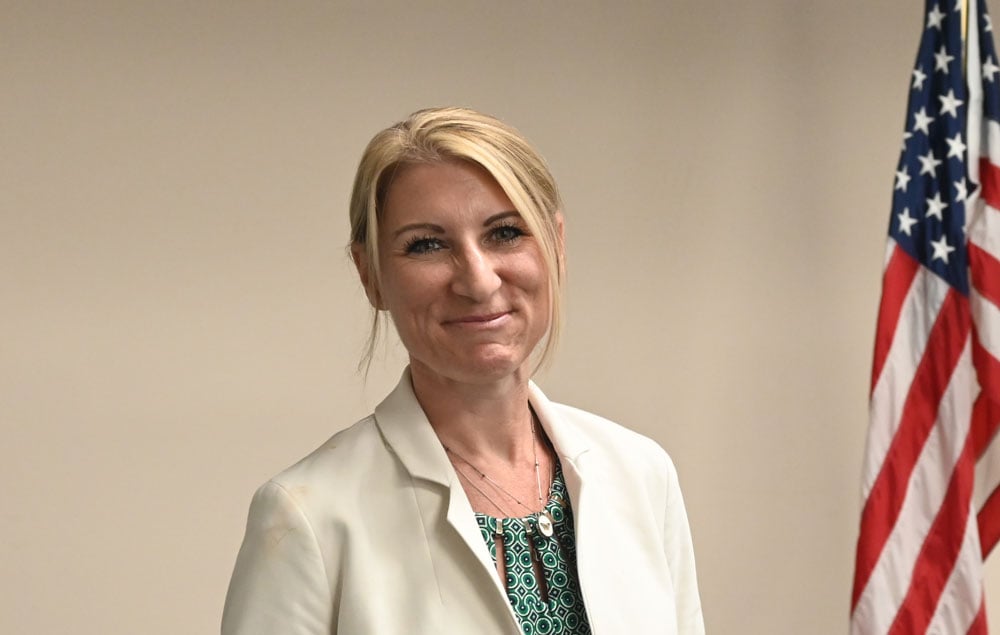
Theresa Pontieri is one of two Republican candidates for Flagler County Commission, District 2, an open seat this year: Greg Hansen has opted not to run again. Pontieri is running against Greg Feldman. Only registered Republicans may vote in the primary. Independent Raymond Royer is also running. The winner of the Republican Aug. 18 primary will face Royer in the Nov. 3 general election, when all registered voters are eligible to cast a ballot.
Two seats are up on the commission in this election cycle. Incumbent Republican Leann Pennington is defending her District 4 seat in the primary against Republicans Ana Jones and Drew Moss. Since a write-in candidate filed to run, it will be a closed primary, with only voters registered as Republicans eligible to cast a ballot.
Flagler County Commission members serve four years. They’re paid $77,000 a year, an amount that will likely go up by a few thousand dollars by next year. .
The Live Interview format changed this year. Since 2010, FlaglerLive had submitted identical questions to all candidates, enabling them to answer in writing. There typically were a round or two of follow-up questions, also in writing. Artificial intelligence has made that approach obsolete now that candidates can run the questions through AI and spit out prefab answers. To get around that, candidates were invited to a video interview. The video and the transcript are provided below.
The candidates were provided the same basic question within half an hour or less of the scheduled interview, but obviously not the follow-ups, which all differed. The questions to county commissioners are here.
Following the interview and before publication, the interview transcript went through two rounds of editing at this end, once by AI (yes, the irony is inescapable) for spell checks, copy editing and to smooth out verbal tics or repetitive words, and once by me for the same purpose. The candidates were then provided with the interview transcript and the video to review–not to make substantial changes, but to verify transcription accuracy, and, if they so chose, to add a postscript: if they felt they may have misspoken, or not clarified a point, or preferred to revise an answer, they were given that chance in the postscript, without changing the original text in the transcript. The postscript window is remaining open for subsequent additions, until the election.
The interviews can be quite long–not a surprise for a site pathologically incapable of brevity, but the county is awash in candidate quickies. We offer a little more depth, seeking to draw a profile rather than check off boxes. The Live Interview’s aim is to elicit as much candor and transparency as possible, and to learn about the candidate beyond the basics in what amounts to extended conversations about the person, the character and temperament behind the candidate, the candidate’s seriousness, and the issues.
The rest is in the reader’s hands.
–Pierre Tristam

Flagler County Commission Greg Feldman (Dis. 2, R) Theresa Pontieri (Dist. 2, R) Anna Jones (Dist. 4, R) Drew Moss (Dist. 4, R) Leann Pennington (Dist. 4, R) Flagler County School Board Cathy Moon (Dist. 1) Jill Woolbright (Dist. 1) Will Furry (Dist. 2) Rob Wood (Dist. 2) Christy Chong (Dist 4) Ron Long (Dist. 4) Trevor Tucker (Dist. 4) Palm Coast City Council Tony Amaral Jr. (Dist. 2) Jeani Duarte (Dist 2.) Jimmy Hengy (Dist. 2) Dylana Dee Galery (Dist. 4) John Kvederis (Dist. 4) Ramon Marrero (Dist. 4) Darlene Sheley (Dist. 4) The candidates' interviews will be live-linked the day their interview publishes. |
The Interview Themes in Summary: Quick Links
- Basics
- Preparation and Character
- Grading the Commission
- Goals
- The homestead amendment
- Sales tax increase
- Blaise Ingoglia’s claims of waste
- Consolidation
- Environmentally Sensitive Lands
- Beach management
- Public safety budgets
- County airport
- Rap sheet
- Postscript
The Video:
FlaglerLive: Well, Ms. Pontieri, good morning, and thank you for taking part in the Live Interview.
Theresa Pontieri: Good morning.
FlaglerLive: So we’re going to start right off from the very beginning. Can you tell us your place and date of birth?
Theresa Pontieri: Yes, Mountain Home, Idaho, February 7, 1985. I was born on the Air Force base. My parents got divorced when I was rather young, so my dad was in the Air Force. But just because they were divorced at a young age, from Idaho we moved to Cincinnati and then eventually made our way to South Carolina, where I spent my formative years.
FlaglerLive: How did you end up in Florida, and then particularly in Palm Coast?
Theresa Pontieri: I went to UCF, so I graduated high school in 3 years, moved down to Florida when I was 17, and have been here ever since. But I went to UCF for undergrad. I graduated with a bachelor of arts in legal studies, and then moved to Jacksonville for law school, and then kind of migrated my way down. I lived in St. Augustine for a little while, and then moved to Palm Coast after that.
FlaglerLive: Do you know the year you moved to Palm Coast?
Theresa Pontieri: Yes, I believe it was in 2015 or 2016. I’ve been here for about 10 years.
FlaglerLive: And what was the particular attraction of this town?
Theresa Pontieri: Affordability-that was a big part of it. Also, I have quite a bit of family that lives here. I have an aunt and cousins and second cousins, who I call my little nieces. So a good bit of family, and it also brought me closer to my family down in Tampa. They all live in the Tampa Bay, Saint Petersburg area.
FlaglerLive: What is your current job?
Theresa Pontieri: I am a partner in a law firm. I practice business litigation and family law, so I do anything from contract litigation to real estate litigation, and then am also a family law practitioner.
FlaglerLive: What is the name of the law firm?
Theresa Pontieri: It is Lesak, Hamilton, Calhoun, & Pontieri.
FlaglerLive: Do they ever intersect with city business?
Theresa Pontieri: Not really. I have clients that live in the city, sure, but city business, no. Obviously, I have to know when to put my attorney hat on versus my city council hat on, and I keep those very separate. So people ask me about certain things in the city, but when I respond to issues happening in the city, it’s city council. It’s not as an attorney.
FlaglerLive: What is your political affiliation?
Theresa Pontieri: I am a lifelong Republican.
See how Greg Feldman Responded

FlaglerLive: How have you prepared yourself to be ready to succeed from day 1 on the county commission?
Theresa Pontieri: So I think being on city council has certainly prepared me to hit the ground running as a county commissioner. I know when I became a city councilwoman, it was like drinking from a fire hose. There is so much to learn, everything from even what’s really important about this job is understanding government accounting and what you can actually do with certain revenue streams and tax dollars and the limitations to those, and really how they interact with the different fundings and how you can be more efficient and use the best money in the most efficient way possible to get projects done. So that’s a huge thing because it takes a long time to get anything really done in government. Unfortunately, when you have the benefit of somebody who’s experienced in getting things done within the system that we have to operate, that’s a huge advantage. So that’s an advantage that I have over both of my opponents now. But in addition to that, I’ve developed great relationships with the city and the county. I work very well with folks in the county, both on the board of county commission now, but also with the staff, I’ve developed great relationships with all of them. And in addition to that, I actually just came from an event where I got to interact with Representative Sam Greco and Senator Tom Leake. I’ve developed great relationships with them. I have their numbers in my phone and can contact them anytime we have any issues in the city and county, and I’ve developed good relationships with a lot of our federal partners as well. They’ve been very responsive to me and helpful. So whenever you have those relationships and you can leverage those in order to bring benefit back to your city and your county, that’s always a leg up.
FlaglerLive: I don’t think it’s very arguable that you have been very effective on the city council. But you’ve also been effective in general among our 39 elected officials. So it raises the question: Why would you want to leave at the end of your first term to go to the county commission when you are on track to potentially–certainly–be reelected or in two years be the mayor? Why would you leave? And also leave the city potentially in a lurch, since it would lose that experience and effectiveness.
Theresa Pontieri: This has been a really tough decision for me. I won’t act like leaving the city has been an easy decision. It’s been very hard because my heart is genuinely invested in the betterment of the city and in the future of the city. I get asked all the time why I don’t run for mayor, and I’ve said repeatedly I’ve never wanted to run for mayor, despite what a lot of people have said. You know that I was gunning for the mayor at times and all those things. That’s not true. I got asked to run for mayor last time around by a lot of people, and I’ve been asked this time. I hear all the time, “We’re going to support you, we love you, we want to see you on the county board, but truly, we wish you would run for mayor.” It’s not that I don’t want to lead the city and be the most effective that I can, but as you stated, I’ve been very effective in the seat that I have now. So I’ve never felt the need to be the mayor to have that title. We all have 1 vote. We all have an equal vote on that board, and at the end of the day, that’s what matters. Nothing else really matters. Being the figurehead for the city, I think, is important from certain aspects, certainly when it comes to economic development and being able to get things done in Tallahassee, because you need strong, reliable leadership to get things done, and positive leadership as well to attract people to the city and to the county, which I think that we’ve struggled with at times. But at the end of the day, if I can persuade 2 other people on that board to vote the way I want them to vote from the dais, I don’t need to be mayor. Now, my decision to go to the county is because I have been very frustrated at things at the county level that we don’t have any control of at the city level that I want to do something about, that I want to change, that I obviously can’t change because I’m on city council and I’m not on the county board.
FlaglerLive: For instance.
Theresa Pontieri: One of them is the taxes at the county level. I know it’s very frustrating for the board of county commissioners, because about 80% of their budget goes to the constitutionals, so it goes to your clerk of court, it goes to the property appraiser’s office, it goes to the sheriff. So it’s a big chunk of money that has to go to the constitutionals every year, and it leaves them only that 20% to really get other things in the entire county done. But I’ve been able to do a lot of really effective things at the city level to reduce taxes, to find efficiencies. So I want to use that experience and that ability at the county level to do those same things and to affect that same change. So that’s just 1 thing. But on a larger level, what we’re seeing at the state, and we’ve been seeing it for quite some time, is an erosion of home rule, and more and more power is being stripped from our local boards, so our county commissions, our city councils, and is being put in the hands of legislatures in Tallahassee. Some of it good, but I think the most of it not good. I think that government should control more on a local level. Just like I don’t want the federal government reaching into the state of Florida and telling us how to do things, I don’t want Tallahassee reaching into Palm Coast and Flagler County and telling us how to do things. I foresee in the future that city boards are going to continue to have power stripped away from them, and I think that county boards will be less affected by that. So when that starts coming down the pipeline, I want to remain effective, and I think that me looking into the future and using my, not just looking 6 feet in front of me, but looking 10 years in front of me, looking at what’s coming down the pipeline. I just want to make sure that I can remain effective and have a positive effect locally on my community, and I think I can do that more at the county level.
FlaglerLive: Why the distinction between the vulnerability of cities as opposed to counties?
Theresa Pontieri: If you just look at some of the things that we are unable to do at the city level because the county has more of an ability to do it. A good example is ESL funds, right? The city has no ability to control our environmentally sensitive land funds. Only the county has that ability. So when you get your tax bill, you see all these different things that your millage is dedicated towards, and actually ESL is one of them. Sales tax is another one. So there’s only a certain control that the—well, the city has no control over its sales tax. The county has some control over it. So things like that. The larger things that really affect, I think, from a financial standpoint, that affect our cities and our counties are done at the county level, not at the city level. Now, development, I think, is split. Development is both controlled by your city board and your county board. But when I talk about an erosion of home rule, the cities are really feeling that pinch right now. The counties are as well to an extent, but I do find that the counties still have a little bit more power because of the way they’re structured than the cities do, legislatively.
FlaglerLive: Don’t take this crassly, but does the difference in salary between $26,000 on the council and $72,000 on the county commission play a role in your decision?
Theresa Pontieri: Until you told me that they made $72,000, I didn’t know that. So no. Quite candidly, this job right now as city councilwoman is a second full-time job, and I think that if you do it right, it absolutely becomes a second full-time job. I work 30 hours at least in the city every single week, and I have a job that I work 50 to 60 hours a week. And so I get 5 hours of sleep a night, and I have a 2-year-old. It’s hard right now, and campaigning. I’m not going to lie, it’s been tough. So I do what I do now for 20 whatever it is that you just said we make. I apologize, I think 26. I don’t know to be quite honest with you. Based on what I could bill hourly as an attorney, I lose money being on the dais. I lose money as a city councilwoman, and that’s okay because I genuinely enjoy the job, and I’m very happy with a lot of the things that I’ve been able to accomplish. And I think that I’ve been able to really protect the city from a lot of bad things that have tried to get done at the city level. And I’m going to continue to do that. I’m going to continue to have what I call my spidey sense up so that I can protect the county and the city in the future as well. But no, the salary has nothing to do with it. To be quite frank with you, obviously more money in the household is always helpful. Of course it is, but that had nothing to do with my decision. No.
FlaglerLive: Tell us about a character flaw and how you handle misjudgments in office.
Theresa Pontieri: I think for me, a character flaw right now is I have an extreme lack of trust, and that can, I think,
FlaglerLive: In whom?
Theresa Pontieri: Really, in anything that comes before us right now. It’s not really—I guess it is, to an extent, a ‘whom’ because there are people who craft things and put them in front of us. There could be applicants for zoning changes, so developers. I mean, to be clear—
FlaglerLive: You’re not referring to the staff.
Theresa Pontieri: Well, so yes, to an extent, yes, and it’s not that I don’t trust my staff now. Our staff now at the city is exponentially better than it used to be, and there are some wonderful people on our staff, no doubt about it. I don’t have a trust issue from an integrity standpoint with our staff now. I had some severe trust issues with integrity, and I think bad intentions previously. But when documents get put in front of me, staff’s role is very limited. When they get an application, for instance, from let’s say a developer and their attorney for a zoning change, it’s not staff’s job and it’s not the attorney’s job to opine as to whether or not this is good or bad for the community. It’s their job to make sure it’s legally compliant with our process. So, in other words, is an application complete? Did they include all the studies that they have to include? So, really, they have a checklist, so to speak, and they have to make sure that the application that is submitted checks those boxes. And from a process standpoint, from a legal standpoint, does it meet those thresholds? Yes or no, and then it’s put in front of city council. But I have become very skeptical of the way things have been portrayed to us, and whether or not we’re being given all the information, and whether or not we have to ask certain questions in order to pull more information out. Because in the past, had I not gone down rabbit holes, there are very important things that we never would have been told, and that I never would have discovered. And so, the reason I think that’s to an extent a character flaw is I think that it comes off as me automatically thinking somebody’s bad, and it’s not. I don’t want people to think that I think they’re bad people, or that they’re trying to do something bad. But I feel like I have a pretty good pulse of our community. Not everybody in our community agrees with every decision I make, and that’s fine. I would never expect that. I think that’s an act of futility to make 100% of people happy 100% of the time, but I do know what our community on the large wants, doesn’t want, and needs out of their local officials, and a lot of times I don’t feel like what’s being put in front of us is necessarily in tune with that, and so I have to—I feel like scrape and dig and do all this extra work to kind of pull out the information that I need in order to make a decision that’s best for the community, and I think that that can come off sometimes as me being very negative, me being rather pessimistic, and that’s not it. And it could be that I’m not conveying it correctly, and I think that I could certainly work on the way that I convey my concern. It’s not coming from a bad place. It’s coming from a place that I feel like I have a job. I have a job to ask questions and protect the community, and I don’t mean to offend anybody in that process. But I think sometimes I do, and I need to probably work on that communication.
FlaglerLive: What you described, you use the word skepticism, and I think that’s the more correct word than a character flaw, because we do expect our elected officials to be questioning and to be, to some extent, adversarial. It’s their job. That’s what you have to do. And we’ve gotten too much used to the sense of rubber stamping that often takes place. You hear it from the public, and we sometimes see it in action on some boards. I would call that more of a professional responsibility than a flaw. I was more interested in something personal about you, in how that something in you affects your conduct on the board, and that might—you might sometimes think at the end of the day, “Well, this really interfered with what I was trying to accomplish,” and how you overcome that.
Theresa Pontieri: I think I’m very passionate about what I do, and I think sometimes I allow that passion to kind of overtake my analytical ability, my ability to kind of step back and say, “Take your passion out of this and try to look at it more objectively.” And I say that because there’s a lot of things that just hit me in a certain way where I feel like—and that’s the attorney in me. I represent people all the time. I have said numerous times that I feel like God made me an attorney because I can fight for people who can’t fight for themselves. And sometimes, even as an attorney, sometimes that passion to really represent people overtakes and maybe clouds my ability to look at things more analytically. And I do miss things sometimes because I am kind of overcome by that, “No, gosh darn it, we need to get this done,” and sometimes I probably don’t make 100% of the time the best decisions because that passion is overtaking that analysis that’s supposed to take place.
FlaglerLive: Who do you admire in office today in our county? Who would you consider among the elected officials on governing boards like yours, who would you consider to be a model of leadership?
Theresa Pontieri: I really respect Dave Sullivan. I think that he’s been wonderful, and he’s always very consistent. And I think that is one of the marks of a very good representative. And I use the term representative because I think that’s what Dave Sullivan has been. I don’t feel like he is a politician. I genuinely feel like Councilman Sullivan has been a representative. If you look at the decisions he made at the county level, they were very consistent, and he’s been very consistent on the city board. He and I were talking the other day, and I asked him, just generally speaking, “How is it that you just kind of keep your cool all the time on the board?” And he said, “I’ve lived a lot of life.” He said, “I was really fiery when I was your age, and I understand why you’re fiery, but I’ve lived a lot of life, and I don’t need to be fiery anymore.” And I’m like, “Man, can I get there sooner, please? Because I’d like to just be that cool and relaxed.” And he just seems very level-headed. He listens. He genuinely cares. He’s a veteran. He’s lived a lot of life. He’s got a lot of wisdom, and I really admire what he’s been able to do.
FlaglerLive: Temperamentally, who do you find yourself aligning with on the county commission? Temperamentally, I don’t mean politically.
Theresa Pontieri: I think it’s probably a cross between Andy Dance and Kim Carney. I think I sometimes tend to be very assertive in the way that Commissioner Carney is, but at the same time, I think I carry a level of empathy in the way that Commissioner Dance does.
FlaglerLive: Surprised you don’t mention Leanne Pennington.
Theresa Pontieri: Leanne and I are actually very different. Our representative styles and our persuasive styles, our advocacy styles are very different. Her and I are very aligned as far as policy goes, but the way we convey them and get things done is entirely, I think, pretty opposite, actually.
FlaglerLive: We know you are close. You know each other. You campaign together. Do you think that that might actually be a problem on the commission where you might clash?
Theresa Pontieri: No. Leanne and I disagree about things now, and we talk about why we disagree and listen. Not on my own board obviously because of sunshine, but on other boards, not just the county commission. I’ve spoken with other representatives in the community in the county on things that I’ve disagreed with, decisions they’ve made, and decisions I’ve made that they disagreed with, and also stakeholders in our community as well, attorneys in our community, people have just come up to me and said, “Why did you say this?” or “Why did you do that?” We have very professional conversations about it, and I think at the end of the day, Leanne Pennington is a consummate professional. And when you get to a level where you can respectfully disagree and engage in respectful discourse the way it should be, clashing doesn’t really occur. I think healthy discourse is necessary in government, and I’m sure that we’ll engage in that. But I don’t have any concerns that will, to use your term, clash.
 
See how Greg Feldman Responded.
FlaglerLive: What grade would you give the county commission?
Theresa Pontieri: I don’t armchair quarterback, and I certainly don’t Monday morning quarterback. What I will tell you is, I think the county commission is operating on a level now where they seem to be more in tune as a whole with what the community wants and needs. I think in the past there have been some people on the county boards who have been more politician-like than what we currently have on the board. I think right now what you have on the board are truly people who want to serve, and that is the most important. We need people who want to serve, and I respect the county board right now because I genuinely believe, regardless of me agreeing or disagreeing with some of the decisions and policy positions of each one of them, I truly believe that each person on the county commission is there to be a servant leader, and that I highly respect.
FlaglerLive: Can you venture a grade?
Theresa Pontieri: No, I’m not going to give you a grade. I’m sorry. I very rarely decline to answer a question directly, but I just, I really don’t know. If there was a letter grade, I think there’s so much gray. I’ll tell you what. I won’t give them an F or a D or a C, and I think they’re probably maybe a B. And I only say not an A because there’s always room for improvement, and I think one of my frustrations with the county board is I think they could be more pointed in the decision making. Sometimes it feels like we’re just kind of constantly hitting the brakes and really afraid to make a decision because it’s going to be controversial or it’s going to be a tough decision, but that’s our job. Our job is to make tough decisions every single day. That’s why I think you have to have a certain skin for this. You have to have a certain compass. You have to know, in my opinion, to be a successful representative, you have to be very assured of yourself and your compass and your policy position, you have to be consistent with that. And so sometimes I feel like on the county board, it’s like they know what they want to do and they’re kind of leaning a certain way, but they’re afraid to just do it. And so that’s kind of my frustration sometimes. I think the public actually feels that frustration sometimes from them as well, so I think they do a great job. Like I said, I respect everybody on that board. Only for the purposes of always having room for improvement, I would give them a B. I guess you pulled it out of me.
FlaglerLive: Well, the follow-up to that was to explain with some examples of where their flaws are and where they excel, and you’ve explained to some extent where you see some flaws in their indecision or at least getting to a decision. Is there another example? And then can you say where they have excelled?
Theresa Pontieri: Where they have excelled is I truly do believe they are trying very hard, and they have done some good things as far as infrastructure preservation, taking care of our farmers, which is incredibly important for the county. Very, very important. I think in those areas they have excelled financially. I feel like we’re getting there. We’re getting closer to tightening up our financials. I do believe that the decisions they’ve been trying to make over the past couple years, too, have very much been grounded in what do our residents really want, not what special interests want or stakeholders that have this name—stakeholders who we don’t even really know who they are. It’s this amorphous term. Well, all of the residents are stakeholders, and I think sometimes that’s forgotten. I don’t believe it’s forgotten by this specific board. Where I think, if you want a specific thing that’s been frustrating for me, it has been the beach management. The beach management has been incredibly frustrating for me, and the reason for that is not the board’s fault; it’s staff’s fault.
But I want to be very clear on this answer. I don’t want to fault current staff because I do think current staff is now moving in the right direction. But for a long time, I feel like that board was spinning its wheels because it didn’t have the data that it needed to make decisions for the beach management, and that was incredibly frustrating to watch.
FlaglerLive: It sounds like the one missing factor here in the staff today versus yesterday is Heidi Petito. Are you saying that it was Heidi Petito who was causing that issue?
Theresa Pontieri: Well, Heidi Petito is not the only person that’s no longer on staff now. I do think, I want to make sure I’m very clear about this. Jorge Salinas was a wonderful man. I believe he was an incredible asset to the county. His shoes, I don’t believe, will be filled in my lifetime. What a great person and a great mind.
FlaglerLive: There may be very many readers or listeners who might not know, but he died in a crash last October with his wife.
Theresa Pontieri: Yes, he was the deputy county administrator, and unfortunately, he was taken from us and his family way too soon, very tragically, and it left a void, like I said, that I don’t believe we’ll ever be able to fill. But Heidi Petito is not the only person who’s no longer on the staff. But I think collectively there should have been certain data points and studies and information that should have been either acquired from a consultant or internally maybe, you can’t expect a board, and I have these frustrations too on the city council. You can’t expect a board to make decisions when they don’t have all the data they need, particularly when we’re talking about millions of dollars over a long period of time. And I feel like the board at times has been put in that position very unfairly. Where I say my frustration with the board comes in is the ability to tell staff we need more information. This is specifically what we need, and to give that policy direction because what I think a lot of people don’t understand is the difference between your staff and your elected board is that your elected board gives the policy direction and the instruction for staff to then go out and execute. So if the staff is not given very specific direction and is not told, “Listen, these are the data points that I need in order to make this decision,” then staff is kind of left going, “Okay, well, what do we do now?” At the same time, it’s also staff’s job to try to anticipate the needs of the board and try to bring to them options and say, “Look, option A would require us to look into A, B, C. Option B would require us to get X, Y, Z study.” So it is a team effort, and I just feel like with this beach thing, it’s been very—I’m going to use a term that maybe some people may not like, but I feel like there’s been decision constipation over and over and over on this thing, and it’s like we need to fish or cut bait here. Let’s make it happen, and that’s that. But again, that’s my style. It’s not everybody’s cup of tea, but that’s how I am. I’m very, “Look, this is what we need. Let’s make it happen, or let’s not.” But we got to make a decision and figure it out.
FlaglerLive: From your perspective, where you’re sitting, and given that you had experience dealing with chief executives at the government level, how would you judge or evaluate the semi-firing of Heidi Petito?
Theresa Pontieri: I put this in the same bucket as I do with regards to the firing of [former Palm Coast City Manager] Denise Bevan. I think that both women are nice women. I really liked Denise a lot. Denise was thrust into this position, and I think that she did—I think her integrity was in the right place, but I do feel that she was not suited for that position, and I feel the same way about Miss Petito. I don’t feel she was suited for that position, but I also do not agree with the manner in which either one of these women were terminated.
FlaglerLive: You voted against terminating Bevan, as I recall, at the time, right?
Theresa Pontieri: I did because of the manner in which it was handled. If I am going to terminate an executive, I am going to tell them ahead of time. I want to let you know that on this date, I will be moving to terminate you for 1, 2, 3 reasons, whatever those reasons are. That did not happen with Denise, and I felt horribly for her. Nobody should be terminated in that manner in public like that, particularly when they are a person of integrity. Denise put her heart and soul into that job, and whether or not she was qualified to make some of the decisions that she made is definitely something that needed to be addressed, but there’s a better way to deal with people. And at the end of the day, these are people that we’re dealing with, and they deserve a certain amount of respect for the hard work that they’ve done. So I agree that we need somebody else in the county position. I don’t think that Miss Petito, particularly when we’re looking at the budget and what might be coming down the pipeline from Tallahassee with property taxes, I don’t feel that she is the right person for the job, but I also don’t agree with the way the termination was handled.
See how Greg Feldman Responded.
FlaglerLive: Let’s talk about goals. A couple of goals that you do consider yourself aligned with that the county commission is following through with right now, a couple of goals you disagree with, and then a couple that you will bring individually to the commission.
Theresa Pontieri: Yeah, I agree with what they’re trying to do with the budget right now. They’re having what I think are some of the best budget discussions they’ve had in the last 4 years, really drilling down very closely on the numbers, having some really tough discussions. I know, an example, nobody wanted to cancel the adult daycare. Nobody takes joy in eliminating programs like that. But those are the tough decisions that people get elected to do, and sometimes when we’re talking about making sure we don’t have flooding on certain roads out west like they do, versus having an adult daycare that isn’t frequented by a lot of our community very often, and I think really, too, where else could we use those monies, or how can we enter into a public-private partnership, which I think is something they’re working on now, in order to enable a program like that to keep going. So with regards to how they’re starting to look at the budget, I am very encouraged by the exercises that they’re currently undergoing. I also think that they have approached the way they’re analyzing development as of late the right way as well. Before I got on the board, my city council, and before—so 4 years ago when myself and Miss Pennington took our seats, these boards had rubber stamps for development in their pocket. I’m just going to call it like it is because that’s the truth. There wasn’t a development that came across my board’s dais that they didn’t like, and it was very frustrating for the residents. We’re dealing with those repercussions now, and I feel like that, not to the same extent, but to an extent that was happening at the county as well, and that hasn’t been happening. There are always going to be controversial developments that come before the boards, and there’s always going to be a group of people who don’t want to see a certain amount of development. But at the end of the day, the correct analysis is legally, what do we have to analyze from a legal standpoint when we’re talking about approval or disapproval? What do we have to analyze? That’s the first thing. The second thing is, are certain things going to be done and negotiated by the developer between the developer and the board to make the development more palatable and more positive for the community? Are there going to be public benefits? Is there going to be certain preservation? Are there going to be sufficient buffers? Those are things that can be done between the board and the developers and negotiated both on the dais and during meetings off the dais because a lot of work is done before we ever hit the dais, or at least it should be, to make sure that legally we’re not denying something that we can get sued for, but when that development ultimately comes to fruition, is it something that’s going to benefit the community? Will the infrastructure needs be addressed and complied with? Will impact fees be sufficient? All of those things, and I think this board has worked overtime to make sure they’re engaging in those conversations. And I think our board currently, the city council board currently is doing that as well, where you didn’t see that in the past. There wasn’t a whole lot of pushback on developments or developers 4 years ago. So they had their prime time, so to speak, and I think the boards in the last 4 years have been very different.
FlaglerLive: So, a couple of goals that you would bring to the table.
Theresa Pontieri: Yeah, so I think my ability to, as an attorney, my ability to look at documents and pick out minute details that other people just are not trained to pick out, and that’s just it is what it is. You go to law school for a reason. You learn how to analyze and anticipate and try to look, like I said, not just 6 feet in front of you. I tell my clients all the time, “My job is not to make sure the contract that you enter into today is a good contract. My job is to make sure that 10 years from now, 20 years from now, this contract is still a good contract for you.” My job is to anticipate the issues that could arise and to get ahead of them before they ever happen, and to prevent you from being injured before they ever happen.
So my skills in doing that are what I bring to the table, and when I say I’ve been able to protect the city from some bad things that have come down the pipeline, it’s because I’m an attorney and it’s because I think that way. One of the things is in our LDC right now, our land development code, we’re undergoing amending our land development code, and I have said numerous times that in that land development code, and this is true for the impact fees as well. When we were entering the ordinances for the impact fees, there were a lot of instances where staff, particularly the land use administrator, could override or make decisions without board approval, and I immediately raised the red flag and said this should not be the case. Bureaucrats in city hall or in the county building should not be able to make decisions like this, taking it out of the elected officials’ hands because essentially you’re taking it out of the people’s hands when you do that. So finding little details like that when we’re talking about legislation, and that’s what an ordinance is. It is local legislation. When we are enacting local ordinances, it’s very important that those details are paid attention to because that’s what really protects the residents. And I don’t fault anybody for not catching some of those things previously, they don’t have the same training that I have, and I’m not going to be shy about that ability and that talent because I think it’s very valuable.
FlaglerLive: You’re describing your analytical method. I was hoping you might give us sort of a big picture goal, like something you would put on the strategic action plan for the city, the same thing that you would do for the county, that you yourself would originally bring to the table.
Theresa Pontieri: As far as a goal for the county, I’ve said this over and over and over. It’s got to be economic development. I want to make sure that we are investing, and we’ve been doing that on the city level for the last—well, last year we did it, and hopefully we’ll do it again this year. But truly investing in economic development, and I mean coming up with an economic development strategic action plan. We have feasibility studies that show us what type of industry and economic development would work here. But we haven’t taken that next step to say, “Here’s the economic strategic action plan for the county.” We did it with Parks and Rec, right? The city and the county entered into a Parks and Rec master plan. We don’t have that for economic development, which is crazy because it’s so important that we focus on economic development, that we invest in economic development, and that we start—this is a long process. I was talking to our economic development director about it at the city level, and he said, “Vice Mayor, the most frustrating thing for me is that it takes 20, 30 years to really have a plan and then start to truly see the economic benefits from that plan.” So we got to start. We should have started years ago, but at least we can start it now, so that we can start to take the tax burden off of the homeowners and really start to bring in, not commercial dollars—there’s a difference—but economic development dollars.
FlaglerLive: Before explaining that difference, you say “invest.” What concretely do you mean by investing in economic development?
Theresa Pontieri: For instance, for a general fund, a municipality or county should invest anywhere from 1 to 3% of their general fund monies into just economic development. So according to incentives—
FlaglerLive: For instance—
Theresa Pontieri: We’re doing incentives at the city level. At the Promenade, for instance, this is just a small example. If a restaurant wants to come into the promenade, but they can’t afford a $250,000 grease trap, perhaps an incentive will help them do that. And I use that example because I’ve heard it from a lot of restaurateurs. This is one of the hardest things for us: being able to pay for these things that are required by code, because ultimately what happens is that brings in both active economic dollars and passive economic development dollars. People are spending money in the county, so those are small investments. But when we look long term, we really got to talk about workforce development and the education pipeline. So what I would like to see is, and we have the industrial development authority. I think that’s been a wonderful step. Now, speaking of a decision that I agree with from the county, creating the IDA, the industrial development authority, has been wonderful. I wish they actually had a little more power to do—they feel very—
FlaglerLive: Restrained. They do feel [limited to] a very specific, particular mission, and they wanted to act more like the Economic Development Council that we used to have, but that was disbanded several years ago.
Theresa Pontieri: Yeah. So I would like to see them have a little more ability than what they currently have, but I do think the creation of that board was a very good first step. So I commend our county board for doing that. But we really need to get our colleges, our healthcare providers, our chamber, our school district—we truly need to get all of these minds around the table and figure out a plan. Probably at least it needs to be broken up. So what are your 12-month? What’s your 12-month plan? Your 5-year plan? Your 10-year plan? Your 20-year plan? To truly go after certain sectors, very specific sectors based on what those studies have told us, and put a plan in place to bring those industries here and create the workforce so that those industries want to come here because they’ve got workers here. Now, along with that comes the creation of a housing product that can house a lot of the students that may be undertaking that endeavor to earn those degrees. So that’s why I say this can’t happen in silos. This has to be an all-hands-on-deck approach, and it will take a strategic action plan to get there because this isn’t a linear initiative. There’s a lot of tentacles to it, and you got a lot of moving parts. It can be done, but it’s going to take a strategic action plan to get there.
FlaglerLive: So to go back to something you said in the first part of your answer about examining developers’ requests before boards. You were saying that it takes a lot more questioning and examination of the details and the fine print. You did this with the E-section development by ICI, and a couple of the candidates that I’ve interviewed so far brought that up as a problem in the way that it was done. They said they did not have an objection to the end result necessarily, but they had an objection to the way we got there, and the way that from first reading to second reading, suddenly there were all these new elements that had never been brought up before—you’ve heard that already from the floor at the city council. But I’d like you to address that specifically. Why did the public get that? And I think it was fair that they raised—I raised the question myself. I was like, “Where did this come from, and why so suddenly?” So address that, and in what way was this fair at second reading without that having been discussed before?
Theresa Pontieri: It’s hard to Monday morning quarterback, and it’s really hard to Monday morning quarterback yourself to kind of look at what you could have done better, and certainly I think there could have been some things that were done better, and I think communicated better in that situation. I think the end result is still a fantastic result, and I stand behind that decision, and I’ll continue to stand behind that ultimate vote that I made. And—
FlaglerLive: What we’re talking about is all 71 houses would be more affordable to certain professions, right? Not just the 13 additional houses.
Theresa Pontieri: Correct. So for clarity, what is going to happen is these properties are going to be deeded to a nonprofit. The homes will be built at cost, and assistance to purchase and finance those homes will be provided for our frontline workers and our first responders. So our teachers, our nurses, our first responders—our backbone, part of a very strong vertebrae, we’ll say, of the community. So I, again, 100% stand behind the decision. Where I think we could have done better certainly is in the way that we communicated how we got there. I think all council members probably meet with applicants, so developers and their attorneys, oftentimes when they want to talk to us about something that we’re going to vote on. To be clear, we don’t meet—I never meet with another council member and any applicant. It’s always one-on-one because we don’t violate sunshine. But we meet because they want to say, “Hey, look, this is what I have. What are your issues with it?” And I tell them, “These are my issues with it.” Sometimes they are able to fix those issues before they come before city council. Sometimes they don’t, and my vote then happens accordingly.
I have been very clear, and I think very consistent as to how I have voted as far as development goes. In this specific situation, ICI reached out to me and said, “Hey, what do you feel about this idea? What if we agree to put these properties in a nonprofit and make sure they’re built at cost for our first responders, our teachers, and our nurses?” And I said, “I love that idea,” and here’s why, Pierre. I have said numerous times from the dais, and this is a policy position that I will not give up on: I will not subsidize housing. Our taxpayers should not be paying for housing, for affordable housing for other people. I am a very staunch believer in capitalism, in hard work. I don’t believe in subsidizing affordable housing. I do think that there should be a pathway for people to achieve—hold on, hold on. I think there should be a pathway for people to achieve a home and to purchase a home, and that’s what this program does. It’s not giving them a home. It’s saying we, as a private entity, are willing to build this home at cost and give you education and a pathway to pay for your own home. That’s the partnership that a city and a private entity, or a county and a private entity, should be entering into in order to help what is in fact an affordable housing crisis.
Now, here’s what I’ll also say, and I’ve said this too: the real estate market is cyclical; it goes up and down, up and down. We see prices drop. We see prices rise. So houses become more affordable based on different things in the market. It happens every 5 to 10 years to some extent. I grew up very humble. Okay, I didn’t own my own house until I was 30 years old. When you asked me earlier why I moved to Palm Coast, one of the reasons: I lived in St. Augustine in an 800 square foot condo that was fully furnished because when I got divorced the first time, I left that divorce with nothing. I didn’t even leave that divorce with my wedding ring. I gave everything away and said I’m going to start fresh. And I was just out of law school. I was just starting out my law firm, or I started my law firm shortly after that. So I didn’t really have 2 pennies to rub together. And so for a year, I lived in an itty-bitty little space with nothing to my name, not even a TV. But I made it work, right? And sometimes you have to do that.
I moved to Palm Coast because I loved St. Augustine, but I couldn’t afford to live in St. Augustine. So I bought a house here in Palm Coast that was built in 1982, and everything was original to 1982. I mean, it had purple tile and a tub in the bathroom. Okay, I mean it was 19—and my husband and I ended up gutting it and remodeling it. But you know, I didn’t even have a couch for months when I moved into my home, and so you do what you have to do to kind of get to where you want to be. But at the same time, we know we need certain people in our community to make things go round, and they’re very important. And unfortunately, because they’re paid by taxpayers like deputies and firefighters, and sometimes private entities can’t afford to pay their nurses what they should be paid. Some of the nurses working in the ER, their lives are incredibly difficult, and they don’t get paid enough. Sometimes our teachers, oh my gosh, they don’t get paid enough. So we have to create pathways for them to be able to afford to live here. And if we can partner with a private entity so that the cost of that is not falling on the backs of the taxpayers, sign me up. I will support initiatives like that. I know people were upset about the way that it was done because of a lack, I think, of communication as to how we got there. But when I say—and people have met with the nonprofit and have had conversations and have been convinced, “Wow, you guys actually are doing things the right way.” And I think that as we start to see this project come to fruition, it will be shown that yes, this was a really good initiative for the community, and while we could have been more communicative as to how we actually got there, how we got from point A to point Z, at the end of the day, I believe in the initiative itself.
FlaglerLive: You were very radical about not subsidizing housing, but how is the mortgage interest tax deduction not one of the most massive subsidies for housing that we have today?
Theresa Pontieri: So you’re talking about something on a larger level. I’m talking about a local, using local funds to subsidize local housing. I think that’s a little bit different. That’s something on a massive, larger scale that we have no control over.
FlaglerLive: But you’re not opposed to the deduction.
Theresa Pontieri: Well, no, because everybody’s entitled to it. I mean, everybody has an equal opportunity for that as a homeowner if it’s homesteaded and there are certain obviously things that have to take place. But I believe that certain things have to be earned, but there should be pathways that are provided to get there. If you’re willing to do the work and you’re willing to put in the time to get there, there should be a pathway for you to get there.
See how Greg Feldman Responded
FlaglerLive: So the homestead amendment, how will you vote on that?
Theresa Pontieri: I hate this question because I think that the way people vote should be up to them. But I’ve answered it. I will be voting yes, and here’s why. And I’m really glad to be able to talk about why I think property tax reform is necessary. There’s two reasons. One, the amount that you pay on your property taxes is not just determined by the tax rate; it’s determined by what the property appraiser says your house is worth. A really good example as to why that doesn’t work: in the last 4 years—well, the last 3 years I’ve been on the board, we have reduced the tax rate every single year. My first year in office, we did a full rollback. My second year in office, we reduced the tax rate. My third year in office, we reduced the tax rate. But because housing values continued to climb, people did not see a reduction in the amount of taxes they paid. So even though we said, “Hey, we’re going to cut the rate,” because the value of the homes were going up, they still paid more.
I don’t believe in that system. I don’t believe that because a tax appraiser says your house is worth more—you worked to buy that house, you may have put things into that home—you shouldn’t have to then pay the government more money because of that. I fundamentally don’t believe that we should be paying taxes on the home that we are supposed to own in this country. I don’t believe in that philosophically. However, we have to pay for things, right? We have to pay for fire, police, parks and rec, roads, public works. That’s a huge one that I think people don’t realize. Public works comes out of the general fund, which is funded by property taxes. Public works, they are the unsung hero of the city, I will tell you that all of that comes out of the general fund. We got to figure out a way to pay for that. Here’s why I believe in the tax reform and why I’ll be voting for it.
When you pay your property taxes, that money comes into the general fund. The general fund is this bank account—we’ll picture it as a bank account that we can really do anything with, the monies are not restricted. They’re called unrestricted funds. That means if I want to go buy a water park with it, and the board votes for it, we can go buy a water park with it. If we want to increase the sheriff’s deputies, which we’ve done over the past 3 years, we can increase the sheriff’s deputies. If we want to buy a fire station, you can buy a fire station, right? So really, depending on who you vote onto that board, they’ve got this kind of unrestricted pot of money that they can decide what to do with. I don’t agree with that. I think that that doesn’t provide for the right amount of transparency or accountability to taxpayer dollars.
What I think should happen, and what I think will happen if we see this property tax reform pass, is that you’re going to see more funding or revenue streams, revenue mechanisms that are dedicated to bringing certain funding in, and then in return, paying for certain things with that funding. Here’s what I mean by that. So, on your utility bill right now, you have multiple things. You’ve got your utility, you’ve got your stormwater, we’ve got the waste contract for waste pickup. All of those monies come into stormwater and they go right back out for stormwater. Certain monies come in for utility; they go right back out for utility. They come in for waste pickup; they go out for waste pickup. Those are called restricted monies. Those are our enterprise funds. If we can create more restricted revenue streams, that will provide for more transparency and accountability. So, for instance, one example is—and this is done with MSBUs, but I’m not a fan of MSTUs and MSBUs for different reasons—but like a fire assessment fee, okay? A fire assessment fee is a fee that would go straight to fire. It would get paid only for fire, so it comes in for fire, it goes out for fire. And I think, you know, people are calling it a tax shift. You can call it that. We still got to figure out a way to pay for things, but there’s more transparency and accountability in it, and that is what I want to see.
FlaglerLive: I don’t understand how you say that there’s no transparency in the general fund when we do have as much transparency in it as we do in the utility fund or in—
Theresa Pontieri: Yes, you can technically see where every single dime of the general fund goes, but it’s also on a spreadsheet and unless you’re really drilling down on the interfund transfers and things like contingencies, it’s actually very difficult to drill down on where every single penny goes. There is transparency from the standpoint of yes, the numbers are there, but there’s a lot more fungibility.
FlaglerLive: What you’re describing is an accounting problem that is entirely in the council members’ power to change. In other words, you can make it a policy that we want this general fund to be as readable as a first-grade book, and you could get to that, but you don’t have to revolutionize the tax system in order to get there. You can actually do that today, and you would have every single penny accounted for.
Theresa Pontieri: In November, the next board could turn around and change that. So that’s the other thing that I feel like needs to really be done, is there need to be more mechanisms for good policy to be—and I say this as somebody who I feel like I enact good policy. Somebody else could disagree and say, “No, I want to overturn all the things that you’ve done.” But what you’re describing, Pierre, is not something that, you know, the next board could come in and say, “No, we don’t want to do that anymore. We want everything to be very high level on the accounting sheets, and so we’re going to do away with what that board put in place.” The other thing, though, too, is what you’re talking about is really more on the management side of the organization. That’s really under the city attorney or the city manager’s purview. So, we give policy direction, and I suppose we could give the policy direction that every single penny has to be more explicitly accounted for. But I think what you’d find is that specific operational function is more under the purview of the city manager rather than the purview of the council. So that’s an important distinction as well.
FlaglerLive: You don’t see that the tax amendment’s success would also create the same shift towards state power as opposed to home rule that you want to defend so much?
Theresa Pontieri: Yeah, no, that is a concern. It certainly is a concern. That is the one thing—not the one thing. This bill is not perfect. Okay, I wouldn’t have written it this way, but I do think it’s a good catalyst to reform, and we need reform. Yes, I am very concerned about more state power being given to Tallahassee and being taken away from local communities, and I do find that this could be a power grab. I would hope that that is not the ultimate goal here, and I will not impugn our legislatures to that extent. But that is certainly a concern. Yes.
FlaglerLive: Can you think of an example of, let’s say, parks? How, if it passes, how will we fund parks under the kind of system you’re describing, which is those new siloed ways? Because we’re talking about—you do acknowledge that we’re going to need new revenue, new revenue sources.
Theresa Pontieri: Of course, of course.
FlaglerLive: So it’ll be your responsibility as a county commissioner to come up with those new revenue sources. Let’s say we need to take care of, even police. Let’s say police or fire and parks. How do these things get funded?
Theresa Pontieri: Well, they’re planning to carve out exceptions for police and fire, and you know—so those, all right, we can—
FlaglerLive: Let’s assume they’re funded, but everything else–so parks.
Theresa Pontieri: Parks. Yeah, no, that’s a big one. Obviously, parks are very important to the community here. You know, a lot of counties and cities have park passes. They put a sticker on your window, and you pay $30, whatever it is, a year to be able to access all the parks in the community. And you know, you have a park employee essentially that is hired by a city or a county, and they go around, they make sure everybody that’s in the parking lot has that sticker. I am not sitting here and acting like I have all of the answers on day 1. All of these things will have to be figured out. What I will tell you is, I will also not sit here and say I agree with the current system that we’re under. We can keep operating under the current system and say we disagree with it, or we can try to change the current system and make it better. And I do believe that there’s a way to make it better. Is this specific amendment the answer? I don’t know. What I do know is that it will be a catalyst for change, and that’s a change in the way we look at how we spend taxpayer dollars. It’s a change in the way, to your point, the way we fund it, and people can choose what they want to spend their money on, to an extent. In other words, I hear all the time, “Well, I don’t use this in the community, and I don’t use that in the community. Why are my tax dollars going towards it?” Well, maybe this will give people, the consumers, taxpayers, more of an ability to decide whether or not they want to use certain amenities in the community. And I’m not saying—I want to be very clear—I’m not saying that if this passes, I’m going to say, “Okay, everybody has to pay $50 for a yearly park pass.” But perhaps a solution like that will put it in the hands of somebody who says, “You know what, I don’t use our parks,” or “I walk the sidewalk in my neighborhood, or I live in a CDD that has a playground and a pool. I don’t need to pay taxes towards parks.” That gives them that ability to make that decision. There’s certain types of things that can be done.
FlaglerLive: But you’re severely fragmenting the meaning of community.
Theresa Pontieri: I don’t know about that either. To an extent, you could be correct. Like when you talk about schools, you know, I hear a lot of people who say, “Well, I don’t have any kids in the school system. Why does so much money of my ad valorem tax dollar go to the schools?” But schools are incredibly—education is obviously incredibly important for an entire community. I don’t think when you’re talking about something like parks and rec, if certain people choose—if they don’t use the parks, they don’t use the parks now. How is them not using the parks in the future because we institute some type of fee fragmenting community? I think the what’s at risk are people who can’t afford to pay that type of fee not being able to use our parks, but they’re likely paying property taxes now. And if they’re a renter, a lot of landlords are paying higher property taxes and are putting the property tax costs—they’re working it into the cost of that lease.
So ultimately, at the end of the day, most people are paying property taxes in one way or the other. Look, like I said, there’s no perfect solution. Government accounting, paying for government services, is always going to be a hot topic of conversation. It’s always going to be a challenge. I think the important thing that voters need to keep in mind, and that residents need to keep in mind, is who do you want at the helm of that decision making when those tough decisions have to be made. Do you want somebody who has a clear and steadfast position as to whether they’re willing to be creative, whether they’re willing to be bold, whether they’re willing to listen and figure out solutions, or do you want somebody who says, “Well, yeah, but I don’t want to do this because,” or a group of residents shows up and advocates against something, but you know it has to be done to provide certain services. So you have to make that tough decision to do it. You have to have the right decision makers in those seats because these are tough decisions. And like I said, there’s no perfect system, but I don’t agree with the system we have now. So what do we do?
FlaglerLive: You don’t trust so many different elements that come before you as a government official, but yet you’re going to be putting your trust in one of the most important means of keeping us coherent as a society in all those future elected officials to do the right thing of what you’re describing here.
Theresa Pontieri: What do you mean?
FlaglerLive: You have this lack of trust in how things are brought before you by city staffers, by people out in the community submitting requests, and so on and so forth. But you’re willing to entrust elected officials in a way that you don’t extend that trust to your own staff to reach the decisions that you’re describing that are going to be colossal, that are going to be very difficult in how to split that pie and ensure that all the services are funded fairly. That’s going to be on the back of elected officials to do, and you’re trusting them to do this, even though you have no trust for much smaller issues before you.
Theresa Pontieri: I want to clarify again: it’s not that I don’t trust staff to do its job. It’s not staff’s job to make policy decisions that the people want. It is staff’s job to make sure that applications that come before us have been legally vetted and are legally sufficient to come before us. I have previously had a mistrust in staff for not giving us certain information that I think should have been given to us in order to give us a full picture of what we are voting on. The staff that we currently have, I believe, has been working very hard to make sure we are given all of the information that we need to make decisions and making themselves available.
I meet with staff all the time because I ask questions and want to meet with them, and I do believe that they’re making themselves available to me and providing me the information that I ask for. So I want to clarify that. As far as this whole trust thing, the people will elect who they want making these decisions. So yes, when we have to make these decisions, am I putting trust in the electeds to make decisions that are tough decisions to make after the people have voted them in? Yeah, that’s our job. It’s not going to be perfect. We don’t make the right decision all the time. We’re human beings. But I do believe that when residents hear from their potential electeds, the candidates, and they understand, “Okay, these are the policy positions of these individuals, and I agree with this, or I disagree with that,” or look at their voting record, “I agree with what they’ve done, or I disagree with what they’ve done,” and then they vote on those officials.
Yeah, we have to put our trust in ultimately the will of the people to make those decisions. And one of the things that people have asked whether or not I agree or disagree with the amendment. I’m a Republican. We have a Republican House and a Republican Senate, and they said, “We want this on the Constitution. We want this to be voted on by the people.” So I support that. I have to support that because, first of all, our representatives in Tallahassee, Sam Greco and Tom Leake, are fantastic. They agree that this isn’t perfect, but reform is needed. So we have to have a way to get there.
See how Greg Feldman Responded
FlaglerLive: Sales tax—the county commission has flirted with it a few times, but it hasn’t raised it. So if it comes up again as part of this discussion we’ve just been having, would you support it—the half-penny increase?
Theresa Pontieri: It depends. I think if the property tax reform passes, we have to look at the budget as a whole, and figure out how we’re going to fund things. Here would be the unequivocal, absolute 100% no for me, is if it’s not dedicated funding. It would have to be dedicated funding. In other words, if we were to analyze the half-cent sales tax and say, “Okay, yes, we’re going to vote on it,” it would need to be specifically for infrastructure, specifically for public safety. I will never vote on a sales tax that acts as an unrestricted fund. It has to be dedicated, and not only would it have to be dedicated, but we’d have to make sure that it’s very hard to overturn. In other words, if we were to pass an ordinance putting the half-cent sales tax into place, we would need a supermajority or a referendum to overturn how that is dedicated. So if we as a board decide, “Hey, we’re going to do this specifically for roads,” then in order to overturn that, we either need a supermajority vote of the board twice now because you have to do it twice, or it needs to be on referendum. Sitting here today, I would say no. But if there is tax reform and we have to figure out how we’re going to pay for certain essentials, it’s going to have to be considered. You have to consider it. But I would only vote for it if it’s absolutely dedicated.
See how Greg Feldman Responded
Blaise Ingoglia’s Claims of Waste
FlaglerLive: Do you take Blaise Ingoglia, the CFO—do you take his claim of $59 million waste in Flagler County government over the last five years at face value?
Theresa Pontieri: I take nothing at face value. I’m an equal opportunity hard butt, so no, I don’t take it at face value. I know factually, the county was in pretty dire straits several years ago. They, as a coastal community, we have to have sufficient reserves. We did not have sufficient reserves. They paid off quite a bit of debt. So I think that that was a superficial analysis, and I use the term analysis rather loosely, of the funding. Here’s what I will say, though. And I did this looking at the city budgets. Post-COVID, we had an influx of residents. We had a rise in property values. We took in a ton of general fund money, and during that time there were no rollbacks, there was no effort. I think the tax rate stayed flat. It may have gone down a little bit—I don’t want to misspeak—but for the most part, I believe it stayed flat, even though we had quite an influx of cash. So I think probably a little more consideration could have been done at that time to see how the taxpayers could get a break based on that influx of money and the rise in the property values, kind of like we’ve done over the past 2 years. “Hey, property values have gone up. We’ve still had an increase in population. Let’s try to give the taxpayers a break and reduce the tax rate.” I think that could have been done back then, but to say that Blaise Ingoglia’s analysis should be taken at face value, absolutely not.
FlaglerLive: Your former colleague Ed Danko uses this site often enough to badger you a lot about your claim that you reduced the tax rate. Philosophically, I agree that the way Florida defines taxes and tax increases is flawed. But going by the way that the state defines it, the claim is that you reduced the tax rate, but you did not reduce taxes. You touched on this a little bit earlier, but how do you defend the claim under Florida law’s definition that you have reduced taxes when, in fact, the taxes, by that definition, have continued to increase over those years?
Theresa Pontieri: Well, first of all, as to Ed Danko, Ed Danko didn’t vote for the rollback, so I think that’s really important to keep in mind. He himself voted no. When we did a full tax rollback, he was a no vote. It passed 3 to 2. He was one of the 2. So for him to be commenting on my tax reform and the things I’ve done to keep taxes low is quite laughable, to be quite frank with you.
FlaglerLive: Just for the context of that vote, as I recall, I think that was—I mean, it was a mess, that meeting, that vote, and everything took place because there was the fear that the vote was really the first of two parts, with the second part being either the public safety, the public service tax, or the franchise fee that would have been right. And it may have been that the no vote was, “Well, I don’t want to be part of that double vote kind of thing because you’re just going to do rollback here, but you’re going to do the increase over there.”
Theresa Pontieri: He said, “I’m not going to rob Peter to pay Paul.” I remember it. The problem, though, with that behavior, is I think that he was unable to separate the two things and do what was best for the community, and wanted to have a talking point.
FlaglerLive: I personally think you were nuts to do rollback, and I think you were nuts not to do the fees, the franchise fee. I’ve always wondered why you didn’t do both those, and I’ve always sort of thought of rollback as, especially in the last few years, as irresponsible. But that’s very personal, and I don’t want that to interfere. I didn’t want you to interpret my explanation as in any way supporting his vote or not supporting his vote. I’m just trying to put context into the discussion.
Theresa Pontieri: No, I don’t take your questions and kind of prying a little bit in any way one way or the other. But what I will say is that the rollback was overdue, and it was overdue for the reasons that I already explained. In that post-Covid, we had an influx of population and a raise in the property values. Yet the city just kept on taking in the revenues and not giving much tax relief. So I think it was overdue. My issue, though, with kind of letting anybody—and I don’t want to pick on Councilman Danko, even though you’re right, he picks on me incessantly. I don’t want to pick on him. I think that generally speaking, though, you have to separate votes. You have to be able to say, “Okay, for this vote right here that’s in front of me, is this what’s best for the community? Yes or no?” And a rollback at that time, I believe, was overdue and what was right for the community. I separated that from the franchise fee; that vote is a different vote. They had nothing to do with one another. They didn’t depend on one another in any way, shape, or form. So I think it’s really important that anytime you’re voting, it’s more important to represent the people than to represent yourself. And in that instance, I think a talking point from him was more important than making the right decision. That happens sometimes.
FlaglerLive: Address the fact that under Florida law you have not reduced taxes.
Theresa Pontieri: So the tax rate has decreased obviously, but what people need to understand is out of their full ad valorem dollar, the city only gets 23 cents of it. Out of every dollar that people pay on their property taxes, the city only gets 23 cents out of that dollar. 45 cents goes to the county, 29 cents goes to the school district, and then I think there’s like 3 cents that go to random things here and there, like the Florida Inland Navigation District. So a lot of times it has nothing to do with anything the city does. It’s the county and the school district, and obviously the property values. Anyone who wants to say, “Well, she hasn’t reduced taxes,” let them say it. I know what I’ve been able to do. I know what I’ve done. I know that every time we roll back or we reduce the tax rate, staff and other members of the community say, “Why are you doing this to us? Why are you reducing taxes and taking away our ability to fund things?” I’m not taking away the ability to fund things. I’m asking you to be more efficient in the things that you’re funding, and I think that’s very, very important. In my opinion, I’m a Reagan Republican. I believe in federalism. I believe in a separation of powers. I believe in consistency. I believe that the government should fund core functions, not pet projects. Now, did I vote—I did vote to fight the splash pad litigation and to get the splash pad up and running because that amenity, there are people that come into the community from all—from the Tri-County area. I know people who come from Jacksonville, St. Johns, and Volusia into our city to go to the splash pad.
FlaglerLive: To be clear, you said you fought the splash pad litigation. You were supportive of the litigation that the city instituted, right?
Theresa Pontieri: Yes, I was supportive of the litigation and also supportive of getting it back up and running. Not only is it a good amenity for our families, but it also brings in tourism dollars. It brings in money into our community from outside of the community. So there are certain projects in parks and rec—amenities that are very important to me because they’re very important to our community. Overall, if you look at statistics as far as health in a community and all those things, parks and trails and all that are very important. But other pet projects, I have not supported. I’ve supported infrastructure. I’ve supported public safety. So I think that we need to really focus on those things, get back to that, and to your comment about the rollback was crazy, there are people who have told me that, and that’s fine. We did just fine. We did just fine. And what I do want to point out to a lot of naysayers about the tax reform, and I said this during the FCAR and the Chamber of Commerce forum: there’s been skepticism, “How are we going to pay for things?” I’ve heard all of these things before. We will figure it out. Again, it is a matter of having the right people making those decisions when that comes down, and when we did a full rollback, is it tough? Does it mean you have to make some tough decisions? It’s not just a tough decision for that year, because you are reducing revenues not just for that year, but for every year moving forward, unless and until you raise the tax rate back up. You’re changing culture. It’s about changing culture. It’s about doing more with less, and it’s doable. And I have to commend our staff because they do a bang-up job at it. Our staff is wonderful. We’ve got directors now who are very mindful of the taxpayer dollars, and we have one of the lowest tax rates in the state of Florida. They do a really good job with what we give them.
See how Greg Feldman Responded
FlaglerLive: Can you think of consolidated services now? If that amendment passes, can you think of some further services—not what’s already consolidated, because several are—but are there further services that could be consolidated between the county and the cities?
Theresa Pontieri: Yeah, there are two that come to mind. I think code enforcement, and also—I’m trying to actually do it now already. I’m trying to get the My HealthOnSite initiative kicked off the ground on the city level. The reason for that, and so for the readers and the listeners, at the county level, they have a health care clinic on the campus that employees can use. And the reason that is fiscally responsible is it drastically cuts down on the insurance claims that are made by employees by going to outside medical providers. There’s a lot that can be handled at this facility that otherwise costs a lot of money when you have to file an insurance claim or go through insurance. And our insurance monies have increased year after year after year. I think this year it was by like $800,000. It is crazy how much we spend on claims, and actually when we did this analysis, it showed—I asked staff, “If we bring My HealthOnSite for the city employees and their families, what will that save us in claims?” And from year One, it saves us almost half a million dollars.
The reason I say that’s consolidated is because what we would do is we would create another site because right now they have one site where the [Government Services Building] is, where the government services building is near the county. We would put another site on the other side of the city, and both the county and the city employees could use both sites. So you’ve got some cost-sharing that can occur there, and then you’ve also got some savings on the claims. The other area I think it can work is—
FlaglerLive: Before getting there, just to finish that thought: as a county commissioner, would you compel the sheriff to take part in this? Because he has just done the opposite. He has not wanted to be part of what you’ve just described. Would you say, “Well, you know, the savings are right in front of us. You really need to be part of the system.” And you, as a county commission, I’m not sure if you have the authority to, but would you compel him? Would you make the argument that he should be part of this along with all the other constitutional officers?
Theresa Pontieri: I would certainly encourage it. There are limitations as to what we can do as a county board when it comes to the expenditures that the constitutionals and how they actually spend their money. But I’d want to talk to the union. I’d want to talk to the members of the police union, the deputies union, to say, “Hey, what do you guys think about this?” And then I think that type of advocacy can be done as a county commissioner talking with the sheriff and the admin at the sheriff’s department in conjunction with also the union. The union needs to be a part of that conversation because they’re going to be the main users of a product like that. So certainly a conversation to be had, absolutely, particularly if we have tax reform. I think that when we’re talking about who’s going to have to make sacrifices and tough decisions, it’s everybody. Nobody is completely exempt from having to maybe change the way they look and think about things. So I think that, and I think code enforcement is another area. You know, we have some joint animal control initiatives right now. We all use the Flagler Humane Society, so I think that’s kind of an easy consolidation as well, and it makes sense to a large degree. When we’re talking about consolidating other services, I think I’d be maybe overstepping, being that I’m not a part of the county yet. But at first blush, I think those are 2 of the things that we could consolidate.
FlaglerLive: I’ve not understood the desire for the city and the county to split away from the humane society instead of reforming the society and consolidating all three services—animal control and sheltering—in a way that would help all three organizations and save money, presumably.
Theresa Pontieri: Well, the city’s not wanting to split away from the Flagler Humane Society, or at least I’m not, and that’s not what I hear from the dais. My specific frustration with the Humane Society has been a lack of planning for expansion. We’ve seen it. We’ve asked them, “What are your plans for expansion?” And it wasn’t until being pressed very hard by me over the past 2 years that we’ve actually started to see plans for expansion come to fruition. I think we’re going to need the Flagler Humane Society to expand. We’re also going to need a municipal and county shelter, and they will perform different functions. And we’ve talked about this during meetings—the different functions that they’ll serve. But particularly with westward expansion, we’re going to need both. So I don’t want to say there’s been a splitting away. I believe that there needs to be more accountability, and that there can be some better operational things to make the Humane Society better. But they’re their own entity; they’ve got to figure out a way to operate. We do have a contract with them. That contract will be up for renewal before my time is done. And I’ve made my position very clear on what I expect from them in order to get a contract renewal, so I don’t have a desire to stop working with the Humane Society, but I do think we need additional services.
FlaglerLive: So even with the new shelter that you’ve been discussing, that does not mean that it’s an end of the relationship with the Humane Society?
Theresa Pontieri: That’s not what I envisioned. It is not possible. It’s not feasible to do that.
FlaglerLive: I had misunderstood, actually. I had thought that it was to try to—because there had been a lot of criticism of the society.
See how Greg Feldman Responded
Environmentally Sensitive Lands
FlaglerLive: We come back to ESL, and of course the public here has been extremely supportive. I think one of the votes was 72% in one of the renewals. When you’re a county commissioner, should you be elected, you’re going to be sitting on the renewal, so that you’re going to be putting it on the ballot for the next 10-year renewal. So the question is: first, are you supportive of doing that? And second, do you think, as Kim Carney, the commissioner, has been talking about, its mission should change? For instance, should the beach be part of ESL or other things? And then the third part of this is we’re paying 12.5 cents per $1,000 right now. Would you be supportive of maybe raising that slightly? We’re not talking about a lot, but maybe 20 cents or something to that effect. So, if you could address those questions.
Theresa Pontieri: I won’t be in favor of raising it. I can tell you that’s the low-hanging fruit for me. I am supportive of the ESL program. What I want to do, though—and I met with county staff a few weeks ago. I met with Adam Mengel and also their financial services director, and we didn’t get to delve into this as much as I would have liked because we ran out of time—but I want to see an audit of the ESL fund to determine—and I think prior to us making a determination as to whether we will renew it, I think we need to do an audit of that fund and see very specifically how the monies have been spent and whether or not we should be looking to state and federal dollars to accomplish the same goals, rather than taxing locally. I can’t answer your question as to whether or not I’ll support renewal of it or not. I support the program itself. I’m supportive of preservation. And if an audit of the fund shows that we’ve been able to conserve properties, put properties into conservation that were—here’s what I think is very key. Are we buying properties that are developable, or are we buying properties that will never be developed? Are we buying wetlands that you can’t build on anyways? Because I don’t know that that’s the best use of taxpayer dollars.
If they can’t be developed on anyways, we’re never going to see development on them. I don’t think we should be spending taxpayer dollars on them. I don’t know the answer to that question as we sit here today. Now, if the monies have been used to purchase lands to protect them from further development, to pull them into perpetuity for conservation, then absolutely that type of program should continue. But I also, at the same time, would want to make sure, too, that there aren’t other grants out there. And this dovetails—this actually goes to one of the questions you asked earlier as to initiative. I want us to have a grant writer, just like I said for the city. We should have a grant writer. So I want to make sure that there aren’t other funding mechanisms that we can go after, rather than the local tax dollar.
FlaglerLive: They’ve been able to acquire 10,000 acres over the life of this program, but it’s typically been a combination of state and local dollars that have bought the various properties.
Theresa Pontieri: I get that. I think it’s really important, though, to make sure that there’s not more that we can do, and if we don’t have a grant writer that’s constantly out there looking for those grants—I’ll tell you this, and I think both the county and the city do the best job they can with grants, but nobody has the bandwidth. Nobody has the bandwidth to just be out there looking for grants and writing grants all the time, and there’s a ton of them. So I think we do need to—hey, that’s another consolidation service. Maybe we get a joint county-city grant writer. Why not? We’re going after a lot of the same initiatives, a lot of the same funding. So again, I like conversations like this because it does get your wheels turning, right? So there’s a way to get all these things done. And yeah, I want to see—I want to delve into the ESL accounting and see what has been purchased, and I believe in the initiatives and the goals of the program. I want to make sure the money is being spent the right way.
See how Greg Feldman Responded
We come back to ESL, and of course the public here has been extremely supportive. I think one of the votes was 72% in one of the renewals. When you’re a county commissioner, should you be elected, you’re going to be sitting on the renewal, so that you’re going to be putting it on the ballot for the next 10-year renewal. So the question is: first, are you supportive of doing that? And second, do you think, as Kim Carney, the commissioner, has been talking about, its mission should change? For instance, should the beach be part of ESL or other things? And then the third part of this is we’re paying 12.5 cents per $1,000 right now. Would you be supportive of maybe raising that slightly? We’re not talking about a lot, but maybe 20 cents or something to that effect. So, if you could address those questions.
Theresa Pontieri: I won’t be in favor of raising it. I can tell you that’s the low-hanging fruit for me. I am supportive of the ESL program. What I want to do, though—and I met with county staff a few weeks ago. I met with Adam Mengel and also their financial services director, and we didn’t get to delve into this as much as I would have liked because we ran out of time—but I want to see an audit of the ESL fund to determine—and I think prior to us making a determination as to whether we will renew it, I think we need to do an audit of that fund and see very specifically how the monies have been spent and whether or not we should be looking to state and federal dollars to accomplish the same goals, rather than taxing locally. I can’t answer your question as to whether or not I’ll support renewal of it or not. I support the program itself. I’m supportive of preservation. And if an audit of the fund shows that we’ve been able to conserve properties, put properties into conservation that were—here’s what I think is very key. Are we buying properties that are developable, or are we buying properties that will never be developed? Are we buying wetlands that you can’t build on anyways? Because I don’t know that that’s the best use of taxpayer dollars.
If they can’t be developed on anyways, we’re never going to see development on them. I don’t think we should be spending taxpayer dollars on them. I don’t know the answer to that question as we sit here today. Now, if the monies have been used to purchase lands to protect them from further development, to pull them into perpetuity for conservation, then absolutely that type of program should continue. But I also, at the same time, would want to make sure, too, that there aren’t other grants out there. And this dovetails—this actually goes to one of the questions you asked earlier as to initiative. I want us to have a grant writer, just like I said for the city. We should have a grant writer. So I want to make sure that there aren’t other funding mechanisms that we can go after, rather than the local tax dollar.
FlaglerLive: They’ve been able to acquire 10,000 acres over the life of this program, but it’s typically been a combination of state and local dollars that have bought the various properties.
Theresa Pontieri: I get that. I think it’s really important, though, to make sure that there’s not more that we can do, and if we don’t have a grant writer that’s constantly out there looking for those grants—I’ll tell you this, and I think both the county and the city do the best job they can with grants, but nobody has the bandwidth. Nobody has the bandwidth to just be out there looking for grants and writing grants all the time, and there’s a ton of them. So I think we do need to—hey, that’s another consolidation service. Maybe we get a joint county-city grant writer. Why not? We’re going after a lot of the same initiatives, a lot of the same funding. So again, I like conversations like this because it does get your wheels turning, right? So there’s a way to get all these things done. And yeah, I want to see—I want to delve into the ESL accounting and see what has been purchased, and I believe in the initiatives and the goals of the program. I want to make sure the money is being spent the right way.
See how Greg Feldman Responded
We come back to ESL, and of course the public here has been extremely supportive. I think one of the votes was 72% in one of the renewals. When you’re a county commissioner, should you be elected, you’re going to be sitting on the renewal, so that you’re going to be putting it on the ballot for the next 10-year renewal. So the question is: first, are you supportive of doing that? And second, do you think, as Kim Carney, the commissioner, has been talking about, its mission should change? For instance, should the beach be part of ESL or other things? And then the third part of this is we’re paying 12.5 cents per $1,000 right now. Would you be supportive of maybe raising that slightly? We’re not talking about a lot, but maybe 20 cents or something to that effect. So, if you could address those questions.
Theresa Pontieri: I won’t be in favor of raising it. I can tell you that’s the low-hanging fruit for me. I am supportive of the ESL program. What I want to do, though—and I met with county staff a few weeks ago. I met with Adam Mengel and also their financial services director, and we didn’t get to delve into this as much as I would have liked because we ran out of time—but I want to see an audit of the ESL fund to determine—and I think prior to us making a determination as to whether we will renew it, I think we need to do an audit of that fund and see very specifically how the monies have been spent and whether or not we should be looking to state and federal dollars to accomplish the same goals, rather than taxing locally. I can’t answer your question as to whether or not I’ll support renewal of it or not. I support the program itself. I’m supportive of preservation. And if an audit of the fund shows that we’ve been able to conserve properties, put properties into conservation that were—here’s what I think is very key. Are we buying properties that are developable, or are we buying properties that will never be developed? Are we buying wetlands that you can’t build on anyways? Because I don’t know that that’s the best use of taxpayer dollars.
If they can’t be developed on anyways, we’re never going to see development on them. I don’t think we should be spending taxpayer dollars on them. I don’t know the answer to that question as we sit here today. Now, if the monies have been used to purchase lands to protect them from further development, to pull them into perpetuity for conservation, then absolutely that type of program should continue. But I also, at the same time, would want to make sure, too, that there aren’t other grants out there. And this dovetails—this actually goes to one of the questions you asked earlier as to initiative. I want us to have a grant writer, just like I said for the city. We should have a grant writer. So I want to make sure that there aren’t other funding mechanisms that we can go after, rather than the local tax dollar.
FlaglerLive: They’ve been able to acquire 10,000 acres over the life of this program, but it’s typically been a combination of state and local dollars that have bought the various properties.
Theresa Pontieri: I get that. I think it’s really important, though, to make sure that there’s not more that we can do, and if we don’t have a grant writer that’s constantly out there looking for those grants—I’ll tell you this, and I think both the county and the city do the best job they can with grants, but nobody has the bandwidth. Nobody has the bandwidth to just be out there looking for grants and writing grants all the time, and there’s a ton of them. So I think we do need to—hey, that’s another consolidation service. Maybe we get a joint county-city grant writer. Why not? We’re going after a lot of the same initiatives, a lot of the same funding. So again, I like conversations like this because it does get your wheels turning, right? So there’s a way to get all these things done. And yeah, I want to see—I want to delve into the ESL accounting and see what has been purchased, and I believe in the initiatives and the goals of the program. I want to make sure the money is being spent the right way.
See how Greg Feldman Responded
FlaglerLive: The county airport—it’s an asset. It’s also, to some extent, a noise problem for those who live around it, and it’s a pollution problem to some extent. Again, what do you propose that the county should or can do, if anything, to address those issues?
Theresa Pontieri: I think what we need to do with the airport is make sure we are in fact utilizing it to the best of our ability as an economic development driver, and I do believe that it can be. We’ve heard it multiple times, and it’s true, we are to a very large extent preempted by the FAA with regards to noise pollution things like that. There are certain things that we can do, and I’ve worked with the county. The leases that we enter into with some of the flight schools, those leases to rent space, they can have certain restrictions worked into those leases, and it’s a private contract. So in other words, we can put in the leases that if you’re going to rent space from us, you agree to do certain things to operate a certain way. And my last conversation, my last meeting with [Airport Director] Roy Sieger and the deputy county attorney was that when those leases came up for renewal, they were going to try to work in some of those things. Now leases are contracts that are negotiated between the parties, right? So both parties have to agree to that.
FlaglerLive: Like restrictions on when they fly. For instance—
Theresa Pontieri: Yeah. So there are certain things from a private contracting standpoint that I think we can do, and that I believe they are looking into. But it stinks to have to say, “We’re preempted, there’s nothing we can do.” I think the only thing that we really can do is make sure we’re being very transparent about elevations. In other words, if we have data that shows that these planes are in fact taking off and landing and flying at the right and legal elevations, then we need to provide that data to the community. We need to show it. Maybe we have a dashboard that shows it. Whatever we can do to better educate and to provide that information, that transparency, I think is very important. I get emails on the airport. The city absolutely can’t do anything, and there’s people who say, “Oh, well, you could have noise ordinances.” No, we can’t do anything. I’ve looked into it. I’ve spoken to private aviation attorneys. I’ve gone to that extent, and there’s nothing we can do. But making sure that we’re not sitting back on our laurels of just being able to say, “Yeah, we’re preempted,” and making sure that if something is happening that shouldn’t be happening, that we’re not jaded by it, and that we actually do address it. Having some type of transparency dashboard or offering that technology that we know exists to show where these planes are elevation-wise, I think that’s really important. Just so that the community knows, “Hey, we hear you. We’re monitoring these, but as it stands right now, what is currently occurring is legal, and there’s nothing that we can do to stop it because the FAA truly governs this area of the law.”
See how Greg Feldman Responded
FlaglerLive: The last question you’ve seen it before. That’s the legal question. If you’ve ever been charged with a felony or misdemeanor anywhere in the state, in Flagler, Florida, the United States, other than a speeding ticket, or faced a civil action other than a divorce, but including bankruptcies or civil litigation.
Theresa Pontieri: Yes, I got a DUI when I was 19 years old. So I’m going to tell my age—21 years ago.
FlaglerLive: Or you revealed your age at the very beginning. Remember?
Theresa Pontieri: That’s true. Yes, I gave you—it’s been a long interview. Yeah, I did actually, 1985. So yeah, over two decades ago.
FlaglerLive: And where was that?
Theresa Pontieri: When I was in college, it was in Orlando when I was at UCF. The one thing that I’m very thankful to God for with that is that I didn’t hurt anybody or myself. I made mistakes in my life, and what I’ll say about this one is, God has a plan for my life, and my life would have taken a very different direction had I not gotten the DUI. It changed a lot of things, and I wouldn’t be sitting here in front of this computer doing this interview today had it not been for every single thing that’s happened in my life along the way. So, the DUI taught me a lot of really hard lessons. I definitely wish that I had not made that bad judgment call that night, but I learned from it and I moved on.
FlaglerLive: To be clear, you’re not recommending that people get DUIs to have life lessons. You know how things can be misinterpreted.
Theresa Pontieri: No, drinking and driving obviously is—it’s an epidemic in our country, actually. And like I said, the one thing that I am very, very, very grateful for is that that evening I didn’t harm anybody or myself.
FlaglerLive: Any professional demotions, professional board sanctions, disciplinary issues with the bar, anything like this?
Theresa Pontieri: No, sir.
FlaglerLive: And so that’s about it then. It wraps it up. So thank you very much for the time and the detail. And I really do think that those conversations are to me very educational and enjoyable, but thanks a lot for setting aside all that time for us.
Theresa Pontieri: Yeah, of course, and I’m happy to speak with anybody who wants to delve into any of those issues more. I always make myself very available, and people can email me at [email protected].
See how Greg Feldman Responded
Theresa Pontieri: I am committed to making the greatest possible positive impact for our community, and I believe that long-term, meaningful progress can best be achieved at the County level. My experience in government budgeting, intergovernmental coordination, land use, and constituent service uniquely prepares me for this role and distinguishes me from my opponents. I have consistently fought against unchecked overdevelopment while remaining focused on the core responsibilities of government: public safety, infrastructure, and strengthening our local economy through responsible economic development and job creation. This position requires difficult decisions, sound judgment, and steady leadership. I have demonstrated that I can approach those decisions with consistency, level-headedness, and careful analysis, always guided by the best interests of our residents. I will bring that same commitment, discipline, and resident-focused leadership to the County level.






















Keep Flagler Beautiful says
She lost me at “Dave Sullivan,” who was so often rotten Joe Mullins’ minion. If that’s her role model, NO THANKS. That lineup of commissioners was a wrecking crew. Flagler County does not need more of the same. What the commission could use is another Leanne Pennington or Andy Dance.
Standing in the Middle of Palm Coast Parkway says
Is there any reason that the sections titled ‘grading the Commission’ and ‘The Basics’ are the same content? Did the candidate not grade the commission?
FlaglerLive says
That was FlaglerLive’s editing error. It has been fixed.
Standing in the Middle of Palm Coast Parkway says
Excuse me, Commissioner Pontieri, but how does a free splash pad at a public park increase tourism?
This interview is yet another example of how candidate Pontieri is a do-er but not a builder. She said, “It’s not that I don’t trust staff to do their job. It’s not staff’s job to make policy decisions that the people want. It is staff’s job to make sure that applications that come before us have been legally vetted and are legally sufficient to come before us. I have previously had a mistrust in staff for not giving us certain information that I think should have been given to us in order to give us a full picture of what we are voting on.”. Whose job was it to hire and train that staff? This Commissioner isn’t doing that. Maybe it was the City Manager’s job, but this commission has yet to hire a city manager who can prove they can hire and train people.
Her answers regarding economic development seem to suggest that it’s still someone else’s job. All the storage facilities that the commission approved were the staff’s fault?
Over and over again. Candidate Pontieri is saying things in this interview that prove she needs to spend more time in Palm Coast and abandon this run for county office.
Ed Danko, former Vice-Mayor PC says
Thank you Flaglerlive for calling “Tax & Spend Theresa” out for her false claim of lowering taxes every year since being in office, and her failed scam to impose a FPL Franchise Fee on electric bills through the use of a “bait & switch” mileage tax rate rollback scheme. As you can see for yourself, when her lips are moving, she’s lying!
Ed P says
Insightful, impressive and worth watching the entire interview.
The format brings the candidates into focus.
Ps. Hands down more informative than every caucus, political dinner or meeting I’ve attended, combined. I urge everyone to take advantage of this opportunity before casting your ballots.
Atwp says
I thought she was a Democrat.
jnlocal says
These interviews are so helpful! FlaglerLive asks great in-depth questions and I have enjoyed the interviews with both Greg Feldman and Theresa Pontieri. Looking forward to the rest of the series, thank you FlaglerLive.