




The Florida Department of Children and Families verified three cases of child victims of commercial sexual exploitation, or child prostitution, in Flagler County in 2025, 14 cases in Volusia, five in St. Johns and two in Putnam, the four counties that form the Seventh Judicial Circuit.
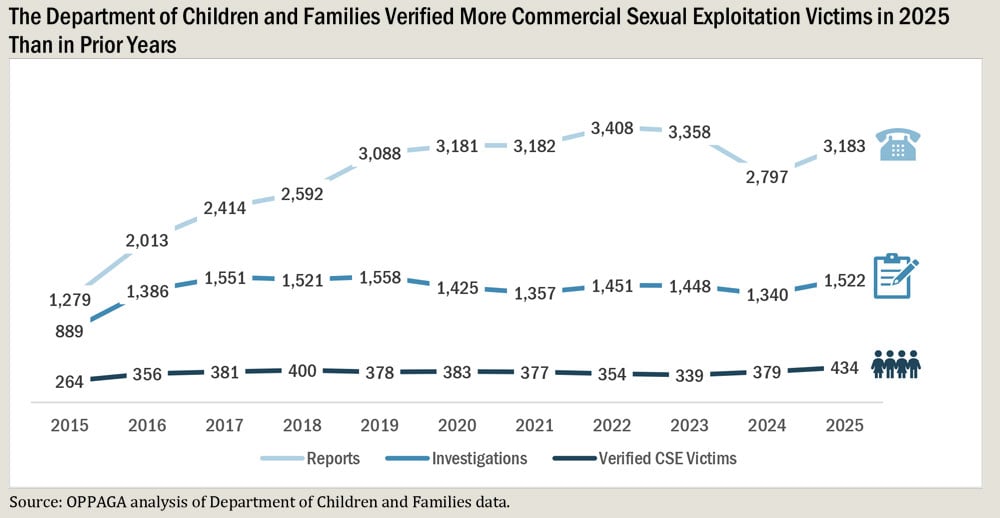
In Flagler, Volusia and St. Johns, the identifying agency was the Community Partnership for Children. DCF verified 434 children as CSE victims statewide, the largest number in one year since the number started getting tracked 10 years ago. There were 379 verified cases in 2024 and 339 in 2023.
The increase is not necessarily due to an uptick in the actual prevalence of child exploitation but to better identification of human trafficking and a more coordinated response among state and local agencies to reports of exploitation, according to DCF, including enhanced training for investigators, case managers, and law enforcement.
The figures and conclusions are part of the 2026 report on “Commercial Sexual Exploitation of Children” by the state Office of Program Analysis and Government Accountability known as Oppaga, the nonpartisan research arm of the state legislature.
Oppaga is recommending that the Legislature and state agencies expand access to safe foster care–which requires money–and require better two-way information sharing between DCF and the Department of Juvenile Justice, which is lacking currently. The Baker Act Data Collection System was also found to be lacking, all of which means that keeping track of exploited children or those at risk of being exploited remains more difficult than it should be. Oppaga is also recommending that DCF expand child victims’ access to survivor mentors and increase awareness of survivor mentor services.
In a response to the report, DCF wrote that “In Fall 2026, the Department will implement the Comprehensive Child Welfare Information System (CCWIS), which is expected to strengthen information integration, enhance reporting capabilities, and support a more streamlined and automated process for producing the information required by statute.”
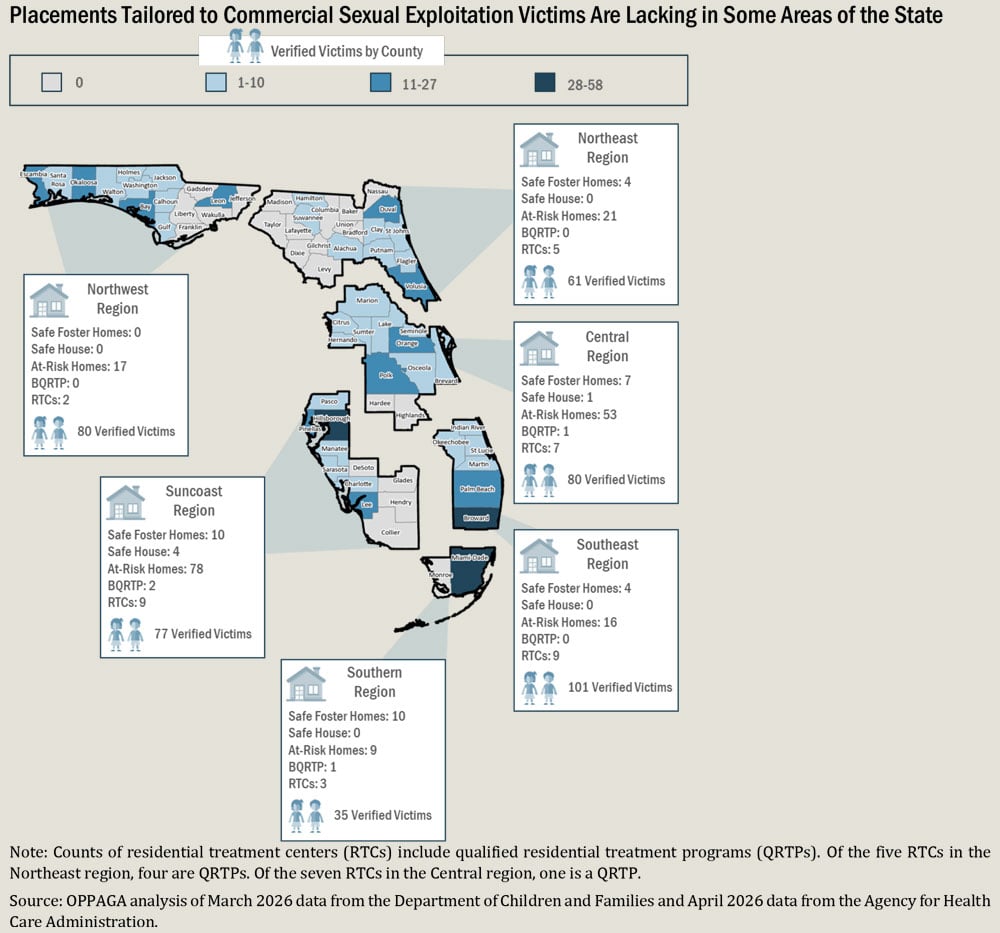
In 2025, most victims–87 percent–were girls, 68 percent were between 15 and 17 years old (which is to say that 19 percent were younger), and 51 percent were white, continuing the trends Oppaga found going back to 2015. The counties most prone to child sexual exploitation were the largest counties by population–Broward (58 cases), Miami-Dade (35), Hillsborough (33), Orange (27), Duval (26), and Palm Beach (25).
Most CSE victims–69 percent–continue to be community children, the report found, as opposed to dependent children who may have been placed in community or foster homes from elsewhere. But dependent children were far more vulnerable to maltreatment. Nearly half (46 percent) had prior child welfare system involvement with a verified finding of abuse, abandonment, or neglect.
“Nearly a third of CSE victims experience DJJ involvement, and most CSE victims with DJJ involvement entered juvenile detention facilities,” the report states.
On June 23 Flagler County Sheriff Rick Staly announced the partial results of an ongoing investigation into sexual exploitation and potential human trafficking in the region, including the rescue of three adult victims. No children were identified or involved in those findings so far. (See: “Ten Arrested On Prostitution And Drug Charges In Joint Flagler County Undercover Sting, 3 Victims Rescued.”)
Federal law defines sex trafficking as “the recruitment, harboring, transportation, provision, obtaining, patronizing, or soliciting of a person for the purpose of a commercial sex act.” Florida law does not provide separate definitions for labor and sex trafficking but rather specifies that while victims of human trafficking may be forced to work in prostitution or the sexual entertainment industry, trafficking may also occur in the form of labor exploitation such as domestic servitude, restaurant work, janitorial services, sweatshop factory work, and migrant agricultural work. The Oppaga report focuses only on sexual exploitation.
Once identified, CSE victims are placed in environments tailored to address their specific recovery needs, whether in safe foster homes, safe houses or at-risk houses. Safe foster homes, for example, are family foster homes that provide care specifically to CSE victims. Safe houses and at-risk houses are group homes for the same purpose. At-risk houses are open to children who are at risk of being exploited rather than only to those who have been verified to have been exploited.
The report notes that safe foster homes and safe houses can be limited and made more so by stringent training requirements on the recruitment of providers and lengthy application processes. As of March, there were just 35 safe foster homes and five safe houses. In the Northeast region Oppaga studied, which includes Flagler County and more than a dozen other counties, there were no safe houses and just four safe foster houses, even though the region as a whole had 61 verified victims.
“Most CSE victims recommended for a safe house or safe foster home in Fiscal Year 2024-25 were not placed in these settings,” the report found. According to DCF’s 2025 Annual Human Trafficking Report, of 399 CSE victims assessed for placement, 120 were recommended for a safe house or safe foster home and only 45 were actually placed. The rest refused placement, ran away, or were denied placement for lack of space.
The effectiveness of those safe environments depends on reporting by Community-based care lead agencies, or CBCs (such as the Community Partnership for Children in Flagler County). Residential treatment centers are also an option for CSE victims–and the most effective one, according to reporting agencies, but a limited one. Safe houses get better grades than safe foster homes for effectiveness as “recruiting safe foster homes is challenging,” the report found.
While telehealth counseling and substance abuse treatment is accessible in most areas, other forms of treatment, from survivor mentor services to equine therapy to group therapy to mindfulness and Eye Movement Desensitization and Reprocessing therapy (what’s known as EMDR) are not as accessible. Transportation and financial assistance are rarely available.
Case histories based on children who have been Baker Acted show that an exploited child will typically have been the subject of extensive histories of child welfare investigations, experienced multiple placement changes in the foster system, and had multiple arrest charges within three years of their first Baker Act examination after CSE verification.
The report includes several case histories based on Baker Act records that illustrate the ordeals exploited children go through and the challenges in attempts to care for them. Here’s an example.
Before the child was verified as a victim of exploitation, DCF conducted multiple child welfare investigations involving the child’s family, including for alleged substance use by the mother and family violence that could threaten children in the home. The child was diagnosed with ADHD and was exhibiting significant behavioral issues, including threatening other students with gun violence. A year later, the child was removed from the home due to the mother not meeting basic and essential needs and for allowing an individual who sexually abused the child to continue to have access to the child. The child was using marijuana, was not attending school, was being physically violent, and threatening to harm other students and children, and underwent two additional Baker Acts within a year of being identified as an exploited child. In the three years following the first Baker Act, the child changed placements 14 times, with most time spent with a relative or in in-home care. The child’s school attendance improved within three years of the first Baker Act following CSE verification, but the child’s grade level was two or more years lower than expected based on age.




























Gina Weiss says
And for the reasons above is why we so desperately need the Carver Center, a place
where our youth can go to relieve their anxieties and tensions of daily living, their
worries and state of mine, to socialize. By not supporting our Carver Center for our
community is the equivalent to setting people up for failure since we don’t have
many if not any resources in Flagler County that provide the above services mentioned.
We don’t even have a homeless shelter. I don’t know why any commissioner would ever
even consider such a drastic measure, just goes to show where Pennington’s head is at!
Atwp says
What a shame, children lives being destroyed before they can start to enjoy life. Parents please notice your children, yhey are precious gifts from God.
TR says
Wow, not only are you racist (you said it many times yourself) you’re also a hypocrite. You talk about God and want to give out advice to what everyone with kids should do. But yet in the Bible it states you should love your neighbor. (BTW, by using the word neighbor there is absolutely no reference to ones skin color)
Atwp says
Tr I said before and I’ll say again you need mental help.
TR says
LOL, and you would be totally wrong, again. I’m not the one with almost every comment be racist and now your trying to me a medical professional as well? Give me a break. I guess the man in the mirror is the one needing mental help who can’t except the truth. Zip it Skippy.
Atwp says
I’m not looking in the mirror, no need to. Know who I am and what I stand for. Don’t be jealous of a confident African American Man. A man who takes care of his responsibilities.
TR says
LOL, thanks for the laugh because jealousy is not what I am. No one in their right mind would be jealous of someone who admits to being a racist everyday. Besides, I never questioned if you take care of your responsibilities, did I? Which I don’t care if you do or not.
Laurel says
TR: No need to attack a man when he shows that he cares.
TR says
Apparently you haven’t been reading Atwp’s comments over the years. I’m not putting him down just pointing out the facts. Then because he’s wrong he tells me I need help. Give me a break. The person who needs help is the one who continues to spew his racism remarks all the time and puts the white man down with false facts. Like I stated earlier, he’s also being hypocritical. Racism continues in this country because of people like him. Hell, when I first started commenting on FL, I offered to meet him and buy him a beer, (I would have had a soda because I don’t drink beer.) I even tried to get him to look up the inmate percentage of white’s compared to black’s getting arrested in Flagler County only and he didn’t want to do it because he would have been wrong with his comment at the time. So if you think he cares, then go right ahead. I don’t think he cares about anything except to spread his hate.
Laurel says
I have read his comments for a couple years now, and I don’t always agree with him. Apparently, you haven’t read my comments. He and I have disagreed often.
My point is, Atwp has shown, more than once, that he does care about people, and that is not the time for you to knock him, now is it?
TR says
You can believe that he cares about people, I don’t. If he cared he wouldn’t use the color of ones skin to bad mouth them. So like I said you can believe him all you want. I will not and will say so. Have a nice evening. I’m not arguing with a racist, hypocrite anymore in this section. I also won’t be taking advice from someone who is a racist. BTW, just because he comments a little here with a positive comment, doesn’t mean he changed his spots so to speak.
Atwp says
You offered me a beer, man you don’t know me. I don’t drank. If you offered years ago thanks but no thanks. There is no way I’ll entertain your offer. If I’m racist so be it, look at the leader of this country. Yes Tr you do need some mind help, what false statement I made about white folks, if I’m racist I’m not a liar, didn’t put out any false statements about the white man. Tr you sound like the typical white man always labeling other people and act like you are angelic perfect person. Admitting I’m a racist everyday do not sound like being a hypocrite. At least I’m writing my true feelings about white folks and society.
TR says
You have no clue what you’re talking about. I don’t drink either and that’s what I said I would have a soda. As far as all your false statements about the white mans goes. You continue to tell everyone that the white that commits a crime wouldn’t get the same treatment as if a black man committed the same crime. That is absolutely false. That’s why I told you to check the amount of white males to black males that get arrested in Flagler county. You wouldn’t do it because it would prove that there are more white males getting arrested on a daily bases compared to black males. As far as the hypocrite part goes. You brought up God in your first comment and yet you go against what God wants by being a racist. Again I’m not the one who needs help. I never said I was perfect, so get that though out of your head. But you’re the one repeating your hate for the white male, making it seem you’re better then they are. You’re not btw. Your true feeling are hate, which are not good IMO. Good luck dealing with your hate.
Deborah Coffey says
Republicans have failed Florida for decades. Fascist Republicans have nearly destroyed the livability in our state. It’s time for change. David Jolly for Governor!
Well ? says
Typical, Completely ignore the issue and turn it into a campaign speech. Way to go Dems !
Voter says
What’s is the State of Florida doing about this? Guess what NOTHING.
T says
Trump is in epstein files more then anyone
Well ? says
Clinton more than anybody, amazing how you always seem to ignore that, not to mention a whole gaggle of Democrat politicians and Hollywood A-listers.
Laurel says
No one side is free of guilt, but that does not justify the other.