


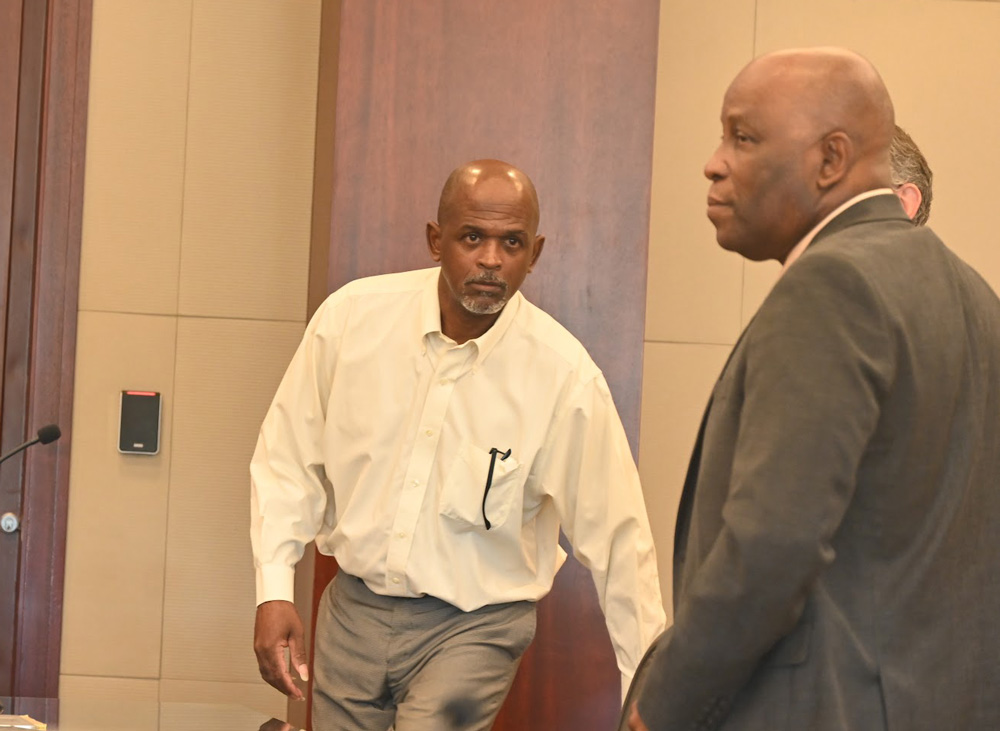
Jury selection today in Jermaine Williams Sr.’s death penalty trial for the stabbing death of his wife Yolonda Williams two years ago opened the first window into Flagler County’s thoughts on capital punishment in almost 20 years: the last such trial took place in 2007, when 69 percent of Americans favored it, compared to 52 percent now. A jury pool is a crosscut of the county’s demographics–and attitudes about one of the most controversial issues in American justice.
So it was today.
A jury was not seated. It will take at least two days, more likely three, barring a miracle (as one of the lawyers put it at the end of the day), to seat a jury of 12 and two alternates, a reflection both of the gravity and cruelty of the crime and the difficulty of seating a jury willing to recommend death, if Williams is convicted of premeditated murder.
The 54-year-old Williams was indicted for the murder of Yolonda, 50, in the driveway of the couple’s home on Aug. 2, 2024. Yolonda was on her way to work at a local nonprofit where she cared for, among others, victims of domestic violence. In an injunction she’d previously filed against Williams, she’d told the court he’d been abusing her and threatening her life, often with a gun to her head and with their children as witnesses, for 30 years.
By noon today, almost half the potential jurors in a pool of 75 were excused for hardships or because they’d been exposed to publicity about the case. By early afternoon, after two rounds of questions directly about the death penalty–one by Circuit Judge Dawn Nichols, one by Assistant State Attorney Jason Lewis–another 14 were excused.
That left just 28 even before the defense had a chance to question the jurors, before they learned of some jurors’ history with domestic violence or their unwillingness to watch gruesome footage of the stabbing, before lawyers on each side got a chance to remove jurors peremptorily–that is, for no reason: each side gets 10 peremptory strikes–or before each side challenged for cause. The two sides get an unlimited number of those, but they’re not easy to get past the judge.
Circuit Judge Dawn Nichols will tap into a pool of 100 additional potential jurors summoned to the Flagler County courthouse Tuesday morning. Starting late Tuesday morning or Wednesday afternoon, a second set of jurors will go through the same process that today’s set did. That’s fine with Nichols, an experienced judge of death penalty trials. Nobody is rushing the process.
“I understand that some of you may have strong feelings about capital punishment,” she had told the jury pool before it began thinning, and explained that if most trials take two or three days, some require two or three weeks.
“Every now and then, one comes along which requires me as the judge to recruit or draft members of this community to be jurors to hear a case of some length,” the judge told the jurors. “This happens to be one of them. Simply put, we need your help. We recognize that serving on a jury for this long can present a hardship for some of you, and I will give you a chance to tell me if there are things in your life that you believe would legitimately prevent you from serving. Some of these we may be able to work around, but please understand that your definitions of hardship may not meet the legal definition of hardship, and I’m required to follow what the law says.”
Surprisingly, only seven of the 75 jurors said they’d heard about the case, and only two referred to a news source. The rest referred to friends, Facebook pages, work discussions or “the news” in the abstract. Five of the seven were excused: some had said that from what they’d read, they’d made up their mind. It’s never clear whether the juror is using the exposure to a news account as a pretext to get out of jury duty.
Hardships harvested many more, each of whom addressed the judge and the lawyers out of view of the rest of the pool. One juror was leaving for Colorado to see her sister Friday. Another had trade shows to attend to. One was hard of hearing. One cited her own severe mental health issues impairing her judgment. At least two had heart conditions.
One juror had something little short of a medical episode, breaking down in tears over her health issues. The judge kindly excused her through the judges’ chambers to avoid exposing her to the rest of the pool in the hallway: There are often unspoken, unreported touches of immense humanity in some of the grimmest trial proceedings, whether toward jurors, witnesses or even defendants: justice may be harsh, but it is seldom heartless. Nichols combines justice and heart.
The hardships continued–a wife’s surgery, difficulties making rent, elderly parents without recourse to anyone else’s help. Only then did the judge and the lawyers turn to the question of the death penalty.
For the most part, even jurors who initially declared themselves “in favor” of the death penalty proved more nuanced and balanced when questioned individually. Put another way, if there were enthusiasts of the guillotine–or lethal injection, as happens to be the case in Florida–they did not speak in those terms today. Had they done so, they, too, would have likely been excused, even by the prosecution: Prosecutors aren’t interested in armchair executioners.
Rather, several jurors expressed shock that they were to sit for a murder trial. “I never thought in a million years” it would be a death penalty case, one told Assistant State Attorney Jason Lewis during jury selection. Lewis is prosecuting the case with Assistant State Attorney Helen Schwartz.
In an earlier round, the stay-at-home mom and Palm Coast resident for a year had said she could vote to recommend death in an answer to the judge’s question. She was more expansive when Lewis questioned her. “Truly, I was sitting here now, no pressure, right?” she said. “I would think I really want to hear all of the evidence. I would want time to really think about it and consider it. If it seemed warranted, if it was an extreme violent situation, I could be for it. If I felt like it was something that didn’t deserve the death penalty, I could also go in that direction. I have no one way or the other. I’m not for it or against it. I need to know the whole situation before I can actually make a real decision.”
She was not the only one to speak along those lines among the diminished pool: the closer the more probing questions came to them, the likelier jurors were to qualify the categorical support for capital punishment they’d expressed earlier, when the judge had asked them whether they could apply the law.
“It makes me sick to my stomach to even think about it,” another juror said. “I don’t know, I’ve never been in this situation. I never even thought about it one way or the other. So how I would really make a decision, I guess time would tell.” Pressed by Lewis, she said she would be 50-50 willing to vote for death.
“I feel I’m not educated enough to pick either one,” an 18-year-old woman who had just graduated high school said. (Three or four jurors were in their 20s.) Pressed, she said she could not vote for the death penalty, even though earlier in the day she had said she could. But she’d heard hours of discussions about it from her fellow jurors, discussions that had somewhat clarified the difficulties ahead, and had clearly changed her mind. She was excused.
“I was pro death penalty but now that I’m faced with it it’s not something I would take very lightly,” yet another juror said. “I’m almost not sure what would be worse: the death penalty or life in prison.”
“What we’re trying to do is find people who are fair and don’t have a bias one way or the other,” Lewis told a wavering juror.
“It would be the kind of thing that you know I would think about the rest of my life,” a young juror told him. “Just goes against what I believe in terms of the value of human life and what I believe religiously.” He was excused, perhaps further reducing the meaning of “jury of your peers.” The constitutional misnomer masks jury selection’s purpose: to pare a jury down to state law’s demands that those who serve are willing to execute its provisions.
The thinning of the jury pool had also reduced the number of potential Black jurors, low to start with: just four of the 75 initial jurors were Black. Two were left by day’s end, increasing the chance of an all-white jury deciding the life or death fate of a Black man, though mostly or all-white Flagler County juries in recent years have exonerated Black defendants on three occasions in high-profile felony cases, strongly suggesting that race is not the factor it once was in a county that barred Blacks from Flagler Beach after sundown.
None of Yolonda’s family members and friends attended today: they would hardly have had any place to sit, with two State Attorney’s Office interns and a reporter shifted to the jury box to allow for the large jury pool to sit in the gallery.
Jury selection–voir dire in the court’s parlance, from the medieval French meaning “telling the truth”–resumes before Nichols at 8:30 a.m. Tuesday in Courtroom 401 at the Flagler County courthouse.





JimboXYZ says
Let’s not confuse the details of this homicide/murder with the business at hand of giving the man his speedy & fair trial. This is a slam dunk case. implying jury selection influences by the severity of a death sentence is nonsense. That would mean he weighed the repercussions of his actions as to that capital punishment solution of potential sentencing vs perhaps actually being caught ? He’s getting 30 years to life imprisonment for the facts of the case. This is a defense stall tactic, that somehow the murderer has a legitimate defense reason for insanity, temporary or permanent. Even on deth row he’s going to get 30+ years of appeals that should never be rescinded beyond a blanket commutation that a POTUS like BIDEN is capable of. Heck if Democrats had their way, the prison population could vote for the next Democrat to screw us economically. Get on with the trial already. Justice is fair & just for the trial by jury, the defense is after sympathetic sentencing. DeSantis won’t stay any execution, but from the actual execution dates, murderer(s) get +/- 30 years incarceration. 30 years their victims never got for the rest of their lifetimes. And it wasn’t humane what they did to anyone, yet somehow the 12-15 minutes it takes for the execution to result in a death has to be a soft end of life for the evil & wicked one(s). I think if Yolanda had a choice that day, lethal injection vs butchered in her driveway by knife, she’d have chosen lethal injection. Most of us wince in pain from a paper cut, imagine your spouse sticking & carving you up like a Butterball turkey to bleed out for that end of life ? And that spouse wasting expensive courtroom resources thinking they’re getting out of the deed they committed ? That one, demanding humane for a death process that isn’t any more humane than anyone drowning in the ocean ? We have far too many charging a billable hour arguing humane for something that scientifically is a painful death. There’s a reason hospice patients are administered morphine to even expire in their sleep as the human body shuts down. The brain & nervous system doesn’t turn off just because the patient is ESRD vs any other way of expiration for homicide/murder. If anything, one would almost have to hope the lack of oxygenated blood flow shuts that down. If you’ve ever felt the burn from a workout of muscle fatigue, that’s gotta probably be as good as the pain & suffering could possibly be ? There was a reason that the near instantaneous decapitation executions of the prior centuries for crimes was a swift execution, they didn’t piddle around with 12-15 minute lethal injections. Sounds barbaric, but in actuality the effectiveness had to be far more effective than hoping a firing squad was an instantaneous death.