


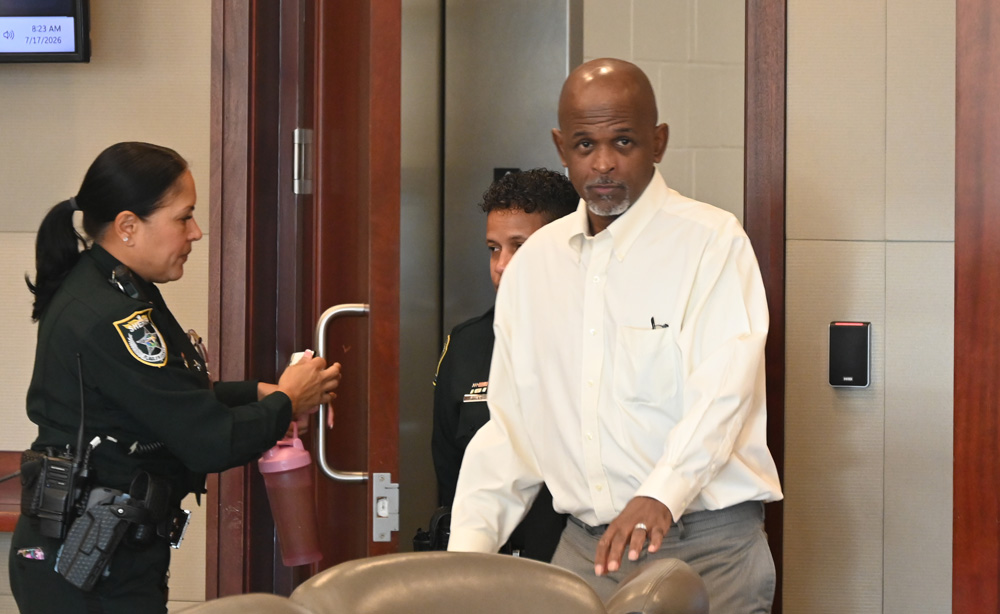
“We are now at a different stage,” Assistant State Attorney Helen Schwartz told the jury this morning. “It is a solemn and somber time. We are now in the penalty phase.”
It was the same jury of 10 women, two men and three alternates who last Friday convicted Jermaine Williams Sr. of the premeditated murder of his wife Yolonda Williams, 50, by stabbing her some 20 times in the driveway of their Bunnell home in August 2024. That left Jermaine Williams, 54, facing two possibilities: death by lethal injection–if and when it happens–or life in prison without parole.
It is now up to the jury to determine which of the two to recommend to Circuit Judge Dawn Nichols, who then imposes the sentence. Nichols is not expected to override the jury’s decision, though she has the authority to do so.
Williams today was no longer in the civilian clothes he had the right to wear during the trial’s first phase, so as not to prejudice the jury against him. This morning he wore the orange and white-striped Flagler County jail garb reserved for those accused–or convicted–of homicide. He arrived hands and legs shackled, though his handcuffs were removed before the jury was seated.
Yolonda Williams’s family and friends were back, too, filling three pews of the gallery, on the prosecution’s side, while the pews behind Jermaine Williams remained mostly empty as they had during the trial but for officers or employees of the court.
The rest was like a trial.
The prosecution was required as soon as it announced its intention to seek the death penalty to provide the aggravating factors that would justify it. The prosecution did so on Sept. 23, 2024. It listed four aggravating factors: that Williams was a previously convicted felon. That he was previously convicted of a violent felony. That the felony against his wife was “especially heinous, atrocious, or cruel.” The felony was a homicide and was committed in a cold, calculated, and premeditated manner. The fourth is moot: he was convicted of it.
Schwartz in her opening statement to the jury defined the terms. “Heinous,” she said, “means extremely wicked or shocking evil. Atrocious means outrageously hateful and vile. Cruel means designed to inflict a high degree of pain with utter indifference to or even enjoyment of the suffering of others.”
The prosecution needs to prove only one of the aggravating factors beyond a reasonable doubt to clear the bar for a recommendation of death, and the jury must be unanimous in its determination that the aggravating factor has been proven. But the jury need not be unanimous in its recommendation of death. It needs only eight of its 12 jurors to vote for death.
“This is not a mathematical equation,” Schwartz said. “Even one aggravating factor may substantially outweigh, may outweigh, 10 mitigating factors, 12, 15, 20. That is your decision.”
Defense attorney Anthony Eric Leonard told the jury in his opening statement that regardless of the number of aggravating factors proven or mitigating factors shown, it is still up to the jury to decide whether to recommend death or life in prison. In other words, the proving of all three aggravating factors does not require the jury to vote for death.
The prosecution began by recreating the incidents of January 2022, when Jermaine Williams was previously arrested for beating his wife. On January 22, the family–without Jermaine–had been to the funeral of Noah Smith, the 16-year-old Flagler Palm Coast High School student who’d been killed while he was a bystander on a Bunnell street. (All the assailants have since been convicted of the murder and are in prison.) Jace, an accomplished singer even then, had sung at the funeral. Williams had not wanted him to go. He accuse his wife of having an affair with Noah’s father.
After bedtime, Jace, who was 11, pretended he was asleep, but heard a thud, then Jermaine came into his room and commanded him to go to the kitchen. Williams was cussing out Yolonda. Why? Because Jace had sung at the funeral. (Jace is an accomplished singer: he would go on to sing at Carnegie Hall in New York.) “He, like, called her bitch and whore, and hoe and stuff,” Jace testified. “He was saying like, she was cheating on him.”
“Did you see him hit your mom?”
“Yes,” Jace said. Williams would hit his mother in the face and the mouth with his back hand every time she told him not to strike her in front of Jace. He struck her half a dozen times before Jace was sent back to his room, where he heard more crying. He peeked out of his room and saw Williams pulling at Yolonda’s hair and striking her again. The next day he would find “a bunch of hair everywhere on the ground, everywhere.”
Williams had used a wooden sign in the garage with his sister Patience’s name on it to hit Yolonda with. The sign broken in half from the violence of the blow.
Williams was arrested, charged with two felony counts of aggravated domestic battery assault, tampering with a witness and false imprisonment. He pleaded and was sentenced to house arrest for a year and a half and probation for two additional years. So he was on probation at the time of the murder.
During the cross examination of Darien Ferguson, Williams’s probation officer, Defense attorney Junior Barrett asked Ferguson a series of questions to establish that Williams complied with his probation–a mitigating factor, perhaps. He had, Ferguson said. Barrett had stepped into his own trap.
“Just so we’re clear, sir,” Assistant State Attorney Jason Lewis asked Ferguson, with a distinct edge of sarcasm, “if someone murders someone else, does that violate their probation?”
“Yes,” Ferguson said.
“Okay. Thank you,” Lewis said, whirling back to his table with his laptop as the gallery burst out laughing. It was spontaneous and as difficult to repress as the response to a visceral joke.
Still, Nichols, the judge, was not pleased. She ordered the jury out and addressed the gallery: “You just don’t get it, do you,” Nichols said, referring to how she’d cautioned the audience again before the start of today’s proceedings to maintain composure. “I cannot have reactions like that in the presence of the jury. If I have any more bouts of laughter or outbursts, I will have you escorted out of the courtroom.”
None of the remains of the day were worthy of laughter.
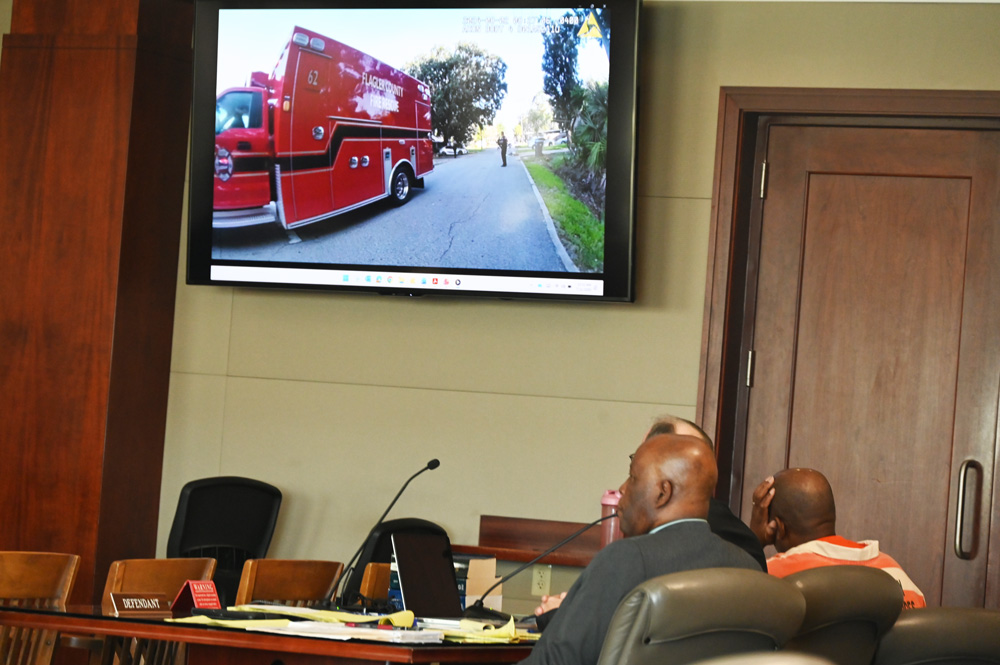
It included a sheriff’s deputy’s testimony and body cam video that showed Yolonda’s last minutes of life as she repeated, bloodied and barely aware, “I can’t breathe, I can’t breathe.” The very last words of Eric Garner and George Floyd, murdered in different circumstances, would also be hers.
And it included statements by Yolonda’s sister, her mother, her aunt and others who, if the jury still had any doubt about the immense impact Yolonda had on her community, the joy she brought and the role model she was to South Bunnell, removed it all.
Anthony Eric Leonard of the Office of Criminal Conflict and Civil Regional Counsel had very little to work with, and responded with little.
Jermaine Williams’s father and brother testified for the defense. David Williams, the father, had stopped the stabbing by pointing a gun at his son and threatening to shoot him if he continued. Today, he testified briefly and, for the defense’s purposes, ineffectively, because his purpose had been to show the jury that the death of his wife–Jermaine’s mother–weeks before the murder had deeply affected Jermaine.
Had Jermaine changed after her death? “Somewhat,” David Williams testified. “He wasn’t as comical as he used to be.” That was the deepest change the father could describe about his son.
Jermaine’s older brother testified to the “discipline” of their father, who would beat them with anything at hand if they misbehaved when they were children. The defense wanted to use that history to suggest that Jermaine had somehow been deeply bruised by it. But no: his brother testified that the discipline was deserved and did not appear to object even when his father lined up the eight siblings “assembly-line” style and beat them all when none would own up to a misdeed. The brother testified that he still maintains a loving, warm and appreciative relationship with the father, and went on to serve in the military.
Hardly the sort of past that would suggest mitigating factors like a difficult, traumatic childhood. If anything, father and son further aided the prosecution.
The most the defense could marshal against the prosecution case was the testimony of an expert witness, Dr. Jacquelyn Olander, a Winter Park-based psychologist. Even that didn’t go well for the defense.
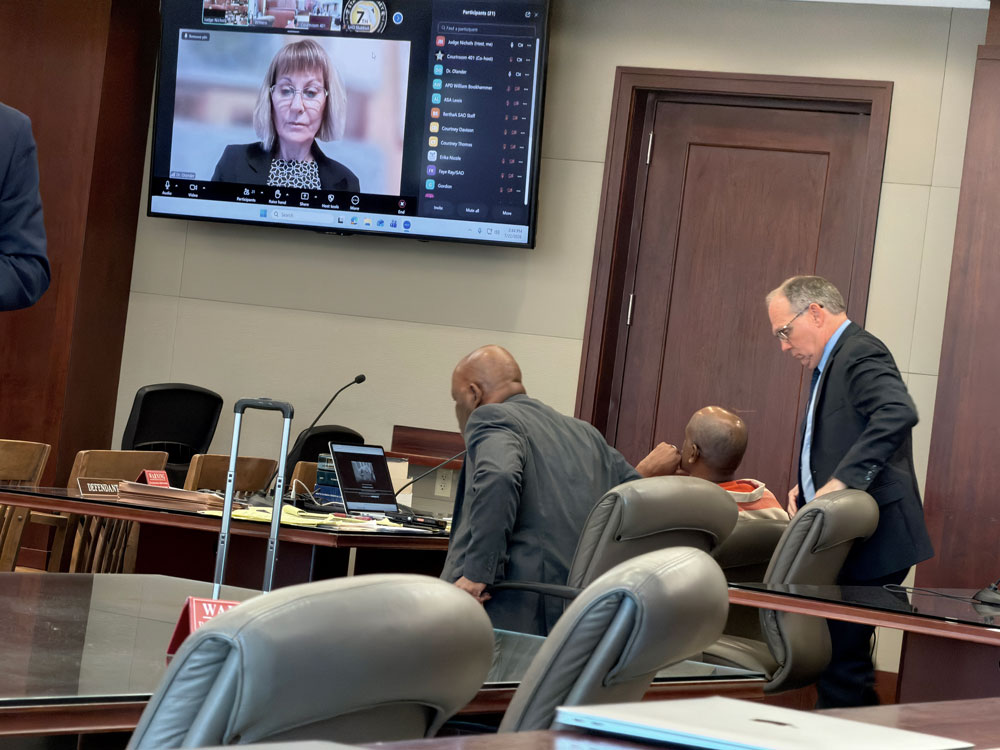
Olander described Williams as a narcissist with an “inflated need to have people see him as somebody important, inflated need for high self esteem,” and an “underlying sense of insecurity” who’d been affected by the history of what she described as domestic violence.
Barrett pressed hard on the domestic violence history and what the psychologist described as “a very traditional male-oriented system in which the father is the king of the family,” but without eliciting the sort of testimony that would provide a hint of sympathy.
Because that’s what the defense needed most: any kind of sympathy or empathy with Jermaine’s past, or even with what may have been “the trigger for that event in which his son was taken behind his back and sung at a funeral, which was in clear disregard against his wishes,” the psychologist testified. But what jury would hold a mother’s decision to take her son to a funeral–the funeral of a 16-year-old boy who had been gunned down–against her, when the son was a performer at the funeral?
The psychologist added more context to the morning of the murder, context that until now had not been heard by the jury.
“Williams had significant power and control over her through the long years they were together, but that started to decline again after his arrest,” she said, referring to his 2022 arrest for beating Yolonda. “She was becoming more and more independent from him. She had now the ability to take trips she did not utilize in the past. She had been planning on leaving on weekends and staying with family and friends, and he described her interactions with him as becoming more and more negative, more sarcastic, particularly that morning when he and his mind was trying to do whatever it took to make the relationship work. She was being sarcastic, which was clearly brought out by the detectives. She started mimicking playing a violin to his pleadings like poor him, and this chronic buildup of tension can often be more powerful than a major event.
And that, the psychologist said, “was where the rage reaction happened.”
The psychologist, who herself got impatient a time or two as Schwartz swiftly figured out exactly what buttons to push, then began talking about “rage” and answering a question by Barrett about “crimes of passion,” which immediately drew a sharp objection from Schwartz: in a pretrial, the two sides had argued that approach, and the judge had ruled against the defense’s claims of “heat of passion” or “crime of passion.” (See: “Judge Bars Heat Of Passion Defense In Husband’s Killing of Yolonda Williams On Eve of Death Penalty Trial.”)
The judge allowed only the terms “rage murder,” which the psychologist described as an “extreme emotional disturbance.” She said the killing met that definition.
Olander had to withstand a withering cross-examination by Schwartz, the prosecutor, who first undermined the neuropsychologist’s credentials by having her acknowledge that she was not board certified, then went on to undermine the validity of her second-hand analysis based on police reports, videos, investigative interviews and interviews with Williams. She met with Williams once, for four hours, in April.

The psychologist had to acknowledge that Williams never witnessed any domestic abuse between his parents, and that he had “multiple affairs with other women,” in Schwartz’s words, and “that there was a history of him abusing Yolanda physically and verbally. In fact he used the terms that she might have been sick of it after 30 years, didn’t he?”
“Something like that,” the psychologist acknowledged.
The morning of the murder, Jermaine had disabled Yolonda’s car, ostensibly for her to ask him to drive her to work. She asked her mother instead. It was then, it appears, that they may have argued, but only verbally, not visibly–the video showed no gestures, no flailing, no sudden movements–and that he went inside to get the knife, coming back out a minute and 10 seconds later with the sort of resolve that resulted in his stabbing her 19 or 20 times.
“That rage,” the psychologist testified, “was an accumulation of intense emotional feelings of loss and her not wanting to ride with him was another clear piece of evidence that his attempts to make the relationship work were not happening, and he was losing her, and she was becoming more and more independent.”
“Killing her wasn’t going to make her come back, was it?” Schwartz asked.
“Of course not,” Olander said.
Why kill her?
“He was preserving his sense of self as a man,” the psychologist said. “That was the underlying basis of his elimination of the person who was devastating his sense of self. That was the last thing he had left to preserve.”
“And so the only way he could stop it and stop her from leaving him was stabbing her,” Schwartz asked, more as a statement than a question.
“The only way to preserve his sense of self as the man, the king of his family, and maintain his sense of identity,” the psychologist said.
Williams watched, looking up at the big screen from his seat at the defendant’s table. He does not intend to testify.
So the jury went home in mid-afternoon with Olander’s conclusion as the day’s last words: that Williams killed because he didn’t feel like a man. Because he’d lost control of Yolonda, the control he’d exercised for 30 years, and she was done with it, if not with him. Williams killed to feel like a king again.
It wasn’t exactly what the defense could call a mitigating factor, or a mitigating testimony. Rather, it was a disastrous way to explain a murder. The prosecution knew it. The defense knew it.
The prosecution will present a rebuttal expert Wednesday morning before closing arguments, when the prosecution will go first, then the defense. Then deliberations. The jury’s recommendation is expected Wednesday.

If you or a person you know is a victim of domestic or sexual violence or abuse, contact the Family Life Center in Flagler County, confidentially, at 386-437-3505 or go its website.




JimboXYZ says
If there is any justice for a lethal injection sentence, they will stab/jab him 20 times for each of wounds he inflicted to commit his murder. Anyone really concerned about how humane that process/procedure would be that day ? It needs to be said that way, not as vengeance or revenge this soon, rather as a testament to what really happened that day at the driveway in Bunnell, FL. Can’t let the passage of time for another 30-40 years soften the facts, or heal a wound that never will heal. Waste of resources for that, just in the staff that maintains this monster as a relative FL taxpayer pet. For every reason to delay for humane execution, there are too many reasons to get on with it, the sooner the better, won’t be any easier. Like Lawnmowing for cutting grass, when that job needs to be done, mow & trim the yard, it won’t be any less of the same effort, that time & motion study of work. What is the cost of inflation of putting an execution off ? This is a thinning of the herd that needs to be expediently carried out, that Constitutional Right we all have, that fair & speedy trial, which should include fair & speedy sentencing & in this case warrant a fair & speedy execution of that sentence.