



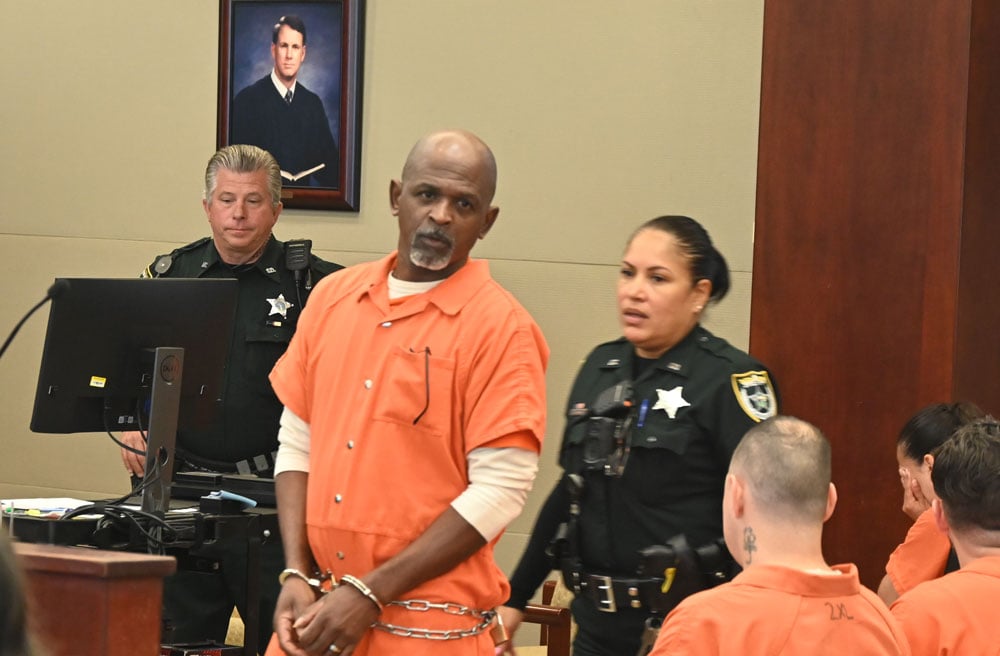
Jermaine Williams Sr. is accused of murdering his wife Yolonda Williams by stabbing her 18 or 19 times. Before her death, she’d written in a petition for an injunction that he had been abusing her and threatening her life since she was 13 or 14.
Was the killing a crime of passion? Of sudden “rage” that Yolonda provoked?
That’s what the defense may argue at Williams’s trial, beginning Monday with jury selection. The defense may claim that Jermaine wasn’t in his right mind at the time of the killing in August 2024 in the couple’s driveway. A crime of passion would negate pre-meditation. It would no longer be a death penalty case. But to get there, the defense would have to show that an act of provocation took place. It may not just assert it. It may not use an expert witness to assert it. That would be hearsay. That, however, is what the defense was intending to do.
The prosecution wants to prevent the defense from arguing “rage” or “passion” based on Jermaine’s state of mind. Assistant State Attorney Helen Schwartz filed a motion Thursday to preclude any testimony or evidence that would support a defense of “insanity, diminished capacity, or any other mental health condition.”
Circuit Judge Dawn Nichols heard the motion this morning and ruled mostly in favor of the state, dealing the defense yet another blow in a capital case that could send Williams, 52, to the execution chamber if he is found guilty of premeditated murder. His is the first capital murder trial in Flagler County since 2007.
The judge did not entirely close the door on the defense’s argument. But to walk through that door, the defense would have to establish (or “lay the predicate,” in legalese) that Jermaine Williams had been provoked. To do so, the defense may have no choice but to have Williams testify. If he does, he might contradict what he told detectives in an interview: that he was not provoked.
The state’s motion was prompted by defense attorney Junior Barrett disclosing in a witness list on May 26 that Dr. Jacquelyn Olander was on that list. Olander, a Winter Park-based psychologist, specializes in the evaluation of competency, among several other specialties.
The prosecution deposed Olander on June 29, when she “testified that she believed she was hired to present testimony for sentencing and mitigation,” the motion states. Mitigation refers to the second part of the two-part trial–the penalty phase when, if Williams is found guilty during the first phase, the jury will hear evidence to decide whether to recommend for or against death. At a pretrial conference earlier this week, Barrett disclosed that he intended to call Olander during the penalty phase in relation to a “heat of passion” defense.
The prosecution argued that any testimony by Olander claiming that Jermaine Williams had diminished mental capacities or abnormal mental conditions would be inadmissible and “an attempt to elicit otherwise inadmissible self-serving hearsay statements of the defendant through the proverbial back door.”
What would have amounted to provocation? Yolonda was on her way to work early the morning of Aug. 2, 2024, when her husband attacked her in the driveway.
“The classic scenario,” Schwartz said, “is the defendant who walks in on his wife while engaged in sort of a sexual act, and it’s so startling, and he shoots and kills the wife’s paramour. Or the scenario where a defendant suddenly finds out that a family member, a wife or child, or something like that, has been suspected to sexual assault.” The stress and the shock would amount to provocation. “The state’s position is that we don’t see anything in the evidence that would qualify as that legally adequate provocation.”
There was an argument. But the surveillance videos the jury will see–including video of the stabbing–have no sound. “There’s nothing that the son Jace Williams, who witnessed the stabbing, could potentially say because he did not hear the details of the argument, only that they were arguing,” Schwartz said. “And the only thing that he heard was that he heard the defendant say, ‘I’m tired of this shit,’ and essentially that’s about it, other than him telling his son to back away from him when he was trying to stop him from stabbing his mother.” Williams’s arrest report states that Williams spoke those words immediately after he had stabbed Yolonda, when she was lying on the ground, motionless.
“So the only insight into what was happening that morning, or the defendant’s state of mind, would be the defendant himself if he were to testify,” the prosecutor said. “Even then, through his interview, during the defendant’s interview, he doesn’t say anything or lay any foundation for adequate provocation.” So anything that goes toward “crime of passion,” including the psychologist’s testimony on that account, would be inadmissible, from the state’s perspective.
Assistant State Attorney Jason Lewis revealed what Jermaine Williams told detectives in a recorded interview that he said will not be introduced at trial: “She just said something to him and got mad. That’s basically what he said in a statement. It’s not like he walked in on her doing something,” Lewis said.
It appeared that the defense wanted to use the expert witness to bridge the evidence gap. The judge would not allow it. “I don’t see how having an expert in any way gets you where you want to go,” Nichols told Barrett, the defense attorney.
“The crime of passion defense is essentially an argument that there is a rage murder that a person got so enraged that he murdered,” Barrett said, “and in fact, rage murder is something that is not unusual for an expert to testify.”
“What the state appears to be arguing is that based upon their view of the evidence, there was no passion,” Barrett said.
“That there was no legally adequate provocation,” the judge clarified.
“Right. That seems to be the argument,” Barrett said. “And at this point, without hearing all the evidence, that’s the interpretation. Obviously, our expert disagrees. I would suggest that the interview done of Mr. Williams, which was lengthy, suggests something different.” But for now, the jury will not hear that interview, potentially forcing Barrett’s–and Williams’s–hand.
“There may be an issue as to whether or not he needs to testify,” Barrett said of his client. He did not say the obvious, the one time the phrase is not a bland cliche: his life may depend on that decision.
The judge’s ruling will read that, if during trial circumstances change and a legally admissible predicate is laid for the passion defense, at that point the psychologist’s testimony and associated arguments may become permissible. As the judge left it this morning, however, Barrett and Williams have a high bar to clear to get there. At the same time, today’s hearing gave the defense a roadmap to do just that, with plenty of time for Jermaine to rehearse his story.
The state is seeking the death penalty based on four factors: Jermaine Williams is a previously convicted felon, he was previously convicted of a violent felony, the killing “was especially heinous, atrocious, or cruel,” and it was committed “in a cold, calculated, and premeditated manner without any pretense of moral or legal justification.”




























Leave a Reply