



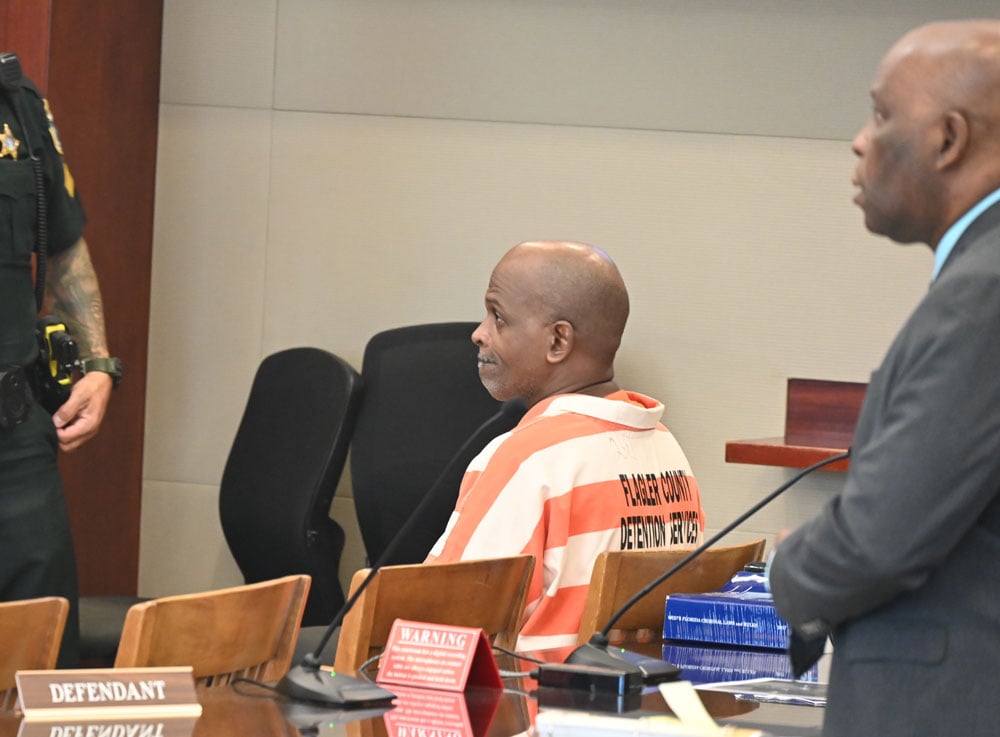
The death penalty trial of Jermaine Williams Sr. will start Monday morning before Circuit Judge Dawn Nichols with the selection out of a pool of 50 of a jury of 12 plus two alternates. The docket sounding hearing before Nichols was very brief today, with both sides saying they were ready for trial. Jury selection will last at least a day.
Williams, 52, faces a charge of premeditated murder and a charge of aggravated assault with a deadly weapon over the stabbing death of his wife, Yolonda Charmaine Williams, in the driveway of their house at 401 South Pine Street in Bunnell on Aug. 2, 2024. A grand jury indicted him on the charges three weeks after the killing.
The alleged murder was captured on surveillance video. Evidence will include video from two locations at 405 South Pine Street, 33 Ring camera video clips from 408 South Pine, and a third pole-camera video, a recorded interview of Williams, and autopsy and hospital photographs, among a lot more. The Flagler County Sheriff and the Bunnell Police Department investigated, collecting almost 1,000 photographs between them and 70 videos of witnesses and bodycam footage.
Several members of the Williams family are on the witness list, though being on the list–a long list in this case–doesn’t necessarily mean they will testify. One of the witnesses for the state, Wanda Hadley, 46, a resident of Bunnell sentenced last September to three years in prison for selling cocaine, is being transported from the Lowell prison in Ocala back to the county jail in preparation of her testimony.
Expert testimony will include that of Dr. Wendolyn Sneed, the medical examiner, and Sheriff’s Detective Mark Moy, a digital forensics expert. The witness list notes that similar-fact evidence would be “noticed,” meaning that similar-fact evidence–or evidence of other crimes or offenses Williams may have committed but was not necessarily convicted for–would be introduced.
The trial is expected to take two to three weeks. The first phase of the trial will determine Williams’s guilt or innocence. If he is convicted, the second phase of the trial, with the same jury, will determine the penalty.
The state is seeking the death penalty, making Williams’s case the first death penalty case for a homicide in Flagler County since William Gregory faced capital charges for the murder of his ex-girlfriend and her boyfriend in August 2007.
Gregory was tried in Volusia County, found guilty and sentenced to death. His sentence was commuted to life in prison in December 2017, at a time when, for a window of only a few years, the Florida Supreme Court had declared illegal the process that led to the sentencing of dozens of defendants. The court has since reversed its decision. The last death penalty tria in Flagler County was that of Cornelius Baker, convicted in 2007 for kidnapping and murder of a Daytona Beach woman. His sentence was commuted in 2022.
Assistant State Attorney Jason Lewis, the most seasoned death penalty prosecutor in the Seventh Judicial Circuit (which includes Flagler, Volusia, St. Johns and Putnam) is prosecuting the case, albeit without his usual co-chair in such cases, Mark Johnson, who was appointed to the bench in Putnam County earlier this year. Johnson had been involved in the case until his appointment.
Williams is being defended by Junior Barrett, himself a seasoned defense attorney in capital cases. Barrett signs all his emails with a poem by civil rights leader Benjamin E. Mays, “I have only just a minute,” whose last verse is “Just a tiny little minute,/but eternity is in it.” It will be Barrett’s job to keep Williams from a accelerated reckoning with eternity. The defense lost some two dozen pre-trial motions that sought to mitigate the trial’s proceedings in his favor.
Circuit Judge Chris France awarded the maternal aunt of Yolonda Williams’s minor children temporary custody until they turned 18. One of them did so last October. Another is 16. Jermaine Williams, who had objected to the court’s order, was barred from contact with them.
In 2022, Yolonda had filed a petition for an injunction against her husband’s domestic violence. She described why: “On Saturday night, my husband forced me to cut my nails or he would break them off with a hammer when he returned home. When he returned home he beat me for about 30 minutes because our youngest son sang at a funeral for a young man who’s father he had accused me of dating. He punched me over and over in my face, head, chest, back and stomach. He also grabbed me by my hair and pulled hands full of hair and plaits from my head. During this time he was calling me dumb, stupid, bitches and whores. He then made our 11-year-old get out of bed and forced him to watch him slap and punch me in my face over and over and over while telling our son that this is what happens to whores who are sneaky and ‘all bitches get consequences for their actions.’ He then made all the other children get up and give him their iphones because ‘no one would be calling the police tonight.’ I tried to get out of the door but he wouldn’t let me and told me I was ‘going to pay for being sneaky.’ He proceeded to beat me some more, and told me that “I’m going to learn that he doesn’t play with bitches.” He kicked and punched me some more before I ran into the garage, which he was still forcing my son to watch. He came into the garage and picked up a large wooden sign and hit me with it.”
Yolonda described running off to her in-laws’ house, and reveals even grimmer details of a life in violence: “I really thought he would kill me because he has threatened to do so many times, which included putting a gun to my head over 10 times in the time of our relationship. He has been beating and abusing me since I was 13 or 14.”
The narrative now stands as the only testament, in her words and in the court record, to the violence she was subjected to. It is likely the prosecution will read her words to the jury during one of the phases of the trial.
Yolonda Williams was a care coordinator at Flagler Cares, the Palm Coast nonprofit, helping people down on their luck, including victims of domestic violence, navigate the labyrinths of social assistance and support. She was preparing to go to work that August morning when Jermaine Williams attacked her for the last time.
He has appeared in court in numerous pre-trial hearings, not infrequently smiling.




























Atwp says
Commit the crime pay the price.
The Geode says
Yeah, they’re gonna smoke his ass for this. It’s just a shame that he’ll be sleeping when the last shot sends him to hell.