


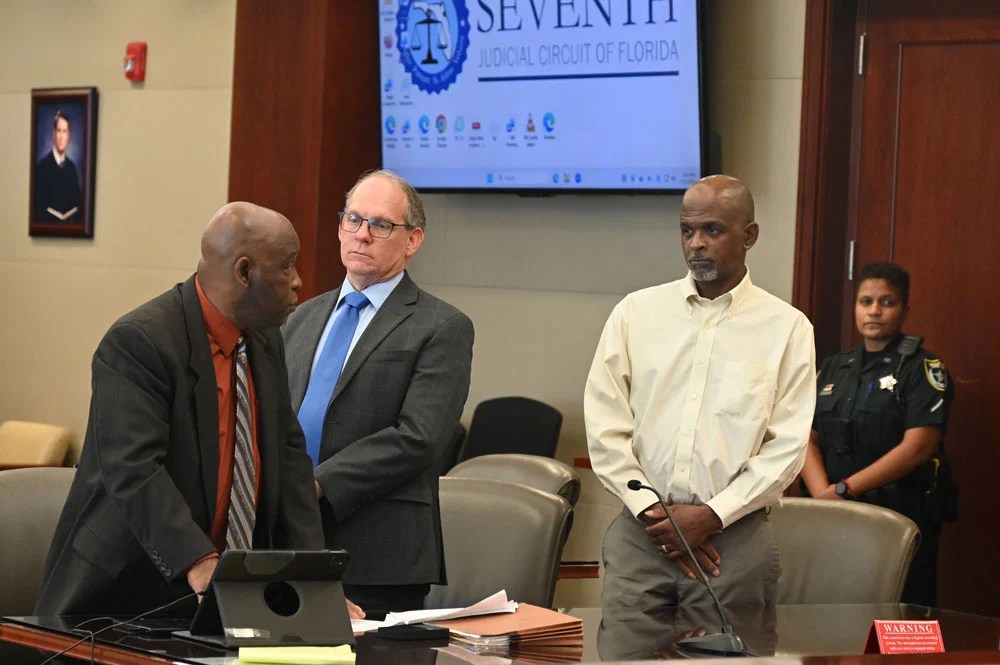
Two and a half days into jury selection for the first death penalty trial in Flagler County since 2009, the prosecution and the defense agreed to a jury of 12 and three alternates out of a pool of 135 local residents by midafternoon today. Opening arguments are set for Thursday morning.
Jermaine Williams Sr. will face a jury of 12 women and three men, including the alternates. The jury is almost all white, Williams is Black (one of the jurors is olive-skinned Mediterranean or possibly south Asian), but color is less relevant than gender in this trial: the jury’s lopsided make-up seems to be a victory for the prosecution. On the other hand, it could be a victory for the defense if an all-women jury is more likely to convict but less likely to recommend death. The defense will take that outcome as a victory.
Williams, 54, was indicted on a premeditated murder charge in the stabbing death of his wife Yolonda Williams in Bunnell in August 2024. (The prosecution dropped an aggravated assault charge this week.)
What will follow over the next couple of weeks are in essence two trials. If a unanimous jury convicts Williams of the premeditated murder charge, the same jury, possibly after a break of a day or two, will move on to a penalty phase. That phase is identical to a trial, the difference being that the rules of evidence are more permissive, especially to the defense.
The prosecution needs at least eight jurors to recommend death for that sentence to be imposed. In that sense, Florida has the lowest bar in the western world for the imposition of the death penalty. In every other state but Alabama, where a majority of at least 10 is required, a unanimous verdict is required. In 23 states and every other western democracy, capital punishment has been abolished.
Alternatively, the defense will be seeking at least five jurors to vote against death. That would not spare Williams from a penalty some, including one juror who was excused, consider harsher than death: life in prison without parole. It is also possible that the jury makes the penalty phase moot if it convicts Williams of a lesser charge than premeditated murder, though he would almost certainly still face life in prison.
Defense attorneys Junior Barrett and Anthony Eric Leonard have all but conceded that Williams is guilty of murder. They hope to move the jury from premeditation to an act of spontaneous rage or passion. Assistant State Attorneys Jason Lewis and Helen Schwartz will marshal copious evidence to show that, as Yolonda herself had written in a petition for an injunction in 2022, Jermaine had been tormenting, abusing and torturing her since her mid-teens, and had at times forced their children to watch the abuse. The morning of the killing, his arrest report shows, he warned one of their children not to interfere, and said he was “tired of this shit” when he was done stabbing Yolonda 18 or 19 times. She was not yet dead when he left her in the driveway of the house they shared on Pine Street in Bunnell. She died shortly afterward at AventHealth Palm Coast. She had been on her way to work as a social-work counselor whose clients included victims of domestic abuse.
Numerous members of Yolonda’s family and circle of friends attended pre-trial hearings, at times taking up two or three rows in the gallery. They are expected to attend the trial–and Circuit Judge Dawn Nichols will likely counsel the gallery, as she does at the beginning of every trial charged with emotions, against outbursts or reactions of any kind. Until now, Williams’s side of the gallery has been empty at every pre-trial.
Williams was engaged through much of the selection phase, consulting with his attorneys, paying attention at every moment, never suggesting that his mind was elsewhere, and, as has almost always been the case, flashing the occasional smile for one reason or another. In his white shirt and slacks today, as in previous days, he looked like an office worker but for the “Defendant” plate on the defense’s table, and the invisible shackles beneath his civilian clothes.
His fate is now in the hands of ordinary Flagler County residents.
Jury selection was the longest for a criminal trial in Flagler County at least since the trial of Cornelius Baker in 2009 for the murder of Elizabeth Uptagrafft. Baker was among three Flagler County residents whose death sentences were commuted to life. William Gregory, who was tried in Volusia County for a 2007 double murder, and David Snelgrove, tried in Flagler County in 2002 for a double-murder, were the others. A seven-day penalty-phase trial in 2020 led to Snelgrove’s commutation. (Jury selection for that trial lasted a day and a half.)
All three sentences were commuted to life in prison after the state Supreme Court ruled that convictions based on non-unanimous verdicts had been invalid. The same court reversed its judgment a few years later.
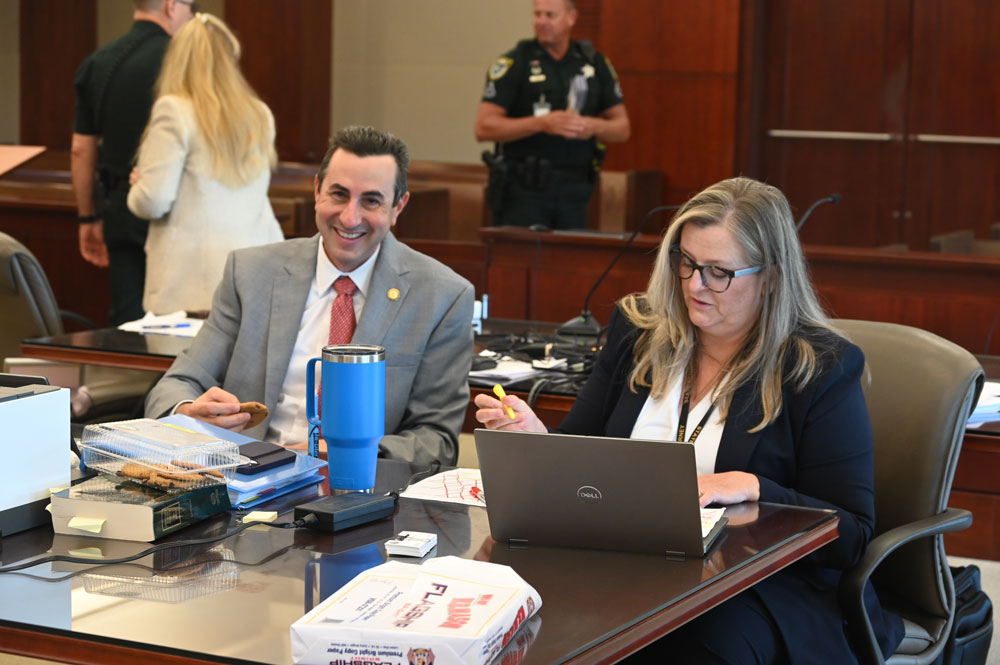
The jurors include a retired army widow, a retired medical office front desk coordinator, a retired woman on disability, an insurance verifier, two stay-at-home moms, a supply-chain worker at a hospital, a former certified nursing assistant, a project manager, a teacher at an elementary school, a retired food worker, a director in a pharmaceutical company, a solar company employee, and a bookkeeper.
Barrett, the defense attorney, had run out of peremptory strikes–the 10 opportunities each side is given to eliminate a juror without having to give a reason–yesterday, at the end of the first round of selection involving the first panel. That left him with no strikes today, while the prosecution still had five in hand. It used almost all of them, weighing the jury clearly more in its favor, at least at first glance: a jury made up overwhelmingly of women, all of them bringing lifetimes of experience and awareness–even if not personal awareness–to the jury box, will not favor Jermaine Williams.
One question Assistant State Attorney Helen Schwartz asked every juror was whether the juror in a 7-4 scenario could be the tiebreaker for death. Most of those who had not already said that they were opposed to the death penalty said they would. There was an unexpected exception.
“Yes, but I want to be clear that I don’t believe in life without parole,” the juror, a recent resident of Palm Coast who works in manufacturing, said. “I think that there’s far, far worse things than death, and being in prison for life is one of them to me, and it’s a burden on society and a waste of resources.”
“Would that cause you to automatically vote for the death penalty when given the choice between life and the death penalty?”
“Yeah. It would,” the juror said. He was excused.
Like the first pool of 75 potential jurors, the second jury pool of 60 included only four Black jurors (or persons of color, including Southeast Asians). Two were excused by the time Schwartz was questioning them on the death penalty. When she asked the only young Black man left in the pool, an 18-year resident of Palm Coast and a pharmacological company researcher, about his willingness to vote for death, he said he would not. Not in this case.
“Like for example, if this was like a pedophile case and stuff like that,” he would vote for death, he said.
“So even if you’re instructed on the law by Judge Nichols, told that you know you must weigh the aggravators against the mitigators, and you believe that the aggravating circumstances outweigh those mitigating factors, and even if you believe that a death sentence is appropriate–this isn’t a pedophile case–you’re not going to vote for death?”
“You also mentioned that I have the option,” he said. “I would potentially probably choose life over death.” He was excused.

If you or a person you know is a victim of domestic or sexual violence or abuse, contact the Family Life Center in Flagler County, confidentially, at 386-437-3505 or go its website.





I Trust the process says
Yolanda is no longer with us to offer her side of the story.
I wish Flagler Live was less ambiguous when saying that Williams side of the court was mostly empty. Both the people in this story had the last name Williams. Prosecution or defense side would clarify!
If you murder someone for whatever reason that seemed so important to you at that time, other than in self defense, you will lose your existing life in an instant, become incarcerated for indefinite amounts of hours days weeks years and eventually go before a judge and jury of your peers. Peers means people from your area, not your friends. I liken it to a game of poker and you don’t control the dealer. The jury you get may be sympathetic, or not. The lawyer for the prosecution could be just out of law school or crackerjack experienced and now after this last case to cement his legacy, is ready to retire after 40+ years of lawyering.
Like Gump’s box of chocolates, you never know what you’re going to get. there are hundreds of variables in between that when stacked together I think its a safe bet that the best plan is to just not look to hurt anyone ever. Then you will never ever find yourself in Mr. Williams current predicament.
Seriously says
Wow. We live in a sad part of the world if men are less likely to give the death penalty than women for a premeditated murder conviction irrespective of the victim’s identity. Truly pathetic. Do those same men go to church weekly and put on a fake face for the community. One has to wonder.
JimboXYZ says
What did anyone think this would become for a decision & sentence, regardless of the demographics of a jury ? He stabbed his wife in the driveway 15-20 times, it got so ridiculous, they lost count ? That his own defense lawyer doesn’t know exactly how many times he stabbed his wife ?
“Barrett, an experienced death penalty lawyer, is defending Williams, with Anthony Eric Leonard in second chair. Judging from the implications of the questions he posed to the jury, Barrett all but conceded today that he will not be disputing what the jury will see with its own eyes in surveillance footage later this week: that Jermaine stabbed his wife 15, 16, 17, 18, 19 times in their driveway. He had conceded as much in pre-trial revelations that he would try the crime-of-passion defense.”
https://flaglerlive.com/williams-trial-day-2/
JimboXYZ says
Well, maybe in 30-40 years when the execution date is finalized, the article for the lethal injection happens and it becomes a political football for Democrat vs Republican Governor that carries out the execution of an 84-94 yo Williams Sr as a black male ?