


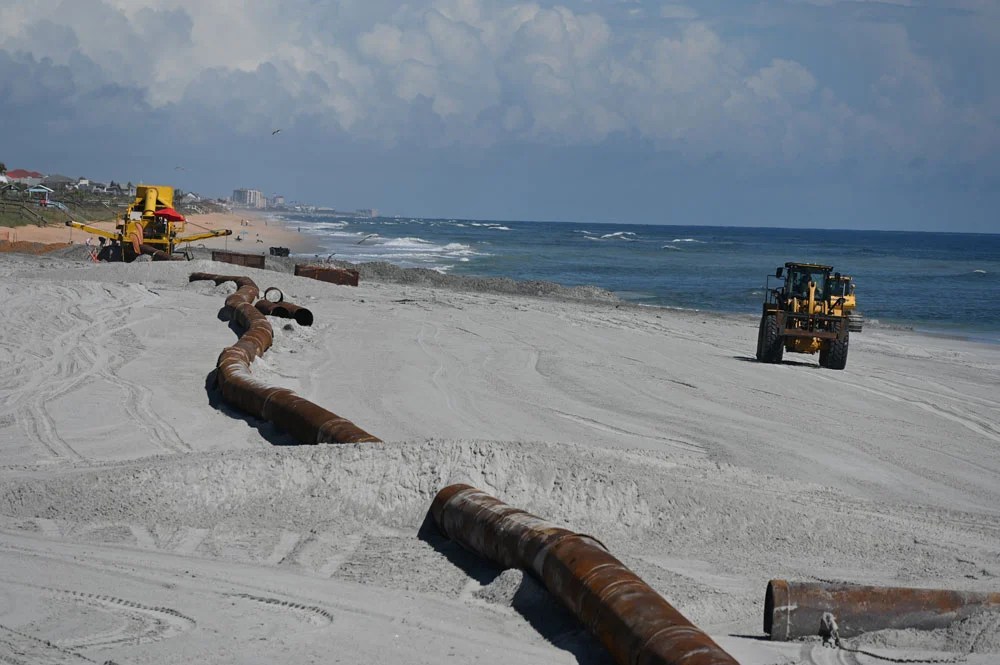
The Flagler County Commission on Monday approved a $34 million bid to Weeks Marine to rebuild 5.5 miles of beach from North 7th Street in Flagler Beach to Varn Park, north of Beverly Beach. The rebuilding will start in early 2027 and take four to six months. The vote, approving an overall $35 million appropriation, was unanimous.
All but $4.2 million of that is paid for through state and federal grants, so the county’s funding share is 12 percent.
It is the first major beach renourishment project in Flagler County since Weeks Marine completed the 3.6-mile renourishment–the first in the county’s history–between North 6th Street and the northern edge of Gamble Rogers State Recreation Area in September 2024. Most of that was a U.S. Army Corps of Engineers project, with the county tacking on to the reconstruction north and south of the federalized beach.
“This is a long time coming, and you’ve done a great job, Hamid,” County Commissioner Greg Hansen, who has championed the county’s beach management program, told Hamid Tabassian, the county engineer. He also credited Sean Moylan, the deputy county attorney.”This is a fantastic. You and Sean, kudos to Sean.”
Commissioner Kim Carney was less effusive.
“I don’t understand how we can move forward with no interlocal agreements with Flagler Beach or Beverly Beach,” Carney said, referring to joint agreements between local governments. “Neither one of these municipalities know what we expect from them after this is done. This is like a drop and punt. I got no problem doing the project. I got no problem spending the $35 million. I am very concerned that these other municipalities are not on board, and I’ve been saying this for a year and a half.”
Flagler Beach and Beverly Beach are on board. Flagler Beach was ecstatic when the county managed the Army Corps project. There are interlocal agreements in place with both governments, as Interim Administrator Adam Mengel noted Monday. They are being updated.
The city has also repeatedly pledged support to the county’s long-term beach-management plan, including yielding the totality of its revenue from a prospective sales tax increase to fund beach management, had the county gone that route. Carney, along with Commissioners Leann Pennington and Pam Richardson, rejected the plan, which hinged on an increase in the sales tax.
At joint local government meetings and in their own individual commission meetings, Flagler Beach and Beverly Beach officials have continually voiced support for the county’s beach management and renourishment plans. What neither government has approved, or is likely to approve–and this, too, they have voiced repeatedly–is a plan that would single out barrier island property owners for any onerous additional tax scheme to fund the beach program, absent contributions from the rest of the county.
But Carney was right when she said that while the beach reconstruction project is in place, there is no agreement with either Beverly Beach or Flagler Beach on who pays to maintain the reconstructed beach from here on. The county doesn’t have the money for maintenance. That’s what the defeated beach-management plan was intended to pay for. And neither Beverly Beach nor Flagler Beach have budgeted maintenance dollars. As things stand today, the renourished beach will be a one-time reconstruction. Left unmaintained, the beach will revert to its degraded condition within years.
Flagler County’s 18-mile shoreline is broken down into five so-called “reaches,” or segments. The U.S. Army Corps segment is Reach I. The new project will cover Reach II. Weeks Marine will dredge sand from the same borrow pit used for Reach I, 11 miles offshore.
It will dump 1.5 million cubic yards, varying from 20 cubic yards to 80 cubic yards per foot, along the stretch. That is less than the $1.8 million cubic yards the county had sought. But to dump 1.8 million cubic yards, the county would have had to pay Weeks Marine $39 million, Hamid Tabassian, the county engineer, explained to commissioners. Flagler County does not have that money.
To rebuild a beach, Flagler County must secure easements from every property owner along the project stretch. The easements are the legal documents that allow the government contractor to work on each private property. Those properties extend to the high-tide line, beyond which it’s state land, where easements are not required.
Flagler County secured every needed easement when it accomplished the renourishment on Reach I. It has not been as successful with Reach II: there are still 13 holdouts. Holdouts create carve-outs of the renourishment sand up to the high-tide waterline, weakening the project overall.
The project will go forward despite the holdouts, county officials say. “In a 30,000 foot project, we are lacking a little over 1,000 feet, less than 5 percent,” Damon Douglas, the county’s coastal program manager, said. “Would it be better if we could get all of them? Yes. Would it be ineffective if we do it without all of them? No.” Especially since sand will still rebuild the beach from the high-tide waterline down.
It will look ugly, and it will compromise protections for property owners north and south of holdouts’ properties.

The Camptown RV Resort in Beverly Beach, where a sea wall was damaged by a more recent storm, will be skipped as the county awaits the property owner to rebuild the seawall. The project will push sand to within 20 feet of the seawall. Chris Creed, the coastal engineer overseeing the project for the county, recommended against skipping the property.
“The performance of a beach nourishment dune project is dependent upon a longshore length without significant gaps,” he said. Most of the gaps are small. The Camptown gap is not small. He is recommending removing the collapsed parts of the concrete wall during dune reconstruction, since the wall’s debris is in the way of the renourishment project, and building the dunes and the beach there, leaving it up to the property owner to rebuild the wall at a later date within the dune structure.
“There are a few pieces of concrete slab at the RV site that are completely detached and on the beach,” Tabassian said. He said the RV park’s property owner agreed to pay for the debris removal. “We are not going to place sand on any type of concrete because these have rebars in them, and we don’t want later on to get exposed and become a safety issue.”
The county issued the invitation to bid on March 5, receiving four bids, with the high bid coming in at $52 million.
To land state and federal grants, including reimbursements through the Federal Emergency Management Agency (FEMA), the county must provide a share of the cost. Those shares add up to $4.2 million. The State Department of Transportation is contributing $5.9 million, the state Department of Environmental Protection (DEP) is contributing $19.7 million, and the state Division of Emergency Management is contributing just over half a million dollars.
FEMA dollars add up to $4.7 million, part of the reimbursements for Hurricanes Ian and Nicole in 2022. “This is money that has already been obligated by FEMA for us to seek reimbursement for various projects,” Douglas said.
On Saturday, U.S. Rep Randy Fine, who is running for reelection and faces primary challengers in the Aug. 18 primary (among them Palm Coast’s Charles Gambaro), is making a campaign stop, billed as a press conference, at the Beverly Beach Town Hall. Fine will take credit for securing $13.5 million in FEMA dollars for the county’s beaches, even though Fine was a state legislator when Flagler County applied for that money.
Notoriously delayed regardless, the Trump administration further delayed FEMA awards across the country for months before courts ordered it to lift the freeze and reverse the cancellation of billions in grants. Fine may have been instrumental in re-accelerating payments with a few contacts, but not by much: the money was owed Flagler County regardless, and would have likely been issued without the delays or cancellations imposed by Trump, who is Fine’s political patron. Fine, who champions himself as a friend of beach communities, never criticized Trump’s previous actions on FEMA.
Not wanting to bite the hand that pretends to feed them, local officials have played the game, as they will again on Saturday, toadying to Fine’s shadow as he preens for the cameras. The real efforts and credit go primarily to the county administration, including its emergency management division.
The county has $10 million in hand. The rest will be reimbursed on a monthly basis from the state, which will require the county to dip into its reserves to cover the gap. That makes county commissioners nervous from a cash-flow perspective. FEMA money will take from six months to a year for the FEMA funding to be reimbursed. Commissioner Andy Dance asked for monthly progress reports to the commission. “We just don’t know, we don’t have a comfort feeling with FEMA. We would lean on our congressmen to help us with that process,” Dance said.
“I discussed this with Congressman Fine this last week,” Hansen said, “and he said, ‘Don’t worry, I live on the beach. I love the beach. I will support the beach, whatever it takes.’”





Waste not want not says
Like sand thru the hourglass
Just keep dumping good money after bad.
Be doing the same thing again in a couple years. What a waste
Fox it right and be done with it
Seawall and jetties with breakwaters a couple miles out