



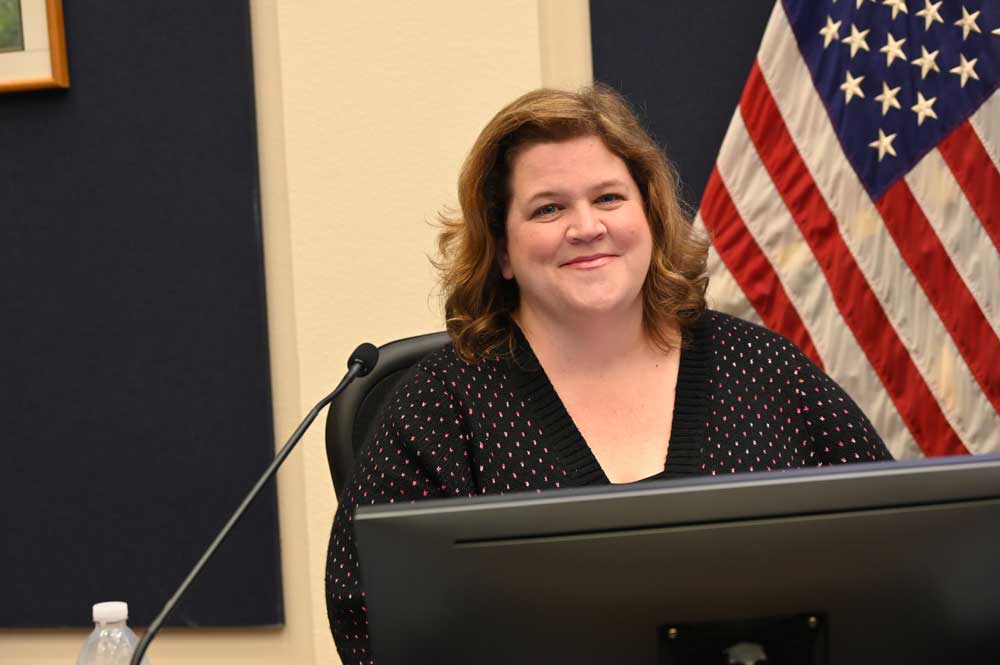
Incumbent Leann Pennington is one of three Republican candidates for Flagler County Commission, District 4. She faces Anna Jones and Drew Moss. Only registered Republicans may vote in the primary. The winner of the Republican Aug. 18 primary will still go on to the general because a write-in has filed, but the Republican who prevails is all but certain to win.
Two seats are up on the commission in this election cycle. In District 2, an open seat, Greg Feldman faces Theresa Pontieri in the Republican primary. The winner will face independent Raymond Royer in the general election.
Flagler County Commission members serve four years. They’re paid $77,000 a year, an amount that will likely go up by a few thousand dollars by next year.
The Live Interview format changed this year. Since 2010, FlaglerLive had submitted identical questions to all candidates, enabling them to answer in writing. There typically were a round or two of follow-up questions, also in writing. Artificial intelligence has made that approach obsolete now that candidates can run the questions through AI and spit out prefab answers. To get around that, candidates were invited to a video interview. The video and the transcript are provided below.
The candidates were provided the same basic question within half an hour or less of the scheduled interview, but obviously not the follow-ups, which all differed. The questions to county commissioners are here.
Following the interview and before publication, the interview transcript went through two rounds of editing at this end, once by AI (yes, the irony is inescapable) for spell checks, copy editing and to smooth out verbal tics or repetitive words, and once by me for the same purpose. The candidates were then provided with the interview transcript and the video to review–not to make substantial changes, but to verify transcription accuracy, and, if they so chose, to add a postscript: if they felt they may have misspoken, or not clarified a point, or preferred to revise an answer, they were given that chance in the postscript, without changing the original text in the transcript. The postscript window is remaining open for subsequent additions, until the election.
The interviews can be quite long–not a surprise for a site pathologically incapable of brevity, but the county is awash in candidate quickies. We offer a little more depth, seeking to draw a profile rather than check off boxes. The Live Interview’s aim is to elicit as much candor and transparency as possible, and to learn about the candidate beyond the basics in what amounts to extended conversations about the person, the character and temperament behind the candidate, the candidate’s seriousness, and the issues.
The rest is in the voters’ hands.
–Pierre Tristam

Flagler County Commission Greg Feldman (Dis. 2, R) Theresa Pontieri (Dist. 2, R) Anna Jones (Dist. 4, R) Drew Moss (Dist. 4, R) Leann Pennington (Dist. 4, R) Flagler County School Board Cathy Moon (Dist. 1) Jill Woolbright (Dist. 1) Will Furry (Dist. 2) Rob Wood (Dist. 2) Christy Chong (Dist 4) Ron Long (Dist. 4) Trevor Tucker (Dist. 4) Palm Coast City Council Tony Amaral Jr. (Dist. 2) Jeani Duarte (Dist 2.) Jimmy Hengy (Dist. 2) Dylana Dee Galery (Dist. 4) John Kvederis (Dist. 4) Ramon Marrero (Dist. 4) Darlene Shelley (Dist. 4) The candidates' interviews will be live-linked the day their interview publishes. |
The Interview Themes in Summary: Quick Links
The Video:

FlaglerLive: Good morning, Ms. Pennington. Thank you for taking the time to do this. Why don’t we start with where you were born and when?
Leann Pennington: I was born Oct. 29, 1977 in Jacksonville, Florida. I’m a native of Florida, raised in the Switzerland area. Most people know that out in Fruit Cove on the St. Johns River, and I came to this area in the fourth grade.
FlaglerLive: So you’ve been in Florida most of your life, or all of your life?
Leann Pennington: All of my life, I did spend one year with my husband, who passed away, but he was from Richmond, Virginia. So I did spend one year of my life with him up there, but for the most part, I’ve been here in Flagler County.
FlaglerLive: And you, in other words, from your childhood, you spent your childhood in Flagler.
Leann Pennington: My first year of school was at Wadsworth, and I believe that was the first year they opened the doors at Wadsworth. I’ve spent a lot of time in Flagler. I was there, private school, but yes.
FlaglerLive: What have been your professions up until your election?
Leann Pennington: I actually have been nearly 30 years now in the banking industry. I started out as a due diligence auditor. I’ve done that for Goldman Sachs, Merrill Lynch. I also was an internal investigator for JPMorgan Chase, and I currently work as a fraud strategist for a large Canadian firm.
FlaglerLive: What is a due diligence officer?
Leann Pennington: So we built mortgage-backed securities. You actually review a paper packaging of all your mortgages secured by investors. So that’s who actually supports how you get funding. So what we do is we bundle those, make sure that they’re going to be performing loans and for the investor, whoever the investor is, so we review all the documentation, ensure it’s in line, and with what the investor would like to invest in.
FlaglerLive: You’re still working other than the county commission.
Leann Pennington: I do. Yes, yes. I’m a fraud strategist, so I work for a large Canadian bank, and I help them with very complicated lending fraud matters.
FlaglerLive: And of course, this is the Republican primary, so you’re a registered Republican, and you’ve always been a Republican.
Leann Pennington: Lifelong Republican.
FlaglerLive: You’re running for your second term. So, what justifies your re-election?
Leann Pennington: I feel like our first term has been highly successful, particularly for the Western District. We’ve been able to deal with some serious drainage issues, get funding from Covid money for that. I’ve brought a special needs shelter out to that district. We’ve been able to get state funding for that, as well as Bull Creek. Bull Creek was destroyed in the last hurricane, and the residents really wanted to see that back, so we were able to do that. We’ve done a lot of conservation work and efforts out in the western expansion, and so now we are prioritizing trying to help them get some long needs on the roads. We have roughly 125 to 130 miles of unpaved road, so that’s a chief priority that I’ve been working on. So that’s been very important to me. And then continuing on the conservation efforts is important, especially with all the growth that we’re experiencing, and I’m sure we’ll talk about it later. But obviously, finding permanent funding mechanisms for the beach needed to be a priority.
FlaglerLive: What is the special needs shelter you’re referring to?
Leann Pennington: When I first came on at the county, growth was incredible, and we had a deficit for a special needs shelter. That is a shelter during any times of storms or crises that we’re having, where people can go and stay instead of in their home when they’re in need of evacuating and they have issues or they have pets. We obviously had a deficit in that because there are so many residents coming on, we also use schools only for special needs, and that was always putting out on the schools because they’d have to close down earlier to set up for it. So all those things combined were an issue for the county, and we were going to have to, per state mandate, at some point address that and build a building, so I actually worked with Jonathan Lord on this project to get a building to get 10 million dollars in funding from actually Senator Leek and Paul Renner out of the state so that we could build that. And it’s actually the first shelter too in the westward side of the county because there are obviously no schools over there, so we were able to work on that, and when it is not in use as a special needs shelter, it will be used as a fair expo hall where people can lease it to have any kind. It’s 16,000 square feet, so it’s very large. It has a kitchen, it has showers, it has laundry. So it’ll be used as our new cattlemen’s hall for our cattlemen, so it has a multi-use facility to it, but it’s very nice. And I believe it opens maybe in a couple weeks, so it’ll be open just a few weeks from now.
FlaglerLive: That’s at the county fairgrounds. Does that preclude any need for using schools anymore during emergencies entirely?
Leann Pennington: Unless there’s more people than we can accommodate at that facility, yes, it would. We’d be able to open it up earlier, get it ready earlier, get the people in sooner than they’ve been able to, and keep children going to school until the event occurs.
FlaglerLive: As far as your performance on the county commission, what would you say is a character flaw?
Leann Pennington: I think I have this flaw in general in life. So I’m highly empathetic. I can be at times very emotionally charged. I feel for people when they come up and talk to us.
FlaglerLive: But that’s not a flaw.
Leann Pennington: It is in government, I think, because to make a very policy-driven, fact-based, fair decision, and obviously, and you’ve seen this covering us for years, you’re trying to make a decision that doesn’t land us in more issues such as lawsuits, regulatory trouble. So it can be very difficult because you want to go one way, obviously, because you can sympathize with a person that is having the issue. But we have to be very fact-based and ensure that we’re not going to be wasting additional tax dollars in the long run with things like lawsuits. So that can be very challenging for me.
FlaglerLive: Is there a procedural flaw that you can think of in terms of how you relate to your colleagues?
Leann Pennington: I think one of the biggest problems we have on our board obviously is consensus building, and I think that’s just always going to assume probably a problem for all boards at some point or another, so we’ve struggled with consensus building or prioritizing what the right issues are. We all have different issues that we’d like to see addressed, so we can get caught up in that at times, and I’m certainly guilty of that.
FlaglerLive: It’s not necessarily all boards. For instance, in Flagler Beach, they work very well despite all of their deep-seated differences between them, they seem to work very well toward consensus, but not so much at the county commission. What do you think is the difference?
Leann Pennington: First of all, I think that’s ebb and flow. You’ll have good years. You’ll have quiet years. Yes, years where it’s craziness. I believe that’s every board. I follow St. Johns really well. I follow Volusia. I see it there. There are strong personalities on every board, and I think what we’re seeing right now is we’re seeing on our board, in particular, new commissioners trying to figure out the lay of the land, trying to understand, come into complex issues years later, trying to pick up where the last person left off, and that they were elected right by people who want change. People want change. You’d be very surprised when they’re going to the booth and voting you in. It’s the last thing they say before they walk in the door. Fix it, change it, make it different. And so you have this a lot of what’s the best way to say it. You carry a lot of feelings that this is really important that you get this right, that you change things, that you change the way everything’s ran. So you come in there and you’re like a bull in a china shop. You want to fix this, you want to change this, and then it quickly becomes very frustrating because you find, well, there’s a reason I can’t change that, or there’s a reason that it’s never been done, or there’s not funding for it, or the staff is adamantly against it, and it becomes a battle with the staff. Or you don’t have consensus on the board, and so we’re seeing all of that right now come to life, and a lot of frustration. Different types of personalities. Some are very procedural on our board. They want to follow processes. They want to slow things down. They want to look at things. Some people are like, “We’ve changed it today. Let’s get a consensus for it.” And so there’s just a lot of that going on. And I think that’s probably the most difficult thing we struggle with. And we’ve got to learn to lead around personalities.
See how the other candidates answered:
FlaglerLive: What is the quality that you bring to the board that gets you to that.
Leann Pennington: I hope when you’re watching it that you’ll find that I try very hard to just take to I kind of pull the gavel out. If you’ve seen me yesterday, it’s just no, no, no, we’re not going down these avenues. We just need to be consensus building at all times, in the most polite manner that we can. When we’re not polite, we’re going to get absolutely nothing accomplished for the people of Flagler. So I find myself a lot of times just when someone tries to go down the path of not being respectful or polite to their counterpart, then I just shut it down. It’s not benefiting any of us up there, and so I feel like we’ve turned a page in the last couple of months. I really do. I can tell. We kind of were spinning wheels there the first year. We had new commissioners on, and they’re good people. Everyone is there for the right reasons on that board, but just competing ideologies. What’s happening there?
FlaglerLive: Just to be clear, the new commissioners were Pam Richardson and Kim Carney, and the veterans were yourself, Andy Dance, who’s already into I think his second or third term, and then Greg Hansen, who’s been there since the 19th century, and he’s leaving at the end of this term. He’s chosen not to run again. So, who in all local governments, do you admire most, or you consider a model of leadership?
Leann Pennington: There’s a couple of them, but I think school board member Lauren Ramirez stands out the most to me right now. I find Lauren is not driven by conflict or the need for attention. I think Lauren is there for all the right reasons in that role. I think she has a desire to serve parents and our constituents, and I think she does an outstanding job. And she really presents herself very well in any public situation. And she’s stood up to a lot of stuff on that board. I think, and she’s taken it with such grace, and so I’d have to say it was Lauren Ramirez.
See how the other candidates answered:
FlaglerLive: Can you give your commission a grade for the last couple of years?
Leann Pennington: I’d say we’re probably a B to B minus. To be honest with you, right now, we’re going through the… As you said, two new commissioners. We’re going through administration change right now, but we’ve been very collaborative in supporting things that are very important, such as public safety. We strengthened our county reserves. We paid off years old debt, so we’ve been very consistent with making sure that we are taking care of our finances. We’ve recently started to advance some major road and drainage projects, which I’m really glad to see being done, and we’ve approved a lot of conservation, which is amazing for us.
FlaglerLive: Can you give a couple of examples where you failed? I don’t mean to use the word so harshly, but a couple of examples where it lowered your grade.
Leann Pennington: We have lacked consistency and prioritization. What is a priority this week seems to fall off the board two weeks from now when we’re dealing with another crisis. I’ve said it several times. If the beach is the main priority for the board because of what we’re dealing with out there in terms of erosion and property destruction, then the board has to keep very consistent when we’re looking at funding other things, capital projects, whatever, and say, does this really align with our number one priority? I think we could do a better job at prioritizing new road paving in the residential areas. That’s obviously not been a priority for a very long time. So when we get revenue or funding that we’re going to expend, we really need to go back to our priority, our chief priority. We don’t have infinite amounts of funding, so I’ve seen us, and I brought it up. I’ve seen Mr. Dance bring it up, but just lose the vote when there’s funding there. Are we putting it towards what we’re saying is the most important thing?
FlaglerLive: Along those lines, when we ran the story about Bull Creek, a lot of criticism online was that well, you’re misspending this money. We could use it in better places, and we didn’t really need this. If you went after this grant it should have been directed at something more essential. How would you address that?
Leann Pennington: Bull Creek is an anomaly to all of this. First of all, just to give people who are new to the county some insight, we are one of the larger agricultural farming counties in this area. We produce a lot of potatoes for Frito-Lay. We produce… I think we’re the largest cabbage producer in the United States. So we have a lot of farming going on out there. We don’t have a lot of any, hardly any commercial. Certainly no restaurants. When the county acquired that piece of property, it was a restaurant. It was intended to stay a restaurant, and it was destroyed. It was where all the farmers met for lunch. It was where all the farmers got their breakfast. It was really a pillar in that community. So when the county acquired it, it was certainly very important to Western Flagler. It’s an identity piece for them, right? So it was destroyed, and there was no funding to put back. We were going to plug like $300,000, maybe build some sort of like container, a shack sort of, to have some type of food out there. What happened was in that particular situation was there happened to be funds already at the county from the State of Florida for a project, and I think it was in the Marineland area. And the State of Florida later on decided that no, the funds could not be used in that project. Please send the funds back unless you have a place where you can use it. And it had to be very specific. It was specific to economic loss. It was specific to hurricane, and they looked around. They looked at every project they had and said, “We don’t want to send the money back because we know when we send money back to Tallahassee, it goes right back out the door to another county.” That’s just the way it works.
So we looked at every project, and they certainly tried to find all sorts of projects where it could be applied, but it turned out that was the only project that rose to the level of that grant issue. So rather than send it back, the state said keep it and rebuild Bull Creek, and so that’s what we did. So that’s an anomaly, but it is so welcomed, and I think it’s really important to keep people content out west, they certainly get the least of our tax dollars, but they are keeping us rural. They are keeping us fed, and so I highly support where that went to. And I think over time, people who come out and enjoy Bull Creek will love it, and because it was always important in that community and is stable, so hopefully people will come out and partake in it and enjoy it.
See how the other candidates answered:
FlaglerLive: Are there a couple of goals that you’ve agreed to as a county commission that you are very supportive of, and maybe a couple of goals that you might not have yourself supported, but you went along with?
Leann Pennington: One thing the board gets right is that we always prioritize public safety. That includes fire, EMS, emergency management. We often forget that one. So that’s a really nice thing that we don’t differ too much on that. We also don’t differ on protecting natural resources and purchasing, raising the funds and purchasing all of the conservation land. So that’s very nice not to have competing goals there. I think we vary some with infrastructure spending. I would like to see a residential road paving program and stick to it, even if it’s one year, just to give some realistic expectations to people who have lived on dirt roads, who don’t want to be on dirt roads, who are having flooding issues because of the dirt road. We owe some commitment there. I don’t think we all align on that particularly because we get kind of sucked up in the other issues.
FlaglerLive: Is money one of the reasons you also don’t align because there is no money to do that?
Leann Pennington: A lot of times, right. I don’t think people understand with taxes, because they say, “Oh, my taxes, my taxes.” The county, when we receive tax [revenue], the bulk majority of them go completely to constitutional officers. That’s your sheriff’s office, your tax collector, property assessor, clerk of courts, supervisor of elections. So then we fund things, medical examiner, all sorts of things, issues in court and stuff. By the time we get down to what is left, there’s only a small amount to work with for the year, in comparison to what these projects’ bids are coming in at. These are incredible amounts to overcome. And then you’ve got the beach, which is one of the higher priorities, but the costs are almost out of line with what we can afford at times. It’s very competitive with infrastructure needs. After that, it’s like, well, there’s X amount, and road paving is coming in one to two million a mile in bids, so that’s very difficult. One to two million a mile is a big chunk of money for them to look at. And then by the time we get money for the roads, we’re now looking at repaving collector roads. Right, we got to repave 304. We’ve got to repave 205, so it makes things very difficult at that point to say, okay, let’s prioritize roads that have never been paved, right? So that’s been very difficult.
But I think at some point we just have to say no, roads that haven’t been paved, we’ve got to have something set up. We’ve got to be doing at least one road a year. There has to be something there. So that’s something that we haven’t talked enough about. As long neglected residential, the other one we’ve talked about, but I feel like we haven’t pushed hard enough on, is advocating at the state level harder, working harder and smarter on this, maybe doing it all year long, and that is helping FGUA [Florida Governmental Utility Authority] expand water down in the U.S. 1 corridor in the south. That’s the Ormond Favoretta area on U.S. 1. What we’ve seen in Palm Coast is ITT kind of developed along 95. They developed now along U.S. 1. Palm Coast has, and it’s left very few commercial pad-ready areas. And so, when it comes to unincorporated county creating economic jobs and things like that, there’s not a whole lot within our sphere of unincorporated that’s commercial pad-ready. We look at the U.S. 1 corridor in the south, and you’ll see buildings on it, but they’re on septic. It’s kind of important that we try to get water down that corridor because by getting water down that corridor, we’re opening up U.S. 1 property where we can see industrial and commercial come in, and it’s a really attractive area for that kind of business because they can also tap into the Daytona Beach Ormond job market. Right, the folks that they’re needing to fulfill these roles, we don’t necessarily have as many people for them to look at as that. So I think that needs to be discussed again by our board and reprioritizing because until we fix our tax base, we’re just going to continue to have these conversations about infrastructure and priority.
FlaglerLive: FGUA is not exactly a government utility, it’s not likely to say, “All right, yes, we’re going to take care of that for you down U.S. 1.”
Leann Pennington: They did say that. We actually took this to Tom Leek, and we’ve taken it up to Tallahassee twice. It’s a large expense. They are not the mindset to fund it legislatively through appropriations, so they have applied for grants, and so we just continue to try to support them through that process to try to get the grants to do it. So there is a want to help expand. Obviously, you go down that area; it needs water long term, and so we’re just hoping that sooner than later, when it comes, so that we can, and then at that point, you have property that is in unincorporated. It’s not in the city of Bunnell. It’s not in the City of Palm Coast. It’s unlikely to annex into any of that. That is where the board can really kind of control and say, no, no residential housing. This needs to be commercial, industrial. There’s no housing around it. It’s got water. That’s where our board could really probably try to focus on.
FlaglerLive: Why not partner with Bunnell’s utility in the same way that the county or Flagler Beach or the Hammock have partnered with Palm Coast? In some cases, not necessarily forcing the partnership to lead to annexation.
Leann Pennington: I don’t think they have the capacity to do it. If they’re certainly interested in it, we can talk. But that is part of what I’m saying. We need to prioritize and have those discussions, right? If we know we have a tax base problem because we’re primarily residential, and we know that we’re missing commercial pad-ready, and people are really coming at us and going create more jobs, create more this, get the economy going here. And you’re going well, you know, I’m trying. We build an IDA, we’ve tried to give economic incentives. They’re not coming, and you’re like, well, let’s look at the issues why they’re not coming. And I can’t get past census issues like the money’s not here or the right type of people to work are not here. But what we can do is give them commercial pad areas, and areas closer to where the money is or where the workers are that still remains in our county and would help us diversify our tax base, so that’s got to be the priority. And whether it comes through FGUA or it comes through Bunnell, the board needs to start having those conversations and bring that project back to life.
FlaglerLive: I was going to ask you what a couple of your goals for the coming four years are, and would this be one of them?
Leann Pennington: This to me needs to be when we talk about top priorities that are not necessarily funded by the county, but that is going to change our county for the better, this certainly is it. One of my very simple goals also would be to set a goal to prioritize and pave one residential street a year. It sounds crazy, just one, but we’re 125 miles of unpaved roads. Some people don’t want their roads paved, and that’s understandable and fine. But there are many people who want their roads paved because of the flooding issues that they experience on the roadways.
FlaglerLive: And have you figured out a source of money for that?
Leann Pennington: That’s what we’re having that conversation with our board this year. We have got to start talking about prioritization, efficiency within roles within government. So doing this is something we need to talk about as a board time study of government roles. Is there a way we can do that and look at what people are doing? We don’t hire back through attrition, not necessarily layoffs, but is there a way that we can do that so we can start freeing up funding without taxes increasing? Because right now nobody in the public seems to want their taxes increasing.
See how the other candidates answered:
FlaglerLive: How will you vote on the homestead amendment?
Leann Pennington: I’m waiting to read the amendment. Obviously, we’ve read what they’ve put out there, but I think there’s a lot of lawsuits that are going to change the way it’s written. I’ve seen where they’re talking about taking it back to the attorney general to rewrite it before it goes on. So I have to see that. I know that this amendment will bring tax shifts. I do recognize that. So, all in all, though, I think I right now intend to probably vote yes, and I know that seems controversial.
FlaglerLive: Contradictory is more–
Leann Pennington: I think you have to look at your situation. I mean, first of all, I became a widow this past year, and I think a lot of people are just not… they’re looking for tax relief, and if we’re not going to give it to them, if you’re not getting it somewhere, and you give them an option like this, they’re going to vote yes. Not thinking about the consequences. Now, I can recognize that there will probably be tax shifts from this. I think the state fully intended when they put this out there that there would be tax shifting going on. I’ve heard conversations about state sales tax rising, things like that. So more consumption taxes, MSBUs, MSTUs. So I look at everyone’s situation differently, and so right now I’m leaning towards yes, but I’m waiting to see if they fix a couple of things, and that would really determine how I go.
FlaglerLive: Based on everything that you’ve said in the first 25 minutes, I don’t understand how you’re not out there campaigning very loudly against the amendment.
Leann Pennington: Because first of all, I don’t think that’s my job is to campaign for or against an amendment individually.
FlaglerLive: I don’t mean as a representative of the commission, but as an individual commissioner.
Leann Pennington: I can see though that… so this is just Leann the resident talking, right? Four years in this role, I can see where people, the staff, people who are consultants, people who are elected leaders. They have a very difficult time having conversations about duplicate expenses, unnecessary rules, growth in administration. Broadening tax base, having hard, difficult conversations that will strip away some of the unnecessary item lines. Right? You say it all the time. I think it’s one of your questions. Well, the sheriff gets X amount of dollars. How do you say enough’s enough? Like everybody doesn’t want to have these conversations because they lead to difficult choices. Adult daycare was one of those, right? So one of the things, whether we like it or not, the conversation around homestead property tax and voting for this amendment forces governments, local governments, to have these conversations, to say, okay, we always knew this might happen, right? I mean, it could happen because the market collapses. It could happen for a million different other reasons besides voting in this amendment. But you’re like, okay, we’re going to have to have these difficult conversations. You may not like it, but we may not need six administrative assistants any longer. We may need to merge communications or permitting with other municipalities. We may need not, as a municipality, to have our own fire and rescue. We may need to go with the county as a choice. They need to have these conversations no one wants to have.
FlaglerLive: I don’t think anybody would disagree with you that we need to have those conversations.
Leann Pennington: We try to have these conversations. No one’s willing to have them because the revenue is still there, and so if that’s what this is going to take, then that’s where we’re headed. Because, and this is not just Flagler hiding. This is government everywhere, right? This is government everywhere. It’s like it’s too big. It’s too expensive. And you’re like, gosh, if I had that access to billions of dollars or trillions of dollars, what are they doing with it at the federal level? I don’t want to bring up the word Doge, but nobody wants to have the difficult conversation. So if this is one of those ways where you’re like, hey, we need to do time studies. Are these rules really necessary? Then that’s what we need to start doing. And that might be this is a painful way to get there. And I know absolutely what will happen with a bill like this, which is you’re still not going to be able to fund all these issues, particularly when you take away this much revenue. So immediately, all these governments will go back to the let me pass MSTUs, let me pass MSBUs, let me add on certain fees, let me get creative with all of this, and I think that’s where you’ve got to say, if you have a very strong board, no, we need to have these difficult conversations about duplicative expenses, consulting contracts, delaying capital purchases, and we’re almost forced to do that with this amendment. So there’s this part of me that says yes because then it forces not not two, not one, it forces all five of you to have that conversation, all in all the municipalities.
FlaglerLive: I don’t disagree with pretty much everything you said here, and I appreciate that you didn’t bring up the fraud of Doge, which has been idiocy thrust upon local governments. But the way you’re describing things is basically saying that we, as a county commission, have not had the fortitude to force these conversations, so we’re punting to the state and this amendment. But it is in your hands.
Leann Pennington: I don’t think it’s the County Commission. I think it’s the people. I think it’s the people and maybe the state level punting to that. What was missed about what Blaise Ingoglia or however you say his name, what was missed in the entire conversation with Ron DeSantis and everything, was you can’t… it can’t continue to grow at this rate the costs because you’re obviously you’re limited on what you can even charge in taxes, your cap right. Your growth could become stagnant value so the way our whole process goes with collecting can go lower, but you can’t keep up at this rate.
FlaglerLive: I’m reluctant to let that be the premise because even from your perspective at the commission, you’ve spoken about this. Ms. Carney has spoken about this. Others have. The sheriff certainly has. [Ingoglia’s premise] is false. It is completely flawed, and it has never been substantiated, no matter how much you’ve tried, including your county attorney, who has sent a very elaborate, very good five-page, single-spaced letter saying we want all this explanation, and he has not been answered. So we’re continuing to set up this claim by the state and by Ingoglia as a valid premise, which it is not.
Leann Pennington: Yeah, I understand that. I take his concern seriously, but I don’t take the calculation seriously because you can’t label everything above inflation and population as waste. You just can’t. They didn’t say these are your wasteful items, these are your fraudulent purchases. He never came back to us with anything specific. So on that front, no, because he didn’t factor in the fact that we had almost been a fiscally constrained broke county prior to 2019, we had no reserves. We now have healthy reserves. We paid off debt. He didn’t factor any of that in, right? But I think the point is, like, at some point, if you keep on this trajectory, you’re going to be taxing everywhere, right? But how do you break the machine down? How do you stop it? How do you say, hey, these bids are incredibly high. How much money are you making off of this? At what point do you stop? How do you stop this big mechanism from continuing to try to generate taxes? These projects from getting out of hand, costly, expensive, and I think like the intent was to do good with that amendment. I don’t think it was written properly, and they didn’t take into consideration some of the fiscally constrained counties. How will they function? How will county like Pierre County function? But when I say how I tend to vote. I have been reading the lawsuits, and I think if some of these questions I have get answered and fixed, then it possibly I could be a yes on that.
I think when they had talked about setting up a trust in the state to help send back revenue into the counties to pay for law enforcement, so that that’s a large chunk of our funding, things like that, then they could fix some of this and give relief. People do need relief. You may say I’m fine, you’re fine. But you and I both know cereal is $8 in the grocery store. They can’t stop the cereal maker from getting $8. So people are looking for whatever way they can cut. So if they’re giving me the opportunity to cut my property taxes, then let them deal with it because people believe just what I was talking about—that we’re growing rapidly. We’re using funding for unprioritized items. They want to see you do the exercise about duplicative services. I get it every day. People come to me. Why do we have two fire departments? Why do we have this? It’s not perfect, but you can certainly see what their overall the message is, which is stop growing unnecessarily.
FlaglerLive: The second part of the question, of course, is how do you make up the loss? But part of that question has to be, in your view, because of the way you’re describing things, do you think there is a loss to be made up? Because a lot of what you’re saying is: well we may not need to make up because there’s too much waste. Along those lines, what are a couple of examples that you can point to in your government that is waste?
Leann Pennington: It’s the return on the investment too. Does the tax dollar being put out benefit a large majority? And that was an instance [with Adult Day Care] where it was like, no, it doesn’t, because you’re only seeing 10 to 20 people a week. The program’s costing us maybe three to $4,000 a month per person, and it benefits very few. So you’re like, this program doesn’t make sense. I’d rather see that funding go somewhere to where it makes sense, right? When I talk about roads. That’s a half mile of road that could have been paved right every year to get us caught up. So it’s important to the people that use that program. It’s important to know that that program’s there. Unfortunately, I don’t think Flagler County is in a position where they can offer these types of programs yet because of the way the tax revenue comes in, because of the way the limit of tax revenue is, and because of the costs of services are going up so much it becomes a program that no longer works.
FlaglerLive: And you as a commission decided not to go with the private public partnership that was proposed.
Leann Pennington: Not yet. No, in fact, that’s still in the works. There’s other companies that have come forward. They want to talk about doing a public-private partnership with that building. The building has a specific deed restriction that it has to be used for senior services. So we are looking at that. But that’s for services like that. We should always be looking at: can we get a nonprofit to run it? Can we partner with a nonprofit? Can we partner with somebody that does this better than us, or can offer more or cover more people in our community?
FlaglerLive: So, a couple of examples of actual waste in government?
Leann Pennington: Yeah, I think that we need to do some time study work on roles. I think there are departments that are understaffed. I think there are departments that are overstaffed. I think the fleet needs a closer look at. We have really grown the fleet in terms of cars and automobiles that may not necessarily be necessary.
FlaglerLive: What department is overstaffed?
Leann Pennington: Without doing time studies I think we have to talk about all the administration areas, the non-essential. I can tell you right now that road and bridge needs more workers, and it’s very hard to not see them adding, but seeing other departments, technology, communications, all of that continue to add. So it’s very difficult to see the roles that support the public in general every single day not having the adequate staff size. So, and that’s for the administrator to do. But these roles are getting expensive and costly. They have pensions. Healthcare is incredibly high. We need the study done. We need to talk about what it costs to hire internally a person versus outsourcing these types of roles because of the simple fact that the pension base and the healthcare base kind of make it a very expensive role, you know. And then I think what we have to talk about is you have all these municipalities collecting taxes and yet we offer the same services. Do we need to see some folding of departments or some collaboration in terms of things like communications, HR, permitting, those type of departments? Where if we’re really truly looking out for the taxpayer, right? Then would it be in the best interest of all of us to start having either interlocals or whatever it is to say, you’ve got five HR people, we have six, I have two, we have nine. Collectively, do we really need that many? Can we come together and compartmentalize that into one department amongst the five municipalities. Same with permitting. Those are probably studies that have to be done and all that. But it should be done. I mean, that’s how private corporations run all the time. Is they’re always looking for efficiency. Is this the smartest, best way, what is the most cost-effective way? Do I really need to have this position in-house? Could we get away with outsourcing certain positions? I think it was Lake County or one of the other counties. When you call in you get a robot basically talking to you at first. Things like that. That sounds horrible, right? But you’re like, if you’re wanting taxes to come down, we’re going to have to have difficult conversations to get there, so that we can free up the funds to do what the people are asking every day, which is protect my property from flooding, pave my dirt road, fix the beach. They’re not coming to me asking me to add additional people to non-essential workers, and those people just get costlier and costlier. People, fleet, all that always has to be done, regardless. So I’m on the county commission or anyone else. You’ve got to continue. You’ve got to set up a way to test that and to ensure that your staffing levels are at a proper level.
FlaglerLive: You’re paying half the cost of the SROs, the school resource deputies in schools. I think there’s 12 or 13 of them. You don’t have to do it, but you have been doing it traditionally in this county for many years. Greg Hansen raised that question in one of the last meetings. Andy Dance had raised it a couple of years back. How do you see yourself continuing to pay that cost?
Leann Pennington: One of the things I did this last budget was I actually looked at what they call sister cities or cities with similar populations. So I was able to do that, and I noticed that quite a few counties share that cost with their school boards, so that’s not unusual to Flagler County. I think that falls though in the bucket of hey, that is a priority that is essential, and that’s a necessity that the public is not banging down the door saying don’t fund the police in our schools. If anything, they’re telling us to fund more of them. We’ve had conversations, but this comes back to that discussion we were having. Nobody wants to have the unnecessary conversations about who should fund this, who’s responsible to fund this, because they don’t want to. We’ve been doing it. I’m happy to continue to pay for that because that’s a necessity. How we get there. Same thing with lifeguards. I feel the same way about the lifeguard situation. So I’m okay with doing that. Would it be nice to have a million dollars back in our budget for roads? Yes. It’s nicer having sheriff’s deputies inside the school system, no matter how it gets paid. So that, to me, is just a no-brainer right now. If the school board would like to step up and say we’ll take the full cost of it.
FlaglerLive: Not likely.
Leann Pennington: But they’re not going to, and that’s the honest truth. So that’s a program that has to be funded. Nobody wants to see it go away, and so that’s what we’re doing, right? We’re not going to touch that. That’s not up for now. School board is always welcome to step in and say, oh, we’ll cover our cost.
FlaglerLive: Carver Center. Here’s your opportunity to talk about that because I think you were a little bit under the gun in the last story that ran, but you had brought up at the county commission meeting some of those difficult questions. “We need to look at Carver Center. We need to look at our funding.” It’s about $90,000 in operations that you provide, and then there is $120,000 that you provide in maintenance. Roughly $200,000 combined.
Leann Pennington: And more because our general services does all the work over there, staff—they’re over there pretty regularly doing a lot of work. Plus, we’re doing a lot of capital improvements. But it is not a building that the county operates out of. We built a wing onto that building, about a $300,000 project. If I recall, it was like the first year I came in, and now they’re looking at paving the parking lot. And again, it comes back to like it’s a difficult discussion to have. But this county’s not operating anything out of it. It is fully operated by the school board and PAL, and PAL has been working out of it.
We do own the building, but it sits in the city of Bunnell. It is utilized primarily by Bunnell residents. PAL, the school board operates the offices out of it every day. So that’s one of those conversations that you’re like, well, it’s important to that community, but can we talk about cost sharing at least on it with the school board? Because you are operating people out of it. We continue to do all the capital improvements. We continue to use general services over there, and the costs just keep going up. And it’s one of those items that have to have the discussion. Whether it comes to the answer of no, we’re going to continue to fund it. That’s fine, but are we having conversations every single budget season with where can they do better with their budget? Where can they help us out with their budget? PAL is in there now operating out of it, can they help us more?
FlaglerLive: As I understand it, PAL is not paying anything for the use of the building, right? Isn’t that a little odd?
Leann Pennington: Well, that’s exactly my point. PAL went in to see if it would work in that community, right? There was not a decision whether or not a firm decision of how long they would last in there.
FlaglerLive: Aren’t they looking for their own place?
Leann Pennington: I haven’t heard that in years, so I don’t know.
FlaglerLive: And also, there is the workforce office upstairs at Carver. I was told by Ms. Robinson, who runs the center, that they’re not paying rent. Why would they not?
Leann Pennington: Well, that’s exactly my point. Like, let’s have conversations with the people who are utilizing that space, and say, what are you doing for… Are you able to help? Are you able to assist? Are you able to use school board maintenance to take care of the building? Is the school board able to fund the capital improvement projects from here on out? Are they able to cost share in that? That’s a conversation that’s perfectly normal that people are going to ask those questions, and we need to be asking those questions. It’s really negotiation, right? And so the county’s glad that they can support Carver Gym, but when we are looking at potential deficits, when we are looking at a beach that needs to be funded. When we’re talking about we need to prioritize flooding problems, we need to free up money for that. That’s exactly where we don’t. We’re limited in where we can go and look for this kind of money to free up. So that’s one of those where we’re just trying to have the conversation. And if it comes down to hey, the county wants the majority of the board wants to fund it, then it’s just going to continue to be funded. But we’re asking the city of Bunnell, we’re asking PAL, we’re asking the job resource place, we’re asking the school board, what are you funding here? And every year we get more requests for capital improvements, so we just want to make sure that everybody’s aligned on and doing their part.
See how the other candidates answered:
FlaglerLive: In your tenure, you’ve already in your four years, I think at least once you’ve discussed the possibility of a sales tax increase. Where are you on that? Is the half-cent sales tax part of that mix to make up the loss from the homestead amendment?
Leann Pennington: We know that making up for the loss is going to take those difficult conversations, looking at duplicative expenses, reducing growth in the employee pool, eliminating unnecessary items. We need to look at vacant positions. Do we really need to fill them back? Consulting contracts. Do we fill any of them? We’d have to delay non-essential capital programs and purchases. That’s just the work that has to be done, and it would and we’d have to do some municipalities and other governments to have conversations like what we were just talking about with the school board. So that’s the work that would have to be done if the amendment is passed, and then we’re going to have to work really, really hard at broadening the tax base and looking at how do we get commercial in here, how do we become more attractive. We do some work in it. We just don’t do enough. Mainly, the year gets by us. We have so many issues coming at it. It hasn’t, you know, it needs to be done, and it needs to be done with all the municipalities as well. So, broadening the tax base to get the relief from other revenue streams. So that’s important. I think you asked about the half-penny.
FlaglerLive: Straight out, are you in favor of an increase?
Leann Pennington: I’ve never supported the half-penny. I’ve been open up front and honest. It’s been a question, probably for every level of government in this county, every election season for the last 12 years. That half-penny has been kicked around by for all sorts of reasons. The last time it was brought to our board, I was up front with the no, and I just continue to sit on that. I think that’s the right thing. I think until we see all governments in our county and around the state prioritizing essential services, and really not spending where we don’t think they should spend, then I don’t know that we necessarily should be digging around for more revenue like that. So the problem when it was brought up to us was it was specifically being brought up for the beach. Now the half-penny that is left as an option for this county is for infrastructure. The way it was written at the state level, it cannot be codified specifically to the beach. Okay, so there were so many ways they were splitting this half-penny.
[Note: The small-county sales surtax tax can be adopted by supermajority vote in Flagler without referendum. The proceeds may be expended for any purposes specified in the adopting ordinance (excluding servicing debt). Expenditures are not limited to infrastructure although the Attorney General has issued a formal opinion that beach projects are “infrastructure” projects within the meaning of the statutes. The small county surtax can be expended for any public purpose as identified in the enacting ordinance. See a longer explanation with references here.–FL]
The city of Palm Coast, city of Bunnell, was not sure if they were going to give their portion or not. The city of Flagler was willing to give their portion. Beverly Beach, of course. Palm Coast, it was 50 percent, it was 80 percent, they didn’t have a consensus. They had two on a consensus, but not three. It got so confusing, and beach funding relied heavily on getting the lion’s share of Palm Coast half-penny. Then at that point, let’s say Palm Coast residents decide yes, I want to give the lion’s share of our last half-penny that could go to our roads and our swales and our flooding issues to the beach. We’re willing to give up 80 percent of that because I don’t even know if the residents even knew that was really out there yet. Even if Palm Coast decides to share it, it comes over to the county, right? But there’s no codifying that it’s going to the beach. Meaning that if tomorrow our board changes over and there are three new people and they find that the most important thing to this county is cleaning the ditches along whatever corridor, they can immediately say, you know what, I don’t want to waste any more money on the beach. I don’t feel confident about the beach, or the beach is too much. Suddenly, what everybody worked so hard to put together for that half-penny is now being redirected somewhere else because it could never ever be codified for the beach. So it’s just another mechanism of revenue. And when I came on that board, it was pushed for roads. Then suddenly, it was commissioners pass the half-penny for beaches. Before I was running for office, it was commissioners pass it for public safety.
FlaglerLive: The half-penny that is in existence now has been codified and specified for [specific capital needs.] So you could do the same with if you were to add another half-penny, you would do the same with that.
Leann Pennington: This is what we were told. You can’t codify it for the beach. I do it. I make it a priority for its infrastructure. But telling you is that any time anybody can come along on our board and say infrastructure today means this, the people that were coming in front of us talking to us about the beach, or had a million reasons for or against the half-penny. The problem, and I’m sure we’re going to get into it in a minute. We can talk about it then, is the half-penny is just a small portion of that actual equation, and I don’t think we had support from Palm Coast to take 80 percent and I think at 50 percent, the numbers weren’t going to work again. If they did 50 percent, it will not end up being enough. It’s never enough, and I think that’s the problem. Until all these boards do the work that they need to do to get lean and mean, am I going to look at a half-penny? No, I’m not. I’m not going to look at a half-penny. I just am not going to do it. But I was honest, open, and upfront from day one on the half-penny, and other commissioners have known that. And I even said in the first meeting where it was brought up for the beach, I don’t support the half-penny, but I am wholly understanding if you want to talk about it and come to that conclusion, and there is a mechanism to put that out on the ballot for the residents to vote for as well.
See how the other candidates answered:
Blaise Ingoglia’s Claims of Waste
FlaglerLive: So it was done previously, that’s right. So we’ve kind of talked about this already, but do you take Blaise Ingoglia’s claim at face value that you have wasted $59 million over the last five years, and that falls on you.
Leann Pennington: It falls on Joe Mullins and it falls on me, right? Because those are both our years. I don’t take it at face value. I take it seriously. But when I look back at that estate calculation, when we’re able to actually look at it, and unfortunately, as you brought up earlier, we haven’t been able to look at whatever they generated. They won’t answer public record requests. But they’ve never identified fraudulent purchases, waste, the term waste. They’ve not come back to us with any unnecessary programs. They haven’t said, “Hey, you need to eliminate these specific expenditures.” So when I look at it, and afterwards, when he left our county, and I’m like, “Well, you didn’t factor into all the carry forward reserves that we did.” We were nearly fiscally constrained, almost a bankrupt county. If you go back, we now have very healthy reserves. Reserves we need to do capital projects. Reserves we need to put out for matches for grants. Reserves we need to put out to get back money from the state. We just didn’t have it. We went from I think seven to 42 million dollars in reserves during that time. So that’s where a bulk of this money went into our reserves. We paid off very old debt. This county was notorious for taking out debt, so we paid off that. We refinanced a lot of debt to get lower interest rates. We paid for constitutional officers, our public safety state mandates that they had on increasing what we had to pay for state mandates. We brought 911 over from the sheriff’s office to the county. So, like more than 80 percent of the reported staffing increase was public safety positions. So, am I going to mislead taxpayers by calling deputies and firefighters waste because we increased those roles. No, I’m not. So I find the target misleading. I get the concept though that the state—that’s what we were talking about earlier. I get what they’re saying. You can’t continue to grow at this pace. You cannot grow taxes at this level. So whatever it is you need to do to get your alignment, maybe you do less, you don’t do certain projects. Whatever it is you need to get there, you can’t keep going at this point. Or we’re going to have people like the state come down with their mandates to stop the spending, like they’re trying to do. So I get the concept. I take it seriously. I don’t take that claim at face value when I look at the numbers. And we’ve started an entire website page to show people the numbers.
See how the other candidates answered:
FlaglerLive: You’ve talked about consolidation, but can you be a little bit more specific about what you would consolidate between municipalities and the county, if anything?
Leann Pennington: I’m going to go back to what everybody talks about when they talk about consolidation. Why do your municipalities have police departments? Why is there fire in different municipalities? Does every municipality need communications? Can permitting be consolidated? Can administrative services be consolidated? Can park and rec be consolidated? So those are all areas I think we consider now. Would I just consolidate to consolidate? No, I think you have to have some very detailed financial analysis there to show that it would prove a cost saving overall to the residents, improve efficiency, things like that. So yeah, you can have conversations about just about everything in terms of consolidation.
FlaglerLive: How would those get started? Would you have joint meetings? Where is the initiative to even start the conversation? It’s invisible right now.
Leann Pennington: That’s exactly where the problem lies. Where’s the initiative to sit down and go, you know what? It seems to me that we’re only going to get that initiative to sit down and have tough conversations if they’re taking revenue from us, right? People don’t seem to want to have the conversation in other municipalities. I get it. People like knowing that they have their own fire and rescue. I don’t think most people know in the county that this county is required to provide fire and police. You already get that service from our sheriff’s department, but those municipalities, if they’re wanting to free up their general funds so they can get more projects done and not raise taxes, then we need to have that conversation. Can the county do it for less money? You know, can the county do it with what we have now? It has to make sense, though, or else we can’t do it. If we’re going to bring those over and costs are exponentially higher, obviously it may not be in the best consideration of the resident. So, but you can’t get these folks to have this conversation for a million different little reasons, and they need to have the conversation.
See how the other candidates answered:
Environmentally Sensitive Lands
FlaglerLive: The Environmentally Sensitive Lands program—it’s coming up for renewal during the next term. It’s at 12.5 cents per $1,000 in taxable value. So it’s a very small amount that’s being charged, about $30 a year for a $300,000 house with a homestead exemption. Are you supportive of putting the renewal on the ballot? Kim Carney, the commissioner, talks about changing the mission of ESL to potentially include different kinds of things where it could be spent, like the beach. She has raised even the possibility that we don’t really need more lands to protect, but we can have other things that we can protect. Where are you on that?
Leann Pennington: I completely support it. I think the county supports it. I wouldn’t just put that on Commissioner Carney. We’ve had those conversations. Can this program be extended to include the beach, right? Is the beach something that we need to conserve and protect? If so, here’s a revenue stream that we could probably see and put out, for the public to vote on. So I think it could be looked at. I definitely support it going back on. Here’s what’s happening with conservation land to purchase—the problem we’re running into is the land that needs to be conserved, protected that we really would love to see shelved away and not developed is getting very expensive, and when I say well it’s getting to where this program by itself doesn’t necessarily generate enough funds to purchase meaningful lands yearly. When we were able to go to Tallahassee and get close to $13 million that helped greatly because they were very in tune with protecting the wildlife corridor. But those funds aren’t going to come forever from them. So what has been happening is the pieces that we’re very much interested in because we want to see them conserved, like Lake Disston. We’re not getting those because obviously those properties have potential developer rights with them, and they can go for a lot more money. And so a lot of those landowners don’t want to sell it unless it’s for more money, and honestly, our program only allows us to pay appraised value. So a lot of the land that needs to be conserved is just becoming unattainable for our program.
FlaglerLive: Would you be willing to raise the amount from 12.5 cents to 20 cents, 25 cents?
Leann Pennington: Yes.
FlaglerLive: You’d be willing to raise that amount, the levy.
Leann Pennington: It has to be a ballot initiative. So yes, absolutely. Our residents like clean living. They obviously are not supportive of industry that’s not clean things like that. They love our conservation program. So I definitely could see people willing to pay more to see more land conserved, and but we should have those discussions too about is this a possibility of a fund that could also protect the beach or acquire beach lands and things like that.
FlaglerLive: Let’s assume that the amendment passes. How does that work with ESL?
Leann Pennington: We don’t know yet. So I did ask that. So I don’t have an answer on it yet.
FlaglerLive: So it could potentially affect things like this.
Leann Pennington: I’m not sure that it would. I think this would stand alone, but I’d have to get more information.
FlaglerLive: [East Flagler Mosquito Control Board’s] Michael Martin has said, if this passes, our revenues are devastated, and we can’t do what we’ve been doing. We can’t spray for mosquitoes.
Leann Pennington: It’s possible that something like this program, and I don’t know this, so we’re just having hypotheticals, but possibly this program could be turned into something like an MSBU or TU, to show benefit to it. So I think it’s going to be one of those that has to be where, look, everyone’s going to be thrown in a tizzy. I think that’s the whole purpose of the amendment is really to make people within the government start questioning their decisions and how do we operate.
FlaglerLive: So you’re okay with the state passing an amendment that makes us lab rats?
Leann Pennington: No, I think that the intention was completely different than what we got. I’m going to be honest with you. I think some people at the state level just did not do the work necessary. They talked about it for what, two years, but at the end of the day, they didn’t do the work necessary to make that a thoughtful bill, a thoughtful amendment. But I do see some movement in the courts that if they get to take it back to the attorney general and rewrite it, it could become a thoughtful bill, a thoughtful amendment again.
FlaglerLive: The sheriff was closer to the truth when he said that they talked about it for a couple of days, and passed it in that special session.
Leann Pennington: I think obviously Governor DeSantis’s idea was out there for a while, but I don’t think that the Senate delivered a quality amendment. I do believe that there might be an opportunity to write it to quality standards, and that’s why I said I think I’m a yes if on it. They do some things to protect the smaller counties and counties like us.
FlaglerLive: In other words, you’re still leaving the door open to voting against it by the time it gets to the ballot.
Leann Pennington: That’s right. We don’t know what it says yet. We don’t know. We know what they wrote. Okay. But there are some very strong, adamant lawsuits that would say it stays on the ballot, but it goes to the attorney general to be rewritten as it should be intended to do this, that, and the other. And there’s some really good questions on it that are like I don’t think you can exempt people from getting the homestead exemption until they’ve been here five years. I think it’s being challenged. So I support the concept of it. I think homestead exemption is important. I’m looking for a couple different things. I’m smart enough to know there will be a tax shift for sure. So I’m waiting to see exactly what the state plans to do because they haven’t talked about what are you doing with sales tax. We’re all consumers, so don’t pretend like consumption taxes you can control, right? You can’t control what you buy. You can control it to some extent, but when you need a new washing machine, you need a new washing machine. You’re going to pay taxes. So I’m curious to see what they’re going to do there.
See how the other candidates answered:
FlaglerLive: Let’s talk about the beach management, and the fact that Flagler County remains the only county without a beach management plan. First, is it possible to continue without a beach management plan? And if not, as I assume you would agree that it’s not possible to continue without a plan, how are you going to get to the point where you can fund one, especially with the amendment looming?
Leann Pennington: We do have an adopted beach management plan that was voted on in October, I think, 2024. So there is a beach management plan. It’s the funding that is a discussion. The funding part will always be there as a discussion, and let me explain that specifically. We just bid it out for Reach Two, like Varn Park, Beverly Beach, Painters Hill. Okay, that we put that out for bid, and it came back. We had money from the state. We had money set aside from our coffers. It came back, and the bids were higher than what we had set aside and what we had from the state. So it came back. I think at $39 million was the bid, and we had about 35. So immediately, what happens to that project? Well, the lowest bid was $39 million. I mean, the higher bids were $50, $60 million just to do five miles of beach. And this is not a one-and-done thing. It has to be looked at, done every several years. I think in Matthew, it was way less. So these costs just keep going up with the beach, with the bids that are coming in. So you look at that bid, and it comes in at 35 million dollars or 39 million dollars. You’ve only got 35. Immediately, you’ve got to have less sand, right? How do we drive the price down so we continue to do it? We’re going to have to take on less sand. Okay, so the project obviously the more sand is beneficial to the project. Now we’re at less sand. Then we have easements outstanding, and if you’re watching this and you haven’t signed an easement. The easements are super critical to this entire thing going on.
FlaglerLive: You have many easements outstanding.
Leann Pennington: 15.
FlaglerLive: Which makes the project impossible to do, regardless whether you have the money and the sand or not.
Leann Pennington: Correct, correct. So we’re like there’s 15, and if you’ve seen it, when we have to work around someone who’s not given an easement, they essentially create this wall, and then this just goes around you of dirt, and then you have basically a pool in front of you where the water comes in because you didn’t get sand in that area. No work was done in your area. That actually becomes a liability too for the county for people who are out there playing on the beach, get hurt near there, and then having 15 of those in a five-mile stretch weakens the project significantly. I’m not even sure, you know.
FlaglerLive: Having one or two weakens it significantly. We learned that from when Flagler Beach was doing its project. That was why it was so critical to even get the one. You spent a year and a half, two years just to get the one easement, and you went to court over it.
Leann Pennington: I know. So 15, and these are not 15 that are going to show up and give it to us tomorrow. I don’t care what they say. I’ve seen the list. People are in probate, divorce, nowhere to be found at all. So they’ve been trying for years to get these folks, kudos to Commissioner Carney who got two of them in the last several weeks by making phone calls. But 15 is a big pill to swallow. Then when we, if we could still swallow that pill, less sand, less easements, we come down to Beverly Beach, who lost a seawall and who cannot get it built back in time for this project, so they would not be able to be complete in time to enjoy the benefit of the project because there won’t be a wall there, and we need the wall back before we can do the sand replacement. So there’s a project that has been in the making for several years, right? We know that Reach One Flagler Beach has a good viable project with the Army Corps. They’re in monitoring phase, maintenance and monitoring. So they need to be dealt with in terms of funding when they come up again. But now we’re trying to do Reach Two construction. It’s almost impossible to deal with those kinds of issues. If we even get past all those issues, the grants that we receive from the state require us to pay for the project upfront, and then we will be reimbursed. That’s where that having the reserves for things like this are so necessary to us. We would almost have to expend almost all of our reserves out for this project to be completed, signed off, for the state to send it back. That’s tricky. That can be dangerous. But the way things.
FlaglerLive: It sounds like that project, that reach, is not going to happen because it can’t happen with all those easements, and you don’t have the money, and you haven’t yet gotten to the point of deciding how.
Leann Pennington: We have some of the money for this project, but here’s the thing. So you’re absolutely right. Like, put the money aside. We need the easements and that wall to be done, right? For this to be a successful project, and time is not on our side with the state grants. So we have these grants.
FlaglerLive: Do you lose the money at some point?
Leann Pennington: We would lose the funding. So we’re going to be having those conversations in the next couple weeks, and it’ll be interesting to see what the go/no go is on it. But absolutely, we’re going to have to have those conversations. And so when the public’s like, oh, it’s all over a half-penny. It’s not over just a half-penny. It’s over easements. It’s over the cost of the bid coming in. Then it’s over–do we have enough money in reserves to put out, still operate as a county and wait to receive back? Because as we know with grants, we could wait a while for the check to come back, right? And our budget group has said, commissioners, we may have to take out tax anticipation notes alone to pay payroll when we expend all of the reserves for this beach. That’s a risky place to be in. No county should ever be in that position. But that’s the breaks. The beach is a very expensive project. It is expensive in perpetuity. Is it necessary? Yeah. You said the do nothing’s not an option. That is absolutely true, but when we get into Reach Three and Reach Four, Marineland, Hammock Dunes, they don’t have permittable projects. They have hard bottom rocking. They may never have permittable projects. We may only be doing dune restoration there. We may not be able to actually do any kind of beach renourishment, benchmen, and renourishment. So, when we looked at that, when we talked about well, everything fell apart or whatever. We have a beach management plan. It’s broken into four reaches. The state was asking specifically. It helps us with grants to have specific dedicated funding for the beach. Doesn’t have to be fully funded for the project. They have to know that you can turn on a spigot and get money directly for the beach. One of the only things they consider dedicated funding is an MSBU and tourism funds. In a lot of counties around the state of Florida, that’s how they get their beaches done. Right? They have an infinite amount of tourism. They have MSBUs, St. Johns County. All of them have MSBUs running, so the board passed an MSBU. I said no to it because we did not have a study back yet. So have passed an MSBU with not knowing if you’re in the zone that should be taxed appropriately.
FlaglerLive: But that’s a possibility.
Leann Pennington: An MSBU is a possibility, and the whole point of the MSBU was specifically to go to the state and go, we have an MSBU of a Reach Three that we can receive funding from, and they’ll say, okay, so you have dedicated funding for Reach Three? Yes, sir, we do, but we know, as a county, we can show them we have dedicated funding that helps us get the funding for the grant. We don’t have to use that to fund the whole thing. We can go back to our existing half sales tax. We can go to the tourism pennies that are allocated for beach. We can go to ad valorem. We can go to all those things, so we know we have places we can pull money from besides an MSBU. Should the people that live on the beach pay 100 percent? No, we agree that everybody uses the beach for the most part, a large majority in the beach. Also, even if you don’t use it, by the way, the beach has jobs, infrastructure, brings tourists, which help pay for bills around here. So the beach is critical, and it’s also the first line of defense when the storms come in for everybody. And so, we believe the beach, long term everyone should be paying a portion of it. So, but when we saw the project, it was taking into account Reach Three, Reach Four, all of these costs, but if you don’t have a permittable project in Reach Three or Reach Four, you don’t. You may not necessarily need to take into consideration those very expensive costs because if I can’t get the permit, I can’t do the project, and–
FlaglerLive: You can’t protect the beach.
Leann Pennington: But that’s a hard rock bottom, and there’s nothing I can do to get around the DEP or the state, right? So I can put a dune back, but a dune is a whole lot less than the other. Yeah. So what numbers are we really working with? If we know, and two, if we’re designated critically eroded, we can actually obtain more funding, which we didn’t have that information when we’re looking at it to fund last year. So it is always going to be assessed like this from here forever. You cannot stick a half-penny on this and say problem solved. You’re never going to do that for this project. They’re always going to go up. There’s always going to be all these variables to it: easements, permits, seawalls. Let’s talk about the portion that is straight A1A. What is the FDOT doing in terms of funding, helping us fund it to protect the road, so it is like a moving target. So, I hate to say it like that, but it just is. It’s a moving target. It’s going to go up in cost every year, and we’re always going to be having conversations about how to fund it, regardless. Until there’s so much revenue here, commercial-wise, until there’s so much revenue tourism-wise, this will always be a lingering conversation. You’re not going to be able to slap a half-penny on it, call it done.
See how the other candidates answered:
FlaglerLive: The sheriff’s budget and fire rescue—they’ve both increased considerably. They’ve outpaced inflation. They’ve outpaced the population increase by several 87 percent increase for the sheriff, as opposed to 22 percent increase for population over the last five years. For example, fire rescue and emergency management combined have increased 80 percent over the last five years. How is this defensible, and how is it sustainable?
Leann Pennington: Well, defensible. First of all, public safety is a core responsibility of county government. I’m not just talking about the sheriff. I’m talking about fire rescue, emergency management. We should put them in there. 911 operators. That is your core service. That is your responsibility to fund, but when we talk about sustain, how are we going to sustain it? They don’t just come to us in a vapor and say, “I just I need this money.” Some constitutionals have done that and not defended why they need it. We take their reporting around it, but there’s all these measures in place to decide to consider whether or not that budget needs to be increased, we have response times, call volume. Call volume is a big driver of it. Just because crime rates down here doesn’t mean that we don’t get a large amount of 911 calls. People are calling because the cat’s in a tree. People are calling for wellness checks. I rear-ended somebody. The more our population goes up, the more the call volume goes up. The more the world’s in crisis, the call volume goes up. Population distribution, people are moving west. We need more deputies out west. Emergency medical demand, just depending on your situation where you get more calls, COVID, whatever. These are all taken into consideration: replacing equipment, replacing training equipment, doing the disaster preparedness training. It can be overfunded, but when they can provide us the data to show us that they need this to continue to support, then yeah, that’s core responsibility of the county government. Yes, that’s what I’m supposed to fund first. The state agrees. That’s what we’re supposed to fund first.
FlaglerLive: Does it make sense anymore when we have those discussions to send the same personnel, like a $150,000 cop and $500,000 fire engine and its equipment to a cat rescue, as opposed to sending a COP, a volunteer, to do the same job for $150.
Leann Pennington: I just had this question the other day. Someone said, “Why is the fire department rollout with the EMS?” And it’s a great question. And why is that happening? So I expect our emergency leaders to have those conversations and do the work necessary to say, are we? I mean, they’re the departments too. They’re not. Let me make this abundantly clear. I know the state tells me to prioritize that. It is a core responsibility. I agree. I think that’s what makes Flagler one of the most attractive counties. It’s beautiful and it’s incredibly safe. And I can call. I’ve had it myself. My husband went through cancer. I can call, and the EMS is here in five minutes. That’s amazing, and I don’t want that to change. And that’s exactly where I want my funding to go. But I still expect those departments, particularly in times like where we’re at now, where we’re having to talk about beach roads, all these discussions, I expect them to do their homework and to tell me, I’m presenting you a budget commissioner that I have ensured that I am not overfunding my… These are real needs. These are not nice to haves, and I am not overfunding these departments. That this is what I need to get by. So I think we’ve got to get a little stronger with that as a board, and we need to make it abundantly clear to fire, rescue, police. I love you. I want to fund you. Please ensure that you’re doing the best you can do here to ensure that we’re not overfunding you, because we take it on their word and their data that they need these items and they need these positions. And so, if they can find efficiency, it’s much appreciated because everybody loves them. We want to see them supported, but we also need to make sure that they’re doing exactly what’s necessary to keep the budget in line.
See how the other candidates answered:
FlaglerLive: This is a question that has a lot to do with your opponent Anna Wood. She’s very concerned about the county airport. So here’s your chance to address this. It’s an economic asset. Nobody’s going to argue that. It’s also a noisy place, and it may be producing some pollution, as some of the neighbors say. So, what would you propose that the county do if you even can do anything? Because the argument from Roy Sieger, the county airport director, has been: Our powers are limited in how much we can control the activity at the airport, including the flight schools. You lose federal grants, you lose state grants, and so on. Is that correct?
Leann Pennington: That’s correct. So basically, everything I think it’s 600 feet above is controlled by the FAA. It’s not controlled by the county. The airport is and has been a public airport since World War II, somewhere in there. It has two flight schools there currently they built their buildings they lease on a 30-year lease from there, so we have gone out. We have a voluntary noise abatement procedure. We ask them, please, could you kindly not play on Sundays? Could you not do touch and go practice over houses? All of those things have been asked of them, but again, it’s voluntary. The FAA has sent us numerous letters telling us that it is not within our jurisdiction to control air traffic patterns.
FlaglerLive: You can’t compel the schools to operate only within certain hours?
Leann Pennington: That’s correct. It’s federally controlled, regulated airspace.
FlaglerLive: When you lease out to a school, you can’t say the lease terms are such?
Leann Pennington: It’s voluntary. It’s completely voluntary. It remains such, and the FAA requires it, and so when we looked at the airport, when I came on, this was a big issue for some people in that area. Some people said, “I hear them. They’re over all day. I didn’t know I moved next to an airport. What can you do?” And unfortunately, the city of Palm Coast has allowed development completely around the airport. The development came after the airport, and a lot of people did not realize they were moving near an airport. We have two flight schools. We can show that those flight schools are not necessarily the issue with the flying and the noise. We have flights coming in from all over, from Embry-Riddle in Daytona, DeLand. So we have planes from all walks of life up above us. The airport is public. It has taken over many, many years grants from the FDOT, grants from FAA to build out the airport. We see it as an economic driver out there, and so we’ve taken these grants, and part of that is ensuring that we follow FAA guidelines and FDOT guidelines in terms of how the airspace is regulated. We cannot we can ask them, but we cannot enforce it, and that seems to be a problem not just in Flagler County, but at many airports across the state. I’ve been reading quite a bit about it for years. We just have to encourage pilots to use less disruptive operating practices. But we have numerous letters which have been sent to the people who have been upset about it from the FAA itself telling us that we have no control or jurisdiction for it.
FlaglerLive: Bottom line, we can’t really change the way things are today?
Leann Pennington: No, we can’t. And here’s the thing: it would cost. We could. It would cost hundreds of millions of dollars to unwind, and probably many costly lawsuits on top of that. We have lease agreements with the operators, not just the flight schools, but there are other flights out there. Obviously, we have hangars everywhere. They have lease agreements. They have built their buildings on the property. We would have to probably refund the FDOT, the FAA. I don’t even know what it would take. We’ve had hypothetical discussions. It would be unrealistic, and a large tax burden to the taxpayers to try to even unwind the airport. It is a public airport. I think you’re not allowed to prohibit lawful flight, and we aren’t allowed to impose unreasonable restrictions, and that’s very clear from the FAA. And that’s not just the county saying that. I mean, we’ve all come in and questioned it, especially as new commissioners. What can be done? What can be done of doing the airport master plan right now? They have people within the air industry on that board trying to figure out creative ways to try to regulate some of that can’t be done. The city of Palm Coast injected themselves into it. They were very adamant about trying to help the residents around that area that were hearing the planes or whatever. They hit the same wall. Their legal also got involved. They hit the same wall we did with the FAA. So it could be done. I think it would be done. It just can’t.
See how the other candidates answered:
FlaglerLive: The last question is about your legal past. If you’ve ever been charged with a felony, a misdemeanor anywhere in the country or here, other than a speeding ticket or faced a civil action, other than a divorce, but including bankruptcies, anything to that effect?
Leann Pennington: No bankruptcies, no divorces. I’m a widow, and I had a speeding ticket that was a suspended license, and that was when I was 20 years old, many years ago. That was it.
FlaglerLive: And any civil actions that you have you’ve had to face?
Leann Pennington: No. No disciplinary actions. I don’t think I would be allowed to be where I’m at and have faced any of this, so no.
FlaglerLive: That brings you to the end of all the questions. So I appreciate very much the time you took and the details that you provided.
Leann Pennington: That was a lot. It was appreciated, though.
See how the other candidates answered:
See how the other candidates answered:
























Dan says
I like her. She’s been a good commissioner and she does really care. Remember she’s one of five and she’s one of the good ones out of those five. It takes three of them to make decisions.
Concerned says
The 3 women are all in cahoots They are out for blood.
C says
She’s been a good commissioner for the west. Please Palm Coast don’t vote her out. We deserve good representation and some lady who just moved here and wants to shut the airport down so she can have a quiet house is not our problem. The other guy is a lunatic. So no, please vote yes on her.
Gina Weiss says
C: ANNA JONES DOES NOT WANT TO SHUT DOWN THE AIRPORT,, THAT’S A DOWNRIGHT
LIE! SHOW US WHERE SHE SAID THAT. YOU CAN’T BECAUSE SHE DID NOT! NO ONE
HAS THE POWER TO SHUT DOWN OUR AIRPORT, LET’S GET THIS STRAIGHT! STOP
LYING AND MISCONSTRUING WHAT PEOPLE SAY , IT’S INFANTILE AND MAKES YOU LOOK
WEAK! HAVE YOUREAD THE FL PONTINERI INTERVIEW?????? HERE’S WHAT PONTIERI SAID
WHICH HAPPENS TO BE CONFLICTING STATEMENTS BETWEEN PENNINGTON AND PONTIERI:
“Theresa Pontieri: I think what we need to do with the airport is make sure we are in fact utilizing it to the best of our ability as an economic development driver, and I do believe that it can be. We’ve heard it multiple times, and it’s true, we are to a very large extent preempted by the FAA with regards to noise pollution things like that. There are certain things that we can do, and I’ve worked with the county. The leases that we enter into with some of the flight schools, those leases to rent space, they can have certain restrictions worked into those leases, and it’s a private contract. So in other words, we can put in the leases that if you’re going to rent space from us, you agree to do certain things to operate a certain way. And my last conversation, my last meeting with [Airport Director] Roy Sieger and the deputy county attorney was that when those leases came up for renewal, they were going to try to work in some of those things. Now leases are contracts that are negotiated between the parties, right? So both parties have to agree to that.
FlaglerLive: Like restrictions on when they fly. For instance—
Theresa Pontieri: Yeah. So there are certain things from a private contracting standpoint that I think we can do, and that I believe they are looking into. But it stinks to have to say, “We’re preempted, there’s nothing we can do.” I think the only thing that we really can do is make sure we’re being very transparent about elevations. In other words, if we have data that shows that these planes are in fact taking off and landing and flying at the right and legal elevations, then we need to provide that data to the community. We need to show it. Maybe we have a dashboard that shows it. Whatever we can do to better educate and to provide that information, that transparency, I think is very important. I get emails on the airport. The city absolutely can’t do anything, and there’s people who say, “Oh, well, you could have noise ordinances.” No, we can’t do anything. I’ve looked into it. I’ve spoken to private aviation attorneys. I’ve gone to that extent, and there’s nothing we can do. But making sure that we’re not sitting back on our laurels of just being able to say, “Yeah, we’re preempted,” and making sure that if something is happening that shouldn’t be happening, that we’re not jaded by it, and that we actually do address it. Having some type of transparency dashboard or offering that technology that we know exists to show where these planes are elevation-wise, I think that’s really important. Just so that the community knows, “Hey, we hear you. We’re monitoring these, but as it stands right now, what is currently occurring is legal, and there’s nothing that we can do to stop it because the FAA truly governs this area of the law.”
AND IT WOULD BE AUTHENTIC IF YOU USED YOUR REAL NAME AND NOT JUST SOME RANDOM
INITIAL!
P says
Gina,
You really don’t know what you’re talking about.
Also, you rather have a delusional candidate with absolutely no experience become a commissioner!
Good luck with that….
Gina Weiss says
Hello , capitol P. Another one initial no name. It’s rather YOU DON’T KNOW what
I’m talking about. There is NO BEACH MANAGEMENT PLAN!
Listen to the last 2 minutes of the workshop meeting where Andy Dance
and Greg Hansen reports that there is none: Streamed live on Jul 22, 2026
Meeting agenda is available at http://www.flaglercounty.gov
As much as Heidi Petito and I had our disagreements she DID have a very
good plan! I love our beaches and Palm Coast is one of the very few places that
is so accessible to our beaches, look at the map. It’s the main attraction that draws
people here! It’s advertised ALL OVER social media, realtor ads, tourists attractions, etc.
We are a city in close proximity to a coastal community which makes us unique. Our
beaches should not be even more compromised because of 3 ladies dumb votes! VOTE
THEM ALL OUT! Also, next time use your REAL NAME, what are you so afraid of?
It would be nice to know as you do who I am talking with.
Joe D says
INTEGRITY, HONESTY, and HARD WORKING….with a HEART. I may not agree with EVERYTHING she has to say, but after being in a budgetary position as a Nursing Division Chief in my career… Everyone has their own priorities…but there are only “X” number of dollars…so tough decisions have to be made, and not everyone is going to be happy.
She DEFINITELY deserves another term over her two VERY LESS QUALIFIED opponents!
RW says
What is her position on getting our beaches re- nourished ? I have been under the impression she has been part of the problem. If so, she will not get my vote.
Gina Weiss says
If there is a plan as she states, what is it?
Waste not want not says
Keep dumping sand
It works so well 😂
Just the facts says
The adult day care subsidized at $4-5000 per participant, per year, not per month.