


The clocks have stopped, the pianos silenced, the drums muffled. The Brown Dog has stopped barking.
Bob Cuff, one of the less visible but most influential founders of Palm Coast when he rose to be the ITT Community Development Corporation’s general counsel in 17 years with the company as it created the city, a former Palm Coast City Council member and a past president of the Flagler Education Foundation and the Florida Bar Association, died on Wednesday.
He had turned 75 last Saturday, and was two days shy of his wedding anniversary with his wife, Toni.
After a prolonged struggle with prostate cancer, he’d stopped all treatments at the end of April and enrolled in hospice, letting his usual wit, more mordant than fate, fill in the rest: “I can’t really talk about time since no one who might actually know is willing to go there, which is fine for me for now,” he texted at the time. “It will go by and whether I’m here to bitch about another Christmas, ‘celebrate’ my 50th year with the Florida Bar or bemoan Trump’s unbeatably awful July 4 remains to be seen.” He made it through July 4, and was 119 days short of his 50th with the Florida Bar.
It had been several weeks since he’d managed to make it to the Brown Dog, the pub at St. Joe Plaza that had become the Boar’s Head Tavern of his Shakespearean court, where his friends converged (he would not have been Falstaff’s best drinking buddy: Cuff drank a beer or two at most). One of his last visits there in May had been with Jason DeLorenzo, who had served with him on the council before becoming the city’s community development director. “We had a good time, even if part of the conversation inevitably included comparing wheelchairs between mine and Jason’s father,” Cuff wrote afterward. “You do what you have to do.”

DeLorenzo had known Cuff since 2006. “I came to know him as a friend, colleague, and deeply committed public servant,” DeLorenzo, now a deputy city manager in Palm Bay, said. “Palm Coast benefited from his steady judgment and extraordinary institutional knowledge, but those who knew him will also remember his distinctive storytelling and dry sense of humor. A conversation with Bob over a beer often moved from South Florida memories to local politics, always with insight, wit, and genuine affection for the community he served.”
Cuff had also served with Jack Howell and Steven Nobile, two of the most colorful and straight-shooting members in the council’s history, before the era when vulgarity and outright insults were confused with straight-shooting.
“One of the great pleasures of serving with Bob was knowing that we could disagree on an issue and still maintain a strong bond of mutual respect and camaraderie,” Nobile, who often disagreed with Cuff, said. “That kind of relationship is special in public service, and it is something I will always value about our time together. I will remember Bob as a steady, gracious, and dedicated public servant. My heartfelt condolences go out to his family and to all who knew and loved him.”

As Howell put it, “I’m saddened by this news. Bob was that ‘one of a kind’ gentleman who truly cared for the community he served. He had a certain amount of kindness, talent, and compassion for governance and the community he served. He also had a wry sense of humor. I am going to miss him, he was one of the good guys! Rest in peace Bob!”
Cuff had kept a low profile after his decision in 2020 not to seek a second term on the City Council, even though he’d won his first in 2016 by winning a three-way primary outright and getting appointed to the seat Bill McGuire had resigned weeks before the official swearing-in. McGuire had been known for his superior, sharp if at times abrasive intelligence.
Cuff would continue in that vein, replacing the abrasiveness with humor and intellect, if not humility: he bristled whenever constituents thanked the council for “allowing” them to speak. Cuff did not consider public comment a privilege but a right. He did not care for the title and trappings of the office. He considered himself a public servant first and last, with emphasis on servant. He would be succeeded by Ed Danko, a shock to the council in matters of caliber and temperament, as then-Mayor Milissa Holland was first to feel: Cuff had been essential to Holland’s mayorship, centering and grounding her to realities she sometimes overlooked. She was not long for the council after his departure despite winning reelection.

“I was deeply saddened to hear of Bob’s passing,” Holland said this morning. “It was truly an honor and privilege to serve alongside Bob. He had a remarkable ability to bring a sense of levity to even the most difficult discussions, especially when we were grappling with issues that carried tremendous importance for our community. His quick wit and gentle sense of humor helped ease tension and remind us of our shared purpose, without ever losing sight of the serious work before us. Beyond his humor, Bob was one of the most thoughtful and principled people I have had the opportunity to work with.”
Holland had known Cuff’s work methods and nuances as few had, summing him up as few could: “He approached every issue with care, listened respectfully to every perspective, and took the time to understand the broader impact of every decision. He never spoke simply to fill the room. In fact, Bob was relatively a man of few words, but when he spoke, people stopped and listened. His comments were consistently insightful, meaningful and delivered with a clarity that often helped the rest of us see the issue in a new light. What I will remember most about Bob is not only his wisdom but his character. He led by example-with integrity, humility, respect, and a genuine commitment to serving others. He earned the trust and admiration of those around him not through volume or position, but through the steady, thoughtful presence he brought to every conversation and every decision.”

Cuff’s tenure on the council straddled its transition from what had been a relatively staid, predictable government under the almost patrician leadership of Jon Netts (who died in 2021) to the more mercurial atmosphere of subsequent years as a more activist public and council upended old norms. When Cuff was appointed early, after his election, Netts was mayor, DeLorenzo, Steven Nobile and Heidi Shipley were members of the council, and Jim Landon was not yet aware that he was nearing the end of his imperious 11-year reign as manager. Cuff’s term saw the first of five turnovers in the manager’s seat to date. By this November’s election, council seats and the mayor’s will have turned over twice since, some three times, counting appointments.
He watched it all with a mixture of bemusement and occasional fury, never regretting his decision to step back so much as the loss of a polity he often no longer recognized. “I hate to say it but it’s probably time I start paying closer attention to the matchups,” he texted less than a month ago, “as it looks”–and here he inserted a fingers-crossed emoji–“as though I could live long enough for the primaries and, maybe, even the general. And I don’t want to give these algae covered, tax-fiddling, book-banning fuckers one vote.” He was not necessarily referring just to the council.
A decade ago, he had mentored Nick Klufas, probably seeing in him a younger version of himself, but not yet disillusioned.

“I met Bob Cuff in 2016, when I was running for City Council — bright-eyed, bushy-tailed, and certain I was going to fix everything,” Klufas said today. “Bob was stoic, and already a legend. He’d been here since the ITT days and knew everything about everything. Not in the way people who like being right know things, but in the way people who genuinely love a place know things. And he shared all of it, generously, with a kid who hadn’t earned it yet. I have never met a single person who didn’t have something kind to say about Bob. Not one. And nobody ever stopped at kind — everyone had a story, and the story was always funny.”
Example: In April 2020, the City Council was bidding goodbye to Richard Adams, who had headed the city’s utility since its acquisition from Florida Water in 2005, and who’d been with Florida Water before that. But it was the first full month of Covid, the country was in lockdown, and the city was holding its meeting remotely.
“Since we can’t get together I will flush my toilet in his honor at 6 o’clock tonight, if he wants to watch the water meter,” Cuff deadpanned to the zoomed-assembled.
A year earlier, he’d responded skeptically–and, in retrospect, accurately–to a sheriff’s request for several additional deputies, telling Chief of Staff Mark Strobridge: “Promising us if we give him six now he won’t ask for more, that’s a little bit like you give me a puppy this year and I won’t ask for anything for my birthday.”
Former County Commissioner George Hanns, who served for 24 years, was also famous for his humor, but his one-liners were ends in themselves. To Cuff, who knew his Clausewitz, humor was politics by other means. It punctured assumptions, prized evidence and seeded consensus, as Klufas witnessed firsthand.
“That humor was more than charm,” Klufas continued. “It was a tool, and he was a craftsman with it. I watched him walk into rooms where people were dug in and angry, land one dry line, and let everybody breathe. Then they’d listen. And once they listened, they usually came around to his side — which, I’ll admit, was more often than not the correct side. I’m not sure I ever saw Bob put himself ahead of the greater good. Every decision on Council, he asked the same question first: what’s best for Palm Coast? That sounds simple. In practice it’s the rarest thing there is.”

Cuff was also a fierce defender of the city staff and an opponent of would-be managers who’d take an axe to the ranks. “I can’t imagine voting to hire somebody that’s gone through this process that doesn’t want to at least have a peek at who they’re going to be expected to work with,” he’d said during the search for a Landon replacement in 2018, “otherwise you end up with some egomaniac who thinks they’re just hiring somebody to come here and clean house. If I had to say one quality that I’m looking for in a candidate, that’s not it. I think anyone who doesn’t value the department directors that we have here, that we’ve been able to build up over the years, many of whom have far more experience in this community than the 17 years of the city’s existence–we have to provide some opportunity for that kind of input.”
As always with those who knew him, there was the pub: “What I’ll miss most isn’t the chambers, though. It’s the Brown Dog — sitting with a local legend, ordering whatever the special was, having a cold drink, talking about everything and nothing,” Klufas said. “Palm Coast was lucky to have you for so long, Bob. You gave this city decades and never once asked for credit. I was lucky too — not just to serve beside you, but to have you as a mentor, a role model, and a friend. Thank you, Bob.”

Robert Gordon Cuff Jr. was born on July 18, 1950, in Weymouth, Mass., where he grew up before attending college at the University of Miami, from where he graduated with honors in 1972, and from whose law school he earned a law degree in 1976, when he wa admitted to the Florida Bar.
He was in private practice for a while with the South Florida firm of Howard Brawner & Lovett in downtown Miami and served as Assistant City Attorney and Acting City Attorney for the City of Hallandale (now Hallandale Beach) and as Assistant City Attorney and City Prosecutor for the City of Hollywood.

He joined ITT Community Development in 1983, when he moved to a then-nascent Palm Coast, becoming directly involved in planning and developing the community’s 48,000 home sites, plus the Hammock Dunes and Matanzas Shores communities.
He started as a staff attorney, serving as general counsel in the last four of his 17 years with the company before returning to private practice, first as a shareholder with Rogers Towers P.A., then opening his own firm, Robert G. Cuff, P.A. in 2010. Along the way and for over two decades he served as the legal counsel for Habitat for Humanity, served on the Palm Coast Planning Board, and served as president and a member of the board of directors of the Flagler Education Foundation, among other distinctions.

Resumes of course are only passing glances, never reflecting the breadth and depth of a person’s accomplishments, especially in private, Cuff’s default Elsinore until he “shuffled off this mortal coil,” as goes what his wife said is his favorite line from Hamlet.
He’d lately been re-reading Homer and Simenon’s Maigret novels (Cuff’s reading redefined the eclectic), among other works. Reacting to a complex passage on death and “unity” from Camus’ Rebel that a friend had shared with him, he replied with reflections that seemed to sum up his credo: “I believe he means that life and its basic struggle and commonality that joins living beings together is the only real unity we can experience in our existence and death is the loss of that struggle as we, and all other living things, break down into our component parts and rejoin the bigger ‘parts bin’ of the universe. While alive and fighting to stay that way, we share a unity with all other living things, since life (I believe as far as we can understand it) only works one way. Whether we are American, French, a finback whale, a sequoia tree or a bacteria. So, unity, until the revolution is lost and everything that unified us, pushed us in the same direction, scatters in chaos to the non-living chunks of the universe.”
His wife and daughter aside, Cuff in his later years and through his long illness had been closest with his friend Jake Scully, who happened to have replaced Cuff on the Planning Board in 2016.
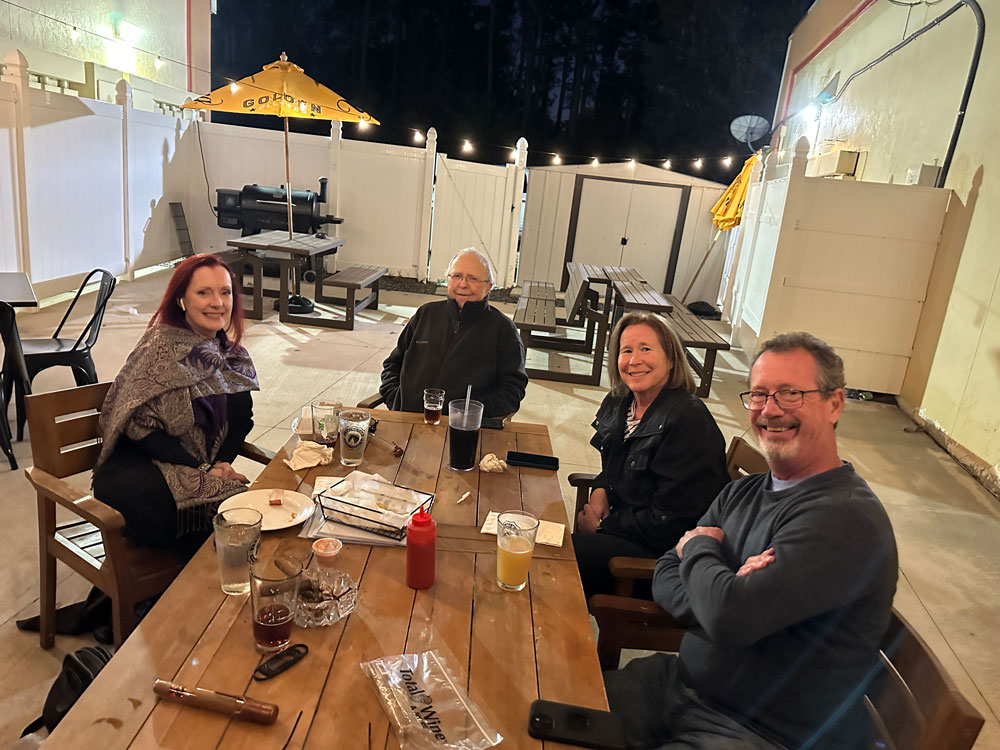
“I looked forward to and cherished Weekly Office Hours at The Dog with Bob,” Scully said. “His stories, always prefaced by ‘Stop me if I’ve told you this before…’ were rich, funny, detailed accounts of family, friends, ICDC [ITT Community Development Corporation], the county and city heroes and villains. Even when I had to lean in to hear him as he grew weaker, I never did ‘stop’ him. I wish I could hear, and ignore, that instruction one more time. Recently I realized that none of these tales were told before Bob asked about me, my family, work or travels – not once. I should be a lot more like my friend Bob Cuff and sure as hell am going to try.”
In character of course, and in Bob’s honor before this morning’s dismantled sun, Scully added: “Be like fucking Bob.”





Me says
RIP.
marvin clegg says
Even as a legal adversary, I appreciated and really liked Bob. He was kind. The Bar is struggling to ‘teach’ more class like he and an older generation represented! He will be missed.
Janet Sullivan says
I did not know Mr. Cuff, but I know he was a good friend of yours. I am sorry for your loss.