


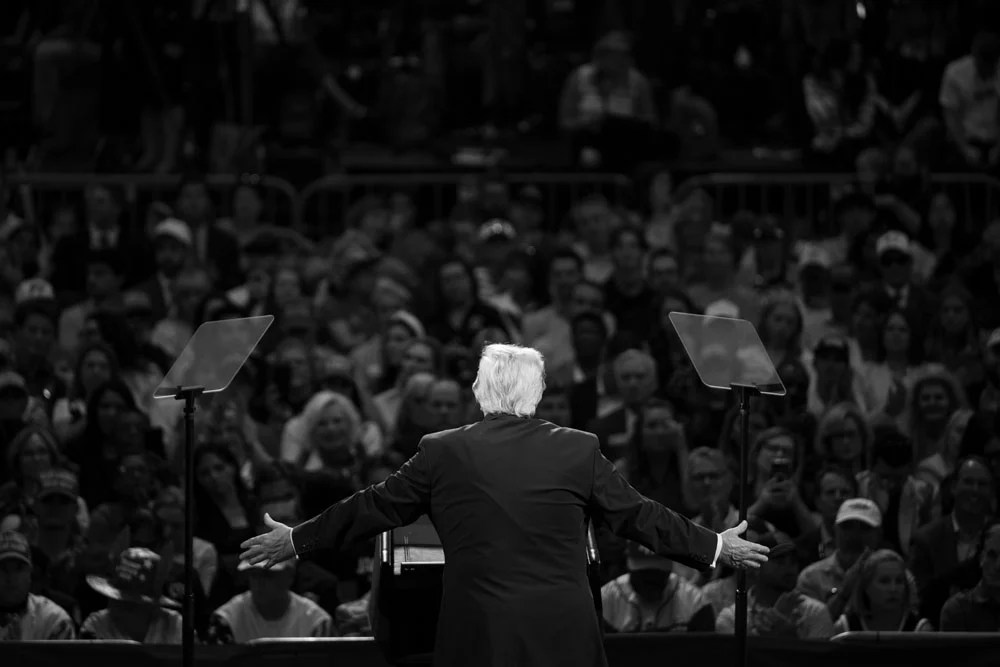
Toward the end of a life ribalded by such parodies of presidencies as those of Warren Harding, Calvin Coolidge and Herbert Hoover, two depressions, two red scares, half a century of wars and the unended terrorism of Jim Crow, H.L. Mencken, only a half-blind cynic and part-time racist, described the United States as “a land of abounding quackery” and “the only really amusing form of government ever endured by mankind.” I doubt he meant the word amusing in the amusing sense, in those days when irony was more art than meme.
 “Nevertheless,” he wrote in the same preface to his 1949 Chrestomathy, “we survive, and not only survive but also flourish. In no other country known to me is life as safe and agreeable, taking one day with another, as it is in These States.” We could still speak of flourishing survival even through the Cold War, Nixon’s high crimes and Carter’s malaise. Things began to fray during the Reagan devolution, when the era of what Kurt Andersen called “evil geniuses” began to transform government into an enemy of justice and equality and a slave to power and profit. You could still survive, if not entirely flourish, during the first Trump administration. But with the second one, it was no longer mere quackery. It was no longer amusing. It’s been barely endurable. These States are no longer safe or agreeable.
Regime Change, the new book about the imperial presidency of Donald Trump by New York Times reporters Maggie Haberman and Jonathan Swan, is the story of an apprentice-dictator rapidly aging toward irrelevance, but not yet there. He has his party and the country in final throes of the mostly uncontested power he learned to wield only in his second coming. He is at his most dangerous. The results have been at their most catastrophic. His and Trumpism’s death rattle aren’t far off. The question is whether the country that emerges from the ossuary can return to a semblant of its less cruel ways.
 There are no new revelations here. None of the insights into the president’s character will surprise–not his indifference to policy, to governance, to anything that doesn’t freebase his messiah complex. Trump revels in his lewd and lascivious violation of all norms and decencies, with malice toward all, with charity for none, salting the nation’s wounds and punching down against the weak while sowing discord at home and with all nations, autocracies excluded. He likes to watch others suffer. Turning self-publicity into an instrument of terror is his one uncontested genius, his one successful strategy. His only strategy.
The 500-page book collects what we already know from 500 days of living in our sodomized republic since his second coming. It applies an almost tediously objective lens that pans out from daily reporting of incinerated trees to capture the burning forest. The result is a chronicle of how Trump has become the American version of the banality of evil before which all institutional guardrails cower–Congress, the courts, the academy, big tech, Wall Street, the press, even spiritual leaders happily whoring principle for opportunism.
Each of the book’s 33 chapters focuses on a theme, mostly chronologically: the pardoning of Jan. 6 insurrectionists; the assembling of telegenic sycophants for a cabinet; Stephen Miller as an even more pernicious autocrat than Trump, because he has brains and a method; how close we came to the suspension of the Constitution as the administration waged war on migrants; Trump playing Love Island with Marco Rubio and J.D. Vance as his 2028 presidential preys; Trump’s boundless corruption and abuse of office to enrich himself and his family more than almost any non-Arab or African or Bruneian autocrat in history; how “Trump was often fixated on male beauty” and how “his appraisal of a job seeker’s handsomeness could be a prerequisite for the most highly visible administration posts” (not unlike the way Himmler picked his SS troops for their Germanic look, as Haberman and Swan refrain from pointing out), and so on: it is a long list.
One of the segments most emblematic of the catastrophe is the story of Trump’s transformation into a war president and a concubine to Benjamin Netanyahu, the Israeli prime minister and war criminal responsible for the Gaza genocide. Joe Biden had been no better–until Trump signed on to let the United States be Netanyahu’s pawn in Iran, entirely for personal reasons. He believes, with reasonabl accuracy, that Iran wanted to assassinate him in retaliation for his assassination of General Qassem Soleimani in 2020.
Trump had only himself to blame. When nations begin to assassinate each other’s leaders, all bets are off. That’s why Lyndon Johnson referred to the CIA era of assassinations as “Murder Inc.,” why Gerald Ford, Jimmy Carter and Ronald Reagan each signed executive orders outlawing assassinations by American agents, broadening the prohibition each time. As with all norms and laws in Trump’s hands, he assassinated those, too. As with everything else, he subordinated the national interest to his personal pathology and lust for revenge.
Trump’s opposition to wars abroad had been arguably one of his most convincing appeals to voters on the verge. He won them over with his Wilsonian promise (“he kept us out of war”), and like Woodrow Wilson after the 1916 election, he broke his promise. Wilson at least thought he was saving the world for democracy, or whatever. Trump was just acting like an offended criminal boss. Netanyahu knew just how to push his Pavlovian buttons.
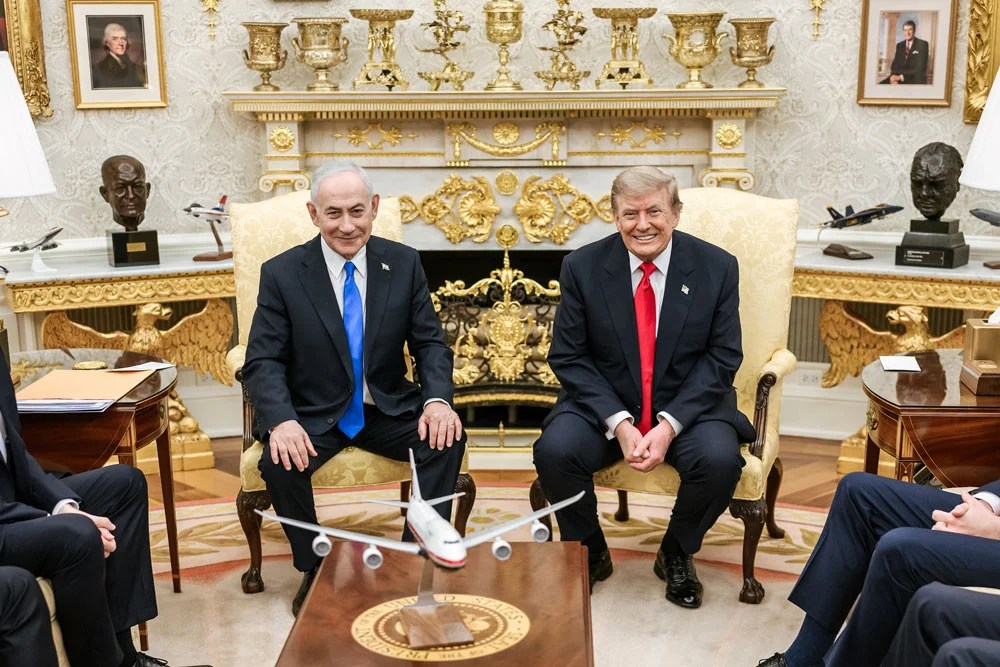
Netanyahu was invited to the situation room at the White House as no other foreign leader had been. Trump sat next to him instead of at the head of the table. Netanyahu made his pitch for war. Trump bit, despite Vance’s opposition, despite Rubio ridiculing the claim of regime change as “bullshit,” despite Tucker Carlson telling Trump it would undo his presidency, despite every political and moral compass pointing anywhere but in favor of Netanyahu’s leer.
After declaring victory a half dozen times in Iran, Trump has now dragged us into his unwinnable quagmire, though Iran is a template for his entire presidency: a lose-lose proposition that has us all on the hook, with two years to go and no way out. He has no idea. Never had any idea. This is how empires die.
You could take each of the 33 chapters and come away with a similar conclusion in a White House that, the Big Beautiful Bill, the tariff debacle and the civil war on migrants aside, has no interest in policy and less so in governance.
One of the more telling observations by Haberman and Swan is about Trump’s real interest these days. It’s not the economy, which he considers “boring.” It’s not Iran or affordability or even the midterms, in which he has zero interest. It’s his ballroom. It’s his triumphal arch. It’s his name desecrating the Kennedy Center for the Performing Arts. It’s the trim and decorations on his walls.
Another of those observations is about Natalie Harp, Trump’s aide known as the “human printer” who pumps him with positive news, a lot of it fabricated, much like Conrad Murray pumped Michael Jackson with propofol and benzodiazepines. I know I’m insulting Michael’s memory here and I don’t mean to, even though he was the pedophile. Oh, wait. Right. There’s that, too.

Pierre Tristam is the editor of FlaglerLive. A version of this piece airs on WNZF.





Pogo says
Agreed, shit tastes like shit; and this country, as always, wants the real thing.
No bar mix for these folks — you gotta open a new bottle and pour it in their face. Then they tip you — for lighting them on fire.
Judy says
I read the book. Scary to say the least. The people around (1) have no idea what they are doing and (2) just say yes to his every whim.