


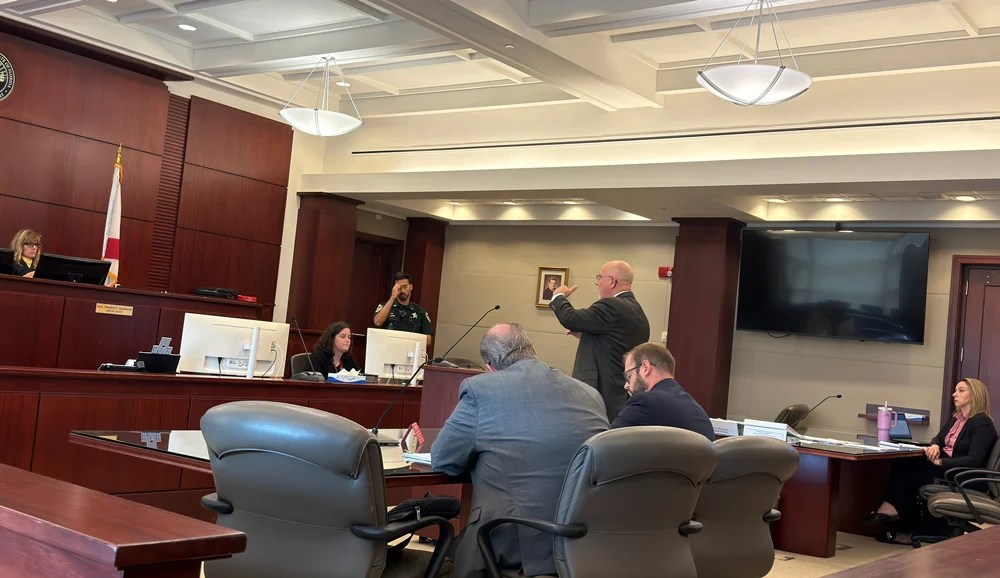
In a devastating blow to Palm Coast government, a judge this morning ruled that the city’s doubling of development impact fees in 2025 violates a state law that forbids local governments from imposing restrictive development regulations.
Circuit Judge Sandra Upchurch at the end of a 55-minute hearing sided with the Flagler Home Builders Association’s argument that the Palm Coast City Council’s new impact fee schedule, which more than doubled fire, parks and road impact fees starting last October, may be defined as a land development regulation, and as such, was a burdensome regulation. Therefore, it violated the law, known as Senate Bill 180, which imposed a three-year moratorium on burdensome regulations.
“I am going to find that these proposed impact fees or the new impact fees are a land development regulation,” Upchurch ruled. “I do find that they are considerably more burdensome than that which was in place before, under the old ordinances. So I am finding that they do violate Senate Bill 180.”
The city argued that impact fees do not meet the definition of land development regulations.
The city has been collecting impact fees under the new schedule for almost a year. The judge–who calls this a “fascinating case”–did not address whether the city would have to halt collection under the new schedule, pending appeals, but the HBA’s attorney said those collections must stop the moment the order is entered. The order is expected next week.
Between October and March, the city collected $4.62 million in park, road and fire impact fees, based on HBA data. The city would presumably have to reimburse about half that amount.
HBA attorney Daniel Webster said Palm Coast’s three impact fee increases would generate $80 million in city revenue in the first 10 years, “a massive increase,” he said. “Even in Elon Musk world, $80 million is a chunk of change. There’s zero factual dispute about those numbers. So we think, as a matter of law, that it meets the definition of more burdensome when you’re doubling the cost and you’re making those homes that much more expensive.”
The city is almost certain to appeal, so the case is nowhere near over, though today’s decision granted the HBA’s motion for summary judgment against the city, in essence halting a portion of the case from proceeding to trial. If the city appeals, Webster said the HBA will request that the case skip the Fifth District Court of Appeal and be submitted for review directly to the Florida Supreme Court, as have previous impact fee cases.
Two remaining counts will also proceed at the trial level. Those counts address the constitutionality of the city’s actions. The HBA has a motion for summary judgement on those counts, too. A hearing has not been scheduled. Based on Upchurch’s clear disposition toward the HBA’s case today, the city is in a poor position, going forward.
If the city does not appeal, the remaining counts are moot.
“What I would love to see happen, what I think the appropriate thing for the city to do, would be to immediately have a corrected impact fee study, all three impact fee studies redone that follow Florida law,” Annamaria Long, the HBA’s executive officer, said after the hearing. “That way they can get those enacted. So they should be able to collect their previous impact fees to not completely upend their revenue stream because impact fees are important. And like we said from the start, if they had just gone to the 50 percent, we never would have even looked further into these to find out just how unlawful they were. But now that we have, and we see that unfortunately the the city was duped by the impact fee consultants, they’ve got to find new consultants who follow the law. We’d be glad to be part of that. We want the best for the city, including the best infrastructure.”
[This is a developing story. More soon.]





Leave a Reply