



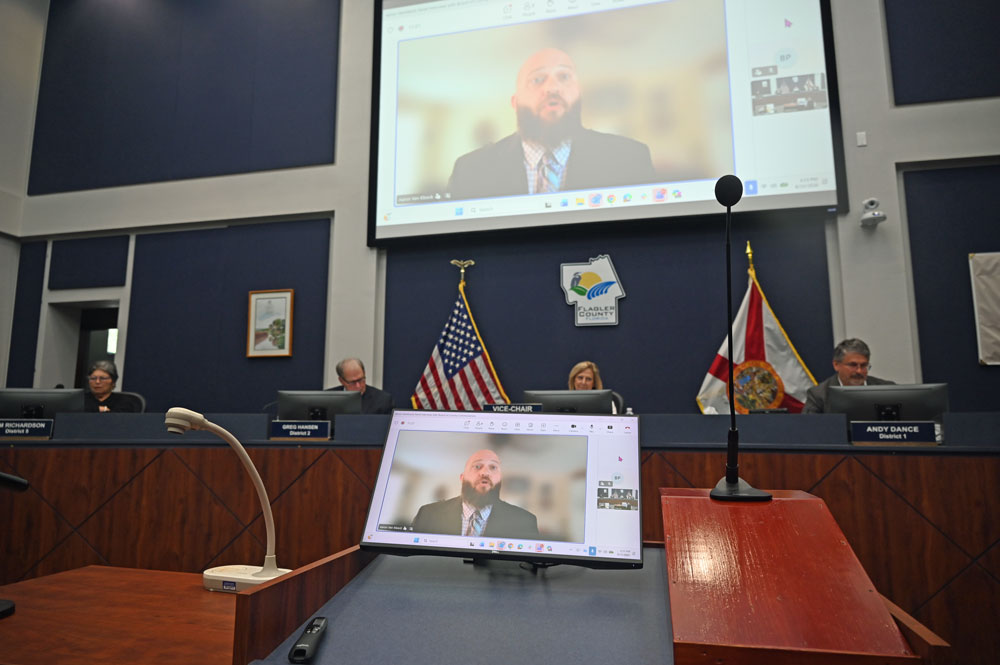
Capping a nearly five-hour session with ample breaks, Flagler County commissioners this afternoon voted to invite three finalists for the county administrator’s job to in-person interviews in early September. The finalists are Rich Reade, Tracy Miller, Shawn Boatright and Aaron Van Kleeck.
They will be interviewed on Sept. 3 and 4, with one-on-one interviews behind closed doors on Sept. 3, and public interviews on Sept. 4, when a meet-and-greet with the public will also be scheduled. They will each get a tour of the county.
Commissioners collectively held 30 to 45-minute zoom interviews with six shortlisted candidates, who also included Stanley Hawthorne and Tom Hutka (who applied for Palm Coast City Council in Palm Coast in 2019). It was an open meeting, but it was not streamed live: commissioners did not want to give candidates the advantage of seeing how their competitors performed. The meeting was taped and will be uploaded in full to the county’s YouTube channel.
The candidates will bring a wealth of experience, choices and dilemmas, as with Van Kleeck, who is clearly the most charismatic and personally favored of the bunch. He has the vibe of a Bobby Bossardet, the Flagler Palm Coast High School principal. He’s a Volusia County native personally and professionally, having grown up through the ranks of the county administration., But for all his departmental experience, he has zero executive experiences a county administrator or deputy administrator.
Reade has plenty of executive experience, he’s been in government 30 years, he is the president of the Palm Beach County Manager’s Association, which includes 39 cities and the county as members, and he alone made a point of speaking of ethics as a lodestar.
Reade was also the most inclusive and fair-minded of the group: “We need to all work together. We need to all be moving in the same direction,” he said. “So it’s absolutely an imperative for me that we build those relationships and we communicate. Being fair, consistent, transparent is so important in building those relationships for me.”
But what may have clinched it in some of the commissioners’ eyes, or at least in Commissioner Kim Carney’s eyes, was that Reade had conducted the “10 percent exercise” that she had implored her own county administration to conduct, without success. That’s the exercise through which the administration cuts 10 percent of its budget, across the board.
Boatright had the commissioners at “Marine.” He’s a veteran, he knew several commissioners had military connections–or careers, in Hansen’s case–and milked the advantage for all its brass, though commissioners were no less pandering in return. It’s a wonder some of them didn’t spontaneously breakdance to the William Tell Overture.
Boatright spoke as if he was already the manager: his self-assurance seemed to seduce some of the commissioners. His disadvantage? He’s a Georgia administrator with no Florida experience. But he was quick on his feet when he sensed the skepticism–the only skepticism–of the interview.
“I absorb information like a sponge, and I retain that information very well,” Boatright said. “So, for me, I do not see it as a large challenge at all. I do, however, see Amendment Three being a vastly large challenge for local governments, and that’s not just really just Florida. Georgia is trying to do the same thing.”
Miller was more puzzling, if only because she had the credentials on paper but spoke mostly in generalities and clichés: all the right words, all the right TED-Talk formulas, but few concrete examples to illustrate and humanize what she was discussing. “I’m all about a good mission and vision,” she said. Great. Everyone is. But what does that mean in your hands? “I believe in self discipline as well as discipline for the organization.” Fabulous. But does that mean cracking whips or sparing rods?
She’s had managerial experience in Bartow, the county seat of Polk County–where dealing with Grady Judd alone (Florida’s showboating sheriff in chief) would have earned her a combat medal of valor–and in Sarasota County, going from small budgets to a billion-dollar budget. She described Flagler County as “in between.” She did not explain what compels her to trade one for the other.
When asked if she had any questions of the commissioners, she asked a curious one–not about the scope of the work ahead, as others did, not about dynamics, not about what they expected of her, but about timing: how quickly did the commissioners want to fill the job? She runs a nonprofit, but she did not intimate that it was because she wanted to close things down. “I’m not in a hurry,” she said. Not are commissioners. But perhaps for different reasons.
That contrasted almost brutally with Van Kleeck: “You’re getting someone that is hungry, an up and comer, and has never has never been passed over for a role like this, and has never had short stints in roles like this.”
Hutka, the most educationally decorated of the bunch–Princeton, Harvard–and the most variedly experienced–government, Wall Street, an engineer who’s maintained his credentials throughout–was in command of his interview, and perhaps too much in command: there was a touch of the condescending lecturer about him every time he completed a sentence with “ok?” but the strong-willed and well-meaning lecturer: “I apologize if it sounds corny, but then and now and all in between,” he said, “I’ve had two goals in my career, is to help people and to protect the environment, and I realize that, and I still agree, that local government is where the action is.” Flagler County could use someone who helps people and protects the environment.
Still, when he touchingly spoke about the way he learned he wasn’t always right (after marrying a woman who had a 12-year-old daughter), he sounded sincere, but also a bit rehearsed.
Hawthorne was the only non-white in the group, also with a varied and deep experience in Florida and certainly the most cultured backdrop in his living room: finally, someone who knows the value, pleasure and necessity of art (a horrendous deficiency among local executives). He seemed to know the county’s dysfunction too well: he sees a need for reassessment of the Flagler County government organization as a whole, to bring in a consultant or facilitator “to help examine the organization inside out.”
But as with Miller, he hewed to pat phrases more often than to concrete examples or ready work plans, and he simply was not as compelling as some of the others. Of course, being compelling has nothing to do with the ability to run a government, where boring is usually better, if not more trustworthy. But in interviews, when shallow glitz beats substance, it can make a difference, especially against candidates with a touch of the performative.
The session was at times as revealing of the county commissioners as it was of the candidates, since each of the six candidates was given the chance to ask the commissioners some questions. Several asked the sort of questions that commissioners may not have addressed so directly, as when Boatright asked them how they perceived their relationships with each other and with the constitutionals.
“Can I go first?” Commission Chair Leann Pennington chimed. “I for one feel like we get along good,” she said. “There, there are two new commissioners that have joined us, and then we have two very seasoned commissioners, and I’m somewhere in the middle of that. So it’s been a little bit of sometimes conflicting ideologies, but for the most part, I think that we all get along very good.” She acknowledged past disagreements.
Commissioners left no question that beach management and funding is a top issue to be resolved, past getting a new county administrator seated.
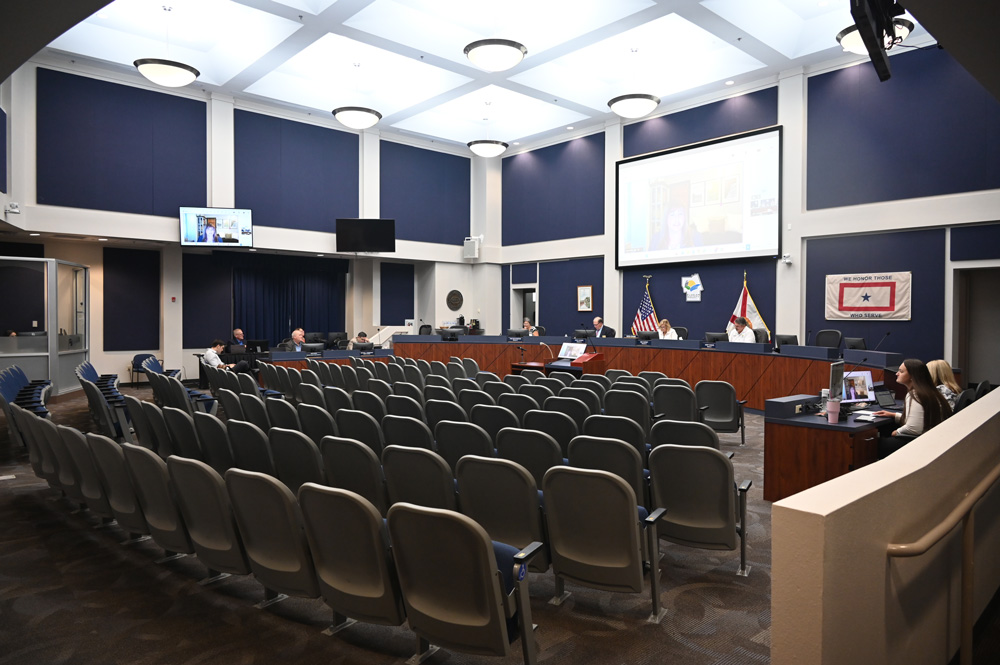
But for a few staffers, two sheriff’s deputies and a reporter, there was no audience in the chamber at the Government Services Building.
The format was a bit rigid, especially in the first few interviews. Each candidate was asked the same five questions by each of the same five commissioners (Pennington participated remotely, with Carney, the vice chair, presiding in the chamber). The questions were drafted for the commissioners by the Human Resources Department, whose Charlie Picano introduced each candidate, laying out the process.
In the end, here’s were each commissioner’s three choices:
Andy Dance: Boatright, Miller, Van Kleeck.
Greg Hansen: Miller, Reade, VanKleeck.
Kim Carney: Boatright, Miller, Reade.
Pam Richardson: Boatright, Hutke, Reade.
Leann Pennington: Boatright, Vankleeck, Hutke.
The commissioners did not tip their hands after the rankings, turning to the matter of future scheduling and housekeeping, no none of them explained why they chose whom they chose. But it was Pennington who pushed the rest of them to go for four candidates instead of three, as had been the original plan.




























Local says
Boatright was definitely the most impressive and genuine. Definitely would be a good choice.