



Palm Coast’s Westward Expansion is dead for now. Raydient killed it.
The Rayonier Corp. subsidiary that spent the last three years crafting plans for a 22,000-home development west of U.S. 1, this afternoon announced that it was withdrawing all those plans. Raydient had worked on the plans with the city administration for the past three years.
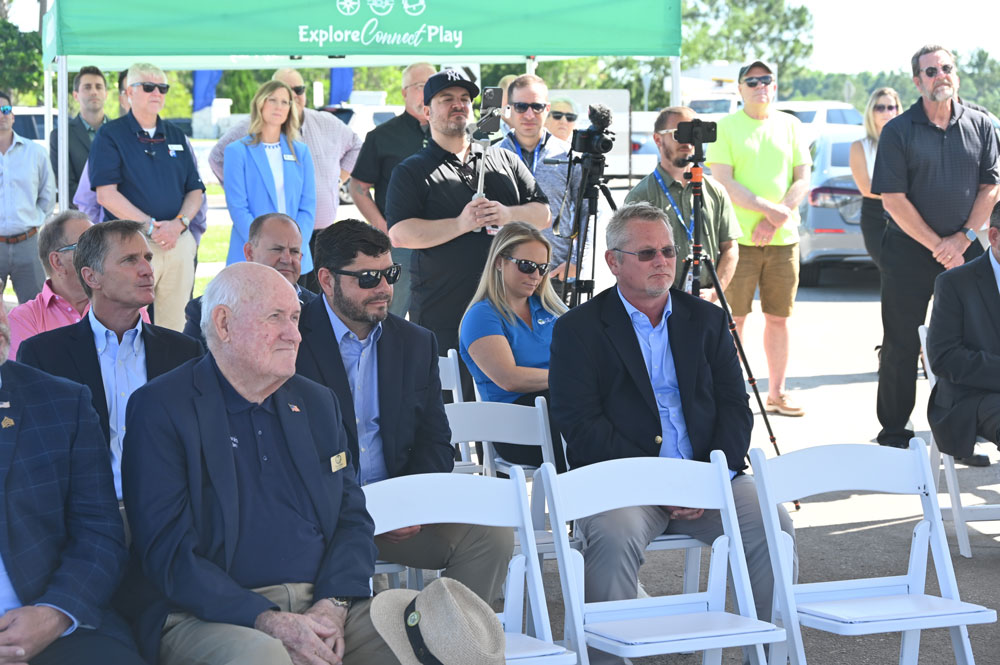
It’s not a merely bureaucratic or strategic decision that goes no further than paperwork. Florida taxpayers have shelled out $126 million on Raydient’s behalf behalf to build the so-called “Loop Road,” cutting through the 21,000 acres of the Westward Expansion. Palm Coast shelled out $6 million in impact fees toward the project. The project broke ground in May.
It is now a road to nowhere.
The development proposal was to go before the Palm Coast City Council next Tuesday after it was tabled on Aug. 4, when it failed to get a vote on first reading. The proposal’s related annexation of thousands of acres was approved, conditional on the development proposal winning approval.
Both the annexation and the proposal, known as a Master Planned Development, are now dead as Raydient withdrew the application in its entirety this afternoon without explanation.
“The purpose of this letter is to provide the City of Palm Coast, Florida, notification that as of August 21, 2026, my client, Raydient Palm Coast LLC, hereby withdrawals from the City’s consideration the following Westward Expansion Items,” Staci Rewis, an attorney representing Raydient, wrote John Zobler, the city’s community development director, in a letter dated today. Rewis then listed the eight technical items forming the anatomy of the Westward Expansion.
“John Zobler had a conversation with them this morning,” Brittany Kershaw, the city’s communications director, said, “that they were considering it and that they would let us know today, and then that letter came through a little after 2 o’clock.”
The two-page letter by the Raydient attorney left no hint as to whether this was merely a strategic withdrawal to regroup or whether Raydient was done with the westward expansion for good, at least in its latest form.
“The understanding I have is that this is done for now,” Kershaw said, “because they were working on changes. They were working on redlining the MPD, and it became a complete withdrawal.”
City Council member Theresa Pontieri, who had long opposed the plan if it did not reflect specific changes, had spoken with Zobler Monday about the latest version of the MPD, subsequent to the Aug. 4 meeting. “I told him that based on the latest draft, I was a no. They would not grant the three things that were a must for me, so I was a no.”
The three conditions Pontieri was looking for were for Raydient to add the certainty of public hearings for any zoning or density changes in the future, allow for neighborhood meetings preceding those changes, and guarantee, as a part of the development phasing, that a certain amount of commercial properties would be developed prior to the next residential phase.
The first two of the three conditions are requirements all developers must comply with under Palm Coast’s Land Development Code. Raydient got an exemption from them by writing them into its MPD. It appeared Raydient was not willing to go with the conditions.
“I just think they realized they didn’t have the votes,” Pontieri said. “I don’t know that obviously, but if I’m a no, the mayor was pretty adamant he wasn’t going to vote for this, so you only need one more no, and it’s a done deal.”
City Manager Mike McGlothin did not return a call before this article initially published, and the cell phone of Mike Hahaj, director of commercial development for Raydient, would not take a call. Acting Deputy City Manager Kyle Berryhill, who was attending firefighter-related functions in Maryland, said it wasn;t necessarily unusual for developers to pull applications. “Often they resubmit. It’s often the case. Sometimes it takes a long time,” he said. But he would not speculate about the fate of this applicant in the future.
“I’m sure we’ll continue to have conversations with Raydient,” Berryhill said. “They’re a significant landowner in the city. But we’re going to follow the direction of council with regards to that.”
Raydient’s development rights are not dead. Palm Coast in 2010 approved an earlier version of the westward expansion in two so-called developments of regional impact–Neoga Lakes and Old Brick Township, which together permit 11,000 homes, but also require the developer to abide by a series of conditions. Raydient wanted to abandon those two DRIs and replace them with the MPD. By essentially abandoning the abandonment, it potentially places the old DRIs back in play, in that Raydient could submit a site plan for subdivisions tomorrow within those parameters. It’s possible, but unlikely.
























Richard says
At the height of pandemic in 2022, Florida gained an overwhelming 310,892 net residents from other states. By 2025, that number slowed to a trickle of just 22,517.
The party’s over.