



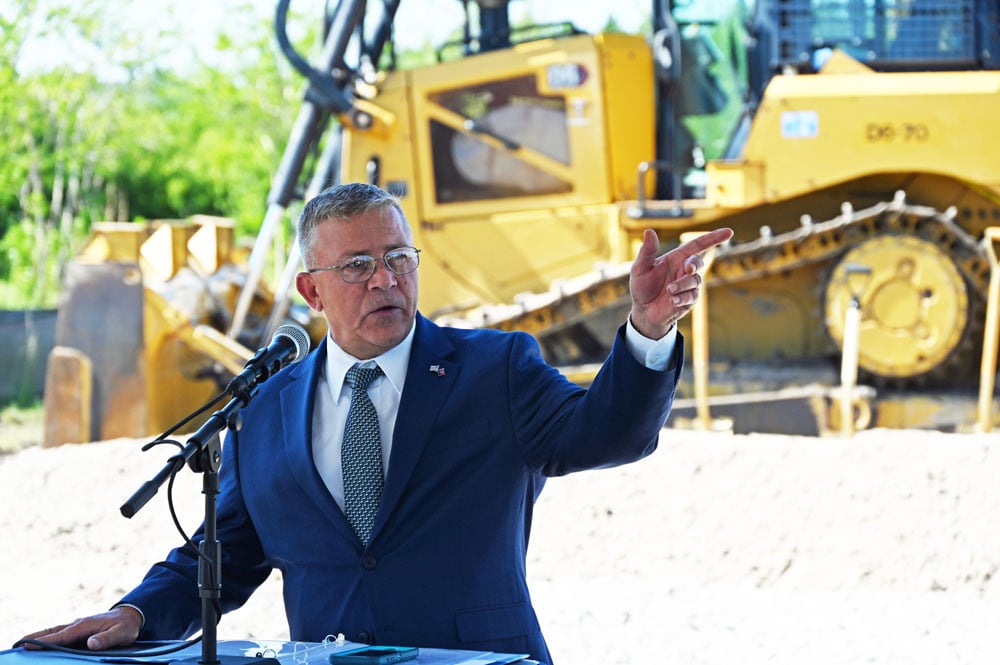
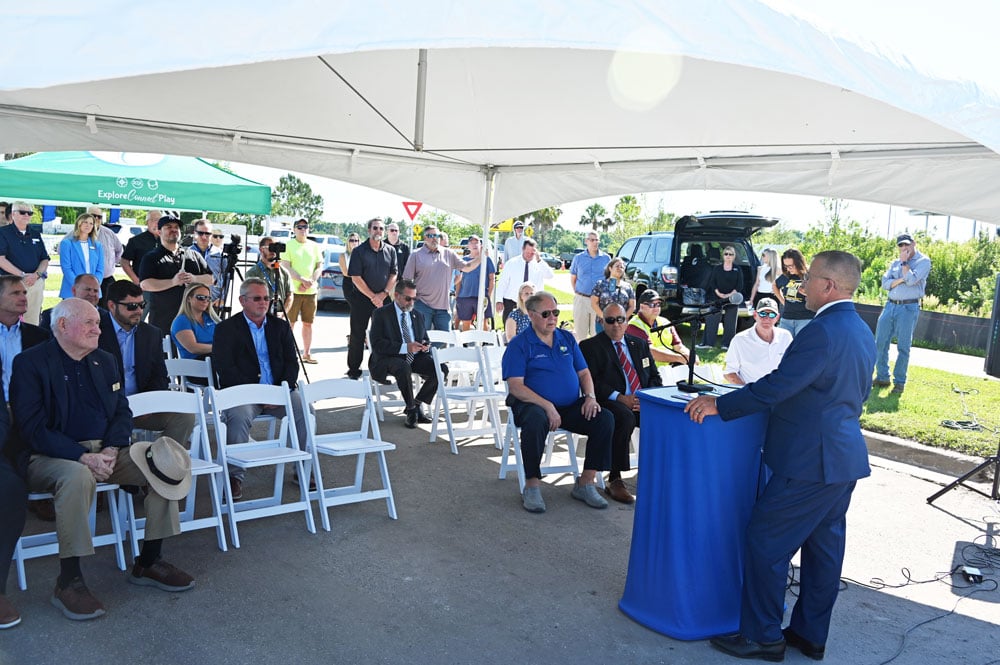
“Do you want me to be diplomatic or be Mike Norris?,” the Palm Coast mayor this morning asked the three dozen people gathered for the groundbreaking of the $125 million “loop road” that will connect Matanzas Woods Parkway to Palm Coast Parkway through thousands of acres set for the development of 22,000 homes.
The question answered itself. The only filter Norris favors is on his cigarettes.
“I don’t support this project, and I’m going to fight it all the way,” Norris said, discarding the speech city staff had written for him and looking at a stone-faced audience. “For the representatives from Rayonier, don’t think that you’re going to do what was done on this side of the railroad, on that side of the railroad. We’re not going to stand for it. Pringle Branch is part of the Pringle Branch Forever forest out there, and we’re going to cut a line right through it. I understand the state’s priority as far as putting corridors in, out to 2209. I can understand that. But when you cut through and you drain the swamp, I don’t agree with that. I grew up in a swamp, and this is not something that I can support.” (Listen to the full speech here.)
Norris is not a fan of the so-called “western expansion” west of U.S. 1, all on land owned by Rayonier, the timbering company, and to be developed by its real estate arm, Raydient. The 6.2-mile “loop road,” so far entirely funded by taxpayers, is to eventually connect with State Road 2209, itself connecting I-95 south of Jacksonville to Orlando and planned as an additional hurricane evacuation route, though the plan is conceptual for now. It hasn’t gone anywhere past verbal references in government meetings and at events like today’s.
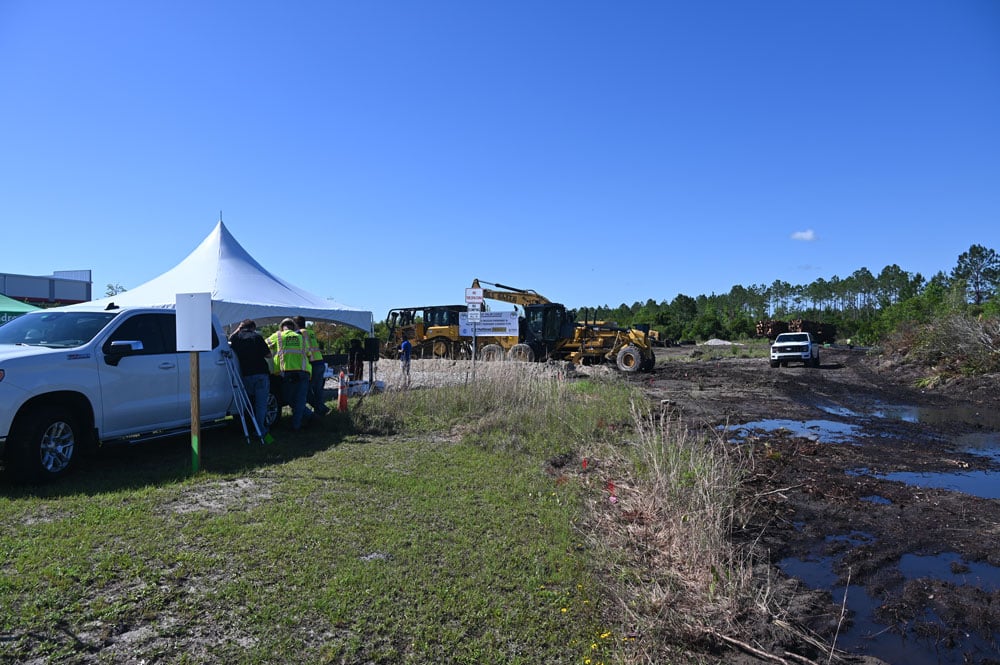
There was something almost admirable in Norris’s willingness to upend the norms of typically staid and scripted ceremonies with a shot across Raydient’s bow even as–if not because–Raydient and city staff are in the midst of negotiating the gargantuan order that will define and control the development over the next three decades. So there may have been at least some strategy behind Norris’s brusqueness.
Council member Charles Gambaro didn’t see anything admirable about it. “What we saw today was an absolute lack of leadership,” he said. “It’s disgraceful, and quite frankly, it just shows that Mike Norris continues to be an embarrassment for our community.”
Gambaro had all but jumped from his seat to take the mayor’s place after the smattering of applause that accompanied Norris off the podium after his three-minute speech. Gambaro wasn’t part of the lineup of speakers (only City Manager Mike McGlothlin had preceded Norris), but he said he had to speak.
“Going to jump in here and end on a positive note,” Gambaro told the audience. “Everybody’s done a great job. Everybody’s worked hard. This project is important for our community for a lot of different reasons, but I want to end on a positive note. There’s no reason to be negative here, okay? Everybody has their own opinions, but this is a time to celebrate a major achievement for our community. We must remain positive. Our residents want us to remain positive as we move forward.” The applause he got was noisily louder than Norris’s.
Mike Hahaj, Raydient’s director of commercial development and operations, was in the audience and spoke with officials before and after the ceremony, but did not address them from the podium and declined to respond to Norris’s remarks.
Norris was somewhat contradictory: he has spoken supportively of the eventual connection to State Road 2209 from his council seat and again at today’s ceremony, calling it “great for connectivity and getting us out to 2209. We need the transportation corridors. I understand it.” But he said he did not understand how “you can go and lobby for money from the state for a road for a total of $226 million and leave the residents of Palm Coast on the hook for $330 million for infrastructure improvements. That’s not the way you do business. We can’t, we can’t survive like that.” He said he will oppose the coming annexation of thousands of acres that are part of the expansion.
The state appropriated $125 million. Palm Coast has contributed a little more than $6 million in design and other costs.
The groundbreaking today begins extending Matanzas Woods Parkway west, with what will be a four-lane bridge over the Florida East Coast Railway lines. The road will then narrow to two lanes all the way to Palm Coast Parkway, where it will again “fly over” the railroad, though in the distant future it is designed to accommodate six lanes. The project is expected to employ many dozens of laborers, peaking at around 90 at certain times, according to the contractor.
Norris’s opposition is nothing new. He has long reflected grumbling antipathy by existing city residents against the western expansion, as the city manager hears at his own monthly town halls or the council hears during public comment segments at meetings. The antipathy is grounded in convictions that the city is all in for expansion at the expense of crying infrastructure needs on the east side of the tracks. The council wrestled with those needs as recently as Tuesday, whether it’s affordable housing or the city’s deteriorating road network.
And City Council member Theresa Pontieri has twice since September 2024 spoken even more pointedly, even harshly, about the dearth of Rayonier/Raydient’s investment in public infrastructure, the loop road included. Just last April she called a draft development order “garbage.” But Pontieri both times did so from her seat on the council, and would not have broken protocol at a ceremonial occasion. She took a different track. She did not attend the groundbreaking. “I think my absence can speak for itself,” she said.
Council member Ty Miller underscored the time-and-place element of the mayor’s attack. “I understand that people may have different opinions about the westward expansion and those things, but I don’t think this is necessarily that,” he said. “We have the opportunity as a council to negotiate those terms, in terms of the westward expansion, to protect the residents. I’m not sure what this rhetoric serves, except to vocalize an opinion, but I don’t know if it was necessary here today. That could be a conversation to be had at council, when we talk about these MPDs, and conversations that we had with staff about our positions on things to protect the residents.”
Communications and Marketing Director Brittany Kershaw sent drafts of the speeches prepared for McGlothlin and Norris to each man on Tuesday, asking each to review and edit if need be, and letting them know that no state officials would attend, since they’re in a special legislative session, “so the ceremony will be short & sweet.” Kershaw proved half right. It was short.
The speech prepared for Norris was not namby-pamby genuflexions to Raydient but sought to reflect the mayor’s skepticism. It reflected his support for “connectivity,” but went on with a pointed but: “But with opportunity also comes responsibility,” it read. “As Palm Coast continues to grow, we have to make sure growth happens the right way. Our residents want smart planning, protected neighborhoods, safe roads, and infrastructure that keeps up with development. I want our community to know that we hear those concerns loud and clear. This City Council is committed to making sure development is carefully planned and responsibly managed. We are not going to allow unchecked growth or a free-for-all approach. Every decision must be made with the long-term best interest of Palm Coast residents in mind.”
It went on along those lines, enumerating milestones with cautions, if not quite going as far as Norris’s blunt statements that he will oppose the annexation and, apparently, the development order itself.

The McGlothlin speech was more standard, with one, very notable absence: Raydient and Rayonier are not mentioned once. There is a reference to “partners,” but McGlothlin, who has quietly developed a reputation as a staunch advocate for his staff, focused his remarks on the project as a city project, if with state and other supports. “Most importantly, this project reflects our commitment to building Palm Coast thoughtfully, responsibly, and with future generations in mind,” he said, before turning the podium over to Norris.
Carl Cote, the director of stormwater and engineering, who is overseeing the project from the city’s side, said it may be three years before the first resident is able to drive the loop road, and even that is an optimistic timeline. The road is broken into four phases. The first two are funded. The last two are not. The current funding will take the road to around the area of Hargrove Grade, which will eventually no longer cross the railroad tracks. There will be a connection between the west end of Hargrove and Palm Coast Parkway.
Past that point, the road is still in design, and funding for it is still not secured, though officials expect–or hope–that state appropriations will pay for the rest. The road is going through significant wetlands, as Norris noted, which will be “mitigated,” meaning that whatever wetlands are destroyed to make room for the road will require the protection of an equal amount of wetlands elsewhere. The mitigation system creates the impression that there is no net loss of wetlands in the end. In fact, there is a loss, since “mitigated” wetlands elsewhere already exist, and only gain protection from future destruction.
The Raydient development order was to go before the city’s planning board this month. McGlothlin pulled it so it could be worked on further, saying it will not be rushed. Acting Deputy City Manager Kyle Berryhill today said the current timeline is for the order to go before the Planning Board in July, and the City Council in August, with a possibility that the timeline could be accelerated, if appropriate. But he said the timeline remains very “fluid” either way.






















Silly says
He has no class. See, all he wants to do is be a politician. Yeah, when you watch him in the meeting, he can’t form a sentence as to the reason things should be denied on technical merits. He relies on others on his board to do all the homework and he just wants to take the glory and beat his chest.
JimboXYZ says
This was the sandbag that Alfin left. I knew Westward expansion would end this way with Rayoneir/Radient from Phase 1 of it, being Wildlight in Yulee, FLNassau County. Jacksonville growth North for expansion. And the Marsh of Fernandina Beach protected East Nassau County. West to Callahan is Westward expansion for Nassau County. Since Jacksonville expansion South for st Augustine is a fill in of overpopulation, only made sense they would grow into Flagler County. St John’s County has a population of +/- 350K. As for Palm Coast Westward Expansion, they have every intention & are going to do that here. Daytona North is Volusia County’s force push to fill in Ormond to Bunnell. State Grants didn’t fund enough of it, that leaves the taxpayers to fund anything. 10 gallons of poop not fitting in a 5 gallon bucket becomes 15-20-25 gallons of poop in a 10 gallon bucket. More gridlock to follow. I-95 is just a stalled parking lot in a lot of locations. Crime, Pollution, Stress & there’s no running from the overpopulation. NE FL for the 5 counties of Nassau to include Volusia is becoming SE FL from St Lucie to Monroe (FL Keys) & that mess over to Marco Island/Naples. The marshes are the only eco-systems saving any natural resources any more & like Miami-Dade they will build right to the UDB everywhere in FL. Hurricane Evacuation won’t happen in FL. That started to become not enough roads out of FL for the Bush era hurricanes of the early/1st 1/2 decade of the 2000’s.
https://en.wikipedia.org/wiki/St._Johns_County,_Florida
The best anyone can hope for is a settlement for the difference of litigation between Raydient & Flagler County/Palm Coast. My prediction is for the day we3read articles after a lengthy lawsuit that really is no value added for driving up property taxes to a new level of unaffordability Get ready to see even more unaffordable housing prices, and taxes that are $ 5-6-7K here in Flagler County. Go thru the Zillow listings. Here’s one in West of I-95 Nassau County $ 7+K for property taxes. Bidenomics lives on for unaffordable.
https://www.zillow.com/homedetails/75133-Pondside-Ln-Yulee-FL-32097/2061793756_zpid/
DP says
I agree with the Mayor. Although this may not have been the proper time and place. Thank god Gambaro is running for stayed congress, let’s not get him elected there. And Ty Miller needs to go as well, he should be up for reelection in 2 yrs, let’s bot put him back in the council. This whole western extension is a complete joke. The current citizens of Palm Coast, shouldn’t be shouldering the costs of infrastructure for raising project. If the developer Raydient and Rayonier already had state/citizen’s tax dollars approved for the roadway extension. They will make loads of money off this project when it’s complete. Therefore if they want into the city of Palm Coast, they should be building water treatment plants, waste water plants, providing wells for potable water, footing the entire bill for infrastructure installation. Providing sites, and building Fire stations/ Leo stations. Providing $$$ for future city, county vehicle needs. Building and providing schools and or sites for such, providing sites for parks to name just a few. Current citizens shouldn’t shoulder a penny for this massive growth, not now, or ever. Growth should be paying 100% of its costs. Stay strong Mayor Norris, I hope you get help on the council this year.
Sick of Unneeded Expansion says
I agree with Mike Norris. This is the man I elected to represent me. He got off to a rocky start, but is now standing up for all his campaign promises. Western expansion would be a heart-breaking move, yet more wildlife will be displaced from the beautiful swamplands.
FLF says
Why does the 22,000 home Raydient development have to be part of Palm Coast? Its their property, let them develop it, install their own water plant, sewage treatment plant, entire road system, schools, pay for the FCSO expansion. Name the new city West Whatever.
JimboXYZ says
Exactly, call it Alfinville, FL or something similar to Radient’s Nassau County mess called Wildlight, where property taxes doubled for the residential that never will pay for itself.
Long time Palm Coast resident says
It’s supposedly a free country isn’t it? Mike Norris is entitled to his opinion and is entitled to voice it.
GAMBARO, as always, is a egocentric bully in all respects. He was appointed to the Palm Coast City Council. He did not earn or campaign for his seat on the Palm Coast City Council. Since the beginning of his appointment to the Palm Coast City Council, he has vocally bullied Mike Norris (Mayor of Palm Coast) and has tried to undermine Mike Norris verbally. Yet, he talks about leadership. During his appointment (not elected) time on the Palm Coast City Council, Gambaro has shown a complete lack of leadership in all respects. By the way, from what I’ve investigated, Gambaro’s brigadier general appointment was a political appointment, nothing more.
Ditto for “Tree” Pontieri, who has tried to undermine Mike Norris from the time he took office. She’s another one who has little leadership. I will not vote for Pontieri for County Commission.
I will NOT vote for Gambaro for congress because he’s an egotistical bully who has publicly undermined Mike Norris at every possible opportunity.
I will NOT vote for Theresa Pontiere due to her constant and continual undermining of Mike Norris, the duly elected mayor of Palm Coast. I will vote for Greg Feldman for county commission instead.
All the above being stated, I am no fan of the westward expansion. I was living in south Florida back in the 1970s when Miramar, Davie, Plantation, Sunrise were all the same as Palm Coast is now, meaning plenty of farmland and empty fields west of University Drive. Then in the 1980s, the “westward expansion” began. That was the same time David Alfin was living in that area. Everything west of University Drive has been destroyed over the years due to that “westward expansion”.
There never was anything wrong with Palm Coast the way it was, and by that I mean, it was sleepy small town where there were trees, lovely well-kept neighborhoods, well maintained streets and a place where generally everyone was content. What’s wrong with that?Now the trees are disappearing, neighborhoods are in disrepair with garish painted houses, pickup trucks and work vehicles parked on swales overnight, cars and trucks parked on front yards, potholes in streets and work vehicles and boats parked in driveways. Palm Coast has gone “down”.
All members of the Palm Coast City Council and the Flagler Board of County Commissioners have pushed and continue to push this “westward expansion” against the wishes of the majority of residents already here.
WE RESIDENTS DO NOT WANT WESTWARD EXPANSION.
So, GAMBARO, you can talk down to us all and continue to bully and undermine Mike Norris at every opportunity, but I hope you lose your political campaign for congress.
I agree with Mike Norris and commend his courage in throwing caution to the wind in chucking the carefully prepared PR speech written by City of Palm Coast staff. He says what he thinks and that to me shows more leadership than what both Gambaro and Pontieri have shown in their time on the Palm Coast City Council.
I would also like to qualify my comments by stating that I did not vote for Mike Norris for mayor, but I do respect his ability to stand his ground in spite of continual undermining and public degradation by the rest of the Palm Coast City Council.
Gary Bogle says
I watched Plantation go from, small town charm, to absolute overcrowded, crime ridden, and condensed into one big continuous mass of building and desecrating ageless beauty, anything west of university drive, has been destroyed!! Won’t be long before they go west of Andytown.iykyk
Laurel says
Greg Bogle: Andytown hasn’t existed for 50 or so years now.. I remember the little bar where men came in and leaned their rifles up against the bar!
You are correct. Developers, real estate investors and politicians convince people growth is wonderful. It is not.
Remember the upsidedown house in Plantation? Now, Plantation floods when it never did before.
Laurel says
All of Plantation drains to the New River, which drains to Port Everglades. One inlet. It backs up now, and cannot drain fast enough.
Not so different from here. Drainage to small canals, to the Intracoastal, to inlets not close enough to here, no inlet in Flagler County.
The future of this county is grim.
Robjr says
Mr. Norris yes.
It is time someone in government stood up and said enough.
The taxpayer is going to be on the hook for the infrastructure and the developer is going to reap the profits.
While the streets in my area have patches on top of the patches that are wearing out.
Anna Jones says
As a candidate for Flagler County Commissioner, I stand firmly with Palm Coast Mayor Mike Norris. Today’s events at the Loop Road groundbreaking once again highlight why his straightforward leadership is so important for our community. Mayor Norris had the courage to speak plainly about the real concerns of residents—concerns about unchecked western expansion, the heavy burden on taxpayers, and the need to protect our infrastructure and quality of life.
While others chose scripted positivity and political decorum, Mayor Norris chose to listen to the people he serves. That’s leadership.
Too many of our elected officials have become tone deaf to what’s happening on the ground. They attend ribbon-cuttings and celebrate projects, yet they seem disconnected from the daily realities families face: strained roads, rising taxes and utility bills, overcrowded services, and the fear that growth is happening to us rather than for us.
I don’t need a focus group or a consultant to tell me this. Just take five minutes to talk to people at the grocery store—like I did again this week. What I hear is frustration, exhaustion, and a clear message: enough with the insider deals and growth-at-all-costs mentality. Our residents want smart, responsible leadership that puts existing neighborhoods first.
That’s exactly why I’m running for County Commissioner. To bring that same no-nonsense accountability Mayor Norris demonstrates to the county level. To fight for infrastructure that keeps pace with development. To ensure taxpayers aren’t left holding the bag while developers reap the rewards. And to make sure every decision reflects the voices of the people who actually live here—not just those with lobbyists.
Thank you, Mayor Norris, for speaking up. Flagler County needs more leaders like you who refuse to sugarcoat the truth.
I’m asking for your support as we work together to put Palm Coast and Flagler County residents first.
Workshop says
As I read your comment, I wonder why you are running for any office let alone the County seat.
Anyone voting for you needs to rethink their own choices in life.
Wow, totally disconnected.
Gina Weiss says
WHAT A GARBAGE ATTITUDE YOU HAVE as you hide behind your
mask. You have some nerve asking why Anna Jones is running for Leann
Penningtons seat another BOOTLICKER just like you. What you REALLY
MEAN is that you HATE the FACT that a no nonsense , for the people,
person is running for that seat! People are waking up and rethinking their
choices of the previous dead beat candidates they helped to vote in that
have ignored emails, blocked on social media, ran their csmpaign
platforms on promises but once they got in FORGOT why they ran in
the first place. Pennington is an advocate for the western expansion, GOODBYE
PENNINGTON TIME FOR YOU TO GO!
NJ says
Pennington is an ASSET of the Realtor, Contractor, Developer CARTEL and Must be REMOVED!!!
celia says
TY Anna Jones Candidate for Flagler Commission for as we know you stand for reality unlike the current Commissioner LeAnne Pennington embracing the westward expansion from the start! She forgets that we Palmcoasters are being forced to fund it! Easy to embrace this un affordable expansion from a seat that pays over 60K a year and same for some county staff and constitutionals asked and cheering for it as well sustained in their high pay rates by Palmcoasters hard earned taxes. We need change we need Anna Jones representing Palmcoasters in the county commission as 45 cents of every Ad Valorem dollar we pay yearly in our homes only 23 cents go to the city of Palm Coast while our roads are not being re paved, extended, repaired, widened or turn lane because lack of sufficient funds! On a city budget approved for over 700 millions only 2.5 millions assigned yearly to repair and maintain our existing 551 miles of roads, currently in fair to poor condition? Lets grasp this concerning reality while they force us to fork 6 millions for the westward expansion and all the other millions in current or recent projects whether expansion for water, storm water or waste water and reclaimed water to benefit new developments and no one sole in city council stops city engineering or ask the proper questions why, even when frivolous excuses given after we the people oppose these projects. No one addresses the historic origins of our services…like all hundreds of miles of fresh and saltwater canals in Palm Coast were built by ITT to drain the whole city and prevent floods as part of the Storm Water System then and are part originally of our storm water system that we already pay into and we do not need a single out MSBU (new tax district) our 23 miles of salt water canal front homes to be unfairly singled out over some spotty dredging needed or seawalls repaired that “are to be home owner obligation”! New Manager, Assistant (Fire Chief) and any sneaky staff that help them in the presentation for an MSBU, need to get properly informed. TY to vice Mayor Pontieri for her opposition to the MSBU. What we need is transparency and dedicated accounts for our rates and taxes paid into and not all going to the free dipper “general fund”. We need change we need in city council candidates Ray Stevens, Darlene Shelley and Jeani Duarte versus a developer/builder, to work with Mayor Norris in the residents “needs” and not the special interest “wants”.
Leann Pennington says
Celia:
Please reference where you have seen me support the Westward Expansion?
celia says
LeAnne, I saw you in county meetings that I attended or watched live you mentioning “the positive for economic development that was the westward expansion”…I wish I have the time to look back the county meetings were you said that. Maybe giving you the benefit of the doubt; I may want to believe that you forgot, but I didn’t as it shocked and upset me from the start as I sure guessed right how costly could be for Palmcoazters. Its too much work to research all the county meeting videos to find the couple were you spoke of your support even if briefly. a while ago. Because we have enough conspiracy theories going around I would never be part of one.
JC says
Honestly “celia” sometimes your comments are conspiracy theories.
celia says
JC which county or city government are you in the payroll? You sound much like some on staff. Unless you disclose your ID proving me otherwise.
Gina Weiss says
Pennington was on the David Ayers podcast onMay 15, 2025, stomping for
the western expansion, Pontieri uncovered that there were deals made for
Palm Coast that were NEVER MET!
The western expansion should not move forward until all those deals are met,
amongst other factors.
flaglerlive.com › garbage-westPontieri Slams Rayonier Westward Expansion Plan As Garbage
Apr 20, 2026 · Theresa Pontieri rejected Rayonier’s Palm Coast expansion plan, demanding the developer fund infrastructure costs subsidized by taxpayers.
flaglerlive.com › pontieri-statementPalm Coast Council Member Theresa Pontieri’s Statement on …
Apr 20, 2026 · Full text of Palm Coast City Council member Theresa Pontieri’s statement opposing a proposed Western Expansion MPD by Rayonier.
flaglerlive.com › pontieri-rayonierPalm Coast Council’s Pontieri Issues Warning to … –
FlaglerLive
Sep 4, 2024 · Palm Coast City Council member Theresa Pontieri said the $105 million the city received in state appropriations for road construction west of U.S. 1 is money subsidizing “the
Sick of Unneeded Expansion says
Hear, hear. I agree with your every sentiment. I DID vote for Mike Norris and am glad to see him fighting for his campaign promises.
Gina Weiss says
BRAVO MIKE NORRIS,
GOOD let them know where it’s at , the real welfare queens the developers
who spend the least but make the most! Why wasn’t this Raynoir guy at
the ceremony, needing to hide face he sends his reps because he knows
he is raping the taxpayers, the environment, swamps, wildlife our scarce
and fragile aqua system, where the hell is he?????? He even owns the timber
that is going to be cut down and will make money off of that beside all of the
real estate holdings. SAY NO with this western expansion until ALL
OF PALM COAST ISSUES ARE RESOLVED:
FIX THE SEWER SYSTEM ON PALM COAST DRIVE THAT HAS BEEN FLOODING
SO BAD THAT MANHOLE COVERS HAVE BEEN POPPING OFF AND SEWAGE
IS IN THE STREETS, You can hear the sewer pipes rattling, water in the toilet and
shower drain bubbling, and sewer fumes in residents homes.
RESIDENTS HAVE PAID TAXES FOR 26 YEARS FOR ROAD MAINTANIENCE!
A friend of mine sent this to me and got it right:
Residents need to look at Palm Coast over the last 26 years to understand that residents are the last to be taken care of. We need a total analysis with costs of Palm Coast. What is yet to be fixed (infrastructure, water, sewer, traffic (with costs) – all the plans from the planning board, what are those costs – all planned future purchases, what are those costs – all scheduled Public Works, what are those costs – all annex property in the works, what are their costs – all projected amenities, what are those costs – all costs to be associated with Westward Expansion – projected support of Sheriff Department, what are those costs – any surprises of County increases). If you have all this data, then you’ll have a vision what is about to happen to existing residents.
STOP RAPING THE TAXPAYERS OF PALM COAST AND FIX WHAT IS BROKEN!
celia says
This is the Palmcoasters taxpayers back stabbing by the past city administrations and also city staff with DeLorenzo-Tyner and Cote at the head. Why 6 millions of our city taxpayer additional went to fund this westward shame other than to repave our city streets in desperate need of repair, extensions, new ones or turn laned?
Mayor Norris is correct and has the guts to tell all like it is! This is why Palmcoasters will never vote for anything to appointed councilman Gambaro! A developers mouth in a developers run state.
TY Mayor!
Dennis C Rathsam says
The streets of P/C are falling apart, throwing a little black top in a hole, lasts maybe 2 days if that. Here on Luther Dr we have cars coming down the 95 bridge on Matanazas Pkw, doing 50+ mph! We cant even get out of our street, do to the long line of busses & cars, during the morning rush. Now the morons at City Hall want to make it worse, not better. Where o where is a deputy with a radar gun, catching the speeders coming down the hill? Most mornings the line of cars backs up from the highschool, down past Luther, & 1/2 way down the block!
Joe D says
Dennis….the world must be ENDING…I fully agree with you on this issue. For this massive expansion westward to take place ( despite the destruction of natural wetlands and biodiversity in its wake), then expect a large percentage ( or MOST ) of the cost required for INFRASTRUCTURE (roads, water supply, waste water treatment, storm water management, police fire and ambulance service, schools and expanded government services) to fall PRIMARILY on the Florida Taxpayers and not the full responsibility of the developer for the cost is INSANE. THE LOOP ROAD ( mostly through or servicing this new PRIVATE PROPERTY development) was a GIFT from our current Governor Ron DeSantis…but almost fully out of TAXPAYERS’ ( not DEVELOPERS) pockets. This long term developer project is likely to be ( In my opinion) another incidence of developers throwing up the minimum in required support services …maximizing profit…then heading out of town, leaving taxpayers to foot the bill to maintain the infrastructure required to keep it all working long term .
Have we learned NOTHING from the development FRENZY we have seen in the last 15 years…and its costs in quality of life. My home is in Flagler Beach, but of course most of my shopping and services are in Palm Coast. I try to make ABSOLUTELY SURE, that my trips there are after 10 am, and I’m back out by 2 pm to avoid the traffic DISASTER Palm Coast has been allowed to become. Let’s not repeat the same thing with this westward expansion, whose every new proposal appears to be allowing MORE HOMES than originally planned, less developer provided infrastructure, and less restrictions on it’s design requirements than when first envisioned! Please STOP this financial MADNESS!
Pogo says
Lots of talk about how to have your cake, and eat it too — by people like to eat cake, but don’t know how to bake.
Good luck.
Skibum says
I haven’t agreed with Mike Norris on a whole host of past issues, but he certainly appears to be a voice of reason on Palm Coast’s obsession with westward expansion! Just like many businesses find out the hard way with too much expansion beyond their original idea and ability to maintain that level of productivity and/or service, outsized expansion has caused many of them to end up going out of business because their grandiose ideas in their heads could not be matched by reality.
Palm Coast should step back and re-think this. It would be so much better if the city would concentrate on improving the existing infrastructure within the current city boundaries and giving those who live here an opportunity to vote on whether or not WE want to have Palm Coast become some huge city, many more times than what it is now. Otherwise, city staff will always have a very disagreeable, disgusted citizenry that opposes what the city wishes to do.
It is not rocket science.
James says
Palm Coast Saint Augustine Daytona and Jacksonville will all become a huge city crap hole! they are connecting all the city boundaries up. It’ll be huge mega city of crime and over population.
Villein says
Raydient can develop their land but not at public expense because there is no public benefit. That is theft. I believe our leaders call it , “fraud, waste and abuse.” Unless and until their developer buddies and campaign donors need to tap the public purse.
I am glad Mayor Norris spoke his piece. It’s incumbent upon all of us to yell and scream at every public meeting on this- to rage against the dying of the light.
celia says
By the way we are like David and Goliath in this westward opposition but may end winning despite the size, as well. But need to be aware …and anyone wants to buy some shares?:https://www.marketwatch.com/investing/stock/ryn/company-profile?mod=mw_quote_tab