



By Daniela R. P. Weiner
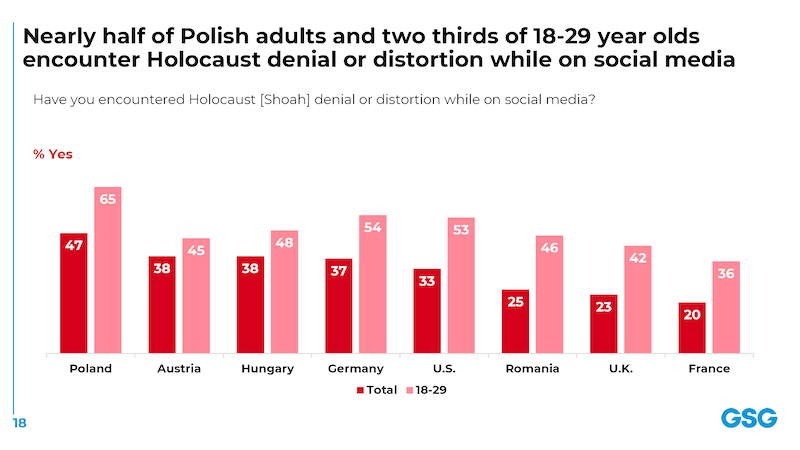
In 2025, 48% of Americans ages 18-29 could not name a single concentration or death camp, according to a survey by the nonprofit Conference on Jewish Material Claims Against Germany, which works to secure compensation and restitution for Holocaust survivors.
Another 53% of surveyed Americans said that they had encountered Holocaust “denial or distortion while on social media.”
Given their ages, approximately 70% of living Holocaust survivors will likely die by 2035. As they do, more and more people will never hear firsthand experiences about the atrocities Nazis perpetuated during the genocide of European Jews.
My research shows that Holocaust education and awareness, though, doesn’t always follow a linear path.

Klaudia Radecka/NurPhoto via Getty Images
Teaching a dark chapter
In my 2024 book, “Teaching a Dark Chapter: History Books and the Holocaust in Italy and the Germanys”, I study how Holocaust education evolved in East Germany, West Germany and Italy from the 1940s through the 1980s. In particular, I focus on the content of history textbooks that schools used for middle school students.
I also explore how two antisemitic incidents, one in 1959-60 and then another in 1977, revealed West German students’ lack of Holocaust knowledge.
Both times, international and domestic West German news outlets expressed alarm about students’ ignorance.
These antisemitic incidents also led to a series of educational reforms, in which educational leaders affirmed the need for Holocaust education and specified how educators should teach about the Holocaust.
The ‘swastika epidemic’
All of the synagogues in Cologne, Germany, were either destroyed or badly damaged during the Nazi pogroms of 1938, sometimes called Kristallnacht, or the “Night of the Broken Glass.”
The prominent, historic Roonstrasse synagogue was among the badly damaged Jewish houses of worship and was one of the few synagogues in West Germany to be rebuilt following World War II. In September 1959, West German Chancellor Konrad Adenauer attended a high-profile ceremony when the synagogue’s reconstruction was complete.
But then on Christmas Day of that year, Roonstrasse was defaced with antisemitic graffiti.
Two 25-year-old men were arrested for the vandalism. They testified during their 1960 trial that they never learned about Nazism in school. At the time, West Germany had vague guidelines on how to teach students about the Nazis and the Holocaust.
Historian James Loeffler has challenged whether these arrested men were actually responsible for the vandalism. He argues that the Soviet KGB actually drew the swastikas in order to discredit West Germany.
Regardless, following the Roonstrasse defacement, a wave of additional antisemitic vandalism spread throughout West Germany and other places, including the United States. The press called this trend the “swastika epidemic.”
Many people attributed the rise in antisemitic activity to a lack of education about the Nazi period. They questioned what West German students were learning about their country’s recent past.
New guidelines on how to teach Nazism
The swastika epidemic wasn’t happening in isolation.
In April 1959, the TV documentary “Blick auf unsere Jugend,” meaning “Focus on Our Youth”, focused on a class of West German high school students. Very few of them knew how many Jews were killed by the Nazis.
The negative media coverage coincided with representatives of German and international Jewish organizations meeting with the West German federal president, Theodor Heuss, regarding the antisemitic vandalism and the failures of the West German education system to teach about Nazism.
A committee of West German state cultural representatives called the Kultusministerkonferenz, or KMK, began issuing new guidelines in 1960 and again in 1962 about how to teach about Nazism in schools.
The West German federal states were instructed to examine how Nazism and what we now know as the Holocaust – the term was not used at the time – was depicted in school textbooks. Feedback was then provided to the textbook publishers.
How books were revised
I analyzed many versions of the same middle school history textbook called “Kletts geschichtliches Unterrichtswerk Ausgabe B,” which translates into “Klett’s Historical Instructional Materials Version B.”
Between 1959 and 1960, the textbook authors completely revised a subsection on “Terror and Crimes,” which examined how the Nazis murdered disabled people, as well as how the Nazis persecuted and murdered Jews.
The subsection tripled in size between the 1959 and 1960 textbook editions. The new version also included important new information, such as that the Nazis murdered an estimated 6 million Jews.
Previous editions had used generalizations like “many million,” without providing actual numbers.
A second controversy
Seventeen years later, in 1977, a West German teacher named Dieter Bossmann published a widely publicized study that offered more detail on the widespread ignorance among West German students, at every level.
Some students admitted to knowing almost nothing about Hitler. Some said relatively positive things about Hitler. One student thought that the Nazis had killed tens of thousands of Jews. Another thought that 16 million Jews had been killed.
The West German news magazine Der Spiegel observed at the time that the issue was perhaps not so much what students were learning, but rather how they were being taught. Although West German textbooks had been revised in the 1960s, somehow there was a disconnect between the textbook page and students’ understanding.
The KMK issued a new resolution in April 1978 that called for new curricular material for schools.
After this, more West German teachers began to prioritize an active teaching model. They encouraged students to analyze primary sources and participate in experiential learning activities, such as visiting concentration camp memorials and conducting local history research.

Dominika Zarzycka/SOPA Images/LightRocket via Getty Images
Remembering history
Holocaust education in West Germany was not perfect after 1978 – or any time since.
For example, Deutsche Welle, Germany’s public news broadcaster, quoted a Berlin history teacher saying in 2023 that among his students, “Adolf Hitler is known by most; the term National Socialism too. Some of them also know about the Holocaust, but knowledge is selective and it contains many blank spots.”
An estimated 18% of German adults incorrectly said in 2025 that 2 million or fewer Jews were killed during the Holocaust.
My particular focus on textbooks and curricular guidelines, though, demonstrates that sometimes, knowledge gaps lead to leaps forward.
Today, in part because of these developments, it’s mandatory to teach about the Holocaust in all federal states in Germany.
In the U.S., Holocaust education requirements are determined at the state level, and not all states provide Holocaust education guidance or mandates. If the West German case shows anything, I think, it is that guidance on teaching history should be continuously updated and reiterated.

Daniela R. P. Weiner is Teaching Assistant Professor of the First Year Experience and Humanities at the Stevens Institute of Technology




























Just saying says
Sit them down and have them watch “The Boy In The Striped Pajamas”
DEBORA A STEINERMAN says
That’s the worst Holocaust film to suggest! It has misinformation that just leads to mis-education. There are many more appropriate films to be found to educate about the Holocaust if that is the chosen means: From “The Number on Great-Grandpa’s Arm” to “Schindler’s List.”
Laurel says
Here, in Florida, I learned of the Holocaust reading “The Diary of Anne Frank,” and viewing movies and documentaries, mostly on PBS. I recall no teaching, on the subject in school.
The problem I have is that the majority of teachings refers to the death of six million Jews only. Many, many people died who were helping the Jews escape the horrors of the time, who were not Jewish. The other thing is, Holocausts happen to people all the time, around the world. The dark side of humans, and the light side of humans are not distinguished by color, race or religion.
Eli Wiesel was one of the few people who acknowledged the suffering of others, to his credit.
“Eliezer “Elie” Wiesel was a Romanian-born American writer, professor, political activist, Nobel laureate, and Holocaust survivor. He authored 57 books, written mostly in French and English, including Night, which is based on his experiences as a Jewish prisoner at Auschwitz and Buchenwald during the Holocaust.” – Wikipedia
Studying this man may enlighten many.
Deborah Coffey says
That would be Florida. We were immersed in that history in New York State.
Jim H says
Laurel – Perhaps a memory jogger. South Florida in the 50s and 60s was replete with the history of the Jewish holocaust – especially in Dade County.
Our last Broward County High School play was ‘Anne Frank.’ That play was an outstanding play performed by really amazing directors and 17/18-year-olds. I bet all of us can still recite our lines.
We saw all 400+ students walking away with tears in their eyes.
The holocaust was then made indelible. Unforgettable!
Laurel says
Sorry, don’t recall from Rogers Jr High, Stranahan High, or North East High.
As stated, got my info from Anne Frank’s book (most of my book recommendations came from my friend, but could have come from school). The other learnings were from documentaries and movies.
The only thing I recall is one of our buddies, throughout school) got a Jewish holiday off, and I was stunned to learn he had never tasted bacon!
That’s all, folks
Former Teacher says
Yet another failure of the faddish educational establishment that pushes left wing ideology over sound curriculum and instruction.
Samuel L. Bronkowitz says
Former teacher of pilates no doubt
Sherry says
@former teacher. . . and so, in your mind, “left wing ideology” is to blame for our poor education. Really?
Wikipedia defines “Left Wing Ideology” as:
Left-wing ideology is a broad political classification that champions social equality, egalitarianism, and social progress. It generally advocates for the reduction or elimination of unjustified social hierarchies, supporting collective responsibility and government intervention to protect the disadvantaged and ensure fair distribution of resources.
So “teacher”. . . please tell me how essentially being open minded and advocating “equality” is BAD. Also, precisely how is your obviously “right wing ideology” better?
You do realize that “states” control education. Florida is a majority “right wing ideology” state with a Republican governor and majority legislature. Why has Florida not excelled in education, then? Or. . . is it Biden/Obama/Hillary’s fault?
Skibum says
If they were blasted on Tik Tok daily by teenaged “influencers” who far too many young people follow like they are legitimate celebrities, I’m certain teens could cite each one verbatim. That unfortunately, is the sorry state of what history and education has become in such a social media consumed society. You can be sure that with the future of AI, we can expect it to only get worse.
NJ says
There are too Mass Murder Events that remain Silent! WHY??? Study History or Make the Same Mistakes!
Sherry says
HOLOCAUST:
Origin: The word comes from the Greek term holokauston, meaning “a completely burnt sacrifice or offering”. Shoah: In Hebrew, the event is referred to as the Shoah, which means “catastrophe” or “utter destruction”.
Personally, I see “Gaza” as the latest Holocaust site!
SickofIsrael says
The timing of this essay is suspicious. I suspect that Ms. Weiner is working for the Israeli propaganda machine. While the horrors of the Nazi death camps were real, choosing to print an article like this at a time when the Israeli government and it’s citizens engage in the same barbaric ethnic cleansing of Palestinians in Gaza and have, since the beginning of the Israeli state, killed over 100,000 of it’s Arab neighbor civilians, is an obvious attempt to divert our attention away from the cruelty of the Zionist Jews who have copied the Nazi playbook to the letter now that they have the power to do so. Ms. Weiner wants to complain about gaps in the teaching of history? Get in line! The U.S. doesn’t teach about the CIA assassinating foreign leaders, interfering in foreign elections and wrecking foreign economies when they don’t bend to our will, Japan doesn’t teach about it’s role in WW2 and how they forced thousands of Korean women into prostitution as “comfort girls”, Ireland doesn’t teach about the Catholic Church operating “laundries” which were fronts for homes for pregnant teens who were forced to give up their babies for adoption against their will, Canada doesn’t teach about the government removing indigenous children from their families and sending them away to learn English and “westernize” them. The list goes on forever. Shame on FlaglerLive for allowing it’s platform to be used for this Israeli Zionist propaganda!
Kennan says
Sick of Israel, thank you. You beat me to it.
Daniella R. P. Wieners, well documented and thoughtful questioning of the educational understanding of Nazi ism, and the holocaust was well written. The understanding of the above story is noted. However; I wonder whether the timing of this story is somehow defective in nature as well.
Whenever we warn younger generations to not repeat the mistakes of our history, we are really talking about ourselves because we have become so good at it.
I have a more nuanced understanding of the Middle East, given my father‘s multifaceted expertise in the Middle East, both historically, as a professor at Georgetown, and of course, this time as a political prisoner in his home country of Syria.
Shortly after the terrorist attack on Israel by Hamas on October 7, 2023, we witnessed a genocide on the people of Gaza. A genocide that quickly turned into a 21st century holocaust seen in ultra high definition all over the world in real time. It continues to this day with the fake cease-fires as well as settler violence in the West Bank and bombings in South Lebanon.
Before October 7, 2023, and the subsequent genocide that followed, 90% of the American public knew nothing about the “NAKBA” of 1948. The systematic expulsion of almost 1,000,000 Palestinians off their land and the occupation in 1967 of their land by Israel.
Today’s population has been exposed to the modern day real time, blood and guts reality of history in the making by the minute. My contention is this:
Why are the horrors of the holocaust and the concentration camps constantly re-hatched while the horrors that Arabs endured in 1948, 1967 and now the crescendo of post October 7, 2023 ignored? Why?
Antisemitism exists. Bigotry exists in spades.
Wiener makes a very good and important historical narrative, but I still come away asking the question…. Why oh why is it made impossible to ignore the plate of Jews in this country, but Arabs and Palestinians in particular are completely marginalized and ultimately ignored. Even now with everything happening out in the open. Brazenly with depravity.
I mean not to take away the importance of people needing to know more about history, but let’s face it. Israel has an incredibly strong lobby in this country, and with the fear of the obvious Nazi playbook being played out by the very country that suffered at the hands of Nazi Germany in World War II has applied the same subjugation and cruelty to Arabs since 1948.
It seems the exchange rate for human life is just not very good if you’re an Arab.
I’m very sorry, but the timing of this story has great relevance in my mind. The more we know the clarity of reading the international room will come into focus. Timing is everything.
R.S. says
Actually, I’d suggest beginning with Wounded Knee and going further back in history to account for 60 to 100 million indigenous people killed right here. Ain’t nothing to be done about Sachsenhausen or Theresienstadt etc., except to weep over that cruelty. But there’s a lot of mind-changing to be done right here to learn about the cruelty over the genocide right here and the dreadful sin of chattel slavery. What’s the biblical comment: Why do you see the splinter in your brother’s eye, but don’t notice the beam in your own?
Laurel says
Trump is trying to wipe out the history of the Code Breakers”.
JimboXYZ says
I must admit that as I’ve aged, I’ve forgotten the names of those places. I lived in Miami, FL, they had a Holocaust memorial that was erected in South Beach area. It’s one of those things that one can easily research online with a Google search. Same goes for any of the Civil War & slavery locations. It’s Jeopardy question material for the most part. Unless you are winning a jackpot on a tv show, being a Holocaust/Slavery expert is wasted space in anyone’s long term memory banks. I wasn’t a party to any of it, never going to get a holocaust & slavery card to play out of it. Most of the places that I’ve been employed are my own personal list of salary & wage slavery locations for historical perspective. I have my own list of Adolf Hitler(s).
As for visiting Europe, most of us will never make that trip. I have no desire to ever make the journey. I have my own memorial for my own family tree that is a drive-able hour & a half North of Flagler County. We have St Augustine & too many other locations for our own USA history of relative human race shame. Virtual Memorials on the internet that has made actually wasting time & natural resources to physically travel to those locations unnecessary. One has to ask themselves what purpose it would serve to make those treks ? Enlightenment & educated ? All one needs to do is be aware that they can make that educational trip online ? Dad was a WW2 vet, one visit to Pooler, GA for that museum was plenty & I can visit that too online.
https://holocaustmemorialmiamibeach.org/
https://www.mightyeighth.org/
Sherry says
In my experience and belief. . . Those who simply refuse to spend time in another country and culture are “close minded”, and relatively ignorant. Perhaps that is where much of their small thinking and anger comes from. In any case, they are choosing to live tiny lives with no true understanding of the amazing humanity and awesome natural beauty of our planet. How very foolish and sad for them!
Kennan says
Talk to text can be a total bitch sometimes, so apologies in advance.
Nice to see that there are some others out there that see and feel the almost unnecessary narrative point that many people are not well-versed in Nazi ism and the Holocaust.
The above narrative, although Rich in facts and statistics…… Well, I questioned the timing. I question the very possible deflection, whether on purpose, or not, to rehash a horrific event in human history that was initiated as a eviction and subsequent subjugation of 1 million Palestinians by a state that had escaped the horror of the Holocaust just three years previous.
The meticulously timed urgency of this history, lesson conveniently bypasses Israel’s taking of Palestinian land and eviction of its people in 1948. What was also known as the”NAKBA”. The occupation of said Palestinian territory in 1967, and finally the crescendo GENOCIDE turned open air Holocaust. Things that were virtually ignored for decades that Garner international attention now.
Timing is everything. I’m sorry but, with Israeli popularity in the toilet(as it should be) I can only focus on Israel’s desperation to stay relevant, and the possibility of a writers timing being not good. I also fervently believe that the leaders in our country have no idea how to read a room.
The Holocaust as historically important as it is, there is an unwavering 21st century holocaust happening right now. In the open, an ultra high definition. 80% of our American politicians are bought and paid for by pro Israeli lobbies. That’s what you need. Money. The exchange rate for human life if you are an Arab? Well, just not very good.
My apologies to Daniela J. P. Wiener, but these are the inescapable realities and thoughts that run through my head as you attempt to educate the public on an event that bears no current significance in the spillage of blood on the hands of the very State, created(taken) by the very people that suffered in the historical narrative you describe.
Shortly after the bombings in Gaza began, there were several boat tours initiated so that Israel’s men, women and children could witness the bombings from the safety of said boats. To watch Palestinians be bombed mercilessly.
Why, oh why , oh why are Jews, absolutely never ever allowed to be forgotten, but Arabs are marginalized, conflated as terrorists, and completely forgotten.
Sherry says
THANK YOU Keenan! Excellent Comment!