



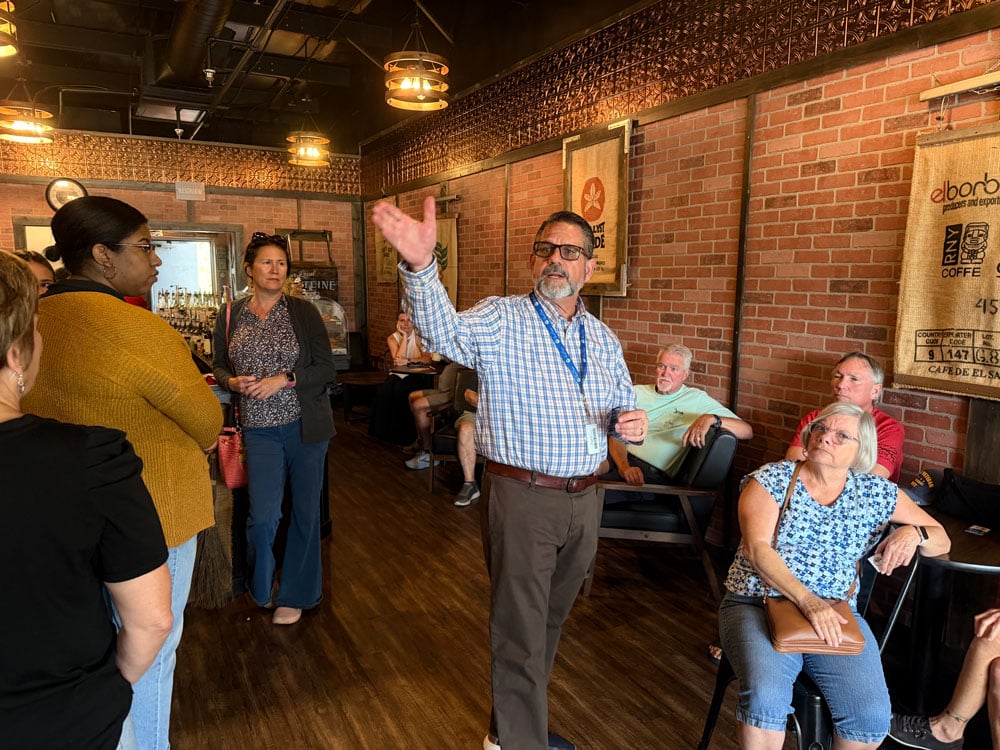
If he is ever a fish out of water, Mike McGlothlin has yet to be one in Palm Coast even though he still calls himself the “rookie” city manager, on the job here only since mid-December.
He’s as comfortable and congenial in formal council meetings or workshops as he is with his staff, in one-on-one meetings with council members (two of them confirmed it) or reporters, or in his monthly coffee chats with the public at large, as he was this morning for an hour at the Jacked Up Bean in St. Joe’s Plaza.
No airs, no presumptions, lots of y’alls and that North Carolina drawl that seems as natural a bearing to him as his Hey Dudes shoes. He fielded half a dozen questions in the third of these one-hour “Coffee and Conversations,” this one drawing more than two dozen people, none of whom was part of the regular crew that attends council meetings or grandstands at public comment time, and most of them different from the two previous sessions, held at different coffee shops.
“This is the type of civic engagement that’s critical to our community, not only where Palm Coast is now, but I need this,” McGlothlin told the group at the 49-minute mark, when questions seemed to dry up. “I need this individually, and I need people to take this back collectively to share with not only our staff, but with our elected officials as well.” He says he will conduct monthly town halls as long as he’s the city manager.
The monthly sessions began in March, generating about a dozen to 15 registrations through the city’s website (registration is not required), with about twice as many people showing up, Brittany Kershaw, the city’s communications and marketing director, said. Previous sessions were held at Panera Bread and the Copper Lotus. June’s is scheduled for Loopers, the restaurant at Palm Harbor Golf Club.
There were no surprises today. Questions and comments, some of them pointed, some exasperated but all respectful and sincere. All the questions were free of political mugginess, focusing on neighborhood matters. Residents raised concerns about growth, traffic, the projected expansion west of U.S. 1 that will nearly double the city’s population over the next three decades, unsafe driving on Woodbury Drive, a leaning utility pole on Prince Lane, and “manhole covers flowing out” during major rain events in the P Section.
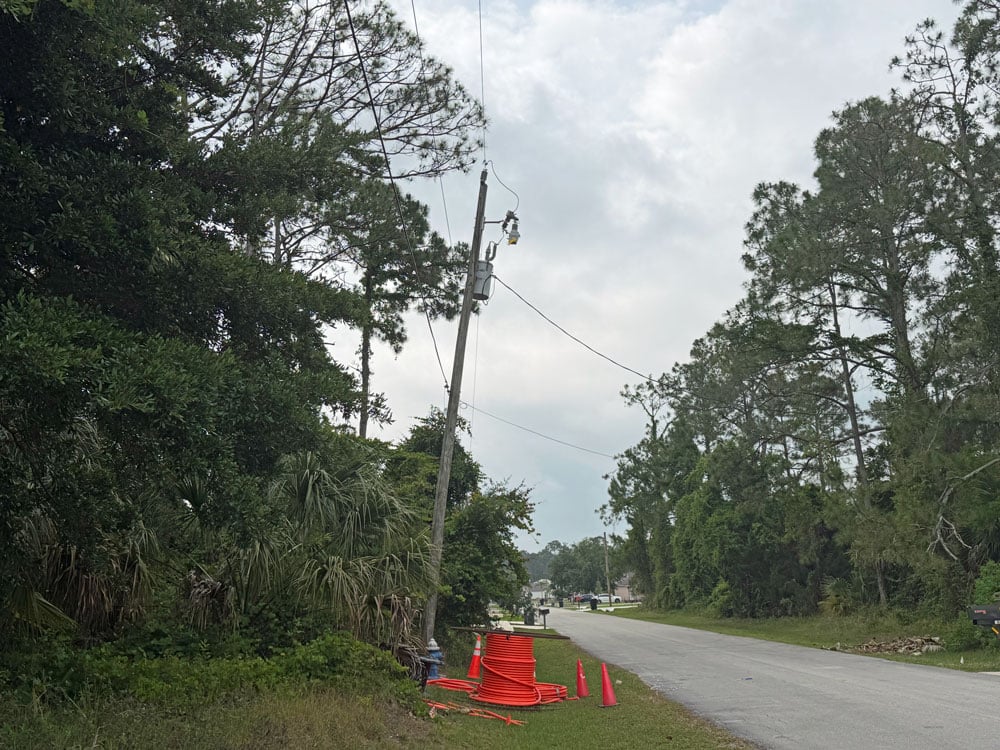
“I’ve only been in Palm Coast a couple of years,” Linda, one of the residents said. “What are we doing about the traffic flow? I live off of Ponce de Leon. I can’t even get out of my street. There’s more accidents, so what are they going to do to improve all the streets?” She said the city should “take care of the people that are already here before bringing more people into the community. We’re real upset with that. Very upset.” (The city itself is not “bringing” people to the community, of course, but people like Linda are choosing to come here, as she did a couple of years ago.)
“I hear that thing a lot, a lot of people have that same concern, and I don’t disagree with you,” McGlothlin said.
“But it’s not being fixed,” Linda said.
“As far as me and my perspective, I just got here, getting involved, getting situated with a particular team,” McGlothlin said, “seeing where we need to shore up some efforts and do things a bit better. And planning is one of those.” Where he could not provide specific answers to a resident’s satisfaction, he provided general or philosophical ones, or provided a few details about large-scale initiatives–like the recently adopted bond issue that will help finance $600 million in utility improvements over the next five years. With traffic issues, he suggested that residents could look up the city’s capital project dashboard. For example–addressing Linda’s concerns on Ponce de Leon–Belle Terre Parkway is in the midst of a series of turning-lane additions to improve traffic flow, one of them at the intersection with Ponce de Leon.
In the first of two statements to that effect, he said “if you don’t grow, you die” (a standard mantra, not just among city and county managers), “but growth has to be smart, and it has to be what’s important to the community, and has to be well planned.” He would later note that when ITT planned Palm Coast, it did so with 250,000 to 300,000 people in mind. (Actually, in 1974, the plan was for 600,000 people, as The New York Times reported that year. Florida government’s regulators under Gov. Reuben Askew, the strongest environmentalist governor the state has known, forced the company to scale back. Like Askew’s type of governance, those regulators have since vanished.)
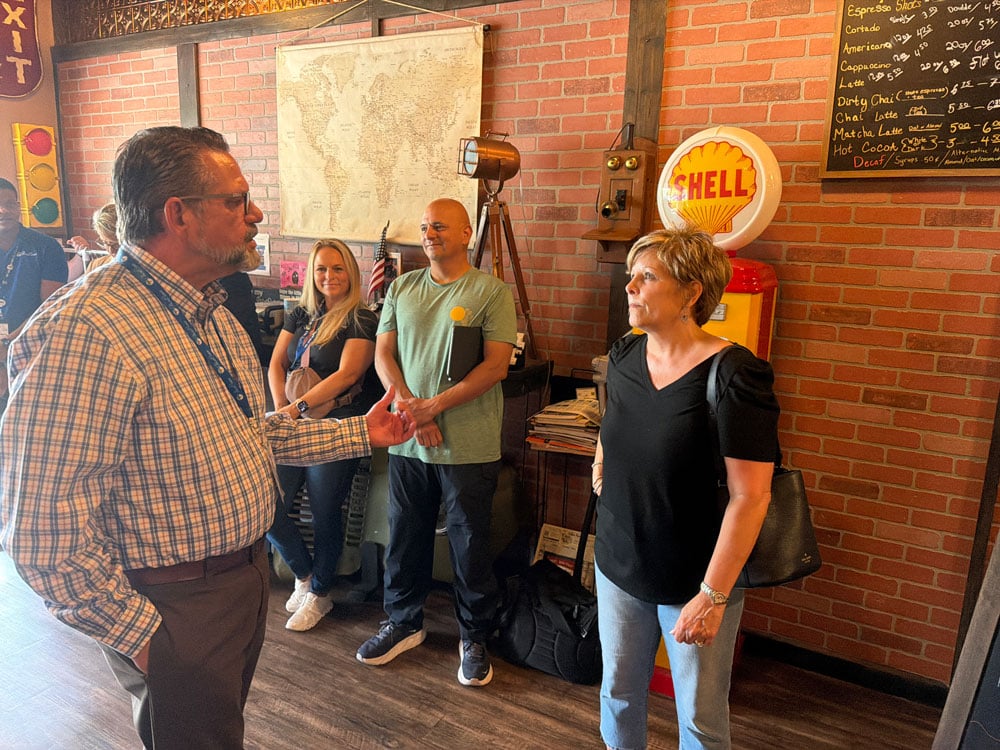
Hearing from another Mike about the “drag strip” on Woodbury Drive, a residential street that happens to connect Pine Lakes Parkway with Whiteview Parkway, generating significant and hurried traffic, Kershaw who–with Terrence Muir–accompanied McGlothlin, filled in some recent history on the city’s traffic calming efforts. Woodbury may qualify for speed humps similar to those in place along Florida Park Drive.
“Well, that’s not going to slow people down. I mean, they fly,” Mike the resident said, describing how a neighbor drives to the bike path on Pine Lakes rather than ride along Woodbury because it is so hazardous. Another resident, Wendy, seconded him. McGlothlin said it was the first time he was hearing of Woodbury’s issues. “I definitely need to have a conversation on behalf of this area with the sheriff’s office,” he said.
He then got an earful from Carol, who said her father built the fourth house in Palm Coast, which puts that ancestry at around the early 1970s, when ITT was beginning to raze the first of Palm Coast’s 92,000 acres of woods and scrubland. She’s been coming to Palm Coast since she was 12 (or since 1975). She’s 63 now.
“I built my forever home, Seminole Woods in Grand Landings seven years ago. Thought I’d be here forever, until now,” Carol said. “That’s because I am thoroughly disgusted.” She said buildings are going up before sufficient infrastructure is in place. She’s upset about apartments going up near Grand Landings–an old prejudice in Palm Coast and other communities happily self-tyrannized by the single-family-home creed.
“It’s not about us being here and being a community. It’s all about money. And I feel like that’s all they care about,” Carol said.
McGlothlin’s easy-going nature helps to mask a latent sharpness that can flash and take you unaware. “When you said ‘they,’ who are you referring to?” he asked Carol.
“That’s a very good question. I would like to know who makes these decisions,” Carol replied, before shifting to an entirely different target: “Because why did they build a data center in Palm Coast?” She spoke of the water and electricity consumption of data centers and “the radiation it’s going to put out” and produce only a handful of jobs (data centers typically generate very low levels of radiation, but consume inordinate amounts of electricity and water and employ few people).
“It’s a low-job yield,” McGlothlin agreed before giving Carol his business card and inviting her to email him. “Thanks for your story. I’m sorry for your frustration,” he told her. She was the only person to get applause other than McGlothlin at the end of the session.
In answer to a couple of questions on the subject, McGlothlin talked about Raydient’s Master Planned Development proposal to build 22,000 homes west of U.S. 1, and made a little news when he said that the MPD would not go before the city’s Planning Board in May, as planned, and he would not put a timeline on it just yet. The third version of the MPD had just been filed, and more versions may be expected.
“We’re still a ways out for that to be finished,” he said. “If we are still working on that concept, their team is working with our internal team on fleshing that out, but we’re at a point that we need to make sure that it’s done right, so I don’t want us to rush.” He added: “We don’t want to be we don’t want Palm Coast growth to be what we’re experiencing now, or where we’re having to, you know, address our infrastructure out of sequence.”
In an interview after the session, he said the back and forth between city staff and Raydient is making progress. “There’s no acrimony, there’s no issues, there’s no negatives, you know, to working through this,” he said. “This process normally takes about a year, and it was a very audacious effort to try to, you know, do it in less time than that. And that experience showed us that we need to be wise and slow down and let’s get it right. Instead of trying to be first.”
Summing up his three town halls so far, McGlothlin said the running theme has been concern about growth but also “support for our amenities and our way of life,” and what Palm Coast is now and could be in the future.
“I want to keep these going as long as I’m here,” he said of the town halls. “And I want that to be long term,” he said with a laugh, a nervous nod to the fact that he is the fifth manager in the last eight years.

























James says
Again with the coffee and donuts?
Is this fella related to former mayor Alfin? Come to think about it, he even sorta looks like him.
Just an opinion.
Jay Tomm says
The main problem is no one listens to the people! Have as many meets as you want, aint going to matter! There isn’t one Flagler resident that wants this building & destruction of nature, increases in traffic, etc. It’s ALL ABOUT MONEY. More people more money. It’s simple as that. The people that are running things are greedy.
FedUp says
Likely, everyone in that room isn’t from here. If you want to fix the problems, y’all can go back to where you came from. That would be a great start to fixing your problems and saving Flagler County.
celia says
FedUP! we are with individuals like you, always harassing on line those of us whether FL natives or Not while we are battling to preserve our safety, quality of life and value of our homes among many other things that your square mind can grasp or understand! TY to all the Palmcoaster’s and none also that attend these meets and specially Carol’s very cleaver and realistic questions! I will try to attend in June at Loopers as being a Palmcoaster since 1991 I sure have also some questions to ask…
JimboXYZ says
Same tired Alfin Coffee Shop format for what Alfin sandbagged Norris with. Just relocated to the Jacked Up Bean vs Panera Bread. Anyone wasting their time attending that event is just creating unnecessary traffic for the same non-solution that the crappiest Palm Coast mayor ever, Alfin ushered in.
given up says
The main problem in the city is the infrastructure they build and build and build the road on my street hasn’t been repaid in 20 years old Kings Road is a speedway 6070+ miles per hour lots of people do. You do not see traffic enforcement deputy that often and when they’re here they’re out in the open that makes a lot of sense. I was thinking about setting up a video camera and record the traffic and the speeders and then send it to the mayor and other people, the city is turning out to be a joke. It’s all about the money, not about the people.
Connie says
Wait! There are people criticizing a City Manager for actively engaging with the public?
There are a group of people in this town who are absolutely worthless and completely miserable. We all came to this area because we liked its location and the amenities it offered.
I’m sure the people that had been here prior to us didn’t want us here, but here we are. I’m haven’t been pleased with the utilities skyrocketing, but I also understand the population of the area has more than doubled.
When you have someone who is willing to meet the public and answer questions, that’s called “transparency”. That’s a good thing.
James says
You’re entitled to your opinion.
But just like the coffee is first come, first served, so is the political power dished out… the last of whom are the general public.
See any coffee cups in the hands of the folks in the pictures?
All I see is an attempt by local government to give the appearance of concern, and also learn how to better formulate their gaslighting sales pitch to the public.
Nothing concrete will come of these impromptu meetings.
Only at the voting booth, if one still has that right.
Note that it’s the city manager, and not members of the council (not that would make a difference)… we don’t vote for city manager.
Sincerely,
“Worthless and Miserable” in Palm Joke.