



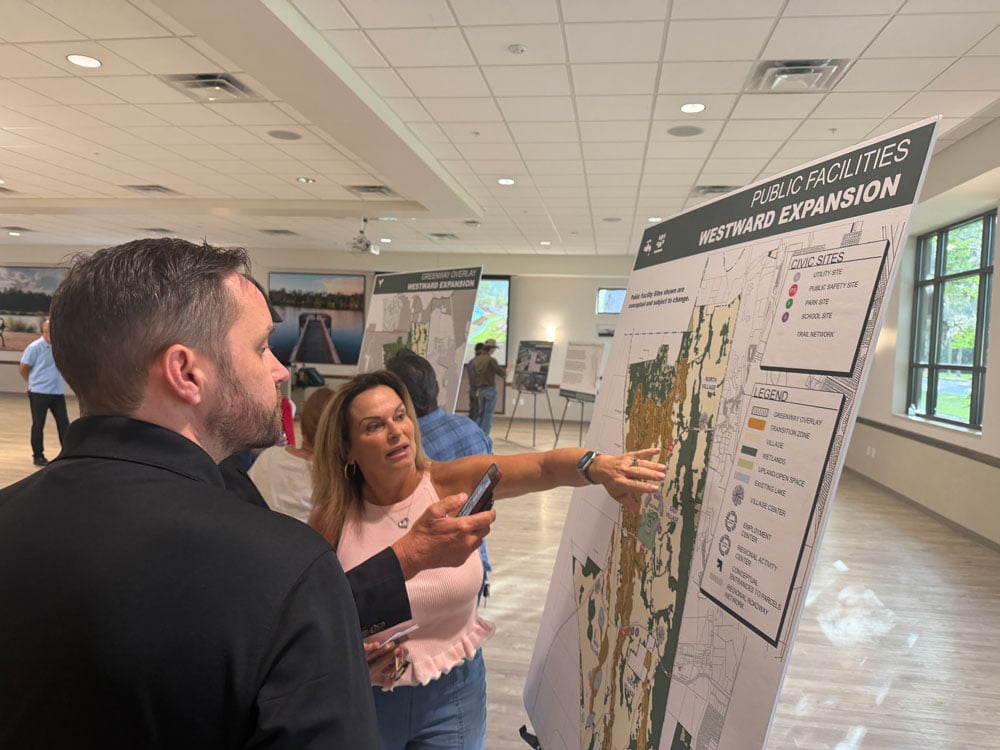
A few dozen Palm Coast residents on Wednesday got their first, cursory look at what the so-called “western expansion” will look like when Raydient builds a planned 22,000-home development on nearly as many acres west of U.S. 1 over the next three decades. Between those homes and the 6,000 yet to be built on Palm Coast’s old ITT lots, the city’s population will almost double in that time span.
Raydient is about to submit its proposed development plan to the Palm Coast Planning Board and the Palm Coast City Council for approval. Approval is eventually likely, but not necessarily immediately guaranteed, especially as innumerable details have yet to be publicized and worked out. Those details were not available on Wednesday. As high-level perspectives go, the one Raydient provided at the Palm Coast Community Center was from about the stratosphere, as even the map color-coding the future plans suggested.
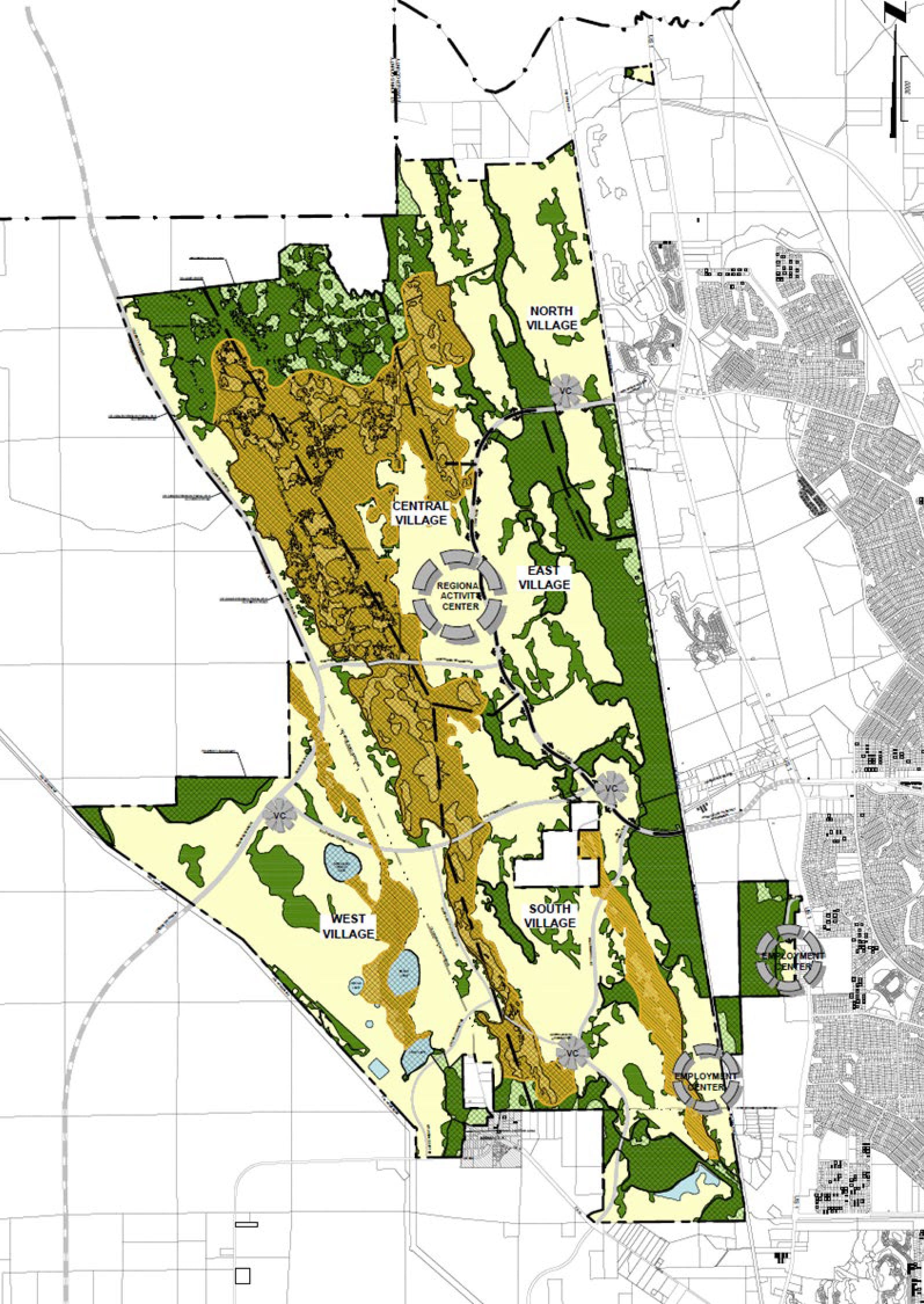
Instead of “sections” (as in P-Section, B-Section and so on) there’ll be four or five yet-to-be-named “villages,” each with its commercial center, its grocery and retail stores, its medical and other offices. Housing density would be much higher in the village center than beyond it, with between eight to 10 housing units per acre in the center.
There’ll be a couple of K-8 and a high school, possibly in one educational campus that would go from pre-K to junior college. There’ll be fire houses and police stations, and a “regional activity center,” or a sports complex.
There’ll be a mixture of housing choices even as single-family homes still make up 75 percent of the total. “There will be places here where you’ll probably have some apartments. There will be places where you have estate lots,” said Karl Soderholm, a landscape architect and planner with England-Thims & Miller, or ETM, the Jacksonville-based design and engineering firm on the project. “So the real advantage here is that you’re going to get a lot of diversity in pricing.”
There’ll be 3.2 million square feet of industrial acreage, mostly at the south end of the development nearer U.S. 1. There’ll be a lot of open space and vast swaths of wetlands that can’t be developed. There’ll be spots for eco-tourism, possible beach-like access to a trio of lakes on the southwest side of the development. And there’ll be roads crisscrossing it all, including that “loop road” from Matanzas Woods Parkway to Palm Coast Parkway, and the future state highway 2209 (currently referred to as a county road) that will skim the western edge of the development as it cuts a new path from I-95 in St. Johns County to Orlando.
Raydient is the real estate development arm of Rayonier, the timber and land holding company that owns close to the totality of the currently vacant acreage west of U.S. 1 but for forests and scrubland.
Raydient and its design and engineering firm, Jacksonville-based England-Thims & Miller, or ETM, presented their very general plans in what was dubbed as a public neighborhood meeting at the Palm Coast Community Center. City government requires developers to hold such meetings ahead of regulatory hearings and approvals of their projects. The neighborhood meetings are intended to be informational, with developers always making verbal presentations outlining the proposal, showing displays and answering questions for all to hear.
To the disappointment of many and displeasure of a few, that’s not how this neighborhood meeting went. Raydient set up a few large displays in a semi-circle at the Sunshine Room of the Palm Coast Community Center. There was no verbal presentation.
The public–what there was of it, anyway–was invited for just 60 minutes to walk around and look at the four or five displays, which weren’t that different from each other but for a city map showing long-term transportation plans. The main map had already circulated in city documents that were not previously made broadly public, but that were available. The map had little context.
A couple of screens showed silent, marketing videos of existing Raydient developments: one in Georgia called Heartwood, and another just south of the Georgia border in northern Florida called Wildlight.
The “neighborhood meeting” was barely publicized. It was not posted on the city’s calendar (such neighborhood meetings never are). Council members were not aware of it. The city’s communications department was not aware of it. ETM sent notice of it to the county administration, but it was only the eagle eye of an executive assistant, Rose Keirnan, that caught it and forwarded it to Acting County Administrator Adam Mengel and other top staffers, then onto county commissioners. Commissioner Andy Dance mentioned it at last Monday’s commission meeting. Perhaps 50 people showed up all told over the course of the hour.
The company made available a few ETM representatives to answer questions, if anyone had any. The ETM representatives, among them Karl Soderholm, a landscape architect, and Grant Bledsoe, a civil engineer, took every question asked and answered each in detail. But most people did not necessarily know which questions to ask since the companies were not providing a contextual overview beyond the maps shown. As displayed, it was as if the proposal had no history, which is not the case.
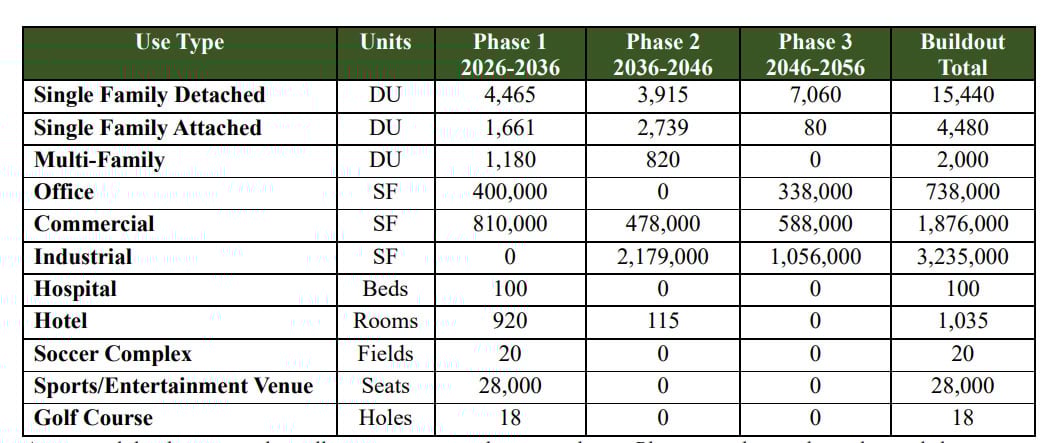
For example, there was no way to know that the development was for 22,000 homes, why the development is now 10,000 homes greater than when it was first approved in 2010, how those housing units would break down between single-family homes, townhomes and apartments (a breakdown is available here), how they would be clustered and according to what criteria, who would pay for the roads and other infrastructure yet to be built, why–as Palm Coast City Council member Theresa Pontieri has asked twice in the last two years–are taxpayers shouldering the cost of a new road through the development that the developer was required to pay for in earlier versions of development plans, who would pay for the sports complex that appeared in one of the maps, and so on.
Nor were there explanations regarding the changes between 2010 and this year. The explanations would have been central to the new face of the development, compared to when it was first proposed as two, smaller, separate developments in 2010, since the current proposal is a direct result of the company’s decision to scrap the previous versions.
Nor were there explanations about the city’s planned annexation of some 7,000 acres in the next few weeks. That annexation will be news to most residents, and not just in the city. The annexation incorporates a large part of the proposed development (now on county land) and will increase the size of the city by 12 percent. The annexation is all but a done deal since Rayonier is voluntarily annexing into Palm Coast. There are no residents on the land to be annexed. The county has no say.
For a proposed development of such colossal size–in essence, a second Palm Coast–both Raydient’s and the city’s dearth of preparatory information for public consumption has been stunning, considering that the city and Raydient have been working on the Master Planned Development for several years, and that the plan is going before the city’s planning board in May, and the City Council, for approval, this summer. (City staffers repeatedly alluded to the western expansion during the development of the latest comprehensive plan, but in general, vague terms.)
Acting Deputy City Manager Kyle Berryhill stood by on Wednesday, ready with explanations, next to one of the displays that illustrated mostly in government jargon the regulatory steps ahead for the “westward expansion.” The display explained the “what” ahead. It did not explain the “why.”
Namely: why have the 2010 approvals been shelved and replaced with this much larger plan.
In 2010, the Palm Coast City Council approved those developments as so-called DRIs, or developments of regional impact, a regulatory term that gives local governments greater authority to define the parameters, the looks and the requirements of a development, with timelines and other expectations.
The two developments were called Old Brick Township and Neoga Lakes. Old Brick Township was named after the historic Old Brick Road that cuts through the west side. Neoga Lakes was named for one of the small lakes on the west side. Neoga Lakes was permitted for 7,000 homes (or housing units) and 2 million square feet of non-residential development (commercial, retail, office, industrial). Old Brick Township was approved for 5,000 homes and 1.15 million square feet of non-residential development. In other words, 12,000 homes total. (See summary analysis of each development order here and here.)
The DRIs are still the official development documents. Raydient wants to scrap those DRIs. It wants to replace both with a single Master-Planned Development, or MPD. The MPD still gives the city significant authority to define the manner and scope of development. But the MPD Raydient is proposing retracts numerous previous commitments, including paying for the loop road that taxpayers are putting up $126 million to pay for, paying for the sports complex, and paying for other amenities that are part of its commitments in the two existing DRIs.
The MPD requires approval by the City Council. The Planning Board’s recommendation is to Raydient’s advantage, but a Planning Board decision is not binding on the council. Only two public hearings on the MPD are scheduled before the council.
With that approval, should it be granted, the next step would be negotiations between the city and the developer on more detailed “concurrency” agreements that define each side’s responsibilities for infrastructure, who pays for what, and when is it built. Those agreements will require City Council approval as well. Only after that would there be permitting–which takes over a year–site (or building) plans, platting and construction. Bledsoe, the ETM engineer, estimated the earliest time for house construction to start is about two and a half years away, assuming regulatory steps are fulfilled at a reasonable pace.
No part of the displays at the Community Center presentation alluded to future plans for Old Brick Road, the historic brick road the County Commission intends to protect, and that the county, the city and the developer imagine as a future nature park and tourist destination. But maps do show the future state road connecting I-95 to I-4 hugging Old Brick Road for much of its Flagler County length.
Why so close? “I guess there’s a couple of trains of thought on that,” Bledsoe, the ETM engineer, said. “One, the road is a straight road, a straight line, and so it’s an established road today. The thought would be that you somehow preserve and highlight the road, make it accessible to people, versus just ostracizing it in the corner of the property. So you would have a road that runs off of it. It’s not right on it, but it’s a clear corridor today.”

The public notice that was mailed ahead of the Wednesday meeting:
2026 04 08 recd 04 10 - ETM St Aug - Neighborhood Meeting 04 22 - PC MPD Westward Expansion





















R Stewart says
Was the notice mailed out or posted? I received nothing in the mail. The big question is WHO IS PAYING FOR THIS? Homeowners in Palm Coast are still reeling from the property tax increase we were saddled with a couple of years ago. Of course developers won’t have a problem with this. They’ll just snatch up our property when we can’t pay the taxes. This is getting ridiculous. Bigger is not better. The ones who benefit from it most will, as usual, be the developer and the ones who approve these developments.
JimboXYZ says
Westward expansion of Palm Coast was the precursor to the 6-8K Bunnel expansion & Annexation for Flagler Beach. I wanna hear what the STF situation is going to be for these 22K for New Palm Coast/Alfinville., FL ? The inflation for utilities is not ever getting better for affordable quality of life ? They will need more STF Capacity, Staly’s relative National Guard will continue to swell the ranks for all the crime. more overpopulation, gridlock & pollution, all as the inflation economy continues on Bidenomics pace. You read it here first in this comment. Raydient/Rayonier isn’t fixing their flawed gouging for the dog & pony show of a circus for those council meetings. Stay bent over grabbing your ankles for that financial sodomy.
[disallowed handle] says
“Bidenomics pace” when Trump has been in office for over a year and manipulates the markets via “Truth”Social.
Conservative complaining that conservative politics suck. Eat it
a Concerned Observer says
In what left-leaning addled mind could anyone blame President Trump for this local out of control growth? Is he also to be blamed for the weather? Local politicians, YES. Greedy land speculators, YES. Anyone with a vested interest more and more homes being constructed with no regard to the feelings of local inhabitants watching the quality of life they came here for being inexorably degraded, YES!
disgusted says
There was a time when they called a real estate developer, a real estate speculator, well not now and not in Florida, They grease the palms of all they can and their buying up huge parcels of undeveloped property at cheap prices guarantees them millions if not billions in the future. It is time to tell them NO, if they want to build on this speculated property, then they should bear all of the costs involved and nothing at the taxpayers expense. They need to pay for all of the future infrastructure requirements as well as for the impact on existing infrastructure and not the taxpayers. We have too many billionaire property developers that have undue influence on our legislature. Now they need to pay their share and not just reap the profits.
Rudy says
Is it not enough that developers and homebuilders already subsidize the existing infrastructure?
For a city of its size, Palm Coast has the 2nd lowest millage rate in FL.
Flagler County has had 5 consecutive millage rate reductions.
Meanwhile, school impact fees increased despite declining enrollment, Park impact fees doubled in order to subsidize new parks while existing ones deteriorate, and developers pay up front utility fees (years before their projects have any impact on water/wastewater) despite installing miles of pipe that is far superior to ITT’s existing leaky 50 year old pipes. All so that residents like yourself were able to enjoy over a decade of artificially low water/sewer rates.
Not to mention the recent illegal and opportunistic doubling of traffic impact fees.
“Fair share” policy arguments over the last 150 years in the West, when successful, have tend to result in the same thing: destruction of infrastructure and markets. At least 19th Century Marxism had the excuse of lacking access to instant and accurate data.
You, my friend, have no such excuse. Or perhaps you do have the information and are too blinded by something to honestly engage with it.
anon says
Artificially ‘LOW WATER/SEWER RATES’???? Get the He// OUT of this county, you gaslighting crook. You are one of those rooting for the destruction of Florida in order to line your pockets. Ugh. Go back to the state you came from, grifter.
Skibum says
Am I missing something?
The City of Palm Coast wants to expand westward, but from reading this latest information it sounds, to me at least, like instead of the city developing a comprehensive master plan for the westward expansion, the city is leaving it entirely up to this private developer. Is that what is happening here??? If so, that should raise huge red flags for all of us who live in Palm Coast.
Pogo says
Coming soon
… Lord of the Flies Coast, by Gov. Rick Scott Productions, LLC (low life creep).
Y’all voted for this in every election in this century.
Eat up fools.
Mothersworry says
And they have been doing it for many many years. If they don’t get industry in here that provides good paying jobs that enable folks to buy these homes the next step will be subsidized housing. Care to guess who pays for that? The taxpayer eventually.
Keep Flagler Beautiful says
In this article, four words stand out to me: “Shifts cost to taxpayers.” Developers get away with murder in this county. They know exactly how to do a “hit and run” and which officials will play ball with them. Mayors, commissioners, council members — ALL need to be held accountable and start representing the people, not the guy who took them out to dinner last night. We do have some excellent people in place, now, especially on the Flagler County Board of Commissioners, but some others need to be shown the door, including the last remnants of the despicable Joe Mullins cabal, which did so much irreparable damage to the county.
Reed says
I told my wife we are getting out of this hell hole place. This is not a nice quiet area to retire. Who wants to hear construction the rest of your lives ! Not me. We are heading back out west to a quiet small town.
MTCH says
Speaking as a resident of Flagler before there was a Palm Coast. Founding Fathers promises of existing residential neighborhoods being protected as the city grew was a Big Lie. How protected will existing “residents of today” feel when all the money is going to Westward Expansion. Will we see the city’s responsibility to residents “evaporate” again for growth westward? My prediction is yes; city leaders will once again forget “founding residents’ taxpayers”, forget they exist for the Westward Expansion. The Now Palm Coast infrastructure (streets, sewer, water, etc.) are failing miserably and what is there to show for my past 28+ years of paying taxes? What will residents see in next 25 years (one example: will residents ever see residential streets designed in the 60s & 70s actually be upgraded to handle new vehicle size/weight as these streets handle increasing traffic volumes). For 28 years I watched the government growth supporting special interests and not existing residents, watched elderly friends that sank their life savings into a home for a peaceful retirement, die seeing their investment deteriorate, their peace destroyed, their health weakened daily. Unless there are changes, taxpayers here now will see how government support of existing taxpayers evaporates for new growth, as seen in the last 26 years.
Rudy says
Not sure to what specific “promises” you refer.
The same Founding Fathers you mention, though, anticipated and designed for a population of 250,000 residents in Palm Coast. We are not even halfway there so please stop with the “increasing traffic” nonsense.
“Die seeing their investment deteriorate.”
Please show me evidence of 1 single property in Palm Coast whose value has decreased in the last 15 years because of development. The property appraiser keeps fantastic records, this is public information and you are wrong about it.
X Rudy
Jeffery Cortland Seib says
The developers know all the tricks. The prior development order was essentially a holding order that had nothing to do with the so-called final order but is used to just hold the land from any tax increases. This land, is right now zoned agricultural, forestry, so the taxes paid per acre are way less than we pay for a one quarter acre homesite. This massive project, a second Palm Coast, will take years to even begin to build homes and whatever else. Water use, wetland destruction, wildlife habitat and green spaces will be the first to go. Don’t give a darn about any of this well how about out taxes skyrocketing as Palm Coast, us, will be footing the big bill for city services to the second Palm Coast. Here’s the agenda, this plan will be hidden from public view for quite some time by the cities planning department who will struggle to make it at least verbally suitable for us to take. Then the attorneys for Rayonier march in to the city council chambers and demand its approval. This should not be rammed through the city council before the November election.
No more water says
So when this grand plan is done …… And the vast green space (and swamps) are turned into blacktop and rooftop how will our aquifer get replenishment?
Flood water runs off rain water soaks in
Deborah Coffey says
AI: Mark McHugh, appointed CEO of Rayonier Inc. in 2023, has an estimated total annual compensation of roughly $4.7 million to $5.46 million.
Marek says
We retired here to Palm Coast because it was nice. It is not so nice anymore. Sad.
PaulT says
Expansion of Palm Coast is inevitable whether we like it or not. In terms of urban planning the ‘villages’ of mixed density housing is a great idea so long as the promise of integrated retail and service providers actually happens. The planners and City council need to make planning approvals conditional on those elements being built in the same phases as the housing, not lagging behind the growth of these ‘little’ communities waiting for a viable customer base.
The big question is how will wastewater and water supply be handled and how is it going to be funded. The expansion of the treatment plants cannot just be dumped onto existing residens’ utility bills.
Really Annoyed says
Tell the developer to take a hike! A pure POS!
City Tim says
I have a question, how about we don’t annex it and tell are publicly owned water company not to give the service. I am not sure the water company can with hold there services, but I do know they can charge them more for it . As long as we don’t annex them in to palm coast .
Jeffery Cortland Seib says
More than two years ago I proposed to the city council that the area west of the railroad tracks that are west of US highway 1 be declared by the city an “urban services boundary” line, like many other cities in Florida and all over have done to protect these areas from being steamrolled into what Rayonier is planning to shove down our throats. What an “urban services boundary” means is beyond an identified geographical line city services such as water, sewer, drainage, roads, all cost much more, twice as much as in the urban area, and the cost is to the developer not city residents. This was met with silence by the council. Too severe? Make it somewhat less. If the people of Palm Coast don’t want this, we should not have to pay for it. We already lost millions in state funding needed here and now that was earmarked for the loop road over there. Lets hold off any action on this until after the November election.
man with the PC plan says
Don’t forget developers and planners:
– houses should be 5 feet apart
– all streets 1 lane with NO turn lanes with expansive 250 foot grassy right of ways on either side of said road
– no sidewalks or street lights even though theres more than enough room
– name all streets the same. i.e. tree road, treee road, treea road, and tre road
– north south running streets should be minimal to enhance traffic pain in the arse
– all lights timed so you get every red after 1 green
– hook all houses up to water treatment plant #1, basically our only water plant
– developers get bonuses cruises and pay zero fees – knock it all down baby
– pass all costs resulting from above onto existing PC residents – they’ll never know
– pave streets with thinnest possible crappy assfault
– dollar stores and storage facilites are to be built on each road
that’s the palm coast way! :-)
Rudy says
“Developers get bonuses cruises – and pay zero fees.”
Please elaborate?
X Rudy
Finally gone says
I am so glad we sold and got out of Palm Coast after 15 years. Never wanted to live in a big city. Thank you Jesus for helping us sell and get out.
Taxpayer says
Developers are controlling the City of PC Officials, they seem to call all the shots and get whatever they want. It is time the taxpayers put a stop to all this development and vote these Officials out of office.
Dennis C Rathsam says
Wake up P/C!!!!!!! Who,s the lawyer helping these builders, get their way? We are witnesing the murder of our community, from folks with deep pockets, & not a RATTS ass about the people, the traffic, frankly, hooray for them, screw the tax payer
Rudy says
“Screw the taxpayer.” Dennis, development subsidizes the Palm Coast taxpayer. No more development, no more impact fees, no more infrastructure upgrades, no more offsite obligations.
If you don’t take the time to learn the facts, and instead continue to strangle the golden goose, you will truly “screw the tax payer”
X Rudy
CPFL says
“There will be places here where you’ll PROBABLY have some apartments. There will be places where you have estate lots,”
I am not one to complain about development and growth, but I am not one to buy into the “PROBABLY”. Either have a definite plan in place or do not come back until you have a solid plan that represents exactly what you are going to do. If it is part of Palm Coast it needs to be in sections and not villages. PROBABLY they should go back to the drawing board and plan around the original number of homes they were supposed to have.
Rough guess is this adds 60k-100k people to the current population, requiring infrastructure that the developers need to pay for and CCD’s in place and set in stone. Make the developer pay for a study on how this will work with our current water/sewer infrastructure…can it be upgraded to meet the demand or do we need more facilities. Pass most of that cost onto the new city of villages being built. Make the developer pay for roads and infrastructure needed and charge them to tie into the city resources. It is not like they will lose anything, they will pass it onto the buyers.
30 years to build this out… why do I get this flash of Back to the Future when Marty goes to Lion Estates in the future and it is a total dump?
James says
“… who would pay for the roads and other infrastructure yet to be built, why–as Palm Coast City Council member Theresa Pontieri has asked twice in the last two years–are taxpayers shouldering the cost of a new road through the development that the developer was required to pay for in earlier versions of development plans, who would pay for the sports complex that appeared in one of the maps, and so on. …”
Ask Toby.
Just say’n.
NJ says
More BULLSHIT from the Realtor, Contractor, Developer CARTEL master leader!! Better Plan: name it Rayonier City and FORCE the Developer to PAY for EVERYTHING!!!! We must Unite NOW to STOP this GREEDY Scumbag DESTROYER of Flagler County! Gov, DeScumbag SCREWED Palm Coast and Bunnell when he Vetoed Bills to help Taxpayers in Palm Coast and Bunnell while signing a bill to help Rayonier develop his land by having the Taxpayers PAY for the “Loop Road”! This is Total CORRUPTION!!! Also, now Gov. DeScumbag is beginning to start his campaign for POTUS! Note: I am a Conservative Republican
FlaPharmTech says
Wow, I actually support Dennis Rathsam’s comment and most of the commenters here. I’m gonna focus on getting a WFH job cuz the streets and traffic are already hideous here. And the stress, on me and my vehicle. So many of us PC residents have concerns over the new builds now, let alone this future gigantic nature killing development. Seriously, when is enough ENOUGH????!!!
Land of no turn signals says says
WATER? We don’t need no stinking water.
Rachael says
City of Palm Coast Officials stop with all this building, you are destroying this town. The sewer, water and roads were not built for all this development that you continue to allow.
It is starting to seem like you are all on the take with the developers. Enough is enough. STOP.
Canary says
If Raydient wants to build a new city so badly….let them have a new city then. Instead of annexing, make them incorporate their own entity, like ITT did, and start from scratch with their own roads, water, and other things. I’m already paying through the nose for my water and roads and everything else…I have NO interest in paying a fortune in taxes and utilities to support real estate developer profits. We’re already paying a fortune for a failing water system…what will our water bills be by the time the city pays for infrastructure to support essentially a whole second city? This is insanity. And that is before we get to things like new roads, storm water drainage, etc…that will have to be built and maintained LONG before all of the lots are sold and built out to provide tax revenue to support those activities.
Atwp says
Tax payers expect to see an increase. A completed project in about 30 years. How many of us will be here during that time? Anything can happen, we will see. A few hurricanes might wipe Florida off the map. A nuclear might end this country, we don’t know what will happen. Why get so upset when none of us might not be alive. A grim comment but a true comment. I choose to live now and I don’t worry about what I can’t control. I’m learning to live in the now.
anon says
STOP with the annexations!!!! And STOP ALLOWING GEORGIA DEVELOPERS TO ruin Florida and especially Palm COAST! GAHHHH! They only care about $$$$$$$$$$$$$$$$$$$$$$$$$, the greedy scum. Out of control Annexations by greedy real estate agents like Alfin, etc. is what got Palm Coast into trouble with lack of infrastructure to begin with.
Brian Singer says
Something very fishy going on here with Raydient, England-Thims and Miller, a gentleman named Paul Rice, and Councilman Gambaro that this publication should look into. Mr. Rice apparently used to be employed by Raydient and now is employed by the England-Thims and Miller engineering firm, a partner with Raydient on the Westward Expansion project. Paul Rice is named as a $3000 contributor to Councilman Gambaro’s campaign for CD-6. This record lists England-Thims and Miller as his employer. Councilman Gambaro has approximately 29 campaign contributors listed with the Federal Elections Commission; pretty reasonable to assume the councilman knows England-Thims and Miller, and Mr. Rice. I believe the good councilman should seriously consider abstaining from any official conversations on the Palm Coast dais and from casting any vote to approve/disapprove the upcoming Raydient request for the city to form a new MPD agreement governing the development of the Westward Expansion. In my opinion, any official participation by the councilman regarding this upcoming Raydient presentation would constitute a clear Conflict of Interest (COI) for the councilman. Though there is absolutely nothing wrong with anyone, or any company, contributing to a political campaign, it becomes an ethical concern and COI when the recipient is in a position to use their office to the benefit of the contributor. Is this possibly materializing before our eyes? Why didn’t Councilman Gambaro mention this contribution during the Workshop meeting yesterday, 5/12/26?