


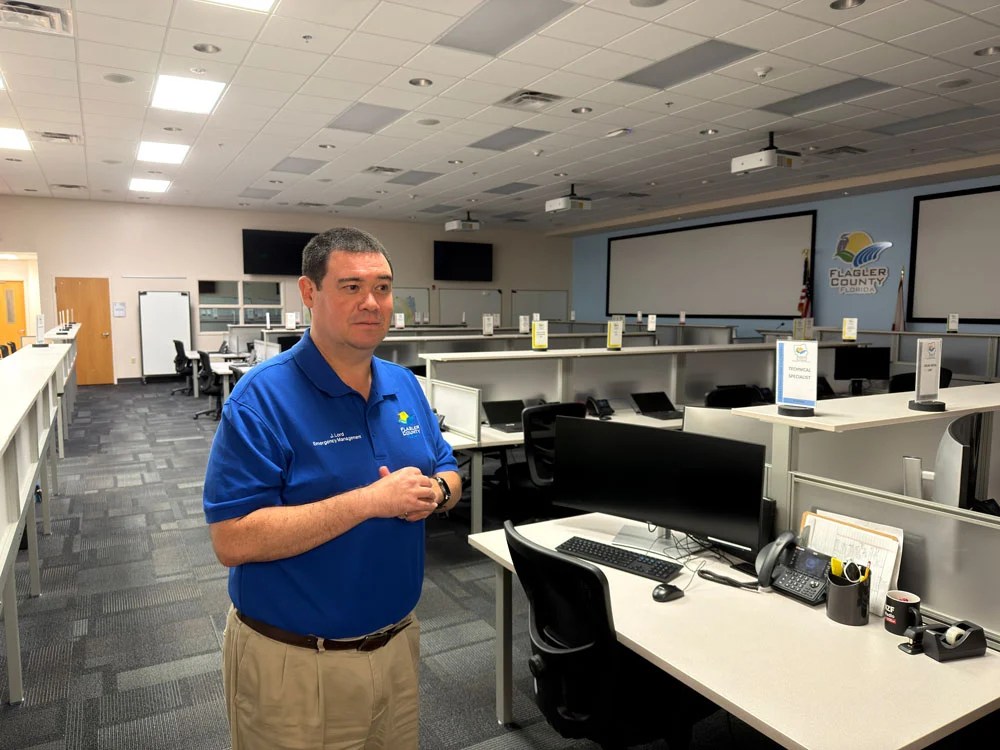
As hurricane season begins, a storm is gathering that may have ruinous consequences for local governments. Unlike the storms that build off the coast of West Africa, this one is human-induced, and took a notable portion of Flagler County Emergency Management Director Jonathan Lord’s annual briefing on the hurricane season that begins today.
On May 7, the 12-person council President Trump appointed to recommend an overhaul to the Federal Emergency Management Agency released its final report, proposing to do just that. The recommendations, which would have to win congressional approval, would make it more difficult for disaster areas to win federal designations, which in turn will make it more difficult for those areas to be eligible for money.
Under proposed rules, a third of the disasters between 2012 and 2025 would not have been eligible for the designation. The financial burden for storm recovery would shift significantly to states and local governments. If, for instance, Hurricane Matthew in 2016 had not been a federally declared disaster, the federal government would not have provided three-quarters of the cost to rebuild the Flagler Beach pier, or 75 percent of the cost of several beach-reconstruction segments. Local emergency management, city and county governments and the sheriff’s Office would not have been reimbursed for storm overtime and other storm-related expenses. Debris removal would have been a fully local cost.
If that had happened with Hurricane Matthew, it would have “wiped out” the county’s reserves, Lord said. The reserves are healthier now, at $7.3 million, but it would not take much to deplete them.
The new rules also propose to shrink the National Flood Insurance Program.
“The burden of disaster cost shifts more to state and local governments and less on the federal government,” Lord said. “So, based on that, my expectation is it’s going to be harder for a community to be cleared for disaster moving forward,” if the proposals are adopted in law.
“I am not a fan of that in any way, shape, form. I’m just being a realist that I think that’s what’s going to happen,” Lord said.
Right now, he said, there is a myriad of programs across multiple federal agencies that residents impacted by disasters can tap into. The review council suggested that the programs all be consolidated into one to make it easier. But it will be harder to qualify for what money there is.
“As we sit today, that has not changed yet,” Lord said. “It takes FEMA, it takes Congress, as well as the President to implement these changes over time, and I don’t assume they would happen right away. But that is what the report is recommending. I think it fundamentally changes disaster funding for the country, and it doesn’t spread the risk out in the same way it used to, so I’m definitely not a fan of that concept. But whether I’m a fan or not, ultimately one of the reasons we have an emergency management program is we need to build the programs and we need to assume that some of these changes are happening and we need to make sure our communities are prepared whether or not the federal government’s there to help us financially. We have to do that as a county government. We have to take care of our community, regardless of the federal financial backstop being available.”
But county funds may not be enough, especially when the second gathering storm is taken into account. That’s the special session taking place in Tallahassee this week. It could potentially result in a proposed constitutional amendment that would either wipe out homesteaded property taxes altogether or diminish them significantly. The voters would have to approve the proposal with a 60 percent majority at the November ballot. If they do, that, too, would not only fundamentally change the way government is funded, but the way it operates. Relying on local dollars for disasters may not be an option.
“I’m extremely concerned about the loss of homestead revenue, not just for emergency management, for every service our community is provided by its local governments,” Lord said, including the cities. As with FEMA, he said, “changing property taxes are a fundamental shift on services, or how services are funded at the local level, and decisions that have to be made by our elected officials of prioritizing services if local tax revenue is not there.”
If the FEMA transformation takes place alongside a reduction or elimination of homesteaded property taxes, a hurricane would be only half the disaster. The other half would be the local governments’ difficulties in meeting the financial challenge to rebuild. Hurricanes are not in anyone’s control. Funding policy is, as Lord notes.
“Our residents, our voting residents, need to be well aware of what those impacts are. Your votes have consequences, right?” he said. “Isn’t that what the elections office says all the time? Votes have consequences. Maybe it’s a good consequence for somebody, maybe it’s a bad consequence. So property tax elimination or significant reduction will have significant consequences, including the ability to fund disaster programs and be ready for disaster programs that are inherently currently funded at the local level throughout the entire state of Florida.”
The bulk of the cost in disaster response is always local. But that bulk is made up in sizable part of property tax revenue. “The folks that are helping rescue people are coming from our fire stations, coming from our sheriff’s deputies and our police departments,” Lord said. “They are local folks that are funded locally. To lose those individuals or have a reduction in those inherently totally changes our ability to take care of ours.”
Homesteaded property taxes account for 60 percent of local general fund revenue. To lose that, Lord said, is a “fundamental change in our ability to prepare and take care of our community.”
Lord’s annual media roundtable at the Emergency Operations Center is typically a repeat of known facts and methods, summaries of planned responses in case of a major storm, predictions by the major forecasters–this year, 13 to 14 named storms, six to seven hurricanes, two to three major hurricanes–and the names of coming storms (Arthur, Bertha, Cristobal, Dolly, and so on.) That was all part of his presentation, too.
So was his customary reminder that the forecasts mean nothing when it takes just one storm to devastate a community. Flagler County has not had a direct hit by a hurricane in decades. That, too, is meaningless, as is the “old wives’ tale,” as Lord put it with understandable hesitation (over the terminology’s old style sexism) that Flagler County is immune from hurricanes. There is no such immunity, he said, noting that the Panhandle thought it was immune from Category 5 hurricanes, until Hurricane Michael struck in 2018.
It is all about preparedness, Lord said, including raising the number of people who are part of the AlertFlagler system that immediately informs residents, no matter where they are, of emergencies–tornadoes, severe storms, a criminal on the loose. (Register here.)
Unquestionably, however, the storm on Lord’s mind is also the potential combined realignment of FEMA and local revenue. As with many storms, the probability of a worst-case scenario is low. But it is nowhere near zero. This cone of probability has all of Florida in its sights, and it is becoming more inescapable by the day.





Belinda says
Here is the catch 22 until we have an opportunity to actually read the final FEMA changes which are law changes and read the final ballot approved FL proposed constitutional amendment and state grant plan we are again putting the cart before the horse. Do not trust the talking heads be they news media, social media, or politicians (federal, state, or local). We need to read it ourselves and educate ourselves. Then make an educated decision on whether it’s good or bad. All the incessant talking and chattering merely upsets people and creates mass confusion.
Most probably the sky is not going to fall regardless of what the chattering people or chicken little says.
Deborah Coffey says
Well, Jonathan, hopefully all the people will actually see that these people they elected don’t give a damn about them, never did, and never will. Hopefully, it won’t take a hurricane to open their eyes.
Laurel says
Oh it will, and the blame game regurgitates.
Joe D says
I HOPE everyone enjoyed the BIG TAX BREAK refunds they got under the REPUBLICAN pushed Big Beautiful Bill (that was SARCASM for those of you who didn’t catch it). Yes I got a bit more money back this year…but nothing great at my retired fixed income level…nothing compared to the upper 1-3% income level tax cuts and the corporate taxation cuts.
I appreciate Emergency Management Director Jonathan Lord’s assessment that we are going to be much more “on our own” with emergency management and disaster relief with all the FEMA cuts and cost shifting to the states of the last 18 months.
Now comes the time WE THE PEOPLE, are going to PAY for those tax cuts in reduced Federal assistance in many areas, not the least of which (for our local area) is DISASTER RELIEF. While in the process of selecting a retirement home (and moving from a state that is also used to flooding and coastal storm risk), I was VERY selective about both WHERE I chose to retire in Florida and the home DESIGN.
I LITERALLY took 20 years to pin down the desired property (and design) I could afford at the time, on my anticipated Nursing Case Manager retirement funds. Flagler Beach provided the desired location, and I was able to find a townhouse facing the beach area, elevated 8 ft off the ground (20 ft above sea level) constructed of POURED CONCRETE and steel cabling ( flexes in high winds better than REBAR), with concrete slab floors and a concrete slab roof. It also has hurricane shutters in place. It was NOT CHEAP! I also plan on adding enough solar back up to ensure BASIC systems (fridge/freezer/ lights/fans, etc.) keep the house functional enough to handle an extended power outage. I’ve survived 5 recent storms with only damage once ( lost the hurricane cover on my roof top HVAC system)…so I’m very thankful at the design. It’s not NEW construction (in fact it’s coming up on its 50 year anniversary). I’m kind of surprised that it’s almost FORTRESS like design wasn’t copied by other local developers. So I’ve tried to do as much as I can do to prepare.
But longer term local area damage ( I remember in one of my first hurricanes, A1A in some areas was snapped in half like a cookie along the center line), is something else altogether. Potential BRIDGE damage, road debris, individual property damage, food and potential water availability long term is a COMMUNITY problem. It LOOKS like we aren’t going to be able to count on near enough FEDERAL RESOURCES in any upcoming emergency.
I hope local citizens and government representatives are paying attention to Director Lord’s warnings ( ESPECIALLY about the FREE ALERTFlagler texting and email emergency alert system that warns of not only Hurricanes, but severe thunderstorms and approaching tornadoes). It took me less than 5 minutes to sign up, and I even get the alerts when I’m 900 miles away visiting relatives (to let me know whats happening back home in Flagler Beach)…there should be 100% participation…but apparently not near that number of participants.
Disgusted and par for the course says
One would think that the powers that be (Palm Coast City Council) would be planning for FEMA shortfall instead of plowing all their time and energy into the “Westward Expansion”.
But then I’m a rational person not looking for votes for re-election.
Laurel says
Flagler County may have not had a DIRECT hit in decades, but we’ve been hit. Not so long ago, I remember furniture lining the streets in Flagler Beach, and before that, just up the road in St. Augustine (St. Johns County) furniture lining A1A. Many homes lost all their trees, as did Washington Oaks State park. Plenty of homes flooded. Insurance skyrocketing. We had some serious cleanup with huge, and I mean huge, piles of broken oak branches. And of course, the pier.
So, you gotta ask yourself, why are the Republican politicians draining help away from you? Draining funds away from you? Where is that money going, are you seeing it in your wallet? What is really going on? We are already paying more for food, shelter and fuel. Meanwhile, politicians, and their families and friends, are miraculously rolling in dough.
Poor Speaker of the House, Mike Johnson, said he cannot live on his $174K salary, so he needs to trade stocks. The market is being manipulated. The corruption is so blatant, everyone knows about it, and it’s no longer even being hidden. We are hearing about how now, one man, with government contracts, can become a trillionaire, yet, as a country, we cannot afford childcare or healthcare. Our governor somehow siphoned $10 into his wife’s project. What happened there?
Strange, isn’t it? Ask yourself, also, is this what you expected when you voted? You will be voting again…will you vote the same way as before and expecting a different turnout?
DeSantisRocks says
It’s interesting one only points at people on the right. Have you actually seen the crazy amount of insider trading, fraud, and outright theft from people on the left? I’m assuming I don’t have to list it all out for you…but then again, you won’t find it on MSNOW or whatever they call themselves these days.
And no, I’ll never, ever, vote for a Democrat again.
Laurel says
You’re a one sided show guy, aren’t you? Try changing the channel once and a while, and see what else is out there.
Laurel says
Two things. Washington Oaks State Park lost all its oaks from A1A west to the current treeline.
“Casey DeSantis received $10 million from a settlement involving Centene Corporation, which overbilled the state for Medicaid services. The funds were directed to the Hope Florida Foundation, which she manages.
Search Assist, healthexec.com, Wikipedia
Koyote says
@Laurel :
Didn’t that 10 million blossom into 31 million once all the trails were followed?
Koyote says
@Laurel:
The 10 million was part of a larger misappropriation – most of which was further channeled into political ads and rallies.
From December , 2025 …
“Gov. Ron DeSantis’ administration diverted more than $35 million in taxpayer funds — an amount far greater than previously known — as part of a brazen agenda last year to defeat two ballot amendments he staunchly opposed, a Miami Herald/Tampa Bay Times investigation has found.”
Read more at: https://www.miamiherald.com/news/politics-government/state-politics/article313630394.html#storylink=cpy
Dennis C Rathsam says
With a great governor, & a greater president, who just happens to live here in FL. Money & Help will be no problems for Floridians ! TRUMP will protect the goose that lays the golden eggs
Jim says
In the face of the Trump administration on the verge of recommending eliminating FEMA, Dennis thinks Trump will save him if/when there is a disaster. TDS at it’s finest!
But move on to the big picture.
Trump eliminates FEMA.
DeSantis cuts taxes on homesteaded homes and no one seems to know where that missing revenue will come from.
Insurance companies are notorious for not accepting claims, reducing claim value, delaying payments or just not paying at all.
So, let’s all be “thankful” we live in a country where we’ll soon have no where to turn for help post-catastrophic event. We’ll be on our own. Those with money and resources will survive. The rest will be wiped out.
You need to really think about your choices in the upcoming elections. They do have real world consequences for each of us.
And so it goes in the Free State of Florida.
Laurel says
As long as there are lobbyists and Citizens United, the average family will be plowed under.
What Else Is New says
Dennis you constantly flag your gums extolling the virtue of the Trump Mafia Organization and Ron Charity Fraud DeSantis. Bless your heart. You can’t name one Trump Mafia cabinet member who is qualified. We have lost our democracy and you celebrate?
Atwp says
So, millions cast their ballots for Fake Trump. Now fake Trump and his brainless helpers is trying to make it harder for people to get help during a natural disaster. Many thought Fake Trump cared for them, news flash he dosent care anybody but himself. Good job voters good job. Get ready and continue to reap the consequences of your unwise decisions at the ballot box.
Atwp says
The 3rd and 4th statements of the article is very concerning. I feel for the poor people and people of color.
James says
Too bad all that money spent on Alligator Alcatraz couldn’t be set aside somehow for emergency hurricane related relief and recovery efforts instead.
Just say’n.
/s
Joe D says
James…
Didn’t most of the “Advanced” payment (to be later “reimbursed” by the Federal government…Ha Ha), for Alligator Alcatraz, come out of Florida’s Emergency Disaster Management fund? Maybe my memory is inaccurate. But if I’m not wrong, we have the POTENTIAL to be hit by a TRIPLE WAMY of reduced FEMA FUNDS, reduced tax revenue dollars (if voters are willing to be DUPPED into believing these Homestead Tax cuts during the Fall election, will REALLY ultimately “put permanent money in their pockets”), and now our illustrious Governor has raided a large portion of a designated FLORIDA DISASTER fund (with LITTLE, if ANY real hope of the Federal reimbursement “promised” by our term limited Governor), for the ill thought out Alligator Alcatraz detention center, now mandated by the courts to be closed down.
If I have the Florida Disaster Fund reference wrong, I apologize, because the money for the detention center money seemed to appear “out of thin air.” It made my head spin, since there doesn’t appear to be much money available for the average day to day needs of Florida citizens ( in my opinion).
James says
Hahaha, yup. 😉
Atwp says
These Republicans are the worse Republicans I’ve ever seen. Most of these people are madly insanely ignorant and crazy. What is wrong with these people? I will never know.
Laurel says
Atwp: They are no longer the GOP, nor Christians, nor conservatives.
Atwp says
Laurel, thank you.