



Clamping its nose from what it considers to be an unsavory decision, the Flagler County Commission voted 3-1 this morning to approve a $20,000 settlement with former employee Samantha Whitfield, the former county human resources manager who sued on allegations that she’d been wrongfully terminated in retaliation for reporting a colleague’s misconduct.
Whitfield worked for Flagler County from August 2019 to July 2024, when she resigned. She sued that November, saying she was subjected to bullying, and when she reported the alleged problems with another employee, the administration did not stand by her. Then-County Administrator Heidi Petito accepted a resignation the administration considered voluntary and uncontroversial. The matter was thought to be closed until the lawsuit was filed.
“Every allegation in this lawsuit is completely frivolous, just balderdash. It is completely incorrect and wrong and false,” Deputy County Attorney Sean Moylan said this morning, addressing the commission. “But it was a claim that’s covered under our errors and omissions policy of our insurance policy.” He also called the lawsuit “bogus.”
Docket sounding–the last step before trial–was scheduled for June 3, and a trial was scheduled for June 15 before Circuit Judge Sandra Upchurch. Pausha Taghdiri, the Roper, Townsend & Sutphen attorney representing the county’s claim, had filed a motion for summary judgment–when the judge could have ruled either in favor of the county, ending the lawsuit, or ruled to continue to trial–on April 16. The motion argued that Whitfield had voluntarily resigned, that she could not prove discrimination, and that her complaint had procedural flaws.
“Prior to the tension in the office,” Whitfield had said in a deposition, when asked why she had resigned voluntarily, “I would have retired with the County. This is my hometown county. I would have stayed here forever. I loved my job. I loved the position. With no issues. So there was never any reason for me to leave. But the — the harassment and the bullying and the — it just — it had made things intolerable, completely intolerable in that office. And I felt like I was — I was not being supported.”
The attorney representing the county had through discovery secured documents, including Whitfield’s letter of resignation and some text messages, that drew a different picture, showing Whitfield to have acted voluntarily, complimenting her colleagues, and speaking of her work environment in positive terms down to an “amazing” leadership retreat on the eve of her last day at work.
Motions for summary judgment are intended to stop litigation before trial if a case is frivolous, as the county says this case was, since there wouldn’t be valid claims to litigate before a jury. It isn’t clear why the motion for a summary judgment was not heard.
The insurer’s law firm on the matter negotiated the settlement as a business decision that would cost the county less than litigating further. “If we were to litigate this through to conclusion, it would cost much more than $20,000 even though you come out victorious, it’s less expensive to settle, as unsavory as that may be, than it is to fight it out and win in the end.”
Commissioner Andy Dance was opposed to a settlement. “It just perpetuates this perception that anything brought against us will be settled,” Dance said. “I understand the positives of it. You get it behind you, you move on, but these types of things can affect future rates.” Moylan said a trial would affect future rates as well.
Commissioner Kim Carney didn’t want to approve the settlement either, but wanted to get it “behind us.”
Dance was surprised that the settlement was part of today’s agenda. It was on the consent agenda–the part of the agenda that normally includes routine items and that commissioners approve wholesale unless an item is pulled for discussion and an individual vote. Settlements of the sort are usually addressed administratively.
Speaking for County Attorney Michael Rodriguez, Moylan said that while previous county attorneys handled such matters administratively, Rodriguez prefers to submit them to commissioners.
“I don’t know that I like it being able to be switched depending on who the attorney is,” Dance said. He is looking for a threshold or “a grading scale, if it reaches some point we don’t settle. Again, I find this a self-perpetuating problem, though, as we continue to settle when we know we’ve got a case, and although it may be more expensive, these will never ever go away.” He asked for a commission policy on how to handle employment lawsuits in the future. The commission agreed. Commissioner Pam Richardson was absent from the meeting.




























Belinda says
Generally if you want insurance, you play by the policy’s rules or pay to defend the suit yourself which is probably an option. However, it then probably negates the policy so not sure that is in the taxpayers’ best interest. If you lose, definitely not. If you win, even if you can recover attorneys’ fees, you cannot get blood out of a turnip. Understand the frustration but that is the way it is in most insurance matters.
Keep Flagler Beautiful says
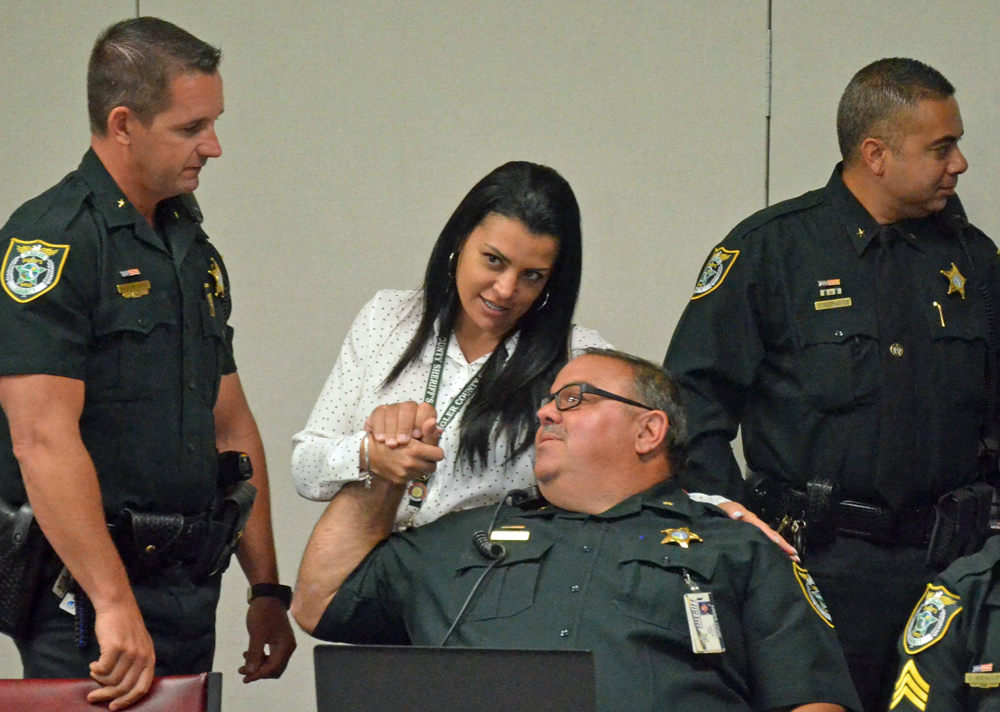
This is yet another example of how taxpayers get hosed in Flagler County, always inheriting the “spoils” from employment mistakes. It’s unrelated to this particular lawsuit or settlement, but I can’t say I love that photo at the top of the page. She doesn’t look “bullied,” does she? I worked at an international IT firm for 20+ years and can guarantee that any close fraternization like that, innocent or not, would have resulted in firings. Wondering if anyone else agrees. I’ll never forget the case of the woman who was paid richly to go away, even given a full retirement package; then got rehired for the very same job immediately thereafter through a headhunting agency that reportedly received a $1 million fee. The “new” hire got yet another retirement payoff to avoid a lawsuit. That’s how to retire rich. Go to work for Flagler County, do a crap job or get your feelings hurt so that either you get fired or resign for some petty reason, and you’ll waltz away with a bag of cash. Insurance rates will surely rise after this payout.
RedOne says
The photo you are referring to is when she worked for the Sheriff’s Department, not the County, for whom she sued. Just saying.
Keep Flagler Beautiful says
Yes, I’m aware of that. I still don’t love the photo or the cozy fraternization it seems to depict.
Tired of excuses says
There is a whole going on up in the offices besides hurt feelings.When some one does a lawsuit they are told not to discuss settlement. How are these commissioners able to discuss and disclose her suit info. They are trying to clean house and fix things
FlaglerLive says
Any legal settlement in Florida government involving public money is a public record. Officials are not barred from discussing it.
Line Stepping says
Not barred to discuss, correct. But not to discuss as “factual” without proper information. As an attorney not on this case, Mr. Moylan let this go too far.
Deborah Coffey says
What a bunch of Donald Trump look-a-likes, do-a-likes. If he can sue himself and settle, we can, too!
Uh-oh says
I am so confused. How is Sean Moylan discussing a case he was not the attorney for? I have many years in governmental law, and I know that’s a big no-no. He should have at that one out. Yikes!
I did a little digging, and anyone read the deposition of the employee named in Ms Whitfield’s Whistleblower case -Anita Stoker? Just my opinion, but that’s the real reason they settled. Not so good for the county! Uh-oh.
Amy Bogard says
How do we see the deposition?
FlaglerLive says
The deposition was linked in the article, and is available here.
We want to know! says
How do we access the deposition of Anita Stoker? She’s the one being accused of accessing personnel files out of her scope of responsibility?
Fun in Flagler says
Commissioner Andy Dance wanted to know why this item was placed on the consent agenda instead of being brought before the commission in the usual manner. The answer seems pretty simple: they may not have wanted the subcontracted attorney appearing before the commission where questions could be asked directly and publicly.
That raises another question: how much did the county pay the outside law firm in legal fees? My guess is that the total bill could be at least equal to, if not greater than, the $20,000 settlement that will ultimately be paid.
Taxpayers deserve to know the full cost of these decisions, including not only the settlement amount but also the legal expenses incurred along the way.
Michael John says
If you don’t defend, the next lawyer just spots an easy target!
If it was a “frivolous lawsuit” defend it so the the defendants and lawyers loose out, set an example to avoid the next
“frivolous Lawsuit”.