



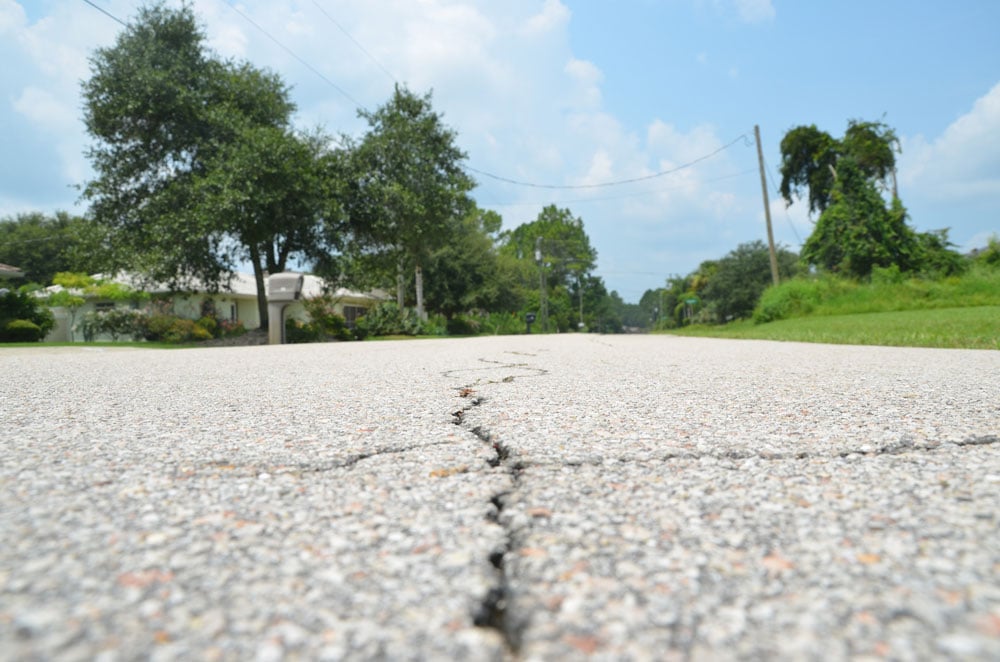
Palm Coast’s 547 miles of roads are deteriorating. A fifth of the arterial roads and half the residential roads are “fair to poor,” putting them on the verge of failing. The city is running out of “microsurfacing” band-aids. It has a $10 million deficit between immediate needs and budgeted funds.
But aside from an extra $1 million a year from the general fund, the council is opposed to any new fee or tax to add to its $2.5 million street budget even though, as its engineer made clear, it is partly to blame for creating the current dilemma.
As he has with increasing levels of despair over the years, Carl Cote, the city’s director of stormwater and engineering, again updated the council on the state of the city’s roads, the cost of the repair bill, some options, and how the city got here.
Toward the end of his presentation, and after much hand-wringing on the council’s part, Cote put part of the blame on the council. He reminded it of the 2020 and 2021 tax rate in effect at the time. It has been reduced since. “In lieu of the rollbacks that council had done since then, if that was dedicated to resurfacing, that would be an additional $8.5 million we’d have in that program today,” Cote said.
“Repeat all that again?” Norris asked him. He probably wasn’t the only one in the room who wasn’t sure he’d heard that much gutsiness from a staffer.
Cote obliged. “The millage dropped about just over 0.6 mills since ‘21,” he said. “In lieu of doing the drop, if that drop was dedicated to resurfacing instead, we would have $8.5 million in this year’s budget added to the $2.5 million. So we’d be at the $11 million, and we’d be just about fully funding the program.”
In case the council still hadn’t heard right, City Manager Mike McGlothlin made it explicit: “I believe the millage suppression long term is a negative factor. And I think that’s what, as an example, is what’s brought us here. We have lost millions of dollars,” he said.
There is so much deferred maintenance that the costs are accumulating: $69 million worth of needed repairs in the coming fiscal year, $116 million by 2031.
On Tuesday, the council again did not agree on a long-term solution. At least not yet.
“We have funding challenges, so we have to figure that out,” Council member Ty Miller said. “Otherwise, we’re just kicking this can down the road. It’ll get to a point where we cannot afford to get out of the hole that we’re digging.” He wants to “have some hard conversations about how we’re going to fix this situation.”
When Mayor Mike Norris reminded his colleagues of the increase in the sales tax that the county had proposed to fund beach protection, he appeared to get support from Miller and Council member Dave Sullivan. That sales tax increase would have allowed Palm Coast to keep a large share of revenue for its own uses.
If the council did not have the conversation Miller wanted, it agreed to a coming workshop discussion about that very subject.
Otherwise, it leaves the city to make do with limited dollars and a five-year plan that would focus on choosing between repaving arterial roads such as Belle Terre Parkway, Town Center Boulevard, Old Kings Road, and so on, to keep them from failing, or putting some efforts into repairing residential roads–or a combination of the two.
“Even with the efforts that we’ve done, we’re still losing the battle,” Miller said. “We’re sticking our finger in the dam and more are popping up. More holes are popping up. Eventually we’re going to run out of fingers to keep it from getting over that point. Our overall [pavement condition index, or PCI] is going down despite all the extra efforts we’re doing in terms of dedicating money from the general fund to this.”
Miller diagnosed the situation succinctly: “The reality is right now, we don’t have the money to fix things properly, and because of that, things are getting worse, and they’re only going to cost us more money in the long run.” But there is no appetite for a costly fix.
“I am not going to advise for any new fees or taxes to pay for roads,” City Council member Theresa Pontieri said. “So we have to figure out what we’re going to do with the money we have. I’m in support of dedicating some current millage towards the roads, but not increasing anything to pay for them.” Millage is property tax revenue. Pontieri is also reluctant to use reserve funds for continuing needs.
Cote earlier had provided a fuller history, going back to before the property tax rollbacks.
The city incorporated in 1999. In September 2002, voters approved the renewal of a countywide half-penny sales tax referendum for infrastructure, with Palm Coast getting 72 percent of the revenue. The council had sold the referendum renewal on the promise of dedicating the money to a 10-year resurfacing plan. By 2012, Palm Coast was getting $2.6 million from its share of the tax. The city resurfaced 50 miles a year.
“After the expiration of the half-cent surtax during the period from 2013 to 2017, there’s a drastic drop in the amount of resurfacing being completed,” Cote said.

Cote’s characterization of the “expiration” of the surtax is incorrect, and his presentation stating a “loss of dedicated revenue source” is mostly incorrect. Yet the council has been operating on those incorrect assumptions, as it did again on Tuesday.
The sales tax never went away. In 2012, the county and the city clashed over the share of sales tax each government would get. The county wanted to increase its share to 45 percent, as it had to build a new jail that Palm Coast would mostly benefit from. The council, led by then-Mayor Jon Netts and City Manager Jim Landon, refused.
So the county renewed the sales tax anyway, but by supermajority vote of the County Commission instead of by referendum, taking away either government’s ability to use the revenue to back bonds. Revenue continued to flow, with Palm Coast getting 55 percent of the share instead of 72 percent, a loss of about $500,000. (See: “Snubbing Voters, Lame-Duck County Enacts 20-Year Sales Tax While Slashing Cities’ Shares.”)
The council could have continued to dedicate the remaining money to the road program, especially since it kept increasing year after year. It did not do so. It was a policy decision to no longer include sales tax revenue as part of the street maintenance mix. Instead, the city is using only revenue from its share of the gas tax and from state revenue sharing.
The city had resurfaced and maintained more than 950 miles of roads between 2002 and 2012. Between 2013 and 2026, a 13-year span, it maintained 350 miles, some of those through band-aid methods.
The council tried enacting an electric franchise fee, which would have more than made up the $500,000 loss. Residents rebelled. There have been three such failed attempts since 2012, the last one in 2023.
An electric franchise fee or a utility tax would have generated millions. It would generate large sums from the planned data center in Town Center and from organizations and non-profits that pay no property tax, such as the school district and AdventHealth Palm Coast. In its absence, the city is limited to property tax revenue, if it applies.
The council in 2023 had actually approved a franchise fee at first reading, conditional on a referendum that would have set the rate at which the fee would apply. “However, the motion was reversed at a subsequent council meeting due to a legal opinion regarding the inability to have a referendum for approval of the franchise fee,” Cote said–again mischaracterizing the matter: the city is always free to hold a referendum. But Florida Power and Light said it would not agree to a rate set by referendum–a legally dubious position, since private companies have no authority over government decisions, but the city did not challenge it.
The city has since taken a patchwork approach to resurfacing, extending the life of its roads through such means as microsurfacing, a form of sealant that coats the road with a tar solution but does not mill or repave it. It can extend the life of a road for a few years, but it is the literal equivalent of a resurfacing band-aid.
“We are running out of roads that we can microsurface,” Cote said. “It adds no strength to the roadway. It gives it a nice black look. Covers up the cracks temporarily.” He added: “It’s definitely a very short term fix. It makes things look good for a little bit, buys you a little bit of time, and it’s limited to residential roads.” The fix may last five years.
Some roads “are falling apart,” falling into ratings of 40, on a 100-point scale, with 100 being a perfect road. The key number is 60: when a road falls below that rating, the road is in trouble. Today, the average rating for the city’s 547 miles of roads is 72.
Meanwhile, the cost of road milling and resurfacing has soared 300 percent since 2005, far exceeding the rate of inflation.
Cote again presented the utility franchise fee and the public service tax as options for new funding. He also presented dedicating a portion of the property tax to the road program, though to do so, it would entail subtracting that revenue from another commitment. Beyond that, the only additional option would be the mayor’s suggestion: pursuing an increase in the local sales surtax.
























MITCH says
WOW – They finally admit that all the funds used for roadways for
Westward Expansion, to support developers, should have been used for
Palm Coast Road Maintenance, to support residents’ taxpayers, residents
that are the FOUNDING RESIDENTS of Palm Coast, those that
made Palm Coast possible with “their taxes” – not those that are not yet here.
AND THIS IS HOW THE CITY TREATS THEIR TAXPAYERS.
– Now FOR Their SPIN, you can’t undo mistreating (robbing) taxpayers that paid for maintenance
Mark says
The roll back of the millage rate is a short-term idea. If prices increase over time, the mileage rate needs to continue at a similar rate to continue funding services at the same level. The only exception would be if new revenue streams are found. The politicians will say, “we’ve lowered your taxes the past X amount of years.” That’s great. Look where where we are now. Also, it’s a lie because residents pay the same amount. Our infrastructure is failing because our elected officials are only concerned with their reelection campaign.
Alternatively, if the millage rate remains the same, it raises the question, have we been overtaxed in previous years? If that were the case, there would be money for these things from the previous years. Therefore, the answer to that is no. The rollback was/is used as a political platform to get elected and remain in office. The roads, water treatment plants, swale maintenance have all suffered due to the incompetence of our elected officials. It would be nice if they considered the people who they represent instead of their own self interests.
JimboXYZ says
Get the inflation in order, all those record profits and nothing for infrastructure. Enough with the taxes to everyone that was gouged 2021-present under Bidenomics. Wasn’t all of this growth going to pay for itself ? Water Utility Bills are up, yet there’s a drought, grow some more is the failed battle cry of a solution. I think there’s plenty of money, greed has always been the problem. Maybe if we weren’t studying trans people to the waste of fraud & abuse that went on during the Biden-Harris years, there would be money for roads, schools, housing, healthcare, energy & whatever else there always is a shortfall for to maintain even a minimal standard of living. Where is all that money going for a month’s worth of road work. They sure as heck aren’t staffing that construction area from the head count standing by the road. Machines doing most if not all of the work ? Let me guess ? They’re running out of road materials on planet Earth again ?
Skibum says
You are so insufferable, dude! Just cannot, will not get all of those Bidin/Harris cobwebs out of that otherwise vacuum space between your ears! Does not matter one iota to you that your convicted felon sex perv protector-in-chief has been in the WH for nearly a year and a half. Not Biden. Not Harris. I’m somewhat surprised you are not still blaming Obama and Hillary Clinton, but at some point don’t you think that your currently worshiped, “do-no-wrong” lying fraudster con man just might possibly be responsible for what is going wrong in the economy, in all of the escalating price increases, in all of the political turmoil caused by the incompetent fauxinfotainment fools he let loose in our federal government?
You want to give the current occupier of the WH credit whenever anything good happens, no matter if he had zero influence or control over it happening, but you sound as if you are his sperm child, thinking he can do no wrong for all of the chaos, fascism, racism and extremism that are his hallmarks, not to mention his complete and total lack of business or economic talent!
Why haven’t you gone to court yet and changed your last name to daddy’s, to better reflect your ignorance… I mean allegiance???
JimboXYZ says
Facts ? The last time Belle Terre was repaved, not mocrosurfaced was April 2020, that was Trump, it was also relatively affordable in comparison from 2021-present. Facts, Trump has slowed the inflation of the Biden era. I get it, Iran has inflation driving up, but who enabled & empowered Iran by funding that war in 2023, Biden ? When were all the approvals for growth done ? Alfin/Biden era. Gotta be fair about where the blame is placed when the inflation kicked in the hardest. Whoever bought into that for 2021-2025, Democracy is that Biden-Harris set the table. Westward Expansion for the increased traffic hasn’t provided the tax base to pay for the roads, 22K new residentials that don’t exist yet = no tax revenue to build & repave decaying infrastructure. Instead of getting to work and building anything more tan filling in wooded lots & wearing down the road surface for 4 years of Biden-Harris. We all have eyes, we watched it, we sit in the gridlock, same roads only worn out from Alfin-Biden Growth. and now they’re just starting to build these over the last 1.5 years ? Driving heavy equipment on the worn out roads of the Biden era that were never repaved/repaired. & if they were repaved, it was prior to Biden and now those roads need repairs. Where did the inflation money go ?
https://www.usinflationcalculator.com/inflation/current-inflation-rates/
Tired of it says
Remember this? https://bidenwhitehouse.archives.gov/briefing-room/statements-releases/2024/11/15/fact-sheet-biden-%E2%81%A0harris-administration-transforms-nations-infrastructure-celebrates-historic-progress-in-rebuilding-america-for-the-three-year-anniversary-of-the-bipartisan-infrast/
What has trump done other than redecorate and start a war?
Laurel says
Made himself, and his family, another $4,000,000,000 while in the office of the President of the United States, in his first year, this time around. His net worth now is $5,200,000,000.
He has sent his “volunteer” son in law, and another real estate developer off around the world in search of other Trump investments, on our dime, but he says himself that he is not concerned about American citizens affordability problem, and there is no way the government can afford childcare, Medicare and Social Security. Time to cut SNAP after the midterm.
Sounds very “conservative” doesn’t it?
i have an index finger for rent says
Finger in the dam is the moral of this whole damn city, lol. It’s the PC Way!
JC says
I know. Let’s put more traffic on our roads. get more people to move here!
Wasred money says
So where is the money paid by impact fees that is set aside for roads & infrastructure ?
Maybe this is the group we want to increase the borrowing power of in the next election?? 😂 😂
Deborah Coffey says
Easy solution. Stop voting for ALL Republicans. This is what they do over and over again.
Atwp says
So people continue to vote for Republicans and drive to work on crumbling roads. I hope the city and the country crumble under Republican leadership. They ok expansion and ignore the need to repair the crumbling roads of the city. Good job Republicans steal from the tax payers and fill your wallets. Republicans are the greedy worse.
Carol DEE says
This is not about REPUBLICANS!! It’s plain to see that those we all elected were NOT about the CURRENT RESIDENTS in PC, BUILD, BUILD, BUILD….. HMMMM We have a lot of homes and an exorbitant amount of apartment buildings… OH BUT WAIT…………….. What about the TRAFFIC ISSUES? What about our HOSPITAL? What about our SCHOOLS???? Maybe the burden should come from their pockets.. If they would have put the burden INITIALLY with a larger IMPACT FEE due to the builder/buyer we would have all of the above taken care of but NOW…. HMMM WHAT ARE WE GOING TO DO??? STOOGES IN CHARGE IN PC!!
Laurel says
Carol Dee: And what is the political affiliation of those in charge in PC ?
Extremely concerned says
Maybe the residents need to hire an attorney and sue the city for not meeting their obligation. Just look at the quality of the average person running for office here. For the most part, we are sadly lacking in experience as well as education. Most have never done a budget or run a business. Elections have consequences.
My street is in bad shape. We have lived here 24 years and it has NEVER been paved. This borders on criminal.
Land of no turn signals says says
I was under the impression that a portion of the taxes on gas went to state/federal/county and city for road repairs.The amount collected in the last 6 weeks should be a major windfall.
Villein says
The roads are like the environment, nobody sees the slow degradation until it’s completely gone. The voters spoke at the ballot box- reduce taxes. But the consequence of that is less service. Infrastructure spending has to be maintained or increased with growth in population. Reducing funds to infrastructure was always going to end this way.
Ask these politicians what services they are going to cut? Because the end of the era of tax cuts without consequences is finally at hand. It’s pretty sad when a rich community like this one can’t even maintain its roads, have adequate parks and libraries, and instead spends all of its money on law enforcement to fight the boogeyman, because there’s so little crime here. And streetlights. Why so many damn streetlights? Nobody is out at night here anyway. It is assinine.
Joe D says
No one should REALLY be surprised!?! Talk of cutting property taxes, rolling back property taxes for homesteaders sounds like money in your pockets…right…who wouldn’t vote for it??
However, simple “quality of life” services ( water supply/ waste water disposal/ storm water management/ roads/ police/fire/ ambulance/parks/ recreation/ beach maintenance) ARE NOT FREE…how do you expect to get those services without the money to pay them….200-300 years ago property owners and community neighbors got together and built those things themselves. Now we pay local elected ( and non-elected) government employees to provide and manage those services for us. Has there been wasted money (probably), has there been some mismanagement (possibly)…but you don’t get these services taxpayers are increasingly demanding, FOR FREE!
So taxpayers need to start attending meetings (even virtually), voicing their preferences for how your money is spent, and let your representatives know your PRIORITIES! You can’t just COMPLAIN, if you aren’t going to help work on a SOLUTION. You also need to PAY ATTENTION to the QUALIFICATIONS, and past BEHAVIOR of your Candidates. Some Candidates will say ANYTHING to get elected! Do your research, get INFORMED on topics. Don’t just vote for someone simply because they say what you want to hear. Don’t just vote for them (or not vote for them) based ONLY on the (R) or (D) behind their name. I’m over 70 years old…I (almost ) NEVER voted a straight PARTY LINE. I’ve looked at the person and their leadership skills and their experience and ESPECIALLY their PAST BEHAVIOR.
People need to WAKE UP and stop the finger pointing ( unless it’s at that person looking back in the mirror), and make INFORMED decisions at the ballot boxes. Your representatives (generally) are TRYING to do a good job, but clearly, you can’t please everyone all the time.
I’m willing to to go out and “buy” my own LOWES POTHOLE KIT ( if they existed), but we REALLY have to decide what we actually NEED, instead of (at least in this current economy), what it would be “NICE” to WANT. Before our infrastructure LITERALLY crumbles underneath us…starting with waste water treatment center #1!
CC says
Joe D. I agree with you re our responsibility as voters to research and know who we are voting for. I would just like to add one comment.
Why did Palm Coast contribute $6 million dollars to the loop road project on private land owned by Rayonier when it is pretty obvious the citizens of Palm Coast are not in favor of western expansion.
I know what I know says
So now the City Directors are the tax and spend liberals. We didn’t vote you in the the Directors position but we can find easily find someone creative that can get more paving done.
That micro surfacing is a great product.
If you crackseal the cracks, and do a double or triple micro surface you can extend the life of 60 And below 7-9 years and for 1/3 of mill and pave.
You save millions now that gets your main roads done and buys your department time and budget.
Think out of the box and stop pointing the finger at the bosses.
Do your job Coates find solutions.
Joe D says
Correct me if I’m wrong, but in prior articles, wasn’t it said the micro surfacing sealer application process could only be used on RESIDENTIAL ROADS, but it wouldn’t hold up to the traffic demand and volumes of the MAIN ROADS? It’s been awhile, and I can’t remember the details exactly, when the resurfacing options were laid out.
Laurel says
You know what: “Tax and spend liberals” here in Flagler County.
Amazing what y’all tell yourselves!
Need a road says
OH. NO !
If the roads get really bad how would we ever get to the Splash Pad ??? 🧐
NJ says
When are they going to increase the length of the left turn lane on Palm Coast Pkwy W to Pine Lakes S? We were told that this project would be Completed before the end of winter! Winter of WHAT Year???
Pig Farmer says
Guess we will all need to buy 4×4 trucks to drive around Palm Coast in the future. Oh, wait…
DMFinFlorida says
Our street (B section) was micro-surfaced several months ago and was quite nice for a FEW weeks. Then the powers that be decided to allow developers to rip up every lot in town and build, build, build. All the heavy equipment coming in and out of the neighborhood just tore up the surface again. I see it daily when I walk my dog. WHY are the contractors not required to repair what they destroy? My family has been in Palm Coast since the late 80’s and came here for the quality of life. Quiet, simple, clean, affordable … We are now just a pathetic shell of what it used to be like to live here. I know a lot of newer transplants think this is Paradise, because often it IS, compared to where they were before. But, for long-time residents, it has been a rapid downhill slope for the past three or four years and our infrastructure is going to collapse unless drastic measures are taken. One of the streets in and out of our neighborhood (not resurfaced) is like navigating an off-road dune buggy race!