



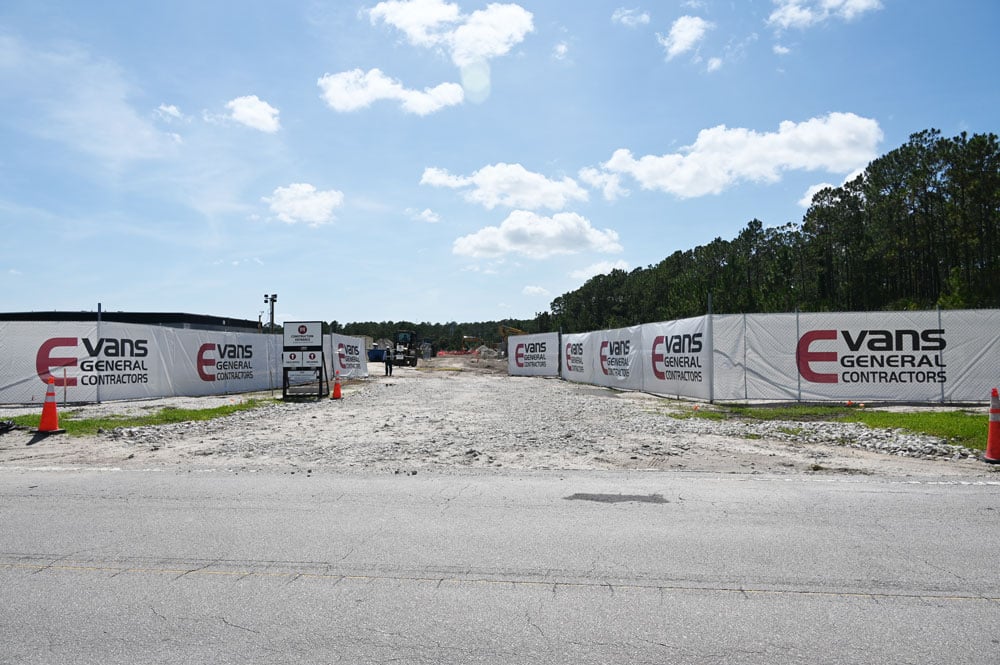
A vice president for DC Blox, the Atlanta-based company building a data center in Town Center, had a stunning surprise for listeners this morning–and for Palm Coast officials, who had no idea–as he described the facility on WNZF’s Free For All Friday.
Free For All host David Ayres asked him how many square feet the Town Center building under construction will be.
“It’ll actually be two buildings that are very similar, built on the same property,” Bill Thomson, vice president of marketing and product management for DC Blox, said, speaking to Ayres on zoom. “Together, they’re about 100,000 square feet, so that’s roughly the square footage of a typical Home Depot, only shorter, because they’re only single-story buildings.”
Two buildings? 100,000 square feet? That’s not the size of the project Palm Coast’s planning department approved when it permitted the site, without review by the city’s Planning Board or the City Council. Had it been 100,000, both those panels would have had to review the plans in public hearings.
Planning Manager Phong Nguyen had explicitly told the company that the plans it had submitted in September 2024, showing a 50,460-square-foot facility, would trigger public review before the Planning Board. “Please address in details the MEP equipment yard because it makes a difference whether your application is approved administratively or going to Planning Board,” Nguyen told the company. The plan included a 13,250 square-foot equipment yard. MEP stands for mechanical, electrical and plumbing.
“Projects that are 40,000 and greater up to less than 100,000 are required to go before PLDRB and projects 100,000 sq ft and greater will have to go before PLDRB and City Council,” Nguyen said in an email to FlaglerLive at the time. The PLDRB is the Planning Board.
DC Blox turned in plans for a 33,760 square foot facility.
That’s roughly the size the city administration and Palm Coast City Council have been referring to again and again since, especially as they have combatted the public impression that the data center will be the kind of large facility that has drawn strong public opposition across the country.
The city just printed rack cards to amplify the point. It lists the Town Center data center as being less than 40,000 square feet. There is no mention of a second building.
There is no mention of a second building in the plans the city provided subsequent to the public record request. Neither the city nor the company disputed a single fact when the article about the facility, its size and its site plan, appeared here on March 26. (“Records Reveal Some Details as Construction Starts On Scaled Down Data Center in Palm Coast’s Town Center.”)
Neither Ayres nor Palm Coast Observer Editor Brian McMillan, a co-host of Free For All, react to the disparity, appearing unaware. (On Saturday, Ayres told FlaglerLive that in his first interview with Thomson two years ago, the plan had always been for a 100,000 square foot facility, so Thomson repeating the number Friday did not surprise him.)
Palm Coast City Council member Ty Miller was in the studio with Ayres and was one of the guests on this morning’s show. He did not flinch when Thomson initially mentioned that there would be two buildings totaling 100,000 square feet. Moments later he addressed the disparity: “I know Bill had mentioned 100,000 square feet, but I think the current approved site plan is between 30 and 40,000 square feet for the first building, I think,” Miller said, “and so potentially a second application would get them to the 100,000 square feet that he’s talking about.”
Phasing in the project as DC Blox and the city have, in effect, has provided another avenue to keep it from public regulatory review. That’s not how site planning usually works in Palm Coast. For example, on Wednesday, the Palm Coast Planning Board reviewed a site plan application for a warehouse on Commerce Boulevard. The project consists of two identical warehouses, each just over 40,000 square feet. The project was submitted as one plan, being one plan.
Miller said after the show that it was the first time he’d heard of the 100,000 square foot plan. The city’s communications director, Brittany Kershaw, had said likewise–as reflected in the city’s own rack card on the subject. Other officials could not be reached before this article initially published: city offices were closed in observance of Juneteenth. But in mid-afternoon Kershaw confirmed that DC Blox is permitted for a single, 33,760-square-foot building. The permit was issued on April 8.
It appears DC Blox had blindsided the city, or at least city officials not aware of undisclosed plans. But it is the city, not DC Blox, that will end up paying the price of a public backlash.
In any case, as Miller noted after the show, the second building will now require public review by the Planning Board and the City Council regardless of its size, as the council is about to approve a change to the Land Development Code that requires all data centers, regardless of size, to have such reviews. But DC Blox’s disclosure could tarnish what goodwill the council had been building with its affirmative attempts to take control of data center regulations. (See: “Palm Coast Fast-Tracks Restrictions and Supermajority Requirements For Approving Future Data Centers.”)
So far, DC Blox has secured the contract for just one cable. It signed a deal with Google for its “sol” cable connecting Palm Coast and Santander, on Spain’s northern Atlantic coast. It signed a deal with Flagler Beach to allow for a total of six cables landing at South 6th Street, paying Flagler Beach $200,000 per cable. (Palm Coast has no such deal with the company.) Once the additional cables are contracted, the second building would go up, Thomson said.
Ayres and Thomson steered the discussion toward minimizing the impact of the facility.
Thomson said large facilities use 300 megawatts to 1 gigawatt. “The data center that we’re building is about 100,000 square feet,” he said, “about 10 megawatts, and essentially that is significantly smaller than the ones you hear about in the news. Generally, those typical AI data centers, or the larger facilities, are 10 to 100 times bigger than the one we’re building in Palm Coast.” The facility will use a refrigerant he compared to an air conditioning system and a water-cooling system that draws water once, then loops the same water over and over again.
“We have a very similar size data center in Myrtle Beach, which right now is pulling about the same amount of water per year as seven average homes,” Thomson said.
Miller has been stressing the difference between the Palm Coast facility and “hyperscale” data centers for weeks, as he did again on this morning’s show, and again returned to its smaller size: “When you’re talking about hyperscale being a million square feet, this is 30,000 square feet, you’re talking about, three one hundredths of its size,” Miller said.
Miller said the company is investing $50 million, which he said would translate to roughly a $500,000 in property tax revenue “to the city of Palm Coast.” In fact, the city will reap only about 22 percent of the tax revenue, the rest going to the school district, the county and other agencies.
The data center is in the Town Center Community Redevelopment Agency, so for several years still, until the CRA expires, a significant share of the tax revenue may only be spent within the CRA boundaries. The property tax revenue doesn’t reflect the significant amount of development impact fees paid the city. But if the proposed constitutional amendment to gradually eliminate homesteaded taxes and lower the cap on taxable, commercial properties’ valuations to 5 percent, future tax revenue will be more limited than the figures Miller mentioned.
There was one other disparity: the city rack card claims DC Blox’s investment is $100 million, not $50 million. Still, Thomson said “the tax revenue per square acre from a data center is far, far greater than almost anything else you can put in a community like Palm Coast. The higher tax contributions are from casinos and from high-rise commercial buildings, so you probably don’t want either of those.”
Thomson appeared to settle the question of whether the facility, officially a cable-landing center, is also a data center. It is: “The reason why we call it a data center, not just a cable landing station, is because we offer co-location space. What that means is local businesses that want to put their computers in a safe and secure facility can lease space and put their computers in our data center, so any new industry or tech companies you would like to attract, it could be any enterprise, it’s not just tech companies that use computers. Any business you’re trying to attract, it’s a benefit to say, ‘Hey, we have a local data center that you can put your computer equipment in, safe and secure, and built for the kind of coastal areas that you’re in.’ It’s also going to attract a significant amount of new fiber networks into the area.”
Thomson addressed several other, uncontroversial and informative aspects of the data center.
“We’re building data centers of various types across the southeast, and that’s keeping us quite, quite busy, along with helping people understand what it is we’re building and why.” Some of those facilities are large and host AI infrastructure. Others, like the one in Palm Coast, are smaller and route internet traffic by bridging undersea data-carrying cables–which carry 99 percent of internet traffic between the United States and other continents–to mainland infrastructure. There are dozens of such cables landing on the Eastern seaboard of the United States.
The cables themselves are “amazingly small,” Thomson said. “Most of the diameter is probably about the thickness of your wrist when you see it coming in, and most of that is just insulation to protect it and keep it from getting damaged.” A single strand of fiber optic cable is barely thicker than a blade of hair. DC Blox chose to build a landing station in Palm Coast because the majority of such stations are concentrated in the Northeast.
It is a matter of diversification and redundancy, in case a cable or a station is damaged. “If that gets cut, that cable operator and the systems that operate data traffic flow can direct it to a different cable annexation over a different subsea cable to get to Europe, so diversity is important for those kind of benefits,” Thomson said.
It also helps as more internet infrastructure is built in the Southeast. Every cable is mapped. The information is public.
Will satellites eventually make land-based infrastructure obsolete? Not so fast, Thomson said. Satellites “are too slow and too unreliable,” Thomson said. “Bottom line, you could never do a Facetime over a satellite.”
Elon Musk’s Starlink wouldn’t dispute that it’s slower, but not so slow as to prevent a Facetime link or movie streaming. Some airlines use Starlink for those purposes. The rapid addition of satellites is intended eventually to shift at least a substantial share of traffic to space-based links. But earth-based fiber optic cables will still carry the bulk of heavier data.
Miller used the occasion again to underscore the council’s efforts to control data center development. “Any future development of what would be quote unquote a data center has to come before city council,” he said. “We can’t receive an administrative approval, and that’s just so that we can look at these projects holistically and see what are good projects and block the ones that are bad projects, so to speak.”
Correction: Bill Thomson was initially mis-identified as Bill Thompson.
That includes whatever plans DC Blox may have for Town Center that it did not disclose until today.

At 8 p.m. Friday, the city issued the following release, titled “City of Palm Coast Clarifies Approved Scope of DC Blox Project Following Inaccurate Public Statements.”
The City of Palm Coast is providing clarification regarding the DC Blox cable landing station currently under construction in Town Center following public statements made during a June 19 radio interview that inaccurately described the size and scope of the approved project.
During the interview, a representative of DC Blox stated that the Palm Coast facility would consist of two buildings totaling approximately 100,000 square feet. That description does not reflect the project that has been reviewed and approved by the City of Palm Coast.
The project currently approved and permitted by the City consists of:
One building
33,760 square feet
Building permit issued April 8, 2026
Construction currently underway
The approved plans on file with the City do not include a second building.
“The City is committed to providing residents with accurate and factual information about development projects in Palm Coast,” said City Manager Mike McGlothlin. “The approved DC Blox project is a single 33,760-square-foot facility. No second building has been approved by the City, and any future proposal would be subject to the appropriate review and approval process.”
Should DC Blox wish to construct additional buildings on the site in the future, those proposals would require separate review and approval through the City’s development review process. Any future expansion would be evaluated based on the regulations in place at the time of application and would be subject to all applicable public review requirements.
Palm Coast’s development review process establishes different levels of review based on project size. Projects under 40,000 square feet may be reviewed administratively if they meet all applicable code requirements. Projects between 40,000 and 99,999 square feet require review by the Planning Land Development and Regulation Board (PLDRB). Projects of 100,000 square feet or greater require review by both the PLDRB and the Palm Coast City Council.
Because the DC Blox project approved by the City is 33,760 square feet, it qualified for administrative review under the City’s Land Development Code.
Additionally, the Palm Coast City Council is currently advancing amendments to the Land Development Code that would establish additional requirements for future data center proposals. Under the proposed amendments, data centers would require a Special Exception approved by a supermajority vote of the City Council following a public hearing process.
The City recognizes that residents have raised questions about the project and has worked to provide accurate information regarding the approved facility. City officials have consistently communicated that the approved project is not a hyperscale data center and that the approved building is substantially smaller than the large-scale facilities often discussed in national conversations about data center development.
The City remains committed to transparency and will continue providing factual information regarding development projects and any future applications that may come before the City for review.
To help residents better understand the approved project, the City recently published an informational rack card that explains the differences between the approved cable landing station and large-scale data centers. The approved DC Blox facility is not a hyperscale or large-scale data center. The rack card is available for review here.
























Keep Flagler Beautiful says
Is this the same Town Center that was envisioned to be a social and retail hub for Palm Coast, with boutiques, coffee shops, art galleries, professional offices, etc.? I’m so shocked that we were lied to and that the anchor is going to be an unsightly, noisy, sprawling, prison-like data center. Maybe we can call in the same outfit that’s going to beautify the “temporary” sewage treatment facility for the new Walmart on Rt 100. Greg Hansen put that idea forward. I think they’re called Lipstick on a Pig, Inc. Our new motto: Nothing is ever ugly enough for Flagler County.
TR says
The area where this data center is being built is no where near the area that was suppose to be the shops, boutiques, art galleries etc. It’s near the end of Town Center Blvd. almost one block away from Royal Palms Pkwy and the overpass of I-95. The closes homes are those new apartments across from the Image school. About 1 mile east of that. However, it should be shut down immediately if the council didn’t approve the side through the planning board. This builder should be thinking it’s better to ask for forgiveness than it is to ask for permission. Unless of course the council knew of the size originally and just told the people what they would except just to get what they wanted. No one can be trusted anymore, sad.
Jody says
Imagine and those apartments are only .4 miles away. The closest hoses in the new development on Royal Palm are .2 miles away. Nearest homes in the P section are .4 miles away.
TR says
Tomato, potato, you repeated the same point except in tenth of miles and I did in comparison to a block. BTW, there are no hoses in the area.
MffEJ says
Directly across Royal Palms is the new Sabal Preseve development. People are buying homes there now and its within sight of the construction. Drive by sometime.
TR says
I drive by there all the time and you can not see the development sight from those homes. Maybe you go try it yourself. The development can only be seen from that side when you get onto the little bridge or the intersection of Town Center Blvd and Royal Palms. Nice try though.
James says
U.S. Geologic survey began in 1980’s of their dwindling water supply with a suggestion to Flagler County to halt building or water consequences could prove disastrous by mid-1990’s. This town cleared out of locals in 2006 after lots of building. I wonder if water quality and affording water a factor for those who left. https://doi.org/10.3133/wri874021
This study was done under 2 or Presidents, back when EPA and water surveys cared. Your water quality and capacity for water was studied by geologists to help Flagler County plan best. Palm Coast took over providing all of Flagler County with utilities. County planning Board needs to be involved in a public review of expansion plans of this industry. Or the County could be sued for the City’s decisions. Decisions that affect everyone’s water. Wells may dry up far from this industry because the County gets water from basically the same place, north of the county. I lived in Cape Coral which hikes all other bills on the people due to one mistake made in the 1940’s: They dredged canals and ruined all of the fresh water aquifers. Cape Coral bought water from other counties for years. When big growth happened, they built a Reverse Osmosis system that runs underneath the Caloosahatchee River. Because they have no water of their own since in the 1940’s they wanted to sell land on canals, ruining all fresh water supplies. Today, impact fees are huge, the current people pay for tue irreversible mistake made in the 1940’s, water must be monitored and upgraded often, a whole team of attorneys is needed for the City to face its water challenges. Wherever people think housing is cheap, in Florida, many other things become expensive. The more people who move to this town or to the State, the more disaster there will be when major hurricanes strike. Population density on what is was a watery swampland has become such a problem. Lack of natural resources lack of water supply, lack of new infrastructure like pipes make things easily breakable. This is why our insurance bills are so high and pricing people out of their homes. We don’t have mountains north of us from which water can flow. Dams, hydroelectricity, desalination plants could have been built while cities like Naples quietly invited up to 25% of to their population to work from home in Naples. 12% of the population across the U.S. worked from home for companies steadily before 2019. No one could have predicted people would buy private airplanes to fly back and forth to Florida in 2021-2024. No one could have predicted The inability to provide things (like garbage removal or storm and wastewater removal) in many cities is from overpopulation. Cities quietly recruited work-from home types with campaigns to get people to move to FL over a few decades. Then International people were encouraged to come to “The Free State of Florida.” Nothing is free and we had severe lock ins, no visiting parks no beach time for many months, no entry to Florida, mandatory testing, mandatory proof to work, no churches open, no reliable school or guaranteed right to speedy trials by jury of peers, Off-on schools for 2 years in Florida. 20% never came back to those schools. But we still pay for 20% fewer students. Nothing and nobody is really free in a state high in hurricanes floods, fires, tornadoes and lightning. I taught the school curriculum in science: Florida is the lighting and tornado capital of the U.S. It does not feel freeing. It changes how you live life. After a population boom, recovery still in Florida from hurricanes floods and damage, now certain people think a tech boom is a good idea? Tourism will drop. People want to visit Florida natural beauty or the big theme parks. If councils destroy nature’s beauty with more buildings, they destroy our #1 and #2 economies supporting the people of this state: Agriculture and tourism. There will be more and more regulations and laws to keep orderliness.
This is just an opinion not facts from someone who lived the aftermath of hurricane Ian, Matthew and others. We were told after hurricane Ian we will
all bear the burden of higher electricity and higher car and property insurance equally, no matter where you live in the state. I think bad faith companies who say one thing and do another should not be encouraged to expand. They should be told the truth about Florida’s water problems even without Data Campuses. The council should have “good faith” to tell the truth to companies who need water that we do not have. My friend cannot sell her Halifax Plantation home because water pressure is so bad, you can’t get much of a shower. It was like that from the beginning. I think it is an 800K home they can’t sell due to KNOWN WATER PRESSURE ISSUES.
Dimitri says
Yes imagine… people can move from the apartments when their lease ends. .4 miles away is a long way away, there will be zero noise from the Center at that distance.
Gwen Mccarthy says
Gosh, that area is a beautiful area with the big lake that has a large population of egrets that like to sit in the trees there on the lake. I wish they could’ve found a different place.
James says
Someone mentioned it’s in the middle of nowhere. It’s in the middle of where everyone lives. These Centers pollute for 5-8 miles for those with breathing issues. Palm Coast gets windy so I suppose it depends where downwind you are from the fans/turbines. They have silent frequencies that people can’t hear but drives pets and animals crazy. Noise frequencies are known to affect the human body. So do electrical frequencies. People are selling homes due to this issue entangled with water/electric hikes. I noticed the water plan included keeping clean water running 24/7. Who thinks of this? Not residents. The deal was to keep clean water flowing 24/7 to cool awesome computers. This campus is connected to Myrtle Beach, another retirement haven. Retires are easy to prey upon. We will all pay for these building’s needs. Watch them blame it on people growth. PC already receives minimum 20M in revenue for water per month. The Reverse Osmosis tower must be very expensive to operate. It’s no coincidence this larger scale campus was in the works for a long time, time enough to plan to hike our rates for water and electric just before the campus gets built. Phase I or Phases I and II are on Roblox’s website with one city council person’s statements on the PC campus’ website. The campus is in the middle of town, thus Towne Center. The Canpus gets the best while a company who bought land near there 19 years ago is denied water and wastewater because “We don’t have it.” That is why the city is being sued. More lawsuits to follow if nobody else in the Towne Center who owns land can get water/waste. It’s reserved for one preferred client only, preferred more than residents or current owners if land in the County. I wonder if DC ROBLOX did any studies that here in PC Florida we really do not have much water and we can’t meet their needs. Another lawsuit? ALSO THE WATER IS NEVER COLD IN FLORIDA SO HOW CAN IT CAN IT COOL? The whole thing is an example of putting many machines well being over population. If the Campus does not get all the water it requires it can sue the City for a lot. There is mo water underground. This County was warned in 1995 by U.S. Geologic Survey to stop building buildings, halt progress or your water will be contaminated.
Dimitri says
How do Data Centers pollute for 5-8 miles…. your answer will be absolutely a laugh. Please entertain us. Data Centers use the exact same thing you use at home to turn on your lights, it is called electricity and last time I checked it does not pollute for 5-8 miles. Some of you just post nonsense. Please read up on what a Fiber landing site/Co Location data centers are all about. Let me guess, you have protested at the Walt Disney World huge Data Center.
Dimitri says
What do you know about data centers? I worked at Walt Disney Worlds data center for years. 1) It does not look like a prison 2) Data centers are not as noisy as the near by airport 3) A data center will bring higher paying tech sector jobs to the area which are desperately needed in Palm Coast. Stop reading what other say about data centers, do your own research and learn what they are all about.
Jim Netherton says
all so you can have dirty water and pay twice as much for power. END GOP TERROR
Dimitri says
What does this. have to do with building a new data center/Fiber landing spot? Politics should not have anything to do with this new local investment into the area.
Skibum says
Here we go! If people thought it was only the housing developers who would lie and scheme to get their paws on the undeveloped land and their crooked hooks into city and county officials in order to get their way, whoa boy, just wait!
Nobody anywhere in all of the numerous news stories I have seen are at all happy with the humongous, noisy, resource sucking data centers that seem to be popping up in every community. Unless local governments put the clamps down NOW and closely monitor for compliance the ones like this one right in our own town center, it likely will end up being mayhem on a nuclear scale!
HayRide says
Noisy, huh have you acutally driven by the location, its actually in the middle of nowhere. The only problem is people moving in without research, like the lady at the end of the runway and complains about touch and goes. She wants to create a petation to shutdown the airport, but didnt spend a day there before buying a house! Shes been told many times by others that the airport was there previously and to let it go. people will have do their research before moving where near the buildings. WHICH DONT MAKE ANY NOISE !!! HOW MUCH NOISE DOES YOUR HOUSE MAKE?
Skibum says
If you believe the nonsense that these data centers are whisper quiet and don’t create noise from all of the equipment installed to keep the inside air temperature at a low level that is necessary for the many heat producing computers that are in these buildings, you are the one who hasn’t done your research!!! All you have to do is google data center noise complaints if you have not seen the many news reports of communities up in arms, complaining loudly about the noise pollution from nearby data centers.
Now, to your other ridiculous comment. How much noise does my house make??? What are you even talking about! Obviously you know NOTHING about this issue, and you would have been much better had you kept your comment to yourself and let others only wonder if you were an idiot rather than write what you did and remove all doubt. Do your research before making a fool out of yourself!
Gina Weiss says
The first time I’m saying THANK YOU to SKIBUM! Couldn’t have said it better. By the way the foreign student flight school mills were snuck in like this data center.
Laurel says
I know this is off track, by I have some sympathy for those who are upset with the flight schools. Not a lot, but definitely some.
Those planes drone over the Hammock, often three at a time, all day long, and into the night, day after day.
I step outside in the morning, and there they are, droning. I step out of my car in Flagler Beach, and there they are. I walk out in Palatka, and guess what?
I used to live very close to Palm Beach International, and never heard so much droning! The planes took off, and went straight east over the ocean. Done. That is until dipstick changed the flight path so the route would no longer go over his billionaires private club.
It all takes some getting used to.
Oh, by the way, the Lantana flight school (or was it Hypoluxo) is where the 911 hijackers learned to fly. It is said they weren’t interested in learning to land.
Skibum says
Thanks, Gina. I don’t disagree with you, and I never was unsympathetic to the many voices who spoke out against the flight school student pilots and the increased amount of noise they generated around our local airport, however acerbic my previous comments might have sounded.
My point has always been that people’s voices in our community have much more authority and ability to enact their will as well as positive changes in local government decisions than they ever will trying to have the same affect on a federal agency like the FAA around airport noise pollution. Even local governments have a very difficult, uphill battle trying to address issues pertaining to airport regulations, especially for airports that have been in place for many decades.
Data centers, however, are an animal of a different type. Not only are they just now becoming commonplace, they are required to obtain local government approval before placement and construction even begins, so our combined voices have great effect on whether or not they will get approved, and how the end result is supposed to look. This data center at the center of attention here in Town Center appears from what I can see to be in violation of the local agreement and rules when they applied for the necessary permits, unless city officials are blatantly lying to all of us to cover their own rear ends.
Gina Weiss says
Skibum: Now they are blaming the marketing lady that she was not
on the same page as the rep from DC BLOX which is total denial and BS!
This is why I have no trust in any of them , they need to BLAME someone
instead of taking accountability, it’s their job to know and to be the watchdogs
and gatekeepers of Palm Coast. A video was made by Ronnie Ward that
blames her in the end. Has nothing to do with this lady, getting the right
approvals, permits has all to do with this! IMO the rep from DC BLOX spoke too
soon and this was the intent all along but if we were told they knew there would
be massive backlash.
Gary says
My cousin lives next to one of these s-it stains. Constant hum. 24/7. Light pollution. Dropping home values. Wildlife disruption. Live by one then, go for it. Have the time of your life.
James says
They plan on at least 4-5 of these data centers on their PALM COAST DATA CENTER CAMPUS, built on over 20 acres, to accommodate long term growth. Oh, this is just phase 1! Our streets will be torn up all the way to the beach. Deer and animals will be running away and car accidents, traffic. Just wait until they find out their only tenant backs out of a lease! Spain is not AI or American friendly right now. Spain has shut American Tech out! Spain has developed millions in fees and fines set up for any American tech company. If they allow Meta to hook up. Spain has their own version of data centers. AI companies from US have spent 20-40 billion in lobbying Spanish govt. to connect in Spain. Spain is going to protect their children under 16 from unlabeled AI content. Tech bros don’t like this because they want the kids hooked.
In the rest of Europe 50% of businesses are asking for EU only technology or using their own T-1 lines, own cloud services, and they have their own OpenAI developed in France. Europe does not use AI technology defense contractors unlike the U.S. The Palm Coast campus is to bring fiber optic to Europe to SE U.S. and Bermuda. We have ATT fiber optic, etc. Bermuda is owned by U.K. and they collude with Spain in heavy regulation. De Regulation in U.S. never leads to prosperity. It’s up to local governments and ours began a hyperscale in smaller buildings. Watch PC company them buy up land around it to allow for expansion.
Dimitri says
Stick to skiing and leave high tech to those that have first hand knowledge on the subject…. But some people are happy having only low paying jobs in Palm Coast.
Dimitri says
Go give your oak tree a big hug for me. Such nonsense being posted. You act like Data Centers are something new however they have been around for decades.
Dennis C Rathsam says
Tell em you know Teresa.
Harvey Citizen says
Well looks like the clowns at City Hall pulled another fast one on the Citizens of Palm Coast. I wonder how much they got paid under the tables for keeping this hidden behind all their B/S. Everyone at city hall should be fired from the planning board and the council that let this happen. Completely incompetent. Total ignorance on their part. Drain the swamp at city hall. Enough is enough
FedUp says
Someone needs to look at each planning board member’s credentials and work experience. I’d bet none of them are qualified for the position they hold. Looking in from the outside, they are all incompetent. Of course, that is the makeup of the entire City Hall.
m thompson says
Gee, sounds similar to when Veranda Bay decided to split their huge project into two separate ones to minimize the scale of things for an approval. That resulted in two huge, over-the-top developments that will destroy the land demographics & it’s residents. Flagler Beach, Palm Coast, Bunnell…….ALL of Flagler County is going to shit!
Wonder if Mikey Chim the power developer attorney with all the loophole info is representing them too….hmmmm
It’s all a smoke & mirrors stunt promising to generate millions of dollars for the betterment of the community. It won’t stop until there is no more land here to destroy. People’s lives & property don’t matter because they don’t live here & they don’t give a rat’s ass.
skiddelydowap says
Wait, didn’t one of OURS go to Veranda Bay recently???
Dimitri says
At least they will not be building the “Promised” River Club and Marina at Veranda Bay… They can not hardly sell any of the slips at their other project. Also ask the developers about the “5 years to build” lie they spew. We are currently at 8 years in our Sunbelt development community and still have have of the lots not built on. As I have been saying…. Do not buy because they always lie.
Pogo says
https://www.youtube.com/watch?v=3z0t11MrlHo&list=RD3z0t11MrlHo&start_radio=1
Ed Danko, former Vice-Mayor, PC says
This is unheard of, a total embarrassment to the city staff, and a slap in the face to our citizens. If I were still Vice-Mayor I would insist on an emergency meeting and make a motion to bring this project to an absolute screeching halt. At this point I have no trust in DC Blox. City Council needs to grow a set, and firmly stand up to this disrespectful and dishonest deception. Mr. Thompson Data Center should not be built.
Jim says
Too late, deals have been made long before and everyone knew this backlash would come and in a couple weeks no one will care. I love how they keep repeating “no new data center permits will be issued” when they only wanted this one.
P Spagnolia says
Stop using the title former Vice Mayor. You’re history! Nobody really cares what you think. If they did, you would have been elected to the FCBOC.
All of this DC Blox was carefully crafted by MAGA City Council members and key city staff. Remember, the term accountability does not exist in government. If it did, heads would roll, and staff would be terminated. Not gonna happen!
T says
We the people do not want it here or anywhere go to hell
Dimitri says
Speak for yourself. What experience do you personally have involving data centers? Some people like you prefer low paying jobs like food service and hospitality. People cannot afford to live on those wages, tech jobs are much better paying, people should be happy that PC is finally getting some high tech in the area.
john stove says
City officials were “blind sided”?!! Oh no, you mean the people we pay and give money to to regulate and issue permits were “blind sided”…..oh no!!
Vote YES on reducing property tax….these buffoons in the City are a joke and are letting anything go in the city. No taxpayer money to review plans and issue permits?….good, then no more development.
Don says
It would be great! If David and whats his name from the observer would stop their Bullsh-it and trying to purswade residents here for what they think and want. Both of these media personalities
Think we care what they think.
Many orginazations here in flagler have
Their owen little club, the Tiger bay snob club. And they act as if they are concerned obout the general public! But they have ulterier motuves to enrich themselves.
FedUp says
What a cesspool Palm Coast has become. Shame on every person responsible for this debacle. They will lie to save their asses and political career. Wait and watch.
FedUp says
Wake up, people, Palm Coast is selling its residents a lot of B/S, and they have been for decades.
Richard Station says
Why don’t you leave? All you do is complain about it here
Jeffery Cortland Seib says
This back door, ambush by the data center people is just what we don’t need here in Palm Coast, now or ever. It sounds like any application or information this place supplied to the city planning department was completely arbitrary, optional, and to make matters worse, false, and then they get on the radio and tell the truth? Palm Coast just got bamboozled. We should immediately ‘pull the plug’ on this, but who would do that? The planning department or how about the city council member that has been talking up the miniscule size of this place or all the residents commenting the same? We the people were let down by the very officials we count on to look out for our issues first and foremost. I hope this isn’t a common behavior going on in city government.
Dimitri says
Please list your reasons on why Palm Coast should not have a data center…. this ought to be a fun read.
Dimitri says
Why are you against Cable landing sites/colofication i.e. Co-Location data centers?
JimboXYZ says
Tell them “NO” and they’ll sue like the Homebuilder’s Association & whine about having to pay a real figure for their impact fees ?
BIG Neighbor says
I’ve got to wonder what is the ultimate net effect on land use is terms of jobs and prudent use of resources? Is there an exit strategy for the types of facilities? Will they be the new rust belt land sore as soon as another technology makes these support centers obsolete?
The dude says
Sounds like they adhere to the trump way of doing business…
In the off chance any of you are local contractors, and they contact you for services… bid twice as much with 100% down. You have been warned.
Laurel says
The Trump way is no bid contracts.
True says
Taxpayers and voters all said we did not want this Data Center in PC and as you can see as usual the City of PC Officials totally ignore that request. City Officials in PC are destroying this town and making it unsafe for our future. No wonder there are so many houses up for sale, people are getting out of here.
Dimitri says
Not all taxpayers and voters said no to data centers…. only those that have zero idea on what they are and what they do are scared of data centers.
celia says
What a shame city and county officials “specially staff and administrators” lie after lie to the residents taxpayers! Administrators lobby for these disasters special interest.! We are so fed up! Also city engineering and utility official expanding a utility south of Rte 100 with over 10 millions cos to help developer, destroying and rebuilding a beautiful 4 lane White View Parkway in a growing city from 4 to two lanes based on frivolous excuses causing havoc currently in traffic at a bunch of millions cost as well and now PC utility with Cote at the head asking for bids that go beyond 10 millions to expand sewer reclaimed water and water to Marineland if all things? Meanwhile the neighbors in FPD deal with sewer backing and gargling inside their bath tubes and toilettes all the time and a sidewalk has been blocked by the utility for as long as weeds are 2 feet tall by the yellow tape and our many neighbors get flooded over city staff allowing builders to backfill infill lots so high surrounded by existing homes that after that are flooding for the first time in decades and city expect that giving away dirt for free will resolve the flooding! Stop the lies and held accountable for damage done and fix the problems that city past elected and staff created.,. What a shameful lie this Data center approved without the public approval based in minimal footage and once approved they build it 3 times bigger? Like multifamily near White View was told to neighbors will be 2 story high and now look finished higher causing backyard floods to nearby small affordable brand new homes!. Money talks.
celia says
Now this Data Center lie but nothing new as dirty dealings been going on for a while in our county and they witch hunt openly causing serious financial damage and defamation of character to the intended whistle blowers:
https://votersopinion.com/2016/11/27/the-dirtiest-little-county-in-florida-starring-tallahassee-lawyer-mark-herron-part-2/?fbclid=IwY2xjawSjWAdleHRuA2FlbQIxMABicmlkETFFUWV6NUdYSDhSYUVtd0FOc3J0YwZhcHBfaWQQMjIyMDM5MTc4ODIwMDg5MgABHi0qOHcpD2O9X-GTxRY7Flj2Mp5N0JbIkQIAEONXFtga7xRQKs9OrxsK4Ct5_aem_pQyRIA97PJMd_8FDArJKkw
Koyote says
Celia :
Interesting article, thank you.
As a side note, you may want to look at the website : https://www.shorturl.at/
it allows you to enter a long url address (such as your posting) and create a short one – much easier on a news board :)
For instance, your link becomes : https://shorturl.at/qhULb
but still goes to the same webpage:)
celia says
Thank You Koyote for trying to help me. I am not an expert online user. But use it plenty anyway to fight for our quality of life, safety and value of our homes since 1991 that I arrived in then Palm Coast Paradise.
Scott says
We need to remember this deal come election time. Some people need to be voted out of office for letting this happen and doing what appears to be sheisty dealings. Someone is getting kickbacks all day on this corrupt deal!
Stooges says
I guess the joke is on us.
Just like the Compass Hotel by Margaritaville.
Just add another floor, threats of ongoing lawsuits, make the county/city bend at the knee.
Here we’ll just add another building, threats of ongoing lawsuits, once again, bend at the knee.
And you want me to vote no on homestead exemption?
What a bunch of spineless money grabbers.
By the way,
Have we ever recovered the $720,000.00 that some bunch of idiots sent to a scammer?
Anyone fired?
Anyone take responsibility?
Sorry, I’m just fed up with the incompetent leadership, day after day.
When the law passes, I say we cut salaries of the leadership in HALF before we layoff anyone
Lyn says
Key concerns regarding the DeSantis Property Tax Reduction bill include:
**Slashed Local Services: With significantly reduced ad valorem tax revenues, cities and counties may be forced to cut essential public services like fire rescue, police, road maintenance, and parks.
**Higher Fees and Alternative Taxes: To make up for massive budget deficits, local governments may implement or raise non-ad valorem fees (e.g., stormwater, garbage pickup, and utility bills). They could also increase property tax rates on commercial and rental properties.
**Increased Rent and Housing Costs: Because the legislation limits assessment increases on commercial and non-homestead properties, overhead costs for landlords and businesses could rise, potentially resulting in higher rent for tenants.
**Uneven and Delayed Benefits: New residents to the state face a mandated five-year waiting period to receive the tax benefits, a restriction that critics argue is unconstitutional; and, will likely initiate lawsuits.
Laurel says
Lyn: Add to that the loss of home rule. At that point, locals will really learn how big decisions will be up to the state, and the locals will be yelling at a brick wall.
Dimitri says
Lyn, When you have retired and your home you live in is paid off in full…. Tell me how you feel paying “Rent” to the tune of over $14,000.00 a year in property tax for something you are supposed to own outright. Add HOA fees and insurance and it costs well over $22,500.00 for us to live in a house we have paid off.
Carolb says
There was a lot of “tap dancing”, double-talking, and “back-pedaling” in that studio on Friday! Snake oil salesmen, hucksters and just plain BS artists come to mind.
This project should immediately be halted and the corrected plans submitted for approval under the new guidelines.
This is a “bait and switch” and should not be tolerated.
But the bridge says
I’m going to the next council meeting.
I have a bridge in Brooklyn I will sell these clowns to use in westward expansion
I’ll sell high price & then they can pay to move it ?
Will see if I’m as good of a talker as these lying developers?
Gina Weiss says
Once again , thank you Pierre for the excellent reporting. Knowing
is power to all citizens.
Gary says
What the EFF!!!
Wake up ELECTED OFFICIALS! Push back. Who wants this? Who the hell wants this? This is unacceptable. The constant hum. The constant light pollution. The wildlife disturbance. For what? FOR WHAT? So people can ask ChatGPT how to make spaghetti carbonara? To make a picture of a dog in a dress? JFC! This is our community! We elected you people to represent ALL of us! Do your effing jobs!!! This will destroy home values and the community. This is shameful. All you elected officials should be forced to live next to this monstrosity. My question is, what did the city spokeswoman know and when did she know it? When she LIED through her teeth about this project from the very second of its conception? G-d da-n ALL of you!!!
Steve says
More like Surveillance centers from what I am learning in my research….
Clemons says
Vote Republican and pay the price. They only care about lining their own pockets and will destroy this state for money. FAFO
Accountabilty says
Can we sue them? I’m just wondering how to stop the madness!
Laurel says
You want to stop the madness? Tell your neighbors to vote differently. The Republicans are in total control here. They dangle unicorn futures and pots of gold at the end of the rainbow, such as no property tax, and private and school vouchers, and it attracts more people to this state, and this area, and they don’t know the local nonsense that’s happening now. They’ll just see the “R” by the name, vote for them, and the madness continues. Why the hell else would the likes of Chong and Furry be running again? Same old crap, new day.
Gina Weiss says
What happens if this data center goes out of business in 10 years, is this
going to be another abandoned building left behind as they leave environmental
hazards? Was there any provision made for the mediation of the
site, a “Performance Bond”. We the citizens want to know.
Keep Flagler Beautiful says
One more thing to consider: The Environmental Protection Agency’s proposal to fast-track the growth of data centers at the expense of the health of people and wildlife will allow data centers and other polluting facilities to begin construction before undergoing air pollution reviews. This means developers can cut down habitat and install electricity lines and pipes before determining how the project will impact the environment and nearby communities, or letting community members have a say. National Wildlife Federation is circulating a petition and inviting public comment. I don’t think a hyperlink is allowed here, so I would just refer you to NWF (National Wildlife Federation).
Kernel Bingus says
What are the building for?
Keep Flagler Beautiful says
Today our HOA sent out a 5-page PDF from St. Johns River Water Management District declaring a “Phase III Extreme Water Shortage “in response to ongoing exceptional drought conditions, declining groundwater levels and reduced surface water flows across northeast and central Florida.” It directed all water users to adopt austerity measures like I’ve never seen before and cautioned that if drought conditions persisted, we should prepare for the possibility of “additional restrictions.” Our lawn is burning up. I wish I could attach the PDF so everyone could read it for themselves, but the bottom line is, HOW will there ever be enough water to support the planned data center (even if they do reuse water through a loop), other commercial businesses, and the massive housing developments that have been so foolishly approved in Palm Coast and surrounding areas? The 25-year Kolter development on South Old Kings Road, which NEVER should have been approved, is going to be a water hog that Palm Coast absolutely cannot satisfy. Flagler County residents raised the alarm and protested every one of the developments that they knew would be unsustainable, but zoning board members and commissioners paid no attention and even made it clear that they wanted us to speak for our 3 minutes, then get lost. Now they realize they’ve painted themselves into a corner, because there’s only ONE water source, and when it’s depleted, that’s all, folks.
Dimitri says
Data centers are cooled using “Chillers” which are closed loop and do not use a continued stream of water. Dan some of you just like to hear the sound of your voice. Research before posting your comments.
Skibum says
Loudoun County in Virginia apparently has more data centers than anywhere else in the nation. That area has been referred to as “Data Center Alley”. The increasing proliferation of data centers in Virginia, Texas and many other states have resulted in communities up in arms over several issues that are making these sites the new “hated neighbor”, primarily because of 24/7 noise pollution as well as the huge amount of electrical energy and water consumption that these buildings must suck up around the clock to cool all of the computer servers inside so they don’t overheat and shut down.
There have been so many complaints in many communities, including Loudoun County, that data center owners have started touting new, off-grid data center construction projects that are supposed to have alternate energy sources so they are not a drain on the electrical grid. There are an increasing number of these data centers that have installed a bank of natural gas or diesel generators to power the servers and the necessary cooling systems. I just viewed a news report on one such location in Loudoun County with a number of interconnected diesel generators outside in an enclosed fence attached to the building. Residents now are the unfortunate neighbors to constant, high pitched jet engine type of a whine as if they are very close to a commercial jet at an airport!
It seems that with these data centers, especially the bigger ones, residents have traded one bad consequence for another.
Here is one such news article regarding the Loudoun County, VA data centers:
https://www.nbcwashington.com/news/local/northern-virginia/neighbors-raise-concerns-about-noisy-data-center-in-loudoun/4080249/
Dimitri says
Ski, you are way out of line and are talking about something you have zero working knowledge of. Data Centers do not use endless supplies of water, the chillers used to cool the inside of a data center are used via a closed loop, not endless supplies of water. As far as noise goes, the noise inside a data center is much louder than outside. As far as power goes, the local power supplier will build a “Sub station” on site to supply the center with power that will not affect you in any way. Stop being a fear monger and get educated on the subject. I come from a long history of building and working in Data Centers across the country including WDW’s Data Center.
Keep Flagler Beautiful says
You pontificate as though you have some sort of vested interest in the proposed data center, or data centers in general. The “closed-loop” solution is not as clean, simple or all-encompassing as you say. Too much involved to go into here. Members of the public should have been given the opportunity to comment before the fools in Palm Coast approved this project, but we were not. I doubt the legality of any decision of this type being made without public comment, if for no other reason because of its impact on the nearby homes, surrounding native environment and wildlife, air quality, noise and more. The Palm Coast commission is accountable to the taxpayers and other residents and therefore must rescind their decision until such public comment can be heard and considered. It should not be up to FlaglerLive to do their job for them. Pathetic!
Skibum says
Dimitri, I am commenting after seeing numerous, valid national news reports, and reading multiple articles and resource material subsequent to previously doing my due diligence in making myself as knowledgeable as possible about this issue. I am doing so because the proliferation of these data centers in communities all across America, including right here in Palm Coast is concerning to me.
No, I do not have working knowledge of these centers. Is that YOUR basis for being allowed to make a comment about them? Do you mean to tell me that all of the public information that has been on reliable news sources, including the one I linked to in my previous comment are falsely reporting on this issue?
I choose to believe the reporting that I have seen. There are WAY TOO MANY complaints, particularly about noise pollution, from different communities in different states for this to be some kind of “conspiracy”. It is a very real concern and a legitimate issue, whether you want to recognize it or not.