



The number of Flagler County students receiving state subsidies through the so-called “Family Empowerment Scholarship” program reached 2,473 this year, a 28 percent increase over last year and a 261 percent jump since the state universalized vouchers.
Students in private school or in homeschools receive between $7,500 and $9,500 annually in public, unaudited dollars, more if the student has special needs, at a cost of $4.5 billion to taxpayers statewide.
The cost to the district is $17.3 million, up from $14.9 million this year, a 16 percent increase.
Flagler school finance officials issued the figures Wednesday during the brief, annual hearing when the School Board sets next year’s tentative property tax rate and adopts its budget. The board has no control over the tax rate. It is set by state lawmakers.
A couple of caveats regarding the numbers: the number of students receiving vouchers does not equal the number of students leaving the district, or the students who have left the district. A large number of students were in private school to start with, and are now eligible for vouchers. School officials like to point that out to suggest that they are not experiencing a loss of enrollment, or at least not as steep a loss as the numbers imply.
But the rationale is undermined by the district’s own figures. According to the district’s own annual report on planning and concurrency, private school enrollment has increased 139 percent, and homeschool enrollment 86 percent, since 2018, while district enrollment has stayed flat or declined slightly. In other words, almost all of the 2,359 net increase in school-age children in Flagler County since 2018 has gone to private or homeschooling, and in most cases to private schools that did not exist in 2018. The district has failed to capture or prevent that erosion. Vouchers have accelerated the erosion. The district’s enrollment flattened out around 12,500 two decades ago (not including enrollment at the local charter school) and has not recovered since.
The $17.3 million diversion of public funds is not strictly a loss to the district’s budget in the traditional sense. The figure represents the amount of money the state is diverting to private school and homeschool subsidies. The state requires local districts to include that figure in their budgets, even though the district never sees the money.
The tentative general fund budget the Flagler County School Board approved on Wednesday totals $167 million, up from $163.3 million this year. But the total includes the $17.3 million to be awarded private school students, and that the district will never see. The actual general fund budget is $149.7 million. The total budget is $354 million. That includes special revenue funds, including $18 million in food service and federal funds, debt, $143 million in capital projects, and a $15.7 million self-insurance fund facing a $1.3 million deficit.
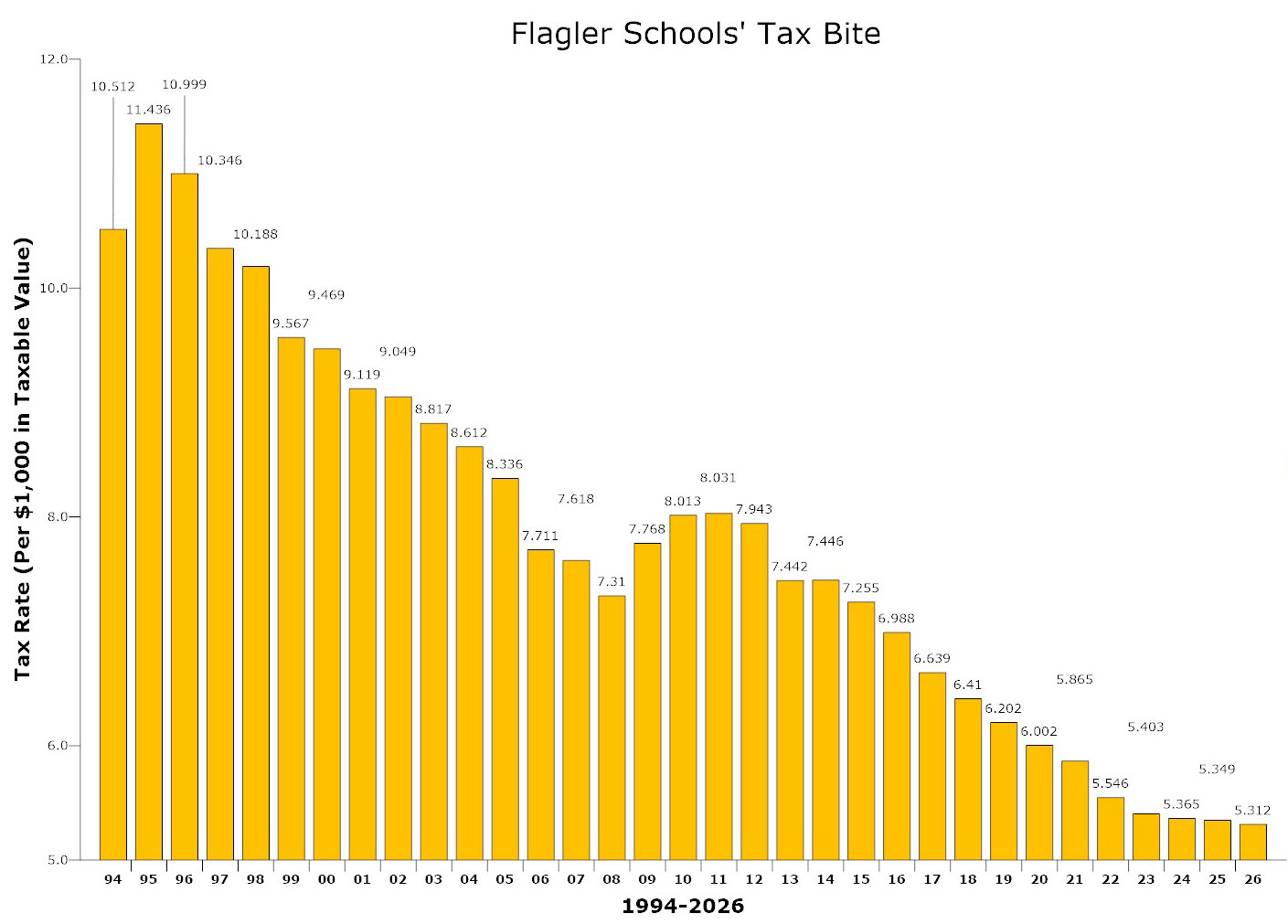
The tentative tax rate is $5.312 per $1,000 in taxable value, down from 5.349 this year. The decline continues a state-led, 32-year trend of lowering the school tax rate, which has declined in each of those 32 years except for three, during the Great Recession. The state is lowering the tax rate even though property values in Flagler County have fallen for the first time in 14 years, so the decline in the rate compounds the resulting loss in revenue.
A proposed constitutional amendment (Amendment 3) would raise the homestead exemption from $50,000 to $150,000 on Jan. 1, and to $250,000 on Jan. 1, 2028. But the new exemption would not affect the school tax rate, which is currently covered by only a $25,000 exemption.
Florida has one of the lowest per-student funding ratios in the nation and ranks similarly low on academic outcomes, relative to other states in nationally normed testing.
The rate breaks down into three components: the so-called “required local effort,” whose revenue goes to the state and is redistributed to the county based on a funding formula that always sends Flagler less money than it sends the state; a 1.5 mill rate for capital spending, and a 0.748 rate that generates discretionary dollars for the district. The first rate covers the cost of the general fund, including the instructional budget, but not including revenue from the county’s own half-cent sales tax that funds technology and other initiatives.
The capital outlay levy will pay for maintenance of buildings and repairs ($6 million), a new cooling system at Matanzas High School ($5.4 million), $2.5 million in new school buses and other district vehicles, $2.5 million in bus driver salaries and benefits, and other spending. (See the list here.)
The board on Wednesday went through the motions of adopting the proposed budget and tentative tax rate with minimal comment or discussion in a 16-minute meeting. There were no public comments. The board will adopt the budget and tax rate in September. The numbers are not expected to change.


























Al says
The loss is only on paper as gross income loss. The net loss is way lower as the district didn’t have to provide services, classroom space, school buses, teachers and so on. Now the school board has to think. Maybe close schools that aren’t needed or consolidate bus routes and so on.
JC says
We aren’t even close to having schools closing in Flagler.
nbr says
I am not a fan of using tax dollars to fund private education, parents, you want to send your child to a private school, then you pay for it. Simple
rbn says
As a taxpayer, I am not a fan of being compelled to send my hard-earned dollars to fund everyone else’s education. If you want to educate your children, pay for it. Those who get the vouchers are essentially getting their compulsory payment back to invest as they see fit. It’s not “the public’s money”.
nbr says
Rbn, we are on the same page
Capt Bill Hanagan says
I imagine that you enjoyed and profited from your own free education.. or at the very least have benefited from living in a country with a literate population.
If you want to drive, pay for your own roads.
If you don’t want your house to burn down pay a firefighter.
If you want a sparkling blue reflecting pool hire a pool guy
And so forth
Laurel says
Yes, Captain, I agree.
I have had no children myself, yet I have paid into the public system that is in our Constitution, all my adult life, and without complaint or push back.
It takes a village to raise a child.
gw says
I watch the buses roll down FL Park Drive everyday school is in session, all going to different schools and about 1/3 full. What a huge waste of PUBLIC tax dollars.
JC says
How do you know by the time they go to school they are 1/3 full? Seems like you don’t know what you are talking about.
TR says
You do realize that the route for the buses aren’t finished yet when you see the buses, right? I have to agree with JC, in that you don’t know what you’re talking about.
The dude says
MAGA hates education and the educated.
Our MAGA regulars here prove this daily with the wholesale slaughter of the English vocabulary, and nonsensical word salads.
Ed P says
Hello Dude,
How so?
Can you point me to anything factual about MAGA “hates” education instead of your hyperbolic statement?
Your comment is all too familiar. Name calling and demonization without any suggestion or solution.
Deborah Coffey says
Ed, if you don’t know what Republicans, and now MAGAs, have done to destroy public education over the past several decades, then you’re not keeping up with all the laws they’ve passed. It’s been the GOP’s goal to completely destroy public education for a long, long time. You don’t remember when Rick Scott first got in the governor’s office and immediately cut $2 billion from public schools? He had to back off because he got so much pushback, but the effort and the goal was crystal clear. Yes, MAGA hates education and the educated. There’s tons of proof out there including Donald Trump’s own words, “I love the poorly educated.”
Ed P says
Hello Deborah,
I’m at a loss, maybe you will tell me exactly what the GOP has done to DESTROY public education.
I’m all ears on how the GOP HATES education and their quest to hurt our children’s education.
Your turn.
Laurel says
“President Trump signed an executive order in March 2025 directing steps to close the U.S. Department of Education, but the department has not been fully eliminated and still operates with reduced staff and functions.”
– Search Assist, epi.org,
clerycenter.org
Trump head the Dept. of Education with a Wrestling mogul, not an education expert.
“I love the poorly educated.” – DJT
Doesn’t look good.
Deborah Coffey says
Florida has a 3rd world educational system and teaches one thing only: How to keep a population stupid. “I love the poorly educated,” said Trump. This is how America become a Fascist nation.
Ed P says
Hello Deborah,
Just a thought, how do we really know it’s third world?
We can’t evaluate teachers by looking at student performance and testing. Results don’t define a teacher’s effectiveness.
The elites think the U.S. News &World report is a joke.
You nor I have been in K-12 for over a half century.
School administrators are non partisan.
Teachers are definitely are not a Republican majority
How did you arrive at your conclusion?
Laurel says
This is an ongoing attempt to privatize everything by the Republican politicians. Putting in a middleman, who requires profit, and no regulation of how the education is provided, rarely produces monetary cuts, nor is it looking out for the citizens of Florida.
Public schooling is in our Florida Constitution for a reason, and that reason is not for profit or deregulation of educational materials. To continue to destroy public education, as is the target, should be flat out illegal. The vast majority of people taking these vouchers already can afford private or home schooling. Yet they are taking away a decent education from those who cannot afford to have a parent stay home, or cannot afford to pay the balance on private schools.
Interestingly, this removal of public tax dollars for education is called “choice” while those of us who oppose it, have no choice. This “choice” will continue to remain on our property tax bill, while other expenditures will be in jeopardy. The argument that public schools are failing is untrue, but will become true with the lack of proper funding, and the children will be the ones who suffer.
Rwboggess says
Problem is, and even the state has admitted that is does not know these figures – no body knows if this figure is true; or even if there are students going to “private” schools, but in reality, are going to public schools while the parents are getting money from the State for sending their kids to private schools. They have no way to tracking this. Heck, many of these parents are using the funds from the State to finance their private schooling to pay for Disney park tickets on the grounds that it is educational. I never heard of a class on “Disney Parks”!!
And all the while, Florida has the lowers Techer’s pay in the US!!
We should be ashamed.
Susan says
This statement is hugely misleading. It is a crime for parents to accept the scholarship and still send their child to public school. The scholarship will pay for a ticket for an amusement park for THE CHILD ONLY, no food, no merch, no extras. No one is funding a “Disney Class” on the backs of taxpayers.
Laurel says
And so when do public schools have the money to pay for it’s children to go to Disney World, and why would they? To become career Mousekateers? Are you serious?
When I was 14, some of us public school kids went on a trip to Washington D.C.. That was actually educational, not for pure entertainment purposes, but our parents paid the price of the trip, with no money from a voucher. A few teachers were chaperones, our parents didn’t have time off to go with us.
Rwboggess says
You and I must’ve been from the same school system. When our school was selected to go to the Macy’s Parade, they had to come up with the money for travel, meals, and accommodations through fund raising. The school system didn’t pay for it.
Laurel says
Rodgers Jr High, Ft Lauderdale.
It was highly educational, and interesting as hell! We took the train up and back, saw the Library of Congress, several monuments, the tunnels connecting buildings, the Smithsonian, Tomb of the Unknown Soldier and much more. Our parents paid for it.
It blows me away that my tax dollars pay for kids, who already have money, to go to freakin’ Disney World!
Seriously?
Canary says
Laurel – Tell me you know nothing about homeschooling without telling me you know nothing about homeschooling.
There’s absolutely loads of educational opportunities in the Disney parks if you actually care to look for them. Epcot and the Animal Kingdom especially. There’s curriculum written to teach physics with roller coasters, learn geography from the world showcase, learn about ecology and hydroponics and other alternative farming methods at Living with the Land, learn about all of the animals and geography at Animal Kingdom, practice a language talking to native speaking cast members…and on and on. Kids learn best when they are engaged and hands on…don’t let your lack of imagination ruin what is a great way to teach kids. Learning doesn’t have to be boring!
Laurel says
OMG! 😂
Laurel says
And, they can learn how to sing and spell at the same time:
M-I-C-K-E-Y, M-O-U-S-E!
Rwboggess says
It’s a crime, yes, but that does not mean it does not happen. It is crime to rob a bank, but banks get robbed. During this legislative session the legislators were aware that there was this “double dipping” going on but would not or could not address the issue for lack of intestinal fortitude or they just didn’t care that the money was being wasted. It was more important to have a special session to come up with a questionable constitutional amendment concerning property taxes (which is another subject).
Nevertheless, if these privately educated student are getting “scholarships” to go to Disney, why are not the kids getting these same “scholarships”? It seems to be special treatment being afforded to private students which means it is not equal treatment and further supports that private schools are being funded on the backs of the tax payer at the expense of the public school.
It is kind of like the Private school parents are getting a refund on their school taxes while those that never had kids in public school ever got a refund for paying into school taxes when they had no kids going to school. Again, not equal treatment.
Ray says
I understand that there are many students that are choosing alternative. The real issue is that come October, November many of these students show up back at the public schools. The reasons vary however, the funding is not returned from these families back to the schools. This is thousands of dollars now unaccounted for- never returned. Maybe parents should receive the funds quarterly? There needs to be some accountability.
Canary says
They already DO actually receive the funds quarterly.
Atwp says
My tax dollars to private schools. You all know how I am. How many African American Students are going to these so called private schools. Will check the numbers myself.
Atwp says
About 28% African American Students attend private schools in Palm Coast. Am I’m happy no, because most of my tax dollars are helping White Students who already have the best this world can offer. Can’t prove it but I believe the student of color will get less of what they need but the white students will get all they need and more, the sad thing is my tax dollars are not being used properly. The old American way, make sure the whites get all they need and want. To be real white peoples taxes are being used also. There you have it.
Edith Campins says
Never had children in public schools. Never minded paying school taxes. Considered my contribution to an educated society. I vehemently object to my tax dollars being used to pay for private schools.
R.S. says
If some of those private schools are religious schools, is not the State running afoul of the church-state separation? And what are the demographics of the voucher recipients? Are we experiencing here a re-segregation or a new segregation of social or income classes of the society? Who watches over the quality of education that the private or home schools deliver? How many future scholars will seek Noah’s Ark or will attempt to find the finger of a deity in evolution? This entire development strikes me as a move toward madness.
Laurel says
I think the goal is two fold: privatization and mass control.
“Choice” is a ruse. The kids with one parent do not have the “choice” to home school if the parent (or two parents, for that matter) needs to work.
The kids who come from a family who cannot afford to pay the balance of a private education do not have a “choice.”
Private schools have the choice to turn a kid away, so that kid has no “choice” either.
Those who can afford these “choices” are literally taking money away from Constitutional public schools.
Laura H says
The money is not a subsidy regardless of how anyone wants to frame it. It is money attached to the specific child for their educational services. Money that can only be spent on approved educational expenses (public, private, or parent designed) based on child’s enrollment and must be submitted receipt by receipt. It is not a subsidy nor is it an $8k check mailed annually to parents.
Honestly, the $8,000 max per average student per year is a bargain to taxpayers. Research study after research study shows it costs much more to educate the very same child in a public school. Additionally, these “alternatively educated” children outscore and surpass traditional public school students on standardized tests at both state and national level. Year after year. So to translate, we as taxpayers are getting better outcomes for less money.
The clamor shows who are the true advocates for all of Florida’s kids.
Ed P says
Hello Laura,
Reading your post feels like you have experience with the private voucher system, which has proven to be a system that actually educates children when properly administered.
Would you expand upon the experiences you’ve had and the steps of checks and balances to help all the naysayers understand your journey and that it’s not a welfare program?
R.S. says
Laura, you say: “It is money attached to the specific child for their educational services.”
I believe that is an instant of the fallacy of division. I’ll exemplify: The military is notorious for their slow decision-making; that is why we cannot expect Major Smith to make up his mind about his car purchase until a couple of years from now. What may be true for the entirety is not necessarily distributable over each and every individual that is an individual member of the entirety.
Explanation: The money is to fund the entirety of the system that serves to educate children; it is not divisible to each child although each child benefits from the system as an entirety. If I deplete the system by distributing portions to each child, I kill the system in its entirety. And that precisely is what’s wrong with this daft me-first attitude, which apparently you advocate here.
Ed P says
Hello RS,
Looking down the road just in Flagler County, it’s estimated we allocate over $15,000 per student when every expense of public education is examined. The voucher system($8,000) is actually a huge tax payer savings, just not immediately, but rather in 3-5 years.
There is a catch up phase. Adjustments for declining enrollment need to be made. That takes time.
With a growth reversal of new students, the need to build new middle and high schools disappears.
Just by halting these massive physical expansions, the county successfully avoids a $100+ million in immediate construction cost and long term taxpayer funded property bond debt. ( it’s not all property tax dollars but also impact fees and 1/2 cent sales tax)
Also, staffing head count at all levels will eventually adjust to the new reality. Traditional Flagler county public school enrollment has stalled at a flat 12,500-13500 range for over 15 years.
I see a better educated student and massive savings for everyone instead of the scare tactics being bantered about.
RobdaSlob says
Ed P – I don’t disagree with what was envisioned by the program but the problem with the Florida system is the lack of accountability. Only takes a few bad apples to ruin it. One state north Georgia implemented the GOAL program. Very similar intent but it works in a way that eliminates the abuse. Because they have income tax they use a tax credit scheme. The State sets the maximum amount of money that the GOAL program will be allowed to have that arrives indirectly from the state. I say indirectly because as a taxpayer you can apply to the program. The State allocated money divided by the number of applicants is the amount you (as an applicant) can give to a private school (or divide it to more than one participating school). Then you are given a credit on your state income tax for that amount (a credit not a write off). Any taxpayer, not just those with kids actively attending, can apply to GOAL and support one of the participating private schools. Homeschool you are out of luck. Florida doesn’t have income tax but it is not to say they couldn’t set up a scheme where first you pay the school then apply for the credit.
That aside I am not a supporter of using my tax dollars for someone to go to private school, even though my kids attended private school for about half of their grade school lives. I’m good with paying for the public school, but if you want more or different than what public has to offer, it is on you.
R.S. says
In other words, the public schools will stop evolving and may well devolve instead, be it by way of halted constructions or by way of halted laboratory expenses, other modernizations, or teacher pay. Any way you twist and turn it, some money is walking away to private schools that should remain to give everyone an equal start. Besides, you know, Ed, that only parents who can also subsidize the private schools, who are thus well heeled will separate their offspring into fast tracks to fame and fortune, thus building family dynasties and adding to the already worrisome gap between wealth and poverty. I would need to know much more about demographic evidence of who goes, who stays, and for what reasons they’re going or staying, before I’d look at the pure finances of the thing. And there’s no way around the fact of state-church conflation by way of the voucher system. It’s been on the radar of the ACLU for years before the so socially conscious ‘publicans boxed it through under Bush. If we’d really care about equal opportunities, we’d put every penny into the public school system.
Ed P says
Hello RS,
So a smaller school system with lower overhead, spending the identical amount per child to educate would be destroyed?
Tell me the magic or sweet spot of our Flagler schools educating that 13,000 students for last 15 years . I don’t follow.
New housing brings in new students but student outflow has kept pace.
Simple math not wealth.
In anything government -bigger is never better.
Endless corruption says
Never trust a Rapeublican, they screw kids anyway they can!