


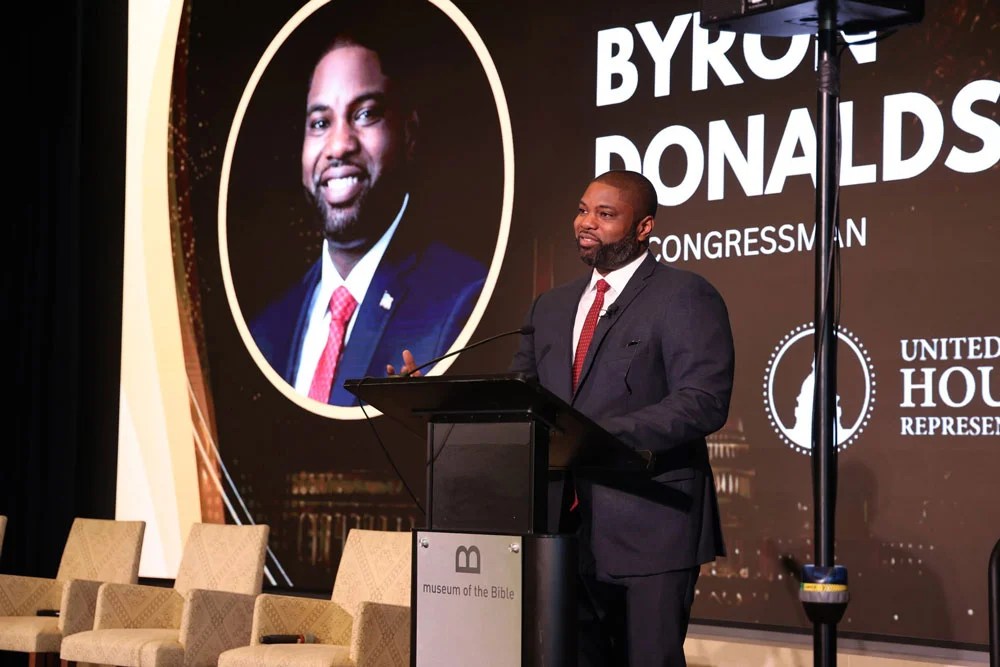
Republican gubernatorial candidate Byron Donalds is questioning whether advertised impacts of this year’s property tax amendment are exaggerated.
“The Revenue Estimating Conference has been estimating revenue in our state for 30 years. They’re often wrong,” the Naples Congressman said in Jacksonville.
“We’ve seen it in the Legislature time and time again. When I was there, we were told that there was going to be a revenue shortfall of about $3.5 billion that didn’t happen. Right now, the Revenue Estimating Conference is estimating a $6 billion shortfall over the next couple of years, and we have to plan for that. But the truth is, they’ve been wrong about this several times.”
State economists estimate that a total of $11.86 billion would eventually be extracted from local budgets per year if Florida voters opt to increase homestead exemptions to $150,000 in 2027 and $250,000 in 2028. But Donalds, a supporter of this year’s Amendment 3, is questioning the assessment of nonpartisan state economists.
The prospective hit to local governments would increase over time as homesteaders receive further reductions, according to the Office of Economic and Demographic Research’s analysis.
In Fiscal Year 2027-28, local governments could expect nearly $5 billion less revenue should the amendment pass. That number is estimated to increase to $8.775 billion in Fiscal Year 2028-29, $9.7 billion in Fiscal Year 2029-30, and $10.751 billion in Fiscal Year 2030-31.
Under the amendment on November’s ballot, local governments would be limited in what they can fund to public safety, infrastructure, schools, debt service and pensions. County constitutional officers, such as Elections Supervisors, Clerks of Court, Property Appraisers, and County and City Commissions, would also be funded.
 Commuter counties with lower commercial development and more revenue derived from homestead property taxes would be most adversely affected in terms of proportion, according to some estimates. St. Lucie County could be the hardest hit, with a 35% revenue loss. Clay, Baker, Citrus and Hernando counties could all face losses of more than 30%.
Flagler County, Volusia County, Hernando County and Sumter County all would see at least two-thirds of homes potentially impacted.
Larger urban counties would face the biggest hit in raw dollars, according to the Florida Association of Counties. Miami-Dade would experience a $445 million revenue decrease as soon as Fiscal Year 2028-29. Hillsborough could lose $353 million, Broward roughly $326 million, Duval $277 million, and Orange $253 million by the same point.
Criticism has come in, including from seemingly unlikely sources on the Right.
The Wall Street Journal balked at what it sees as a “progressive” pitch that could lead to a “graduated” property tax system.
Along those lines, Donalds floated a tiered tax system during his remarks Monday, a model that would put burdens on big counties and compel them to support governments in those areas that can’t support themselves.
“We have one property tax system that governs Putnam and governs Duval. I think in 2026, that doesn’t make much sense at all. Especially considering the fact, again, we have supercomputers in our pocket. I think we can design a taxing system that recognizes a fiscally constrained county versus a county that has large economic development.”
–A.G. Gancarski, Florida Politics





Leave a Reply