



We’re all familiar with Walden Pond, the historic landmark 25 miles west of Boston where Henry David Thoreau re-invented American solitude as self-discovery through nature worship. Back then the 65-acre lake was mainly Frederic Tudor’s ice factory until Thoreau made it his own Marcus Aurelian spa for a couple of years, leaving us with one of the great classics of American literature.
 It was not the mythical place he made it out to be. The Fitchburg Railroad “touches the pond about a hundred rods south of where I dwell,” he wrote. “The whistle of the locomotive penetrates my woods summer and winter, sounding like the scream of a hawk sailing over some farmer’s yard.” He would “hear the iron horse make the hills echo with his snort like thunder, shaking the earth with his feet, and breathing fire and smoke from his nostrils.” Thoreau himself was not the hermit of Walden so much as its occasional tenant as he ambled into Concord whenever he needed to pick up mail, have company, disobediently spend the odd day in jail.
Still, the mythology he created of nature as mirror to our better angels endures even as the more material, less lofty needs for space and comforts keep intruding (the very needs Thoreau hectored in Walden even as he regularly sought them out in Concord). Walden became a pilgrimage stop for Thoreau enthusiasts and a recurring battleground between preservationists and developers.
An amusement park operated for a few years at the edge of the pond until it thankfully burned down in 1902. In 1922 the land was deeded to the Middlesex County Commission and soon after that a public beach was dug out. In 1957 the commissioners bulldozed more acreage to enlarge the beach and build an access road. That drew a lawsuit from the Thoreau Society of Concord. It took four years, and it was only a partial victory. The damage was irreversible. But the judge ruled there could be no further desecration.
In the 1990s environmentalists successfully fought an office park that was to go up 700 yards from what by then was a state reservation. But the pond is such a popular swimming spot that it is now one of the most polluted inland bodies of water in the country by urine density. These days you don’t hear the sounds of the iron horse, but you can hear the rumbles of Boston-pistoned traffic along Routes 2 and 126.
What happened at Walden Pond is a warning and a model of what could happen to Old Brick Road west of U.S. 1, as Palm Coast and Rayonier, the land owner, team up to build 22,000 homes in what they call the “western expansion,” to almost double the city’s population by 2056.
By some measures it’s an awful project that, no matter how much they euphemize it as a cluster of quaint little villages and town centers, will ravage another huge chunk of this county’s natural state. On the other hand, and except for planning details, it’s no different than ITT’s leveling and draining of 92,000 acres in the late 1960s to build Palm Coast. If we live in Palm Coast–as I do, as you do–we have no business objecting to another developer doing the same west of U.S. 1, and probably doing it better than ITT did. (A Florida government planner told the New York Times in 1974 that ITT’s Palm Coast plans were a “dinosaur” that was “10 years out of date as far as enlightened development goes.”)
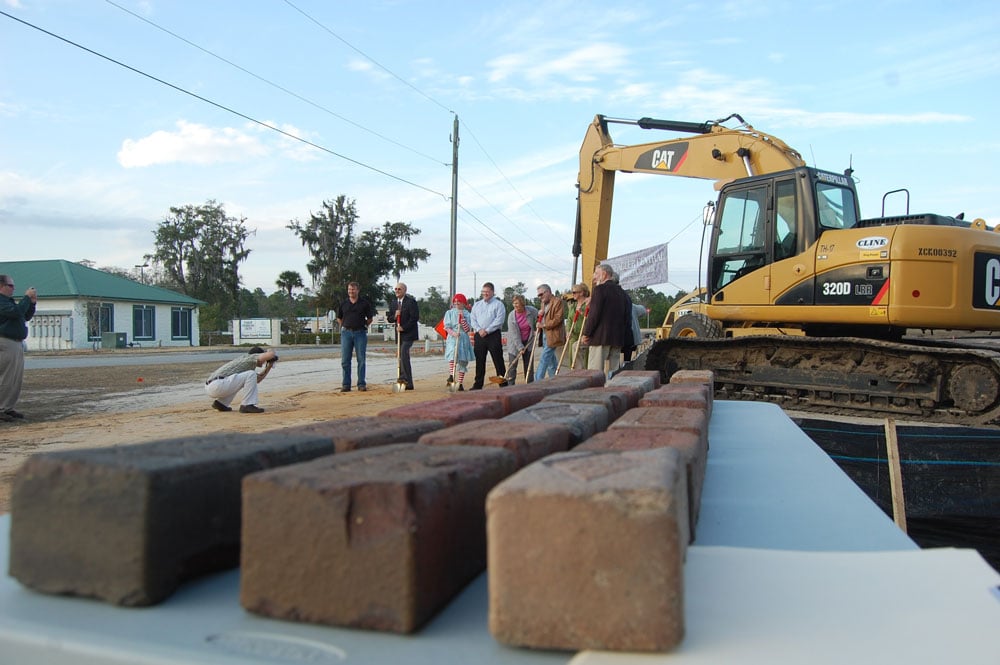
The question is: can we preserve a few natural and historic treasures along the way? Old Brick Road is a national treasure. It is the last remnant of the Dixie Highway built in 1915 between Detroit and Miami. It is almost literally Flagler County’s equivalent of the Appian Way in Italy, the last remnant of a Roman road that, thanks to Roman engineering, endures to this day. Old Brick Road wasn’t built as well. Not even our interstates are built as well as Roman roads were. But close enough. It is being demolished by logging trucks, and the westward expansion risks reducing it to an enclave, starting with a planned highway that would parallel it way too closely and too many planned crossings of the road itself.
The developers, the city and the county all say they want to preserve Old Brick Road as a pedestrian park and destination. But so far, judging by a proposed joint agreement, which the county rejected, only the county is living up to that pledge.
Flagler County commissioners took an impressive stand this week, declaring that they would rather forbid any at-grade crossings on the road than let it become a footnote to a nearby highway. They have that power. It’s a county road, and if the county wants to forbid crossings, it may. It’s a good starting point for negotiations as they demand proper buffers and minimal intrusions on the road, so it doesn’t become another pond of piss and highway noises, as Walden Pond is today.
That planned highway that would connect I-95 near Jacksonville to Orlando is of particular concern. In current drawings, Raydient–the developer arm of Rayonier–has the highway hugging Old Brick Road along most of its 8 miles in Flagler County. At last Wednesday’s vaguely informational meeting on the expansion I asked one of the contracted engineers why they’re wanting this proximity. His explanation: we must build the new road close to the old road so the old road isn’t isolated. So it isn’t “ostracized.” That’s the word he used. The developer has inverted the purpose of preservation to a self-serving logic: Old Brick Road would not be validated–it would not exist, it would not be preserved–but for the proximity of the new road and, by extension, the new development.
That’s absurd. Historic and natural treasures are neither better preserved nor justified by intrusive infrastructure or development. They are only compromised and, at worst, corroded and demolished. Public access is one of those compromises. It would be pointless to entirely segregate treasures from public enjoyment, within reason (think of the value of eliminating cars from certain national parks, for example). But it would be mad to assume that intrusions on Old Brick Road like a nearby road, adjacent development and numerous crossings would be its salvation.
The commissioners have it right. Wide buffers all along the road must be a priority. The buffers should be wide enough to smother noise and sightlines of rooftops or any other infrastructure. There doesn’t have to be any at-grade crossings. It’s more expensive to build bridges. So be it. That should be the developer’s problem–and expense. Private development should not be subsidized at the expense of public treasures, though heaven knows this one has already been subsidized to the tune of $126 million so far (that state money Paul Renner’s generous cronyism appropriated on behalf of his friends at Rayonier for the “loop road” from Matanzas Woods Parkway to Palm Coast Parkway).
Let’s hope the commissioners stick to their resolve. If they don’t, the 8 miles of Old Brick Road will be reduced to a few hundred yards of brick-shaped tombstones.

Pierre Tristam is the editor of FlaglerLive. A version of this piece airs on WNZF.


























Gina Weiss says
Another great article Pierre! You hit it out of the ball park again. For an
engineer to say that a new highway built in such close proximity would
give the old brick road validation is preposterous and laughable, in fact
it’s ironically the opposite. My answer to this joker would be , “please
stop the gaslighting and BS’ing people, you and your developer buddies
could not care less about preserving anything, it’s all about the money with
them and how much they can save while deepening their pockets. They
are the real welfare queens.They don’t care how many trees, forest, wetlands
they uproot, how many wildlife habitats they destroy. The only contributions
they make are wildfires and flooding. Let’s hope the FCBOCC
will stand by their words and JUST SAY NO!
JimboXYZ says
Just me, but to some extent, does Radient perceive the Old Brick Road (OBR) as similar to the Lehigh Trail(s) sections ? They kill the proverbial 2 birds with one stone analogy. The OBR serves as a pre-constructed trail and park ? Something that Radient doesn’t sink any money into and count as one of their contractual obligations to create nature parks & trails for developing the Westward expansion concept ? +/- 8 miles of trails that cost them nothing to take credit for as a carve out of the entire expansion plan is quite the freebie for something that already exists ?
For example, take the growth over off of Town Center Parkway & Royal Palms Parkway ? The plan there is to build apartments right up to the edge of that Greenway, becoming just a narrower strip of what used to be the Lehigh Trails between Belle Terre & the 3 way T that eventually goes under I-95 to Old King’s Road. I understand that 3-way T is supposed to have a 3 way Stop there rather than a traffic circle ?
Gail says
Commissioners, city and county- you have the power to make the preservation of this 8 mile stretch of history happen. Do you have the resolve, the strength to hold all developers accountable? They should be paying for any bridges over this road. They should be paying for the parks, the fire stations, the future schools if needed when the homes come.
There should be huge buffers as stated .
Protect some of our history!
Tina Olive says
And a New Sewage Treatment Plant….Has everyone forgot that we are or close to capacity and yet…..they are still building…..are these new apartments and businesses not going to have indoor plumbing? Where is all this crap going to go?… Once again not thinking about the INFRASTRUCTURE….which is how we got in this mess in the first place…….The developers need to be paying for more sewage issues that will happen…It all has to go somewhere…..
NJ says
The Old Brick Road issue should have forced the ‘The Loop Road Bill” to VETOED! LOL DeSantis and Renner have shown us what Total CORRUPTION looks like! STOP the Taxpayer Funding of the Loop Road-NOW! Time for Real Conservative Republicans to March Forward to STOP the CORRUPTION and the DESTRUCTION of Beautiful Flagler County.
Keep Flagler Beautiful says
Anyone naive enough to believe developers know what’s best for a road should take a drive down Old Kings Road South, past the monstrous, dystopian-looking quarry; torn-up road, massive canyons filled with water (what is their purpose?), and the spoils of what once was forest. It is either the oldest or second-oldest road in Florida — accounts differ — and was one of the most scenic drives in Flagler County. Now it has been trashed, and Kolter Homes will be occupying the area with their mega-development for 25 years. The majority of us living in nice neighborhoods along Old Kings will be plagued by the digging, traffic, dirty air and eyesores for the rest of our lives. All because a few years ago one loathsome POS commissioner, Joe Mullins, cast the tie-breaking vote for his cronies — not for the people he represented, but for his cronies. Residents of the affected area west of US 1, you must stick together and hold your city commissioners’ feet to the fire. You are THEIR bosses, not vice versa. Never forget that not long ago, Palm Coast city officials almost got away with pushing through a potentially catastrophic fuel depot that would have been installed right next to a Palm Coast water treatment plant. And they were giddy about it, even jointly issuing a press release with Flagler County saying it was going to be a great thing for the city and the region! Most of Palm Coast’s elected officials do NOT place a high value on the environment or more than cursorily consider the future impact of the developments they approve. You must tell THEM what to do, because they’re easily swayed by developers and their lawyers . They don’t have a clue.
JimboXYZ says
Yep, drove by that just last night before the sunset. That carve out is quite impressive just as a big hole in the ground at this stage. When homes are built there, it’s across from the county land fill pretty much. How attractive a location with OKR South gonna be for that growth. With the accumulated growth that landfill is going to have even more pollution & garbage dumped there. How much gridlock is that going to eventually become as that residential traffic has to eventually route back to CR 325 & Halifax Plantation for the Tomoka Loop or SR-100. Across the road or North & South of the landfill is not going to be prime real estate. That doesn’t seem to matter though for unaffordable housing. Any realtor talking about location anymore is just full of it ? Any schools have become like living across from a jail or prison really.
Protect History says
When Pierre’s right, he’s right. Well done, especially the part about your conversation with the Rayonier engineer. Per a previous comment, he’s trying to fool us, but it’s an obvious attempt. Jedi mind tricks this is not.
Gina Weiss says
The greedy developers know how to collect the bricks from
the old brick road and hand those historical bricks out to their
greedy donors, friends, officials, they know the VALUE of the old
brick road to keep those bricks among themselves to put whereever
so that they can brag to their bitch friends, “oh look what I have.”
Those rocks that were collected should have been put in the historical
museum or maybe set up in a park for the taxpaying citizens to view
with signage displaying their history. Bastards basterdizing
what little that is left.
Pogo says
Preserving the OBR would be almost the only aspect in actual human scale an otherwise hideous project will possess.
So yeah, small chance for the OBR’s future; bidness — is bidness.
“The more I learn about people, the more I like my dog.”
― Mark Twain
Gina Weiss says
WHAT HAPPENNED TO THE A/H FAVORITE BS SLOGAN,
OH, THIS WAS HERE FIRST!
Plow it under says
Our local circus act of elected clowns will let developer run over brick road,gopher tortoise and probably even some family members to please any developer that is only half way decent at pulling wool over their eyes.
These jokers need to grow a spine and stop getting pushed around
Concerned Citizen says
Unfortunately the OBR is as good as gone.
All this county knows is money. They aren’t interested in preserving history. Once the County is paid off, That area will be plowed up for utilities. Thanks for the memories Flagler County.