



Two weeks after the property’s sale closed, Marineland Dolphin Adventure’s new leadership team appeared before the Marineland Town Commission Thursday evening and promised new wonders for the rejuvenated attraction, starting with a month-long visit by a National Geographic team to film a documentary called “The Miracle of Marineland.”
“I can tell you, we’re proud to be here. I hope you are proud that we are here,” Jack Kassewitz told the commissioners. “We intend to make this successful. It will work.”
“We may have the address of St. Augustine but we are Flagler County,” Felicia Cook, the longtime general manager at the attraction now back in that role after a 10-month hiatus, said.
On Wednesday Flagler County Commissioner Andy Dance and county Tourism Director Amy Lukasik and her staff took “a swag bag and donuts and fruit and a sign that says congratulations,” Cook said, to the Dolphin Adventure staff. “This group has given everything they’ve had and not been treated very well for a while. So it was really good for them.”
Cook has also been in discussions with Ragga Surf Cafe, the private business that had set up shop at the River to Sea Preserve and was ordered out last year, raising the possibility of its return on Dolphin Adventure land.
Ragga Surf had been operating in Marineland for four years, mostly on private land, then moved to the Preserve at the county’s invitation until it was forced out once the state discovered that Flagler County had neglected to properly permit the operation. (See: “Ragga Surf Fiasco: How Flagler County Risked Losing River to Sea Preserve Over Botched Favor for a Private Business.”)
Cook would not disclose the substance of the talks with Ragga Surf. “That’s between Ragga Surf and us,” she said. “We have been talking to them since before we closed, because [James Powell] and I were praying together, and we just knew it was going to happen. But again, that’s between us.” James Powell is the co-owner of Ragga Surf Cafe. He sat with Cook during Thursday’s meeting, prompting speculation. “We miss them too, believe me,” Cook said.
Kassewitz spent the last quarter century working with dolphins, mainly in dolphin communications. He is the director of development for the attraction. He’ll be seeking grants and other financial support now that the attraction is again a nonprofit, and working on increasing the number of visitors, especially among students and people who can benefit from therapeutic contact with the animals.
“We think we can make this a wellness facility where people from all over the world are going to come,” Kassewitz said, whether it’s autistic children or people who are wheelchair users or the marginalized, with the nonprofit developing a fund to help pay the way of those who need therapies but cannot afford the cost. “There’s never been a facility is so well put together to do what we’re about to do. This is the perfect facility to do this,” he said.
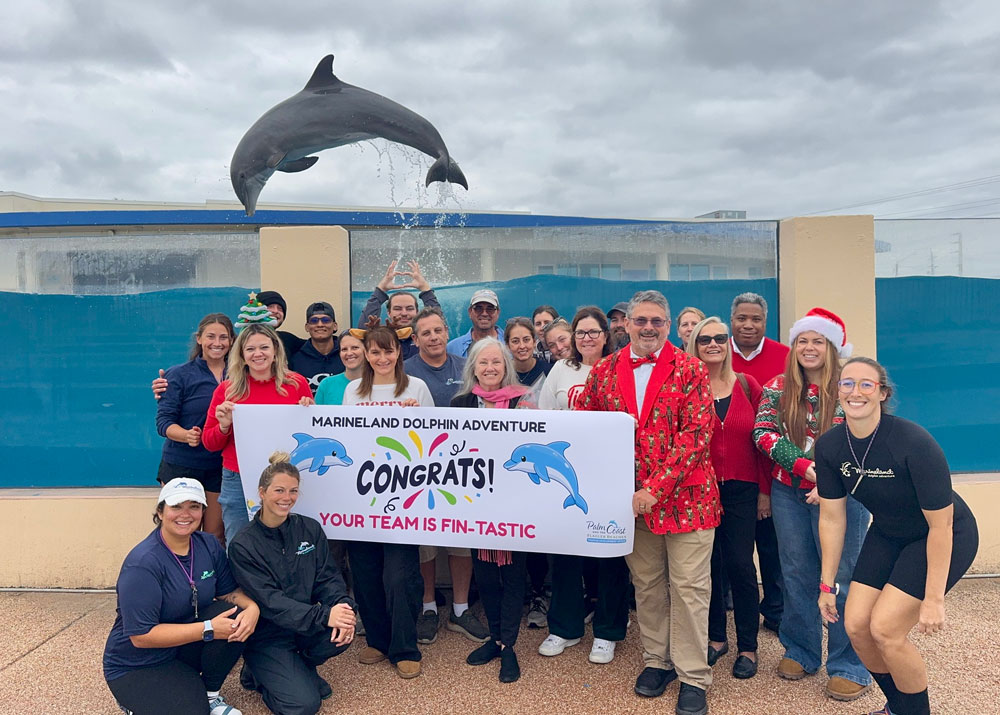
Cook and Kassewitz, along with the three dozen or so employees they have retained as part of the agreement with the former company, are the operating arm under Apex Associates, the company formed by Green Cove Springs philanthropists Barbara and Jon Rubel to put up the $7.1 million bid for the property to take it out of bankruptcy. The Rubels were not at the meeting.
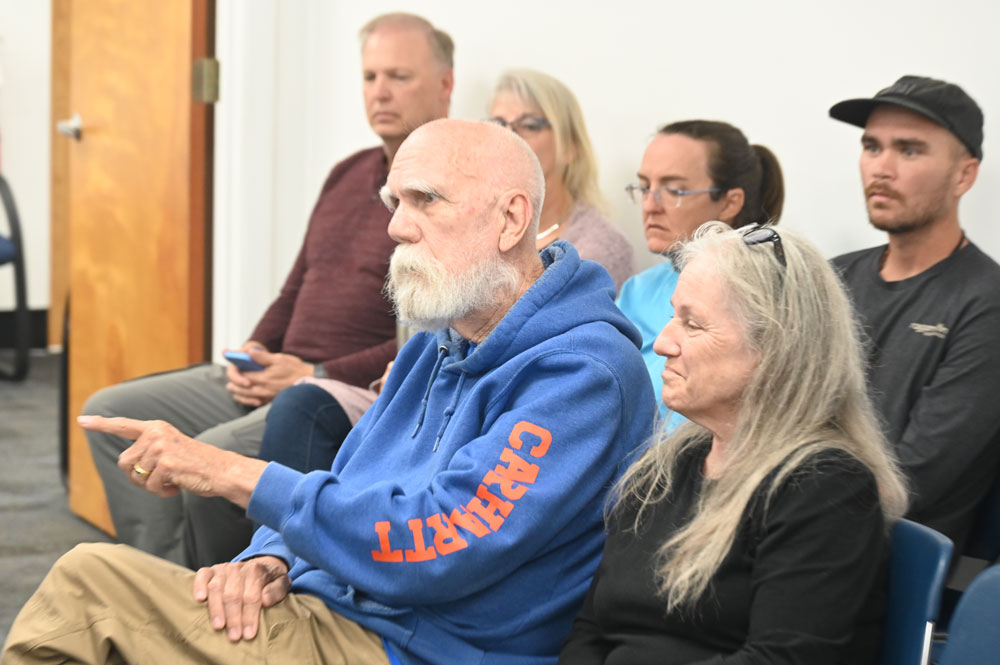
Kassewitz, speaking to the three commissioners and an audience of less than a dozen, filled in the commission on what he referred to as a “miracle”–how Apex was initially prevented from bidding on the property, how a major developer was set to acquire it and build up the place with condos, and how that entity withdrew when a judge ordered the bidding reopened so Apex could place what turned out to be the winning bid.
“We had shown them through the community involvement how important Marineland was and is. And that doesn’t mean the struggles are not over,” Kassewitz said. The facility was not itself deficient, he stressed, nor was it in financial difficulties, especially when Cook managed it before she left last winter as its parent company filed for bankruptcy. (Kassewitz and his wife, Donna Kassewitz, were among the founders and shareholders of the Mexico-based Dolphin Company that declared bankruptcy.)
He acknowledged that tourism in general is down. Zoo tourism has been declining for many years (Canada in 2019 enacted a law that prohibits the capture and display in zoos of whales, dolphins and porpoises). The Dolphin Company’s bankruptcy was part of that trend. “The industry currently has problems,” Kassewitz said. “We think we have found a model that will reverse it, at least in terms of the kinds of people that we want to deal with.”
He said “one of the top researchers in the country” will be affiliated with Marineland, which will bring 20 graduate students a year here.
“Our dream, when Felicia and I came together, was to not only save Marineland, but to save an industry,” Kassewitz said. “We are going to fix any challenges that Marineland ever had. And I think at the end of this year, I mean 2026, you’re going to be so proud.”
Kassewitz spoke of the attraction and the town as one. “They’re not unjoined. They were about to be unjoined,” he said. “We were about to lose one of the most important attractions, I think, in the United States.” He pushed back against wrong assumptions, telling the elected officials: “You’re under the Sunshine Law. So are we. Come visit us if you hear some crap about it–pardon me–if you hear something bad, come see us and talk to us. Don’t make a judgment until you talk to us and listen to the stories.”
The attraction is in fact a private business that, beyond its IRS filing as a nonprofit, does not have to disclose its inner workings. But Kassewitz and Cook pledged full transparency.
“I would say the same thing to the activists,” he said. “If you’ve got a problem, come give me a chance. If there’s something you think we’re doing wrong, come teach me if it’s wrong. I’ll admit it’s wrong. If it’s right, I’m going to do the best I can to convince you that it’s right.”
Commissioners of course were only complimentary. The harder discussion would occur later in the meeting, when commissioners discussed their town’s fate as it loses a third of its property tax revenue now that the dolphin attraction is off the tax rolls.
“I’m so thankful you came to the meeting,” Commissioner Jessica Finch told the Dolphin Adventure team. “I knew that it was a story that needed to be shared, and you’ve added more to it, and I just love being part of this process and seeing what’s going to happen.


























Doug says
This is the best thing to happen in Flagler County in many years. I wish them all the best going forward.
Laurel says
From Captain’s BBQ to Ragga Surf, it’s who you know, and I doubt it has much to do with praying.
RWBoggess says
Out of curiosity, I took a ride today up to the Marineland area. I had not been in that area in over 30 years. Sad to say, while I did not go into the park itself, it looked, from the outside, to be somewhat aged and run down. They do need some maintenance and updating. Make the entrance more inviting!
I wish them all the luck and hope that they can continue the rescue services that they do provide to turtles and dolphins, and enhance their educational goals.
The Voice Of Reason says
My hat is off to these fine people who against all odds was able to acquire Marineland. A beautiful and historic spot, then to put the $ back into it. the animals will be cared for and jobs saved. This accomplishment is a joy to see in these difficult times and warms my heart.