


Soon to be on tap: Bunnell’s new brackish water reverse osmosis system
The City of Bunnell’s water treatment plant will soon be complemented by a new, state-funded, $4.5 million brackish water reverse osmosis system, which will provide an additional 200,000 gallons of safe drinking water per day to the municipality’s current one million-gallons-per-day drinking water capacity.
Reverse osmosis is a filtering method that fires water at very high pressure through a membrane that traps impurities like bacteria and metals that can be as small as a nanometer. For comparison’s sake, a human hair is 80,000 nanometers wide.
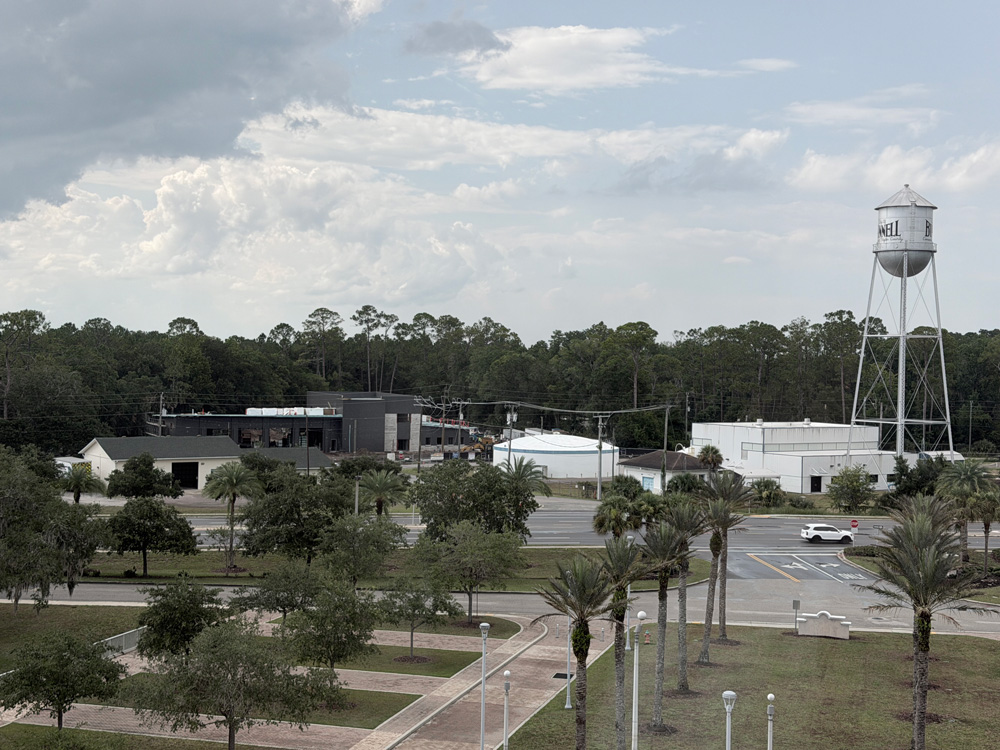
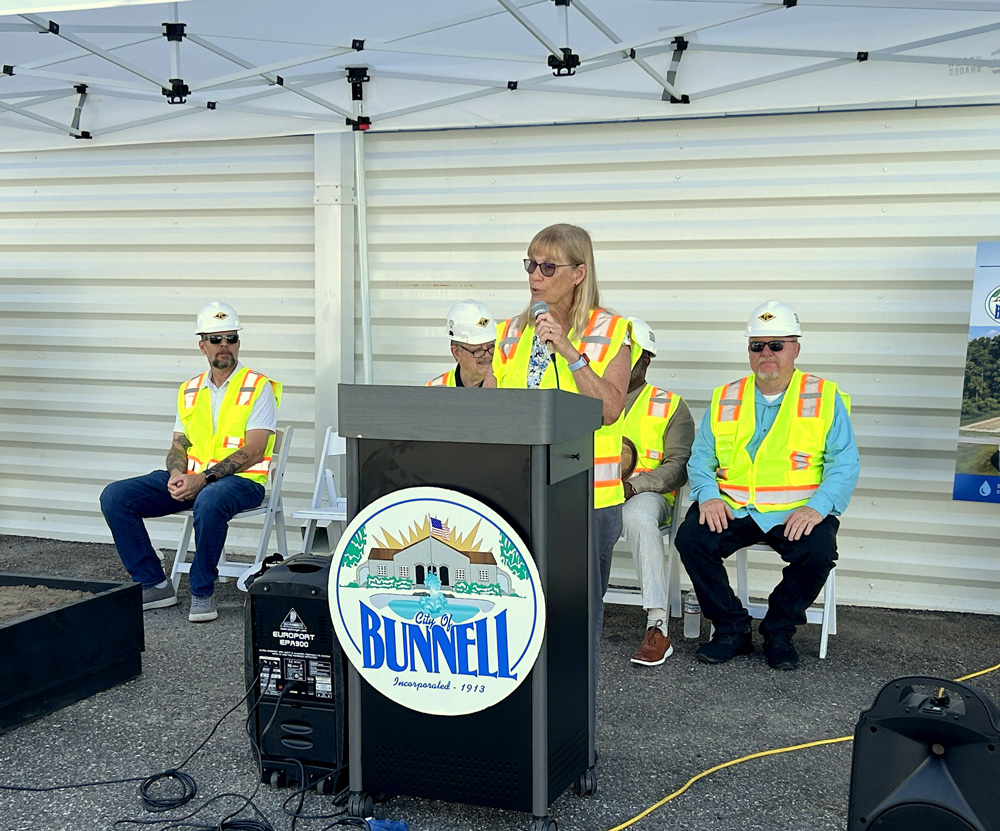
Bunnell elected officials and administrative staff hosted a ceremonial groundbreaking Thursday morning at the plant on Utility Drive, across from the Flagler County courthouse. The project emerged from the city’s Master Utility Plan, a twofold project designed to give the city a roadmap to meet its utility needs over the next decades and produced by the engineering firms Kimley-Horn and Associates and CPH Engineering, for $500,000. The City Commission adopted the plan in March 2020.
The city needs to expand its utility system as its population continues to increase–first with the last decade’s addition of hundreds of homes in the Grand Reserve subdivision, and in coming years, with the planned construction of 6,100 houses and apartments at the Haw Creek Reserve, west and south of the city’s core. This particular plant will not service Haw Creek Reserve, which will have its own utility plant.
“In 2020 we adopted the Master Utility Plan and over the years we’ve been checking the boxes,” said City Manager Alvin Jackson Jr. at the groundbreaking. “Today we’re here to check the box on the brackish water reverse osmosis system.
“The last few projects have concerned waste water, but today marks a milestone for the City of Bunnell. This project is about protecting one of our most valuable natural resources. By diversifying our water supply, we are preserving the freshwater aquifer and strengthening the reliability and resilience of our drinking water system, and ensuring the city is preparing for the future.”
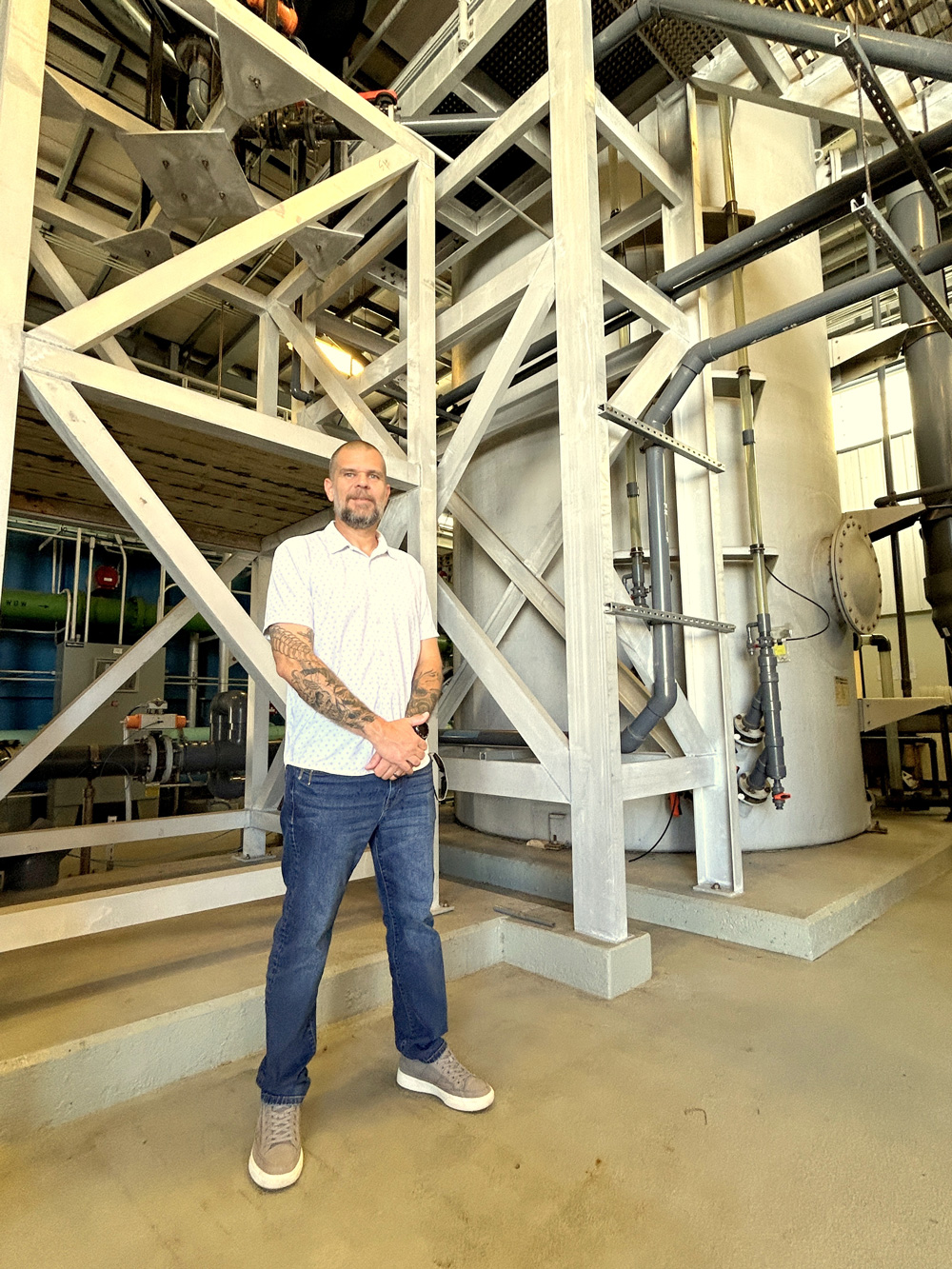
Dustin Vost, Bunnell’s Infrastructure Director, said the city has five operational wells. Bunnell’s current ion-exchange water treatment process produces 400,000 to 500,000 gallons of water daily, with a maximum capacity of one million gallons. (The ion-exchange method is a chemical process that removes impurities through ions, or electrically charged molecules, that get swapped out as water flows through a tank. The tank contains plastic resin beads electrically charged a certain way so that impurities will glom on to the beads, which release cleaner components in exchange.)
With the reverse osmosis system, which will occupy a space at the water treatment plant not much larger than a mansion’s living room, the city “will be able to utilize our two brackish water upper Floridian aquifer wells. With the ion-exchange process, we are not able to fully utilize those two wells because the chlorides and total dissolved solids in the groundwater are just so high – it’s literally Intracoastal water.”

The inability to use the two brackish wells “has been putting additional strain on our three confined surficial aquifer – freshwater – wells,” Vost said. “The new RO skid will allow the safe and effective use of these two wells and achieve utilization of an alternative water source, providing much needed relief to our freshwater aquifer.”
The RO system will only treat water from the brackish water wells, and will not process reuse, or recycled, water. Also, the RO system will be providing additional capacity and will not be replacing the current ion-exchange processing.
The $4.5 million cost of the RO system was covered by a grant from the Florida Department of Environmental Protection. Jackson and Vost said that the city’s investment in its Master Utility Plan paved the way for the grant.
The city “made a $500,000 investment in the Master Utility Plan,” Jackson said. “Most small and medium-sized communities won’t make that commitment . . . Then we all went to work to ensure funding, and the Florida legislature and Gov. Ron DeSantis’s office ensured that we got this $4.5 million.” (Bunnell got luckier than Palm Coast, which has its own utility needs. Palm Coast got only a fraction of its utility requests from the legislature, forcing it to take out a larger loan and raise rates more sharply than it wished.)
“This has been part of the Master Utility Plan since that was adopted in 2020,” Vost added. “So, myself, Dr. Jackson and my project manager Mary Anne Atwood began searching for funding. We received the funding and now we’re done with design and we’re ready to kick off – parts are starting to come in.”
When asked whether the RO system will help accommodate the water demand of the Reserve at Haw Creek, Vost said, “No, this RO skid is for the existing city utility only. The Reserve at Haw Creek development is required to construct an additional water treatment facility per the approved developer’s agreement.”
Carollo Engineers, Inc. designed the RO system, and PC Construction, a national firm whose Florida office is in Palm Coast, will build the system. The groundbreaking was attended by Erica Stone, project manager with Carollo Engineers, and John Yesalonia, construction executive with PC Construction.
“Today is about investing in the future of our community,” Bunnell Mayor Catherine Robinson said at the groundbreaking. “Access to safe, reliable drinking water is one of the most important services a city can provide, and this project is a significant step toward ensuring future generations continue to enjoy a dependable and sustainable water supply.
“By expanding our ability to use alternative water sources, we are reducing the demand on our freshwater aquifer, one of Florida’s most valuable natural resources. This project reflects our commitment to responsible planning, environmental stewardship and building infrastructure that will serve our residents for decades to come.”






Leave a Reply