• Skip to primary navigation
  • Skip to main content
  • Skip to primary sidebar
MENUMENU
MENUMENU
  • Home
  • About
    • Contact Us
    • FlaglerLive Board of Directors
    • Comment Policy
    • Mission Statement
    • Our Values
    • Privacy Policy
  • Live Calendar
  • Submit Obituary
  • Submit an Event
  • Support FlaglerLive
  • Advertise on FlaglerLive (386) 503-3808
  • Search Results

FlaglerLive

No Bull, no Fluff, No Smudges

MENUMENU
  • Flagler
    • Flagler County Commission
    • Beverly Beach
    • Flagler History
    • Mondex/Daytona North
    • The Hammock
    • Tourist Development Council
    • Marineland
  • Palm Coast
    • Palm Coast City Council
    • Palm Coast Crime
  • Bunnell
    • Bunnell City Commission
    • Bunnell Crime
  • Flagler Beach
    • Flagler Beach City Commission
    • Flagler Beach Crime
  • Cops/Courts
    • Circuit & County Court
    • Florida Supreme Court
    • Federal Courts
    • Flagler 911
    • Fire House
    • Flagler County Sheriff
    • Flagler Jail Bookings
    • Traffic Accidents
  • Rights & Liberties
    • First Amendment
    • Second Amendment
    • Third Amendment
    • Fourth Amendment
    • Fifth Amendment
    • Sixth Amendment
    • Seventh Amendment
    • Eighth Amendment
    • 14th Amendment
    • Sunshine Law
    • Religion & Beliefs
    • Privacy
    • Civil Rights
    • Human Rights
    • Immigration
    • Labor Rights
  • Schools
    • Adult Education
    • Belle Terre Elementary
    • Buddy Taylor Middle
    • Bunnell Elementary
    • Charter Schools
    • Daytona State College
    • Flagler County School Board
    • Flagler Palm Coast High School
    • Higher Education
    • Imagine School
    • Indian Trails Middle
    • Matanzas High School
    • Old Kings Elementary
    • Rymfire Elementary
    • Stetson University
    • Wadsworth Elementary
    • University of Florida/Florida State
  • Economy
    • Jobs & Unemployment
    • Business & Economy
    • Development & Sprawl
    • Leisure & Tourism
    • Local Business
    • Local Media
    • Real Estate & Development
    • Taxes
    • Sponsored Content
  • Commentary
    • The Conversation
    • Pierre Tristam
    • Diane Roberts
    • Guest Columns
    • Byblos
    • Editor's Blog
  • Culture
    • African American Cultural Society
    • Arts in Palm Coast & Flagler
    • Books
    • City Repertory Theatre
    • Flagler Auditorium
    • Flagler Playhouse
    • Special Events
  • Elections 2026
    • Amendments and Referendums
    • Presidential Election
    • Campaign Finance
    • City Elections
    • Congressional
    • Constitutionals
    • Courts
    • Governor
    • Polls
    • Voting Rights
  • Florida
    • Federal Politics
    • Florida History
    • Florida Legislature
    • Florida Legislature
    • Ron DeSantis
  • Health & Society
    • Flagler County Health Department
    • Ask the Doctor Column
    • Health Care
    • Health Care Business
    • Covid-19
    • Children and Families
    • Medicaid and Medicare
    • Mental Health
    • Poverty
    • Violence
  • All Else
    • Daily Briefing
    • Americana
    • Obituaries
    • News Briefs
    • Weather and Climate
    • Wildlife

Republicans and Democrats Agree on What Makes a Good Teacher

June 28, 2026 | FlaglerLive | Leave a Comment

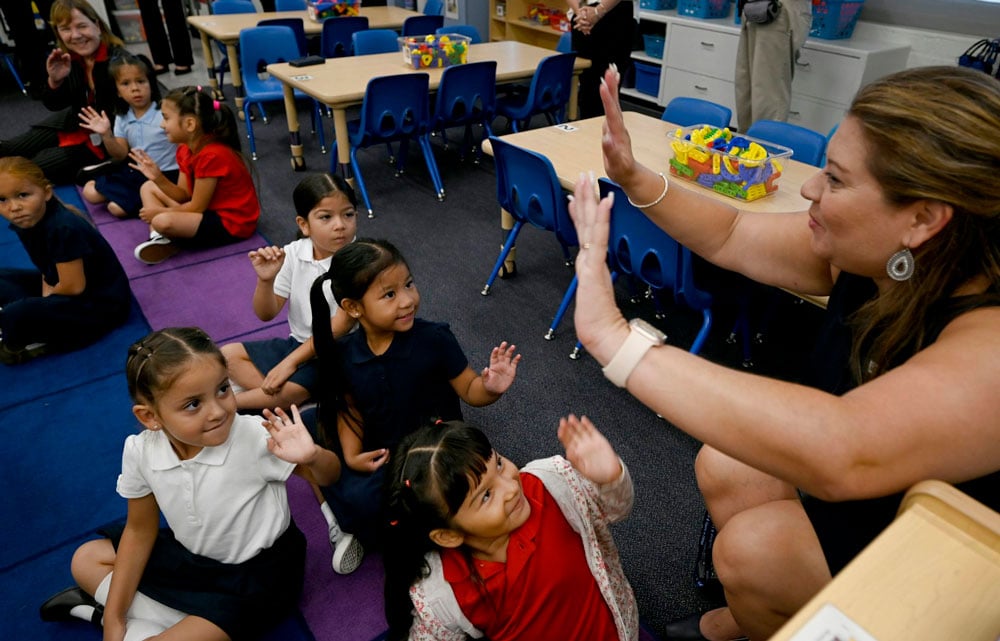
Support for students is one value that both Democrats and Republicans alike value in a teacher.
Support for students is one value that both Democrats and Republicans alike value in a teacher. (Brittany Murray/MediaNews Group/Long Beach Press-Telegram via Getty Images)

By Gustavo E. Fischman, Eric Haas and Margarita Pivovarova

If you follow the headlines, it can seem like K-12 schools in the United States are a political battlefield.

Some conservative parents and advocacy groups are lobbying to remove certain books from classrooms and libraries, most often those that highlight LGBTQ+ issues or race and racism.

Some civil liberties groups, librarians and progressive parents, meanwhile, are pushing back against book bans, saying they are a form of unnecessary censorship.

Parents and school boards also are clashing over a range of other issues, ranging from how transgender and nonbinary students are treated and which bathrooms they can use, to whether teachers should use artificial intelligence in the classroom.

Beyond this evidence of political polarization, though, there’s another, less divisive reality. Ask people to name their best teacher, and regardless of their political affiliation, they will likely offer a similar answer. Most people will say that they learned a lot from a teacher who knew them, cared about them and made learning relevant to their lives.

Over five years, from 2020 through 2025, we asked more than 2,000 Americans, including Democrats, Republicans and independents, what makes a very good teacher. We expected deep partisan divides. Instead, we found something rare: genuine, cross-partisan agreement.

How we ran the study

We began in 2020 with a nationally representative survey of 334 adults, asking them to recall a teacher they learned a lot from. We then asked the survey participants to look at 10 statements that might describe a good teacher and rank them from most to least important.

Five of the statements we offered focused on relationships – like caring about students, making educational lessons relevant and giving students individualized support. The other five focused on whether teachers covered a lot of material, rewarded top performers with grades or prizes, and whether they applied rules consistently to all students.

Respondents generally focused on highlighting the same seven out of 10 statements, giving us a vision of how they perceived a very good teacher. People prioritized the same factors – how much the teachers cared about their students and whether they supported them – regardless of their age, race, gender or political affiliation. Republicans and Democrats were indistinguishable in their descriptions of effective teaching.

People did not prioritize whether teachers covered a lot of material, made students compete or ran a strict and disciplined classroom.

In 2022, we conducted a similar survey of 179 teachers in Arizona and California. The results echoed our 2020 survey participants’ view: Teachers also defined very good teachers as ones who emphasized relationships, made lessons relevant and knew the subject matter.

Given the prominence of politically charged education debates, we were a bit surprised by our results. We began to wonder: Do people privately agree on what it means to be a good teacher, but change their opinion if their image of good teaching is associated with an ideological orientation they disagree with?

A woman with blonde hair hugs a girl wearing a backpack, and they both smile as a man wearing a tie looks at them and also smiles.
A student gets a hug from a teacher at a Garden Grove, Calif., elementary school on the first day of class in September 2024.
Paul Bersebach/MediaNews Group/Orange County Register via Getty Images

Adding a partisan label

To explore this question in late 2024 and early 2025, we ran a third experiment with a nationally representative sample of 1,562 adults from a range of political backgrounds.

We gave all participants the same description of a very good teacher, identified in our previous experiments. We then randomly noted if these descriptions of a good teacher were endorsed by Democrats, Republicans or people with no political affiliation.

When the participants read the teacher descriptions without any political labels attached, about 85% of Democrats, Republicans and independents agreed with the description of a very good teacher.

When we added a note saying that a political party the survey participant did not identify endorsed a particular description of a good teacher, they became less likely to support the statement.

The effect was sharpest among Republicans: Support fell from 85% to 64% when the description was tied to Democrats. Democrats’ agreement slipped less, from 86% to 76%, when the description was tied to Republicans.

Even with these caveats, nearly two-thirds of Republicans and Democrats still agreed on what it means to be a good teacher.

Political scientists call this affective polarization: How we react to an idea depends not just on the idea, but on who we think supports it.

At the national level, education is often framed as an intractable partisan conflict.

Yet at the individual level, many Americans continue to express confidence in their own local schools. Our findings suggest that part of this gap may be driven by how issues are framed rather than by fundamentally incompatible beliefs.

A man wears a tie and gives a thumbs up as a group of children seated at desks raise their hands.
Regardless of political affiliation, people are less likely to prioritize whether teachers cover a lot of material or ran a strict and disciplined classroom.
Paul Bersebach/MediaNews Group/Orange County Register via Getty Images

This matters more than you might think

Federal and state education policy over the past four decades, including laws like No Child Left Behind, which mandated routine federal testing in reading and math, emphasize testing and competition. These priorities don’t always match what Americans across the political spectrum say they value most.

Americans continue to differ on many important education questions, including what children should learn in school, the role of school boards and other issues.

But these disagreements coexist with a shared beliefs about what good teaching looks like in practice.

Recognizing this gap could open new possibilities for education reform. When debates focus exclusively on disagreements, they can obscure areas of agreement that might otherwise serve as starting points for collaboration.

We encourage readers to go ahead and run a similar, small experiment: Ask people about their best teacher, then listen to what they say. The answer, it turns out, is likely more unifying than you expect.

Gustavo E. Fischman is Professor of Education Policies and Comparative Studies at Arizona State University, Eric Haas is Professor of Educational Leadership at California State University, East Bay, and Margarita Pivovarova is Associate Professor of Education Policy at Arizona State University.


The Conversation arose out of deep-seated concerns for the fading quality of our public discourse and recognition of the vital role that academic experts could play in the public arena. Information has always been essential to democracy. It’s a societal good, like clean water. But many now find it difficult to put their trust in the media and experts who have spent years researching a topic. Instead, they listen to those who have the loudest voices. Those uninformed views are amplified by social media networks that reward those who spark outrage instead of insight or thoughtful discussion. The Conversation seeks to be part of the solution to this problem, to raise up the voices of true experts and to make their knowledge available to everyone. The Conversation publishes nightly at 9 p.m. on FlaglerLive.
See the Full Conversation Archives
Support FlaglerLive
The political climate—nationally and right here in Flagler County—is at war with fearless reporting. Your support is FlaglerLive's best armor. After 16 years, you know FlaglerLive won’t be intimidated. We dig. We don’t sanitize to pander or please. We report reality, no matter who it upsets. Even you. Imagine Flagler County without that kind of local coverage. Stand with us, and help us hold the line. There’s no paywall—but it’s not free. become a champion of enlightening journalism. Any amount helps. FlaglerLive is a 501(c)(3) non-profit news organization, and donations are tax deductible.
You may donate openly or anonymously.
We like Zeffy (no fees), but if you prefer to use PayPal, click here.
If you prefer the Ben Franklin way, we're at: P.O. Box 354263, Palm Coast, FL 32135.
 

Reader Interactions

Leave a Reply Cancel reply

Your email address will not be published. Required fields are marked *

This site uses Akismet to reduce spam. Learn how your comment data is processed.

  • grand living realty
  • politis matovina attorneys for justice personal injury law auto truck accidents
  • Conner Bosch law attorneys lawyers offices palm coast flagler county

Primary Sidebar

  • grand living realty
  • politis matovina attorneys for justice personal injury law auto truck accidents

Recent Comments

  • FlaglerLive on Florida Kills Dusty Ray Spencer, 74, For Wife’s Murder in 1992; He Is Oldest Inmate to Be Executed in Modern Era
  • Pogo on Modern Politicians Attempt To Sanitize The Complex And Morally Messy Realities Of Florida History
  • Mike P on Alligator Alcatraz Is Shutting Down
  • Atwp on 1.5 Million Voter Advantage in 1-Party State and Still Scared: Florida GOP Ghost-Hunts Progressives at ‘Showdown’
  • Atwp on Modern Politicians Attempt To Sanitize The Complex And Morally Messy Realities Of Florida History
  • Deborah Coffey on 1.5 Million Voter Advantage in 1-Party State and Still Scared: Florida GOP Ghost-Hunts Progressives at ‘Showdown’
  • jay jay on Strict No Development Policy Continues For Flagler Estates As County Rejects Special Taxing District
  • Smith on 1.5 Million Voter Advantage in 1-Party State and Still Scared: Florida GOP Ghost-Hunts Progressives at ‘Showdown’
  • Merrill Shapiro on 1.5 Million Voter Advantage in 1-Party State and Still Scared: Florida GOP Ghost-Hunts Progressives at ‘Showdown’
  • Skibum on Town Center Data Center Planned for 100,000 Square Feet, Triple Footprint Size Palm Coast Approved
  • Sherry on Flagler and Florida Officials Praise Rising Assessment Scores that Contradict Much Lower National Exam Rankings
  • Sherry on Flagler and Florida Officials Praise Rising Assessment Scores that Contradict Much Lower National Exam Rankings
  • Sherry on The Daily Cartoon and Live Briefing: Saturday, June 27, 2026
  • Jean on Florida Property Tax Amendment Faces Growing Pushback From Local Government Advocacy Groups Campaign
  • Keep Flagler Beautiful on Army Recruit Faced Life in Prison for Raping Sibling. He Is Sentenced to Probation, No Adjudication, No Sex Offender Status.
  • Koyote on Flagler and Florida Officials Praise Rising Assessment Scores that Contradict Much Lower National Exam Rankings

Log in