• Skip to primary navigation
  • Skip to main content
  • Skip to primary sidebar
MENUMENU
MENUMENU
  • Home
  • About
    • Contact Us
    • FlaglerLive Board of Directors
    • Comment Policy
    • Mission Statement
    • Our Values
    • Privacy Policy
  • Live Calendar
  • Submit Obituary
  • Submit an Event
  • Support FlaglerLive
  • Advertise on FlaglerLive (386) 503-3808
  • Search Results

FlaglerLive

No Bull, no Fluff, No Smudges

MENUMENU
  • Flagler
    • Flagler County Commission
    • Beverly Beach
    • Flagler History
    • Mondex/Daytona North
    • The Hammock
    • Tourist Development Council
    • Marineland
  • Palm Coast
    • Palm Coast City Council
    • Palm Coast Crime
  • Bunnell
    • Bunnell City Commission
    • Bunnell Crime
  • Flagler Beach
    • Flagler Beach City Commission
    • Flagler Beach Crime
  • Cops/Courts
    • Circuit & County Court
    • Florida Supreme Court
    • Federal Courts
    • Flagler 911
    • Fire House
    • Flagler County Sheriff
    • Flagler Jail Bookings
    • Traffic Accidents
  • Rights & Liberties
    • First Amendment
    • Second Amendment
    • Third Amendment
    • Fourth Amendment
    • Fifth Amendment
    • Sixth Amendment
    • Seventh Amendment
    • Eighth Amendment
    • 14th Amendment
    • Sunshine Law
    • Religion & Beliefs
    • Privacy
    • Civil Rights
    • Human Rights
    • Immigration
    • Labor Rights
  • Schools
    • Adult Education
    • Belle Terre Elementary
    • Buddy Taylor Middle
    • Bunnell Elementary
    • Charter Schools
    • Daytona State College
    • Flagler County School Board
    • Flagler Palm Coast High School
    • Higher Education
    • Imagine School
    • Indian Trails Middle
    • Matanzas High School
    • Old Kings Elementary
    • Rymfire Elementary
    • Stetson University
    • Wadsworth Elementary
    • University of Florida/Florida State
  • Economy
    • Jobs & Unemployment
    • Business & Economy
    • Development & Sprawl
    • Leisure & Tourism
    • Local Business
    • Local Media
    • Real Estate & Development
    • Taxes
    • Sponsored Content
  • Commentary
    • The Conversation
    • Pierre Tristam
    • Diane Roberts
    • Guest Columns
    • Byblos
    • Editor's Blog
  • Culture
    • African American Cultural Society
    • Arts in Palm Coast & Flagler
    • Books
    • City Repertory Theatre
    • Flagler Auditorium
    • Flagler Playhouse
    • Special Events
  • Elections 2026
    • Amendments and Referendums
    • Presidential Election
    • Campaign Finance
    • City Elections
    • Congressional
    • Constitutionals
    • Courts
    • Governor
    • Polls
    • Voting Rights
  • Florida
    • Federal Politics
    • Florida History
    • Florida Legislature
    • Florida Legislature
    • Ron DeSantis
  • Health & Society
    • Flagler County Health Department
    • Ask the Doctor Column
    • Health Care
    • Health Care Business
    • Covid-19
    • Children and Families
    • Medicaid and Medicare
    • Mental Health
    • Poverty
    • Violence
  • All Else
    • Daily Briefing
    • Americana
    • Obituaries
    • News Briefs
    • Weather and Climate
    • Wildlife

The Bayeux Tapestry’s Norman Propaganda Silenced Voices of Grief and Resistance Now Uncovered

July 9, 2026 | FlaglerLive | Leave a Comment

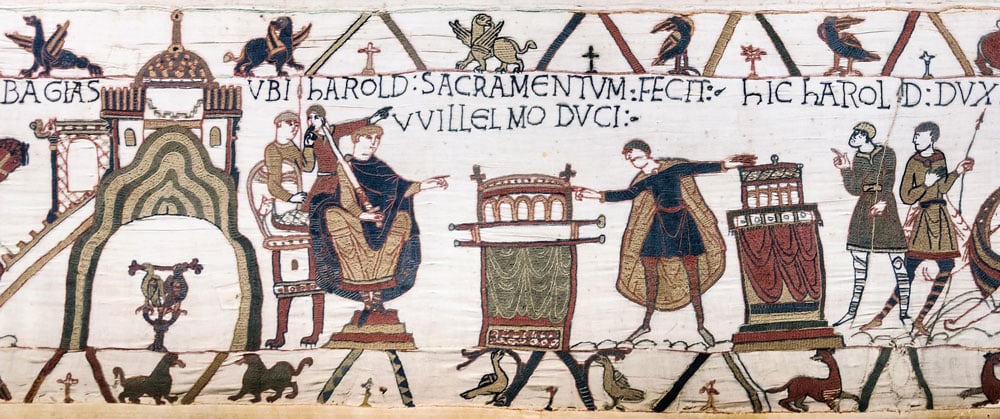
King Harold swearing oath on holy relics to William, Duke of Normandy. Wikimedia, CC BY

By Catherine Clarke

As the Bayeux Tapestry comes to London, the year 1066 and the Norman Conquest are in the spotlight. The tapestry – an embroidered cloth nearly 70 metres long, created soon after the events it depicts – tells the story of the Battle of Hastings in 1066 and William of Normandy’s triumphant defeat of Harold Godwinson, King of England.

The tapestry depicts William of Normandy as the victor, and Harold as a slippery oath-breaker who promises the English throne to William then goes back on his word. But it shows little of the wider impact of the battle on English people – except for one glimpse, just after William’s ships land at Pevensey on England’s south-east coast, when we see a woman and child fleeing a burning building, torched by Norman soldiers.

So what did 1066 feel like from an English perspective? What was it like to live through the Norman Conquest? Remarkable English documents, written in the thick of events, give us an astonishing insight into the side of the story not depicted on the famous tapestry.

The battle on October 14 1066 had far-reaching consequences for England (and later, more of Britain), as the land passed into Norman control. By 1086, only 8% of the total landed wealth of England was still held by English people, with the other 92% in Norman possession. Language, culture and tradition were trodden under the feet of the new occupying force.

Even more than a century later, the Conquest remained a raw and open wound. Around 1196, the English monk William of Newburgh writes that, whenever it rains, the battlefield at Hastings “sweats real and seemingly fresh blood”.

But some English sources have the power to take us right back into 1066 itself.

Contemporary accounts

The Life of King Edward (Vita Ædwardi Regis), was written between 1065 and 1067 and so takes us through the Norman Conquest in real time. The Life was commissioned for the wife and widow of King Edward the Confessor, Edith, who was also the sister of his successor King Harold II. It was written in Latin, probably by a Flemish monk. It’s a clever piece of political spin, setting out to bolster Edward’s reputation – including his posthumous standing as an emerging new saint.

But, unexpectedly, The Life of King Edward finds itself in the teeth of the Norman Conquest, where it struggles to find words for the devastation that has struck England and its ruling dynasties.

Book I of The Life was completed before the Battle of Hastings and deals with the exploits of the powerful Godwin family, including Edith’s father, Earl Godwin of Wessex, and her brother, Harold – who caught an arrow in the eye (probably) at Hastings.

Book II of the Life opens in crisis and despair. In the silence between the books, the Battle of Hastings has happened. Now, Edith’s husband Edward and her brothers (Harold, Leofwine and Gyrth, as well as Tostig who died at Stamford Bridge) are dead, together with other English nobles and perhaps four thousand English fighters. England’s power lies in tatters.

The writer appeals to Clio, muse of history, for help, as he desperately searches for words. “Alas!” the text exclaims, “What will you say?”

What’s fascinating here is that we don’t actually get a direct account of 1066. Instead, the author of this text is dumbfounded. What we see is a writer reeling from this catastrophic blow to the English ruling elite, talking us through the impossibility of his attempt to chronicle it. Shocked silence speaks louder than words, letting us in on the trauma of the English defeat.

How can anyone articulate the horror that has just unfolded? “What madman,” the author asks, “could write of this?” And how can he present this book to his noble patron, Edith, when – instead of a celebration – it’s now a catalogue of personal loss and the kingdom’s ruin?

Today, the Bayeux Tapestry is incomplete, its final scenes lost long ago. Scholars presume it ended with a depiction of William’s triumphant coronation as King of England. The Life of Edward, instead, shows us an alternative ending: loss, grief and desolation for the English.

Moving to later, a generation after 1066, we find a more considered, deliberate response to the Norman Conquest from defiant English voices.

Monks at Peterborough Abbey continued making year-by-year additions to their monumental Chronicle of English history (often called the Anglo-Saxon Chronicle), written in monasteries across England since the time of King Alfred the Great.

On the death of William the Conqueror in 1087, the monks wrote an epitaph – a poem summing up the life of this mighty king and his legacy. The first line takes us straight inside the reality of life under Norman occupation.

Castelas he let wyrcean ond earme men swiðe swencean
(He had castles built and wretched men sorely oppressed)

We glimpse the militarised landscape engineered by the Normans, with castles – their new technology of war and control – built across the country.

The Chronicle poem laments William’s “harshness”, his greed and cruelty to his people. Spitting with irony, it reflects on how he loved his royal forests, lavishing care on boars, hares and stags, while his destitute subjects would be blinded for killing a deer.

“Woe, alas,” the poem proclaims, “that any man should be so proud, / raise himself up and reckon himself over all men”. Just as William has tallied up his new possessions in England – the record of his lands and property in the great Domesday Book – the Chronicle poem takes its own cool and careful accounting to William’s life, and finds it wanting. This is guerrilla poetry, written in English, quietly holding out against the consequences of 1066.

Beyond the Bayeux Tapestry, these medieval documents remind us that every story has another side, and that history is not written only by the victors.

Catherine Clarke is Professor in the History of People, Place and Community at the School of Advanced Study at the University of London.


The Conversation arose out of deep-seated concerns for the fading quality of our public discourse and recognition of the vital role that academic experts could play in the public arena. Information has always been essential to democracy. It’s a societal good, like clean water. But many now find it difficult to put their trust in the media and experts who have spent years researching a topic. Instead, they listen to those who have the loudest voices. Those uninformed views are amplified by social media networks that reward those who spark outrage instead of insight or thoughtful discussion. The Conversation seeks to be part of the solution to this problem, to raise up the voices of true experts and to make their knowledge available to everyone. The Conversation publishes nightly at 9 p.m. on FlaglerLive.
See the Full Conversation Archives
Support FlaglerLive
The political climate—nationally and right here in Flagler County—is at war with fearless reporting. Your support is FlaglerLive's best armor. After 16 years, you know FlaglerLive won’t be intimidated. We dig. We don’t sanitize to pander or please. We report reality, no matter who it upsets. Even you. Imagine Flagler County without that kind of local coverage. Stand with us, and help us hold the line. There’s no paywall—but it’s not free. become a champion of enlightening journalism. Any amount helps. FlaglerLive is a 501(c)(3) non-profit news organization, and donations are tax deductible.
You may donate openly or anonymously.
We like Zeffy (no fees), but if you prefer to use PayPal, click here.
If you prefer the Ben Franklin way, we're at: P.O. Box 354263, Palm Coast, FL 32135.
 

Reader Interactions

Leave a Reply Cancel reply

Your email address will not be published. Required fields are marked *

This site uses Akismet to reduce spam. Learn how your comment data is processed.

  • VERANDA BAY FLAGLER BEACH GATED COMMUNITY
  • politis matovina attorneys for justice personal injury law auto truck accidents
  • Conner Bosch law attorneys lawyers offices palm coast flagler county
  • grand living realty

Primary Sidebar

  • grand living realty
  • VERANDA BAY FLAGLER BEACH GATED COMMUNITY
  • politis matovina attorneys for justice personal injury law auto truck accidents

Recent Comments

  • celia on Tempers Flare As Palm Coast Council Advances Parts of $600 Million Utility System Expansion and Improvements
  • brent Castle on Stricter SNAP Stocking Rules Threaten Small Grocery Stores
  • BW says on No Stand Your Ground: Palm Coast Teen Arrested in Connection with Double-Shooting at Beach Village Apartments
  • Laurel on Water Shortage Restrictions Continue As Drought Recovery Continues
  • James on Palm Coast Council Pushes for Pedestrian-Safety Crosswalks and Signs Near Lehigh Trail at Royal Palms
  • Laurel on Water Shortage Restrictions Continue As Drought Recovery Continues
  • Keep Flagler Beautiful on Palm Coast Teenager Faces Felony Animal Cruelty Charge After Starving Puppy Dies From Organ Failure
  • Laurel on The Daily Cartoon and Live Briefing: Wednesday, July 8, 2026
  • Laurel on The Daily Cartoon and Live Briefing: Wednesday, July 8, 2026
  • Laurel on The Daily Cartoon and Live Briefing: Wednesday, July 8, 2026
  • Pogo on The Daily Cartoon and Live Briefing: Friday, July 10, 2026
  • James on Texas Approves Mandatory Public School Bible Readings
  • R.S. on No Stand Your Ground: Palm Coast Teen Arrested in Connection with Double-Shooting at Beach Village Apartments
  • R.S. on Florida’s ‘Stop WOKE Act’ at Universities Ruled Unconstitutional in Blunt Decision by Trump Appointee
  • Still Time on Tempers Flare As Palm Coast Council Advances Parts of $600 Million Utility System Expansion and Improvements
  • Dennis C Rathsam on Florida Intentionally Keeping SNAP Error Rate High to Slash Eligibility and Reduce Beneficiaries, Democrats Say

Log in