




By Cesar R. Torres
In soccer, memorable goals are generally linked to the players who scored them. Few can be recalled without mention of the individual – or even the team – involved.
Yet, two goals in one game 40 years ago have attained that status. One is known universally as the “Hand of God,” and the other is widely acknowledged as the “Goal of the Century.” Both were scored by Argentine star Diego Maradona against England in the quarterfinal of the FIFA World Cup at Mexico City’s Azteca Stadium on June 22, 1986.

Antonio Balasco/Kontrolab/LightRocket via Getty Images
The goals, scored just minutes apart, are among a handful that are immediately recognized decades later – and they hold special resonance in Argentina. Their perceived importance was such that when in 2012 Argentine President Cristina Fernández de Kirchner inaugurated a “Gallery of Popular Idols” at Casa Rosada, the country’s presidential palace, the exhibit included photos of both goals.
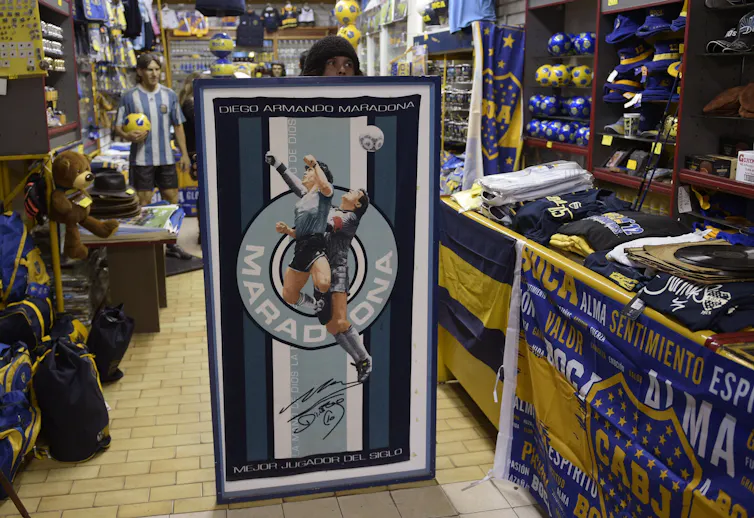
But it was the “Hand of God” that stood out, with the iconic capture of Maradona’s outstretched arm punching the ball over England goalkeeper Peter Shilton placed front and center, jumping out at visitors.
A year after the Gallery of Popular Idols was installed, I toured it with a group of international college students from a study-abroad program led by my wife. Knowing that I was a philosopher of sport, members of the group asked me an ethical question: Why was a goal scored illegally – it should have been disallowed as an obvious handball – given such prominence in the presidential palace? The same could be asked of the place it holds in the Argentine consciousness now, with the image common in murals, T-shirts and in songs.
Juan Mabromata/AFP via Getty Images
As I explained to the students, to understand why that game and those goals by Maradona – of the 34 he scored for the national team – have become so entrenched in the Argentine imagination, it is necessary to reflect on the complex history of Anglo-Argentine relations.
Anglo-Argentine relations
From the late 16th century onward, Britain sought to expand its empire into South America, mainly to expand the markets for its products elsewhere.
After failed attempts to invade Buenos Aires in 1806 and 1807, Britain played a key role in Argentina’s independence from Spain a few years later. Throughout the rest of the 19th century and the early 20th century, Britain had a major presence in the Argentine economy. So large was the investment and so numerous the British expatriate community that Argentina was described as Britain’s “Sixth Dominion.” Soccer, by way of this community, became a consuming passion of Argentines, too.
Still, the relationship was at times antagonistic. A long-running point of contention was over a group of islands 300 miles off the South American coast, known as the Falkland Islands in the United Kingdom and Islas Malvinas in Argentina.
Britain has occupied the islands since 1833, and Argentina has claimed them as its own ever since. Building tension gave way to war in 1982, when Argentina, then under a brutal dictatorship, sent a military expedition to the islands.

Fireshot Studio/Fototeca/Universal Images Group via Getty Images
Britain’s decisive response shattered the Argentine foray. Losing the war was a traumatic experience for Argentina, but one that proved an important step in the country’s eventual return to democratic rule the following year.
Maradona’s World Cup
Relations between the two countries were still tense when Argentina and England faced off during the 1986 World Cup. Diplomatic ties had not yet resumed, and many in Argentina perceived the game as an opportunity to honor the conscripts who died in the war and remind the world of the country’s claim to the Malvinas/Falkland Islands.
It was a game charged with intricate political and historical connotations. And Argentina entered it with the greatest player of the age in Diego Maradona.
As Eduardo Galeano, known as soccer’s global poet laureate, wrote in 1995: Mexico ’86 “was Maradona’s World Cup.”
“With two lefty goals against England, Maradona avenged the wound to his country’s pride inflicted in the [Malvinas/]Falklands war: the first he converted with his left hand … and the other with his left foot, after having sent the English defenders to the ground,” Galeano noted.
In the space of just five minutes, Maradona lifted his nation and was elevated to the status of an idol among idols. After the game, as controversy over the first goal swirled, Maradona, following the cue of a journalist, agreed that it must have been scored by the “Hand of God.”
While the second goal was the incarnation of soccer beauty, the imagery surrounding the first made it equally if not more iconic.
That Argentina went on to win the championship only added to Maradona’s imperishable repute, no matter what he did. His death on Nov. 25, 2020, triggered a wave of mourning in Argentina and around the world.
All that is good in the game
Back at the presidential palace, the students pressed me about how I and others should feel about the “Hand of God.” My answer, echoing philosophical arguments I made in a chapter I wrote for a book co-edited with philosopher Daniel G. Campos, went as follows.
Context matters for understanding the meaning that many in Argentina ascribed to that goal. Nonetheless, context cannot justify it.
Soccer is a social practice regulated by rules and what philosophers call “internal goods” – intrinsic rewards that come from participating in an activity. Soccer’s internal goods not only define the game but also represent the foundation for its standards of excellence. They comprise what are known as “constitutive” and “restorative” skills that the sport is meant to test.
Constitutive skills are those implemented during open play and include dribbling, passing and shooting the ball, and opening up spaces. Restorative skills are employed when a game is interrupted and include the ability to take penalty and corner kicks, among others.
Because of its structure, in soccer these sets of skills are clearly related to different ways to control and strike the ball with one’s feet.
A soccer genius … and a case of cheating
Scoring goals with one’s hand is neither a constitutive nor a restorative skill of soccer. Instead, it is an “extra-lusory skill” – that is, one not meant to be tested and thus does not legitimately belong in the game.
In fact, scoring a goal with one’s hands contradicts and dishonors the internal goods that define soccer and its standards of excellence. In this sense, the “Hand of God” downgrades the competency by which players distinguish themselves.
Additionally, it is an unambiguous case of cheating. Maradona intentionally and surreptitiously violated a rule of the sport to obtain an advantage that he would not have obtained otherwise – it distorts the sport, spoils the result and disrespects the opposing team.
It should not, as such, be encouraged or celebrated. Rather, it should be condemned.
Worse, it draws attention away from the kind of play that Maradona, who was subjected to repeated fouling by the English players throughout the game, embodied in the second goal. Indeed, soccer is honored and flourishes with that kind of play.
Over the course of a 60-yard run, Maradona danced past opponents, escaped challenges and left English defenders helpless before beating the goalkeeper with a clinical finish. Journalist Brian Glanville described it in 1993 as “astounding, a goal so unusual, almost romantic.” He added: “It hardly belonged to so apparently rational and rationalized an era as ours.”
That goal is arguably the most celebrated goal in World Cup history.
Forty years after that epochal game between Argentina and England, I suggest that Argentina and the world of soccer should in one breath condemn the scandalous “Hand of God” and rejoice in the sublime “Goal of the Century” – while never forgetting the context in which the two goals occurred.

Cesar R. Torres is Associate Professor of Kinesiology and Philosophy at Penn State.



























A Concerned Observer says
“When I was a child, I talked like a child, I thought like a child, I reasoned like a child. When I became a man, I put the ways of childhood behind me.” (1 Corinthians 13:11)
Telling children that every pet and person they ever knew that died, went to some beautiful benevolent place, “up in heaven”, where they can be with them “forever”, are all stories for children to help them get over the death of a friend, pet or loved one. Do mosquitos go to heaven when they die? I hope not. Native Americans in the United States believed in a “Happy Hunting Grounds” where there were enough game animals to last forever. Not so great a place for game animals. Some of the Muslim faith whole-heartedly believe that if they blow themselves up, killing as many “Infidels” as possible, they will be individually rewarded in Paradise with 72 virgins. Now 72 virgins are quite a few, but if Paradise is “Forever”, even 72 Virgins will run out eventually. One begs the question, if a man will get 72 Virgins, what do women get in Paradise? Are his 72 virgins supposed to last each man forever, or will they miraculously be reconstituted in perpetuity after each encounter? It doesn’t sound like women will have it so good in Paradise.
Any religious believer who singularly place their own parochial beliefs above everyone else in the entire world is very narrow minded indeed. If some Soccer player believes that some all-powerful benevolent being helped them make a fantastic play in a game, it hurts no one but him or herself. Might the same “Hand of God” also block the other team from scoring a point? In our world today, one believer in God must believe that any god would be too busy to intervein in one play, in some sporting event, somewhere in the world. A painting of the event on a wall is little more than graffiti. Get over it. Maybe, someday, they can put the ways of childhood behind them. Belief in the “Hand of God” intervention in a sporting event hurts no one but the individual believer. I, for one, am capable of leaving people alone, with whatever belief gets them through the day in their own little world. That is, except the one about killing as many Infidels as possible to get your share of virgins in Paradise. Sorry sports fans. In that one, I cannot abide.
Ray W. says
The tiny Cape Verde Islands soccer team has advanced to the World Cup’s round of 32 on the strength of three ties, two of which were gained against soccer powerhouses. With a population of only 500,000, 15 of the team’s 26 players have ties to the country through ancestry.
I hope Mr. Tristam is thrilled by the news.