• Skip to primary navigation
  • Skip to main content
  • Skip to primary sidebar
MENUMENU
MENUMENU
  • Home
  • About
    • Contact Us
    • FlaglerLive Board of Directors
    • Comment Policy
    • Mission Statement
    • Our Values
    • Privacy Policy
  • Live Calendar
  • Submit Obituary
  • Submit an Event
  • Support FlaglerLive
  • Advertise on FlaglerLive (386) 503-3808
  • Search Results

FlaglerLive

No Bull, no Fluff, No Smudges

MENUMENU
  • Flagler
    • Flagler County Commission
    • Beverly Beach
    • Flagler History
    • Mondex/Daytona North
    • The Hammock
    • Tourist Development Council
    • Marineland
  • Palm Coast
    • Palm Coast City Council
    • Palm Coast Crime
  • Bunnell
    • Bunnell City Commission
    • Bunnell Crime
  • Flagler Beach
    • Flagler Beach City Commission
    • Flagler Beach Crime
  • Cops/Courts
    • Circuit & County Court
    • Florida Supreme Court
    • Federal Courts
    • Flagler 911
    • Fire House
    • Flagler County Sheriff
    • Flagler Jail Bookings
    • Traffic Accidents
  • Rights & Liberties
    • First Amendment
    • Second Amendment
    • Third Amendment
    • Fourth Amendment
    • Fifth Amendment
    • Sixth Amendment
    • Seventh Amendment
    • Eighth Amendment
    • 14th Amendment
    • Sunshine Law
    • Religion & Beliefs
    • Privacy
    • Civil Rights
    • Human Rights
    • Immigration
    • Labor Rights
  • Schools
    • Adult Education
    • Belle Terre Elementary
    • Buddy Taylor Middle
    • Bunnell Elementary
    • Charter Schools
    • Daytona State College
    • Flagler County School Board
    • Flagler Palm Coast High School
    • Higher Education
    • Imagine School
    • Indian Trails Middle
    • Matanzas High School
    • Old Kings Elementary
    • Rymfire Elementary
    • Stetson University
    • Wadsworth Elementary
    • University of Florida/Florida State
  • Economy
    • Jobs & Unemployment
    • Business & Economy
    • Development & Sprawl
    • Leisure & Tourism
    • Local Business
    • Local Media
    • Real Estate & Development
    • Taxes
    • Sponsored Content
  • Commentary
    • The Conversation
    • Pierre Tristam
    • Diane Roberts
    • Guest Columns
    • Byblos
    • Editor's Blog
  • Culture
    • African American Cultural Society
    • Arts in Palm Coast & Flagler
    • Books
    • City Repertory Theatre
    • Flagler Auditorium
    • Flagler Playhouse
    • Special Events
  • Elections 2026
    • Amendments and Referendums
    • Presidential Election
    • Campaign Finance
    • City Elections
    • Congressional
    • Constitutionals
    • Courts
    • Governor
    • Polls
    • Voting Rights
  • Florida
    • Federal Politics
    • Florida History
    • Florida Legislature
    • Florida Legislature
    • Ron DeSantis
  • Health & Society
    • Flagler County Health Department
    • Ask the Doctor Column
    • Health Care
    • Health Care Business
    • Covid-19
    • Children and Families
    • Medicaid and Medicare
    • Mental Health
    • Poverty
    • Violence
  • All Else
    • Daily Briefing
    • Americana
    • Obituaries
    • News Briefs
    • Weather and Climate
    • Wildlife

Juneteenth’s Reminders

June 18, 2026 | FlaglerLive | Leave a Comment

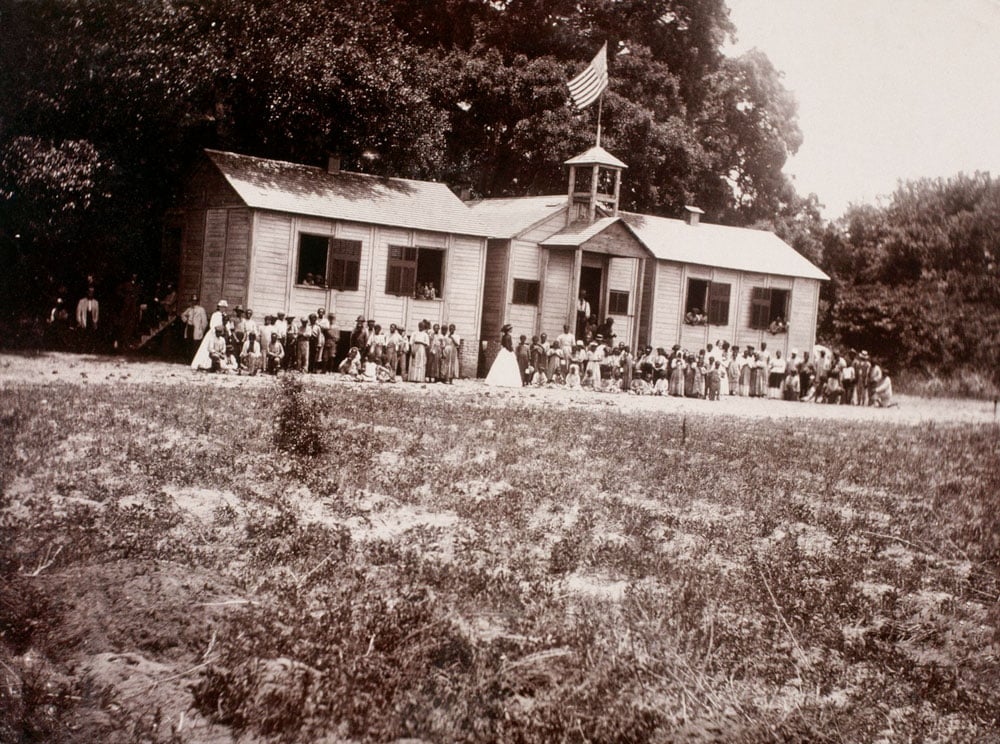
Students and teachers pose outside a National Freedmen’s Bureau school in Beaufort, S.C., in 1865.
Students and teachers pose outside a National Freedmen’s Bureau school in Beaufort, S.C., in 1865. Corbis/Getty Images

By Rodney Coates

The abolitionist and writer Frederick Douglass is known for many things, but perhaps among the most significant is his views on education’s relationship to slavery. Douglass himself was born into slavery in Maryland in 1818.

Douglass described in his 1845 autobiography how one of his enslavers, Mrs. Auld, began teaching him to read when he was a child. Mrs. Auld’s husband ordered her to stop giving Douglass lessons.

“Just at this point of my progress, Mr. Auld found out what was going on, and at once forbade Mrs. Auld to instruct me further, telling her, among other things, that it was unlawful, as well as unsafe, to teach a slave to read,” Douglass writes. “To use his own words, further, he said, ‘If you give a nigger an inch, he will take an ell. A nigger should know nothing but to obey his master.’”

Congress enacted the 13th Amendment on Jan. 31, 1865, abolishing slavery. It was not until June 19, 1865, that word of the amendment reached enslaved people in Galveston, Texas, marking the origin of the Juneteenth holiday.

The Biden administration declared Juneteenth a federal holiday in 2021. Today, Juneteenth commemorates the end of slavery in the U.S. But the story for formerly enslaved people continued to unfold in complex ways well after Juneteenth, including when it came to their educational journeys.

Juneteenth made clear that freedom was not just confined to someone’s physical enslavement, but mental enslavement as well, bound in the laws that barred enslaved people from receiving an education in Southern states.

A black and white drawing shows a group of children and two women dressed formally in a classroom.
A drawing of a National Freedmen’s Bureau school in Richmond, Va., in 1866.
Universal History Archive/Universal Images Group via Getty Images

Making learning illegal

In 1739, the Stono slave rebellion took place in South Carolina. Fearing that educated slaves would go on to plot future rebellions, South Carolina passed an anti-literacy law in 1740, banning slaves from being taught how to read.

Most Southern states soon followed with anti-literacy laws of their own between 1740 and 1834, in the hopes of preventing any further slave rebellions. These laws applied to both enslaved and free Black people.

Despite these laws, thousands of enslaved people still learned to read and write in the antebellum South. Literacy was a means of freedom.

Meanwhile, the first African Free School for Black children was established in New York City in 1787. The one-room schoolhouse began with 40 students, the majority of whom had parents who were formerly enslaved. Six additional, similar schools were created with public funding by 1824.

Juneteenth and the path to freedom

Juneteenth is a complicated story of formerly enslaved people’s faith and resilience, as well as white supremacists’ hate and resistance to formerly enslaved people experiencing liberation.

It also offers an important reminder that true freedom must also include the right to an education.

Formerly enslaved individuals had various responses to their newfound freedom in 1865, ranging from gratitude and joy to despair and loss.

Many formerly enslaved people decided to leave plantations and Southern states to reunite with family members and communities separated by slavery.

Others opted to remain where they had been enslaved, seeking to experience freedom in familiar surroundings. In fact, the vast majority of freed people remained in the South.

Regardless of their choices, the approximately 4 million formerly enslaved people challenged the U.S. to acknowledge their liberation and welcome them as equals.

Relentlessly, they endeavored to establish themselves as free citizens within the nation. One of these newly freed people’s primary goals was to receive an education.

Learning to read, write and more

After the Civil War, newly freed people gathered in churches, homes, cellars, sheds, meetinghouses and even under shade trees in the fields where they worked the crops to learn how to read and write. They also learned basic job skills, such as the ability to read and understand labor contracts.

Many of the teachers had no formal training, and some of them were local Black people who were self-taught.

Other educators included white teachers from the South and the North, sent by churches and aid societies.

White aid societies and religious organizations from the North, including the American Missionary Association and the National Freedman’s Relief Association, sometimes funded these free schools for formerly enslaved Black people.

However, most of the money to fund these schools came from the newly freed Americans, who privately paid for their schools.

While about 90% of the Black population in Southern states were illiterate in 1865, this percentage dropped to 70% by 1880.

A journey into higher education

Newly freed Black people also began to have more options for higher education.

The first historically Black college and university, Cheyney University, was established in Pennsylvania in 1837, well before the Civil War. A total of four HBCUs were established by the end of the Civil War in 1865.

At this point, true liberation began, as a growing number of HBCUs offered academic freedom to Black Americans, who otherwise would have been prohibited from attending most colleges and universities.

In the 15 years following the Civil War, a total of 59 HBCUs had opened their doors to Black students.

In 1867, by act of Congress, Howard University was established in Washington, D.C. It provided not only basic college courses but also programs in law, medicine, education and pharmaceuticals.

A black and white photo shows several rows of young Black people dressed formally sitting in rows of benches with a chalkboard nearby them.
A history class at the Tuskegee Institute, a coeducational elementary and secondary school for Black Americans founded in 1881 in Georgia.
Corbis/Getty Images

A promise that requires education

A whole new set of challenges and opportunities greeted the formerly enslaved Black Americans who sought freedom in the North. Most arrived in cities such as Chicago and New York, where they found some humanitarian support but also racial discrimination and poverty.

Their lives were constantly filled with both legal and racial hostility.

Education ranked high among the free people as a priority, as they looked to gain new skills and advance in life. They learned not only the basics in reading and math, but also job skills, citizenship and advanced learning in professional careers, such as law, medicine, pharmacy and teaching.

Ultimately, Juneteenth offered a promise of freedom – but education was necessary to make it happen.

Rodney Coates is Professor of Critical Race and Ethnic Studies at Miami University.


The Conversation arose out of deep-seated concerns for the fading quality of our public discourse and recognition of the vital role that academic experts could play in the public arena. Information has always been essential to democracy. It’s a societal good, like clean water. But many now find it difficult to put their trust in the media and experts who have spent years researching a topic. Instead, they listen to those who have the loudest voices. Those uninformed views are amplified by social media networks that reward those who spark outrage instead of insight or thoughtful discussion. The Conversation seeks to be part of the solution to this problem, to raise up the voices of true experts and to make their knowledge available to everyone. The Conversation publishes nightly at 9 p.m. on FlaglerLive.
See the Full Conversation Archives
Support FlaglerLive
The political climate—nationally and right here in Flagler County—is at war with fearless reporting. Your support is FlaglerLive's best armor. After 16 years, you know FlaglerLive won’t be intimidated. We dig. We don’t sanitize to pander or please. We report reality, no matter who it upsets. Even you. Imagine Flagler County without that kind of local coverage. Stand with us, and help us hold the line. There’s no paywall—but it’s not free. become a champion of enlightening journalism. Any amount helps. FlaglerLive is a 501(c)(3) non-profit news organization, and donations are tax deductible.
You may donate openly or anonymously.
We like Zeffy (no fees), but if you prefer to use PayPal, click here.
If you prefer the Ben Franklin way, we're at: P.O. Box 354263, Palm Coast, FL 32135.
 

Reader Interactions

Leave a Reply Cancel reply

Your email address will not be published. Required fields are marked *

This site uses Akismet to reduce spam. Learn how your comment data is processed.

  • Conner Bosch law attorneys lawyers offices palm coast flagler county
  • politis matovina attorneys for justice personal injury law auto truck accidents
  • grand living realty

Primary Sidebar

  • grand living realty
  • politis matovina attorneys for justice personal injury law auto truck accidents

Recent Comments

  • For Real on Record-Breaking Walmart Supercenter on SR 100 Clears Palm Coast Planning Board; Nearly 20,000 Car Trips Projected
  • Ray W. on The Daily Cartoon and Live Briefing: Friday, June 12, 2026
  • Sparks on Funky Pelican in Flagler Beach Ordered Temporarily Closed Following State Sanitation Inspection
  • Terrible on Funky Pelican in Flagler Beach Ordered Temporarily Closed Following State Sanitation Inspection
  • Fernando on Funky Pelican in Flagler Beach Ordered Temporarily Closed Following State Sanitation Inspection
  • Mike Warga on Record-Breaking Walmart Supercenter on SR 100 Clears Palm Coast Planning Board; Nearly 20,000 Car Trips Projected
  • Deborah Coffey on Record-Breaking Walmart Supercenter on SR 100 Clears Palm Coast Planning Board; Nearly 20,000 Car Trips Projected
  • Deborah Coffey on Two Flagler School Board Members Dismiss Concerns Over UNF Deletion of ‘Sexual Orientation’ Protection in District Agreement
  • Laurel on Sheriff Staly Blasts Proposed Homestead Property Tax Amendment as ‘Politics’ That ‘Screw Around With the Cities and the County’
  • Laurel on Record-Breaking Walmart Supercenter on SR 100 Clears Palm Coast Planning Board; Nearly 20,000 Car Trips Projected
  • Atwp on Trump Iran Deal Returns Conflict to Costly Prewar Conditions
  • Atwp on 3 Years in Prison for National Guardsman Nicholas McLean, 22, for Bike Week DUI Crash That Killed Robert Clark on Belle Terre
  • Atwp on Record-Breaking Walmart Supercenter on SR 100 Clears Palm Coast Planning Board; Nearly 20,000 Car Trips Projected
  • Villein on Flagler County Commissioners Want Public to Learn How Homestead Tax Amendment Would Gut Quality of Life
  • Mark on Record-Breaking Walmart Supercenter on SR 100 Clears Palm Coast Planning Board; Nearly 20,000 Car Trips Projected
  • FedUp on Record-Breaking Walmart Supercenter on SR 100 Clears Palm Coast Planning Board; Nearly 20,000 Car Trips Projected

Log in