


It appears that Flagler County’s operating tax rate next year will be $7.9945 per $1,000 in taxable value, unchanged from this year, and a bare fraction under the rolled back rate–the rate at which the government would take in the same amount of revenue next year as it did this year, excluding revenue from new construction.
Because property values went down slightly this year, the rolled back rate is actually a marginally higher tax rate next year than it is this year. In effect, the county’s rate of 7.9945 will be a fractional tax cut.
The Flagler County Commission on Monday held what was billed as one of the last budget workshops in preparation for a pair of public hearings to adopt next year’s tax rate and budget, in a season when it’s held relatively few such workshops.
Commissioners complained about the sheriff and the clerk of court not cutting enough from their budget. They complained about the proposed property tax rate not getting cut enough. They imagined whether or not Amendment 3, the proposed homestead exemption reform, will pass in November, and what effect that will have on their and their constitutional officers’ budgets.
They did so in a desert of hard information in a year when local government budgets are dominating the political landscape and frame what could be the most consequential upheaval in tax revenue in more than a generation.
Compared to the hundreds of pages of fine print that bulked up budget workshops in years past, the information the administration submitted to the commission and the public Monday was less than skeletal. It was barely coherent and impossible to decipher if you’re trying to know how much the county and its constitutional officers are spending now, how much they project to spend next year, and what the comparative property tax rate will be. (See the presentation below.)
Those documents are available in the county’s labyrinthine troves of records. They’re not being made public, as they used to be down to line-item budgets for every department and every division. A July 13 presentation, when the commission adopted a tentative tax rate, was a bit less stingy with numbers, but even then, barely so. In previous years–and particularly in the years of County Administrator Craig Coffey’s administration–the commission would hold up to a dozen workshops to go through the budget at times line by line, as the Flagler Beach City Commission still does (albeit with a much smaller budget) and the Palm Coast City Council does to a lesser extent.
Never before have county budget preparation documents been so thin or incomprehensible, and in places so meaningless: the entirety of Monday’s “presentation” consisted of seven slides in large print, with three of the slides listing past and future dates, and the others vague tables about what roof and air conditioning replacements might be ahead, and what special assessment rates will be next year.
That was what Brian Eichinger, manager of the county’s Office of Management and Budget, described as the “final review of the tentative budget.”
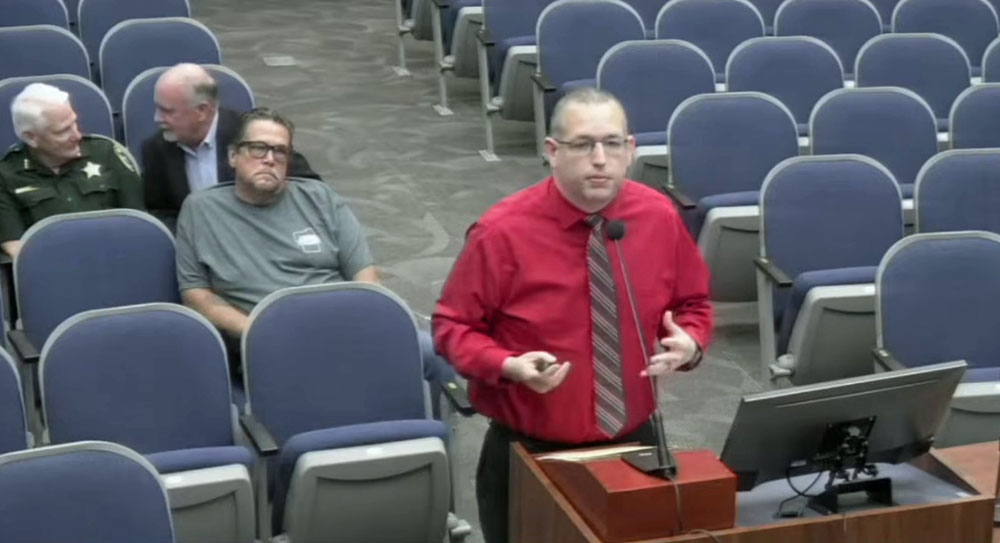
“When we’ve had this meeting in the past, it’s kind of hey, you guys are good with what we’ve presented so far, let’s avoid any last-minute adjustments,” he said, referring to a history as obscure as the documents: even last year, the documentation was more copious at most stages of the process. “So, if you guys are good, this is what you’ll see at the first public hearing. We have tentatively scheduled a workshop for the 17th. If you guys don’t feel like you need it today, after we go through this, we don’t need to meet.”
Commissioner Andy Dance alone requested an additional meeting, and noted the dearth of information. He wants more of it “just to complete the picture before we get to the public hearing,” he said, “where we’ve been with millage, where it is, where it’s proposed, same thing with just the complete picture. I think all of it together.”
The workshop discussion was equally diffuse, starting with a brief overview of the county’s efforts to rein in some of the constitutional officers’ budgets–particularly the sheriff’s and the clerk of court’s. Those budgets drew sharp rebukes from some of the commissioners.
The administration met with both. The two constitutionals “crafted their budgets with their needs in mind,” Acting County Administrator Adam Mengel said, “with their level of service standards that they each applied respectively to their organizations.”
The initial ask from the clerk was an increase of $500,000. The revised ask is $300,000, which includes cost-of-living, retirement and health insurance increases, plus two positions, Clerk of Court Tom Bexley said.
“So, neither constitutional is moving this millage rate anywhere off of 7.89,” Commissioner Kim Carney said, referring to the property tax rate (the proposed tax rate is 7.99). “So if we don’t have anything from the sheriff or anything from the clerk that will help us move that millage off of 7.89, this is just a numbers game. Is all it is. We all know it. We’re going to stick with that millage because that’s what we put in a couple of meetings ago, and we’ve not moved off that millage.”
She was complimentary of Mengel supposedly cutting $5 million from the commission’s side of the budget, though no one could have any idea what she was referring to, since documents showing the cuts were nowhere available for public inspection. Nor was it clear whether the cuts were from the proposed or the existing budget. She complained that other constitutional officers couldn’t yield more savings. “We either have a common millage reduction of a tenth of a mill, we have some kind of a reduction, or it’s futile. This whole thing is futile.”
Commissioner Andy Dance put it even more bluntly: “Go ahead and add two positions, and it’s very possible that you’re you’re cutting them next year. We don’t make those calls, but they’re going to be faced with similar circumstances,” he said. “The big increases that we’ve seen I think I’ve said it I think to each of them before, but it’s kind of tone deaf. They’re not listening to the room, and the writing’s on the wall. The tone is efficiencies.”
Sheriff Rick Staly said the reduction in the cost of living raise would reduce his budget by $200,000. He also proposed that the county fund the positions he is requesting, and that, in exchange he would decide what positions within his agency would go unfunded. Those positions would not be deputies, he said.
Commission Chair Leann Pennington said she expects that one way or another, the homestead exemption will increase–whether through November’s referendum or through legislative reform next year. If the tax rate isn’t lowered, it will spur voters or legislators to approve “ill thought out tax reform plans,” she said.
The county will fund the three additional sheriff’s deputies the sheriff requested–“maybe the only ones you’re getting this year,” Dance told the sheriff, who was in the audience, a reference to Palm Coast’s resistance to adding nine deputies this year. The fire services are maintaining their staffing without additions
Commissioner Pam Richardson said, drawing a bleak picture of the construction and real estate sectors. It wasn’t clear what that had to do with the budget discussion. She appeared to be making the case for a tax cut. “Our real estate economy has dropped to next to nothing, and I have 10, 20 realtors this year looking for jobs,” Richardson said. “Their homes are being built, and nothing, nobody’s filling them. It’s just the facts.”
Sheriff Rick Staly addressed the commission to highlight various savings, such as through a particular inmate medical program (with cumulative savings of over $7 million over three years, he said), or a health insurance rate increase that had been slated to go up 44 percent and was negotiated down to 22 percent. “Even with my increase, I’m still $2,500 less per employee for health care insurance” than the county, he said. “You’re staying at $17,172. My next year in our budget is $15,057.” He cited several grants that continue to offset county taxpayer costs.
Then he turned to the homestead amendment, and just as he did before the Palm Coast City Council in June, he spoke critically of the proposal. “I agree there needs to be tax reform,” he said. “I have felt it myself when I built my new house, so I totally get it, and but I think this was an ill-advised political response. There were so many other ways that could have been done.”
Carney said the commission is barred by law from spending money to advocate for or against the amendment. “That includes ourselves,” Pennington, the commission chair, said.
Carney was partly right, and Pennington was incorrect: county government as a body may not spend money to campaign for or against any political measure or referendum. But Commissioners individually are not barred from campaigning for it one way or the other, from expressing themselves freely about it, or even from spending their own money for or against it. Staly has chosen to be vocal about it. Most other local elected officials have not been as daring.





Leave a Reply