



By Austin Sarat
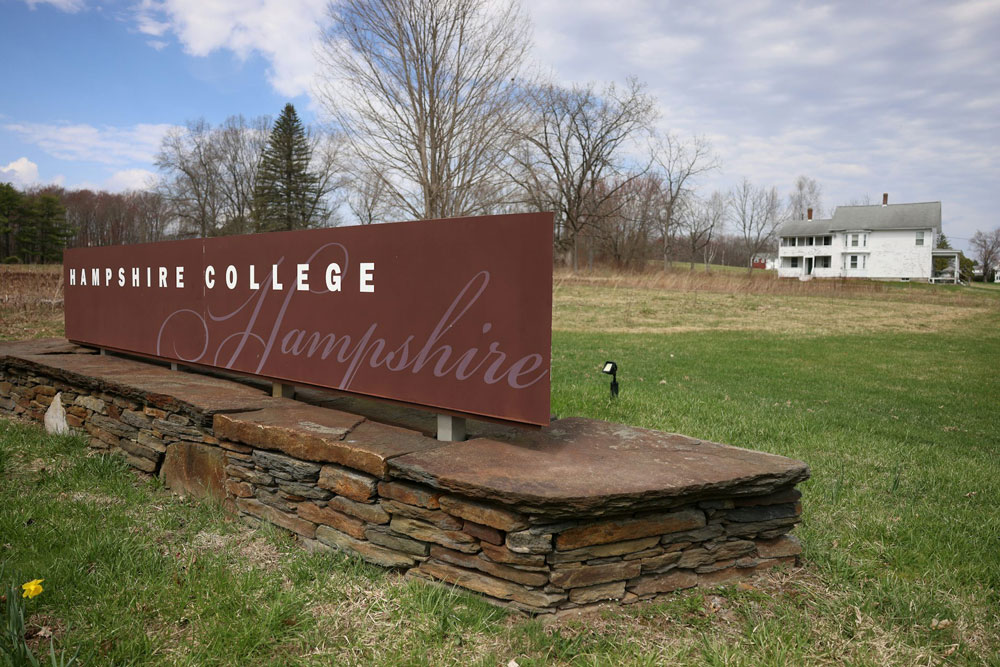
Hampshire College, a private college located in Amherst, Massachusetts, announced on April 14, 2026, that it was joining the list of small, experimental liberal arts colleges that have closed their doors over the past few years.
Hampshire will cease operations in December 2026 because of “declining enrollment, the weight of long-standing debt, and stalled progress on land development,” Hampshire board chair Jose Fuentes said in a statement. Hampshire currently enrolls 625 students, about half the number who attended in the early 2000s.
Recently admitted Hampshire students will receive a refund on their deposit. Hampshire’s current students completing their final capstone project can still graduate from the school. Other enrolled students can transfer to another school in Massachusetts that is part of the Five College Consortium. Amherst College, where I teach law, is part of this consortium. This arrangement allows students from participating colleges to take classes on different campuses.
As someone who has taught many Hampshire students, I can attest that the college delivered an education that lived up to its motto, “Non Satis Scire,” meaning “To Know Is Not Enough.”
I have also written about the financial dilemmas liberal arts colleges are facing, as enrollment drops, finances are strained and they are pressured to adopt vocational programs.
Hampshire’s demise is another sign of the consolidation occurring in higher education, in which wealthy schools and those that deliver a traditional and often vocationally driven curriculum have an advantage. Meanwhile, dozens of small colleges with small endowments, like Hampshire, cannot keep up.

Jonathan Wiggs/The Boston Globe via Getty Images
A growing list of shuttered liberal arts schools
Founded in 1965, Hampshire billed itself as a school that “scrapped generic models of learning” and offered a student-driven curriculum. It does not have traditional core course requirements and encourages students to undertake self-directed projects.
Hampshire is the latest experimental New England college to find its approach was not sustainable.
Three Vermont colleges – Green Mountain College, Marlboro College and Goddard College – closed in 2019, 2020 and 2024, respectively.
These schools were hardly household names in the higher education world, but each was prominent among aficionados of experimental education.
These colleges emphasized students undertaking independent studies, did not have standard academic departments and de-emphasized faculty research. They attracted quirky, passionate students, many of whom did not thrive in traditional high school settings.
The dream of experimental education
The origins of experimental education in colleges and universities can be traced to the turn of the 20th century and the American philosopher John Dewey. While Dewey focused on elementary and secondary education, he also wrote a book in 1899 called “The School and Society: Being Three Lectures,” which became a handbook for schools like Hampshire College.
Dewey “insisted that the old model of schooling … was antiquated,” explained Peter Gibbon, an education scholar at Boston University.
Dewey believed that “students should be active, not passive,” wrote Gibbon. “Interest, not fear, should be used to motivate them. They should cooperate, not compete.”
Those principles inspired the first stirrings of experimental education in the United States.
In 1917, Deep Springs College, a college focused on student self-government and manual labor, opened on a California cattle ranch. There are 24 to 30 undergraduate students at a time at this two-year school. Students are responsible for helping to run the school, including hiring faculty and admitting new students.
In 1921, Antioch College, a private college in Ohio that had opened 70 years earlier, reorganized itself to emphasize learning by doing. It became the first liberal arts college in the U.S. to create a co-op program, which combined in-class instruction with learning through employment outside the college.
Dewey’s influence also inspired Alexander Meiklejohn, who, after a tumultuous tenure as president of Amherst College in the early 1900s, directed the Experimental College at the University of Wisconsin from 1927 to 1932. Students at this independent college, operating within the broader University of Wisconsin, did not receive conventional grades. They also studied in six-week sessions, rather than traditional semesters that last a few months.
Meiklejohn wrote that this school had “one aim and that aim is intelligence.”
Some University of Wisconsin faculty, though, thought Meiklejohn’s approach was not rigorous. In a preview of what was to come a century later, the Experimental College closed five years after its inception.
Sarah Lawrence, a New York liberal arts college that opened in 1926, and Bennington College, a small college that opened in Vermont in 1932, were soon added to the list of the early adopters of experimental education.

Robert Gauthier/Los Angeles Times via Getty Image
Experimental colleges come into their own
Throughout the late 1950s and ’60s, dozens of other experimental colleges were founded, including Evergreen State College in Washington state.
These schools were not developed to transform higher education, argues education scholar Reid Pitney Higginson. They were designed to add variety to the menu of existing schools.
In a sense, experimental colleges captured the spirit of the 1960s. They wanted to free their students from the traditional educational paths and empower them to have a say in how their colleges operate. That sometimes caused difficulty, when students pushed for greater control over their schools.
Yet even in their halcyon days, experimental colleges never became as financially well off nor as prestigious as their mainstream competitors. At its founding, Hampshire seemed to have a distinct advantage: its membership in the Five College Consortium, connecting it with Amherst, Smith College, Mount Holyoke College and the University of Massachusetts.
An exception to the rule
But even that was not enough to save Hampshire. One challenge for it and other higher education institutions is that a rising number of students are questioning the value of a college degree, especially if it does not result in skills or a certification they can quickly use as graduates to make a living.
Tuition and housing for students attending Hampshire in the 2025-26 school year costs more than US$72,000.
Hampshire’s closing signals the full flowering of a higher education era that favors well-resourced schools, which benefit from federal funding and large private donations. Those schools often deliver a more conventional, safer educational product and can attract students from wealthy families.
Because Hampshire remained steadfastly unconventional, its failure may encourage schools to double down on offerings they know will attract a job-anxious generation of students.
What documentary filmmaker and Hampshire graduate Ken Burns told The New York Times about his alma mater’s closing helps explain why it and other experimental colleges could not survive as the exception to the rule in today’s higher education landscape.
“(Hampshire) was dedicated to a transformational education, in an era when higher education has been hijacked by the transactional,” Burns said. “A college education is, to some, like a Louis Vuitton handbag. And that’s not Hampshire.”

Austin Sarat is William Nelson Cromwell Professor of Jurisprudence and Political Science at Amherst College




























Al says
[Note: the comment below lacks context about the Obama action regarding vocational schools. First, there was no cut to student loans. Second, Obama restricted federal financial aid access by low-performing, for-profit, predatory vocational schools exploiting the Gainful Employment Rule to prevent those fly-by-night schools from running up students’ debt without enabling students to gain employment.–FL]
So sad, I remember all the concern when Obama cut student loans to vocational training schools. All universities and colleges should have to meet that same placement threshold in order to get student loans. Not many would last would they? My wife went to UF and graduated with no loans, I went to Texas A & M graduated with no loans. My daughter went to the U and I paid cash so she could start life with a clean slate, we’ve all done well . Now let’s look at this college, 72,000 a year that student is behind the 8 ball before they start. What are the degrees worth if there’s no structure? Ken Burns did well but how about the others before and after him, did they stand a chance with a degree in whatever? Plumbers, welders, electricians can start their own businesses and do way better than most degrees offer in the workplace. Kids taking humanities or liberal arts should take speech courses and practice do you want fries with that.
Deborah Coffey says
Fact check: AI President Obama did not issue a blanket ban on student loans for vocational schools, but his administration did enact the “gainful employment” rule in 2014. This policy cut off federal student aid and loans to career-training and vocational programs—primarily at for-profit colleges—if their graduates consistently faced unmanageable debt-to-earnings ratios or high default rates.
Al says
Thank you for making my point. Debt to earning ratios have forced how many people with degrees into default. Why are all these graduates not able to find meaningful work with their degrees? A college student borrows 200,000 and defaults, that’s 100 vocational students but who’s counting.
Deborah Coffey says
Fact check AI: President Obama did not issue a blanket ban on student loans for vocational schools, but his administration did enact the “gainful employment” rule in 2014. This policy cut off federal student aid and loans to career-training and vocational programs—primarily at for-profit colleges—if their graduates consistently faced unmanageable debt-to-earnings ratios or high default rates.
Al says
If the probably AI that scaned my response had ingested what I wrote the warning wouldn’t be posted. I didn’t say Barry stopped student loans I said he cut the vocational training loans by imposing an unrealistic placement requirement. What I was referring to was that colleges and universities aren’t saddled with the same rules. Students paying 2,000 to learn a skill are not as worthy as one paying 150,000 to learn how to party. Funny how a lot of local colleges now have diesel mechanic, welding, truck driving and electrician courses.
Laurel says
Oh, please integrate the classic with the experimental! We need critical, creative thinking and standard knowledge.
By the time I was in the eleventh grade, I was walking out of classes out of sheer boredom. My teachers wondered where I thought I was going, to which I didn’t respond. They should have known, or, had the freedom to prevent boredom. There has to be interest.
Two different things happened while in college. The first, was I realized that the college was not pushing entrepreneurship, and I confronted my teacher with that revelation (for me anyhow) and was informed it was the school’s intent to prepare us to work for companies.
The second thing was the opposite, at the same school. Since I was interested in art, and was the school paper’s artist, and won an award for one of my drawings, I took an independent study class with the objective to sell a cartoon to a national magazine or paper. One cartoon was printed in a local paper, but it was not sold. Another drawing was sold to Cats Magazine, which is a nationally known magazine. I gave myself an “A”!
Point being, I was taught the basics, but I was not saddled by conformity. I was able to get the experience directly in what I was interested in at the time, and it gave me the confidence to pursue things other than being stuck in a conformity format.