• Skip to primary navigation
  • Skip to main content
  • Skip to primary sidebar
MENUMENU
MENUMENU
  • Home
  • About
    • Contact Us
    • FlaglerLive Board of Directors
    • Comment Policy
    • Mission Statement
    • Our Values
    • Privacy Policy
  • Live Calendar
  • Submit Obituary
  • Submit an Event
  • Support FlaglerLive
  • Advertise on FlaglerLive (386) 503-3808
  • Search Results

FlaglerLive

No Bull, no Fluff, No Smudges

MENUMENU
  • Flagler
    • Flagler County Commission
    • Beverly Beach
    • Flagler History
    • Mondex/Daytona North
    • The Hammock
    • Tourist Development Council
    • Marineland
  • Palm Coast
    • Palm Coast City Council
    • Palm Coast Crime
  • Bunnell
    • Bunnell City Commission
    • Bunnell Crime
  • Flagler Beach
    • Flagler Beach City Commission
    • Flagler Beach Crime
  • Cops/Courts
    • Circuit & County Court
    • Florida Supreme Court
    • Federal Courts
    • Flagler 911
    • Fire House
    • Flagler County Sheriff
    • Flagler Jail Bookings
    • Traffic Accidents
  • Rights & Liberties
    • First Amendment
    • Second Amendment
    • Third Amendment
    • Fourth Amendment
    • Fifth Amendment
    • Sixth Amendment
    • Seventh Amendment
    • Eighth Amendment
    • 14th Amendment
    • Sunshine Law
    • Religion & Beliefs
    • Privacy
    • Civil Rights
    • Human Rights
    • Immigration
    • Labor Rights
  • Schools
    • Adult Education
    • Belle Terre Elementary
    • Buddy Taylor Middle
    • Bunnell Elementary
    • Charter Schools
    • Daytona State College
    • Flagler County School Board
    • Flagler Palm Coast High School
    • Higher Education
    • Imagine School
    • Indian Trails Middle
    • Matanzas High School
    • Old Kings Elementary
    • Rymfire Elementary
    • Stetson University
    • Wadsworth Elementary
    • University of Florida/Florida State
  • Economy
    • Jobs & Unemployment
    • Business & Economy
    • Development & Sprawl
    • Leisure & Tourism
    • Local Business
    • Local Media
    • Real Estate & Development
    • Taxes
    • Sponsored Content
  • Commentary
    • The Conversation
    • Pierre Tristam
    • Diane Roberts
    • Guest Columns
    • Byblos
    • Editor's Blog
  • Culture
    • African American Cultural Society
    • Arts in Palm Coast & Flagler
    • Books
    • City Repertory Theatre
    • Flagler Auditorium
    • Flagler Playhouse
    • Special Events
  • Elections 2026
    • Amendments and Referendums
    • Presidential Election
    • Campaign Finance
    • City Elections
    • Congressional
    • Constitutionals
    • Courts
    • Governor
    • Polls
    • Voting Rights
  • Florida
    • Federal Politics
    • Florida History
    • Florida Legislature
    • Florida Legislature
    • Ron DeSantis
  • Health & Society
    • Flagler County Health Department
    • Ask the Doctor Column
    • Health Care
    • Health Care Business
    • Covid-19
    • Children and Families
    • Medicaid and Medicare
    • Mental Health
    • Poverty
    • Violence
  • All Else
    • Daily Briefing
    • Americana
    • Obituaries
    • News Briefs
    • Weather and Climate
    • Wildlife

Justice Jackson’s Birthright Citizenship Opinion Was Black Grounded in History, Thomas’s In Distortion

July 10, 2026 | FlaglerLive | Leave a Comment

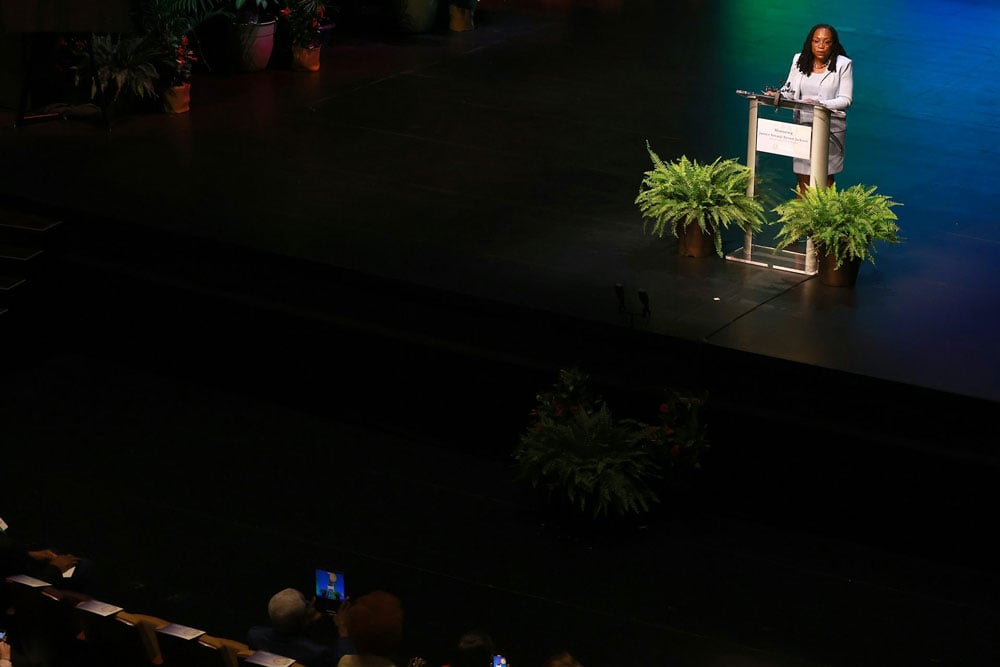
Supreme Court Associate Justice Ketanji Brown Jackson speaks in Cutler Bay, Fla., on March 6, 2023.
Supreme Court Associate Justice Ketanji Brown Jackson speaks in Cutler Bay, Fla., on March 6, 2023. (Joe Raedle/Getty Images)

By Austin Sarat

In the annals of Supreme Court decisions, the public likely remembers what justices wrote for the court in famous cases, such as the Brown v. Board of Education ruling that outlawed racial segregation in public schools.

Or perhaps the public remembers great dissenting opinions that display foresight and speak across the ages. Justice John Marshall Harlan’s dissent in the 1896 Plessy v. Ferguson case, which legalized racial segregation, is a shining example.

But Supreme Court scholars and the public alike seldom pay much attention to concurring opinions, in which a justice expounds on the views of their colleagues in the majority. Some legal experts have denigrated concurring opinions as “the worst form of legal clutter… that are, usually, better left unwritten.”

On June 30, 2026, in the Trump v. Barbara ruling, Justice Ketanji Brown Jackson showed how wrong that view can be when she delivered a monumental concurring opinion in the birthright citizenship case.

Chief Justice John Roberts wrote the majority opinion, ruling that the 14th Amendment guarantees automatic citizenship to virtually everyone born on U.S. soil. The decision invalidated President Donald Trump’s executive order that sought to deny citizenship to children born to foreign parents who are unlawfully in the United States.

Jackson, however, used her concurrence to go far beyond that and offer a new understanding of the origins of the 14th Amendment’s guarantee of birthright citizenship and its promise of equal treatment. She did so while emphasizing the singular contributions of Black Americans to that endeavor.

Along the way, Jackson criticized Justice Clarence Thomas and the court’s dominant originalist jurisprudence – centered on interpreting the Constitution based on how it was understood when it was adopted – for distorting the historical record. Jackson has previously signaled that a responsible use of history requires examining all relevant sources instead of cherry-picking among them to make a particular point.

As a politics scholar who has written about history and law, I believe that years from now, when Americans look back on Trump v. Barbara, it will be Jackson, not Roberts, whom they remember.

No shrinking violet

During her brief tenure on the court, Jackson has shown herself to be no shrinking violet. From the start, she has made her voice heard during oral arguments and in her written opinions.

As political scientists Jake Truscott and Adam Feldman wrote in December 2022, after her first three months as a justice, Jackson “was by far the most active participant in oral arguments.”

Since then, nothing has changed about Jackson’s style on the bench. The Washington Examiner reports that she “took up more than 20% of the Supreme Court’s questioning last term.”

Jackson also is not shy about writing dissenting opinions, and the occasional concurrence, whether in combination with others or alone. In both her dissents and concurrences, Thomas, the court’s only other Black member and its leading proponent of originalism, has been one of her main targets.

A close up profile view of a Black woman wearing glasses.
Ketanji Brown Jackson testifies before a Senate Judiciary Committee hearing on pending judicial nominations on April 28, 2021, in Washington.
Kevin Lamarque/Pool via AP

For example, in her 2023 dissent from the court’s decision to end affirmative action in higher education, Jackson directly criticized Thomas when she wrote that “those who demand that no one think about race … refuse to see, much less solve for, the elephant in the room – the race-linked disparities that continue to impede achievement of our great Nation’s full potential.”

Originalism, Jackson-style

Jackson has also called herself an originalist. However, she departs from Thomas’ brand of originalism.

For Jackson, to understand how any provision of the Constitution was understood requires unearthing sources of constitutional meaning that have been largely ignored by others on the court.

That vision was on display in her concurring opinion in the birthright citizenship case. There, Jackson paid particular attention to what Black Americans did in inspiring and crafting the 14th Amendment.

This contrasts with the traditional originalist story that highlights white protagonists such as Pennsylvania Rep. Thaddeus Stevens, who introduced the proposal to add the 14th Amendment to the Constitution, or President Andrew Johnson, who resisted the 14h Amendment on the grounds that it infringed on states’ rights.

Justice Thomas embraced this sort of vision in Trump v. Barbara. As he tells it, the birth of the 14th Amendment can be traced to the concerns of members of the Reconstruction Congress that the 1866 Civil Rights Act, which extended certain fundamental rights to “all persons born in the United States,” would be repealed or overturned in the courts.

Black people have little or no role in Thomas’ account.

Black Americans and birthright citizenship

Jackson’s opinion registers her impatience with such an exclusion. She faults Thomas for his “narrow vision of the Fourteenth Amendment (that) bears little relationship to the history of its ratification.”

Instead, Jackson traces the 14th Amendment to work done by people “within and beyond Congress.”

Jackson follows Harvard historian Jill Lepore’s suggestion that originalist judges should always attend to “all the people who are basically knocking on the windows and banging on the doors with their ideas about what should be in the Constitution.”

A Black woman and white man walk down steps in front of a federal building.
Justice Ketanji Brown Jackson and Chief Justice John Roberts walk down the steps of the Supreme Court on Sept. 30, 2022.
Anna Moneymaker/Getty Images

As Jackson recounts, “In the decades leading up to the ratification of the 14th amendment, black Americans organized and gathered at more than 600 local and national conventions across the country. There, delegates erected the political and intellectual scaffolding of the 14th amendment and, later, for the black civil rights movement more generally.”

Contrary to Thomas, who argues that birthright citizenship applies only to former slaves and their offspring, Jackson notes that Blacks “helped galvanize the push for full equality.” When ratified, Jackson explains, “the citizenship clause thus vindicated the universalist vision of the delegates at the colored conventions and their allies in Congress.”

And in a pointed dig at her colleague, Jackson writes that the “distortion of historical facts – retellings that reimagine and repurpose past events to lend credence to misbegotten aims” – poses a grave threat to the constitutional project and America’s well-being.

Extending the work of the 1619 Project

Jackson’s concurrence in the birthright case builds on the approach to history taken by the so-called 1619 Project. That project, unveiled by The New York Times in 2019, “aimed to reframe the country’s history by placing the consequences of slavery and the contributions of black Americans at the very center of our national narrative.”

Nikole Hannah-Jones, creator of the 1619 Project, insists “the United States simply would not exist without us. The idealistic, strenuous, and patriotic efforts of black Americans have helped the country live up to its founding ideals.”

Jackson fully embraces that story and, in her concurring opinion in Trump v. Barbara, extends it to include what happened in 1866 when the U.S. restated and renewed its founding commitment to equality. She suggests that the 14th Amendment would not have come into being without similar “patriotic efforts” by Black Americans.

What makes Jackson’s concurrence extraordinary, Slate’s Robyn Nicole Sanders writes, “is that it insists on telling the 14th amendment story honestly … (and) it is at moments elegiac in its remembrance of the people whose suffering and resistance gave birth to the citizenship clause.”

That is why I believe Jackson’s concurrence will be remembered as one of the great opinions produced by a Supreme Court justice.

Austin Sarat is William Nelson Cromwell Professor of Jurisprudence and Political Science at Amherst College


The Conversation arose out of deep-seated concerns for the fading quality of our public discourse and recognition of the vital role that academic experts could play in the public arena. Information has always been essential to democracy. It’s a societal good, like clean water. But many now find it difficult to put their trust in the media and experts who have spent years researching a topic. Instead, they listen to those who have the loudest voices. Those uninformed views are amplified by social media networks that reward those who spark outrage instead of insight or thoughtful discussion. The Conversation seeks to be part of the solution to this problem, to raise up the voices of true experts and to make their knowledge available to everyone. The Conversation publishes nightly at 9 p.m. on FlaglerLive.
See the Full Conversation Archives
Support FlaglerLive
The political climate—nationally and right here in Flagler County—is at war with fearless reporting. Your support is FlaglerLive's best armor. After 16 years, you know FlaglerLive won’t be intimidated. We dig. We don’t sanitize to pander or please. We report reality, no matter who it upsets. Even you. Imagine Flagler County without that kind of local coverage. Stand with us, and help us hold the line. There’s no paywall—but it’s not free. become a champion of enlightening journalism. Any amount helps. FlaglerLive is a 501(c)(3) non-profit news organization, and donations are tax deductible.
You may donate openly or anonymously.
We like Zeffy (no fees), but if you prefer to use PayPal, click here.
If you prefer the Ben Franklin way, we're at: P.O. Box 354263, Palm Coast, FL 32135.
 

Reader Interactions

Leave a Reply Cancel reply

Your email address will not be published. Required fields are marked *

This site uses Akismet to reduce spam. Learn how your comment data is processed.

  • Conner Bosch law attorneys lawyers offices palm coast flagler county
  • politis matovina attorneys for justice personal injury law auto truck accidents
  • VERANDA BAY FLAGLER BEACH GATED COMMUNITY
  • grand living realty

Primary Sidebar

  • grand living realty
  • VERANDA BAY FLAGLER BEACH GATED COMMUNITY
  • politis matovina attorneys for justice personal injury law auto truck accidents

Recent Comments

  • Kim on Florida Intentionally Keeping SNAP Error Rate High to Slash Eligibility and Reduce Beneficiaries, Democrats Say
  • Jeffery Cortland Seib on Father And Son Arrested After Locking Distressed Dogs And Pigeons Inside Hot U-Haul Truck
  • Land of no turn signals says on Father And Son Arrested After Locking Distressed Dogs And Pigeons Inside Hot U-Haul Truck
  • Sherry on The Daily Cartoon and Live Briefing: Wednesday, July 8, 2026
  • Deborah Coffey on Florida Intentionally Keeping SNAP Error Rate High to Slash Eligibility and Reduce Beneficiaries, Democrats Say
  • Gina Weiss on Tempers Flare As Palm Coast Council Advances Parts of $600 Million Utility System Expansion and Improvements
  • TR on DCF Reports 3 Verified Flagler Cases of Child Commercial Sexual Exploitation in 2025, and 434 in the State
  • Laurel on Florida’s ‘Stop WOKE Act’ at Universities Ruled Unconstitutional in Blunt Decision by Trump Appointee
  • Laurel on The Daily Cartoon and Live Briefing: Thelonious Monk Teddy Roosevelt LBJ
  • Laurel on DCF Reports 3 Verified Flagler Cases of Child Commercial Sexual Exploitation in 2025, and 434 in the State
  • Pogo on The Bayeux Tapestry’s Norman Propaganda Silenced Voices of Grief and Resistance Now Uncovered
  • Common Sense on Bryan Jackson, Deputy Who’d Accidentally Shot 11-Year-Old Boy, Resigns Ahead of Internal Affairs Sanctions
  • Laurel on DCF Reports 3 Verified Flagler Cases of Child Commercial Sexual Exploitation in 2025, and 434 in the State
  • Pogo on The Daily Cartoon and Live Briefing: Wednesday, July 8, 2026
  • Sherry on Stricter SNAP Stocking Rules Threaten Small Grocery Stores
  • Sherry on The Daily Cartoon and Live Briefing: Thelonious Monk Teddy Roosevelt LBJ

Log in