



To include your event in the Briefing and Live Calendar, please fill out this form.
Weather: Mostly cloudy, with a high near 78. Friday Night: A 20 percent chance of showers after 1am. Mostly cloudy, with a low around 62.
- Daily weather briefing from the National Weather Service in Jacksonville here.
- Drought conditions here. (What is the Keetch-Byram drought index?).
- Check today’s tides in Daytona Beach (a few minutes off from Flagler Beach) here.
- Tropical cyclone activity here, and even more details here.
Today at a Glance:


Free For All Fridays with Host David Ayres, an hour-long public affairs radio show featuring local newsmakers, personalities, public health updates and the occasional surprise guest, starts a little after 9 a.m. Today: Incoming Palm Coast City Manager Michael McGlaughlin. See previous podcasts here. On WNZF at 94.9 FM, 1550 AM, and live at Flagler Broadcasting’s YouTube channel.
The Florida Ethics Commission meets at 8:30 a.m. in the third-floor Courtroom, First District Court of Appeal, 2000 Drayton Drive, Tallahassee. Except for the closed-door session, the meetings are generally live on the Florida Channel.
Holiday Sale to Benefit Area Homeless: Holiday Sale featuring ornaments décor, jewelry, gifts, home décor, craft and more, Unitarian Universalist Congregation, 56 N Halifax Dr, Ormond Beach, Friday Dec. 5, from 10 a.m. to 7 p.m., Saturday, Dec. 6, from 8 a.m. to 3 p.m. All proceeds benefit outreach programs serving the local homeless. Members of the congregation and friends have donated holiday themed items and things perfect for gift giving for the event. Free parking is available, and bargains abound!
Santa in Bunnel: The Bunnell Police Department will be escorting Santa through the Bunnell neighborhoods. Santa will be coming to visit the neighborhoods of Bunnell for two nights in December, beginning the journeys from the Bunnell Police Department at 4:30 p.m., ready to spread holiday cheer throughout our community. The schedule:
Rotary’s Fantasy Lights Festival in Palm Coast’s Town Center: Nightly from 6 to 9 p.m. at Palm Coast’s Central Park, with 57 lighted displays you can enjoy with a leisurely stroll around the pond in the park. Admission to Fantasy Lights is free, but donations to support Rotary’s service work are gladly accepted. Holiday music will pipe through the speaker system throughout the park, Santa’s Village, which has several elf houses for the kids to explore, will be open, with Santa’s Merry Train Ride nightly (weather permitting), and Santa will be there every Sunday night until Christmas, plus snow on weekends! On certain nights, live musical performances will be held on the stage.
First Friday Garden Walks at Washington Oaks Gardens State Park, 6400 North Oceanshore Blvd., Palm Coast, 10 a.m. Join a Ranger the First Friday of every month for a garden walk. Learn about the history of Washington Oaks while exploring the formal gardens. The walk is approximately one hour. No registration required. Walk included with park entry fee. Participants meet in the Garden parking lot. The event is free with paid admission fee to the state park: $5 per vehicle. (Limit 2-8 people per vehicle) $4 per single-occupant vehicle. Call (386) 446-6783 for more information or by email: [email protected].
The Friday Blue Forum, a discussion group organized by local Democrats, meets at 12:15 p.m. at the Flagler Democratic Office at 160 Cypress Point Parkway, Suite C214 (above Cue Note) at City Marketplace. Come and add your voice to local, state and national political issues.
Irving Berlin’s Holiday Inn, at Athens Theatre, 124 North Florida Avenue, DeLand. 7:30 p.m. 386/736-1500. Tickets, Adult $37 – Senior $33 Student/Child $17. Book here. Celebrate the magic of Christmas with Irving Berlin’s Holiday Inn—a heartwarming holiday treat packed with show-stopping dance numbers, dazzling costumes, and a treasure trove of timeless tunes. When Broadway performer Jim leaves the bright lights behind for a quiet Connecticut farmhouse, he ends up transforming his home into a seasonal inn, open only on the holidays. But with love in the air, rivalries heating up, and performances for every festivity, the holidays get a lot more exciting than he ever imagined. Featuring 20 beloved Irving Berlin classics—including “White Christmas,” “Happy Holiday,” “Blue Skies,” and “Cheek to Cheek”—this delightful musical delivers all the laughter, romance, and seasonal sparkle of a Christmas card come to life. Presented through special arrangement with Concord Theatricals

Storytime: “Alice Doane’s Appeal” is on the surface among Hawthorne’s more gothic tales. The surface is “deceitful verdure,” as we are about to discover in this almost polemical story about the shallowness of American memory. The horror–but by no means not the story, whose prose would make anyone prose pretender feel like a worm–is a mixed bag of sins past and present, unatoned for. Put a simpler way, if I am understanding the story (with the disclaimer that I am the ultimate unreliable narrator): We prefer to imprison ourselves in a present absolving of all pasts, however complicit we remain in the crimes of the past. The current conservative mantra against reparations of any sort, or in favor of restoring Confederate honors and monuments, has something to do with this. The unnamed narrator is on a summer afternoon promenade with two young women to the top of Gallows Hill, “the high place where our fathers set up their shame, to the mournful gaze of generations far remote.” On this Golgotha to 19 “witches” the narrator decides to tell his two companions, mute throughout, the story of a murder. Leonard Droane and his sister Alice had survived Indian raids as their parents and siblings had not. Leonard’s love for his sister had burst past the fraternal to the incestuous. When he suspects “a secret sympathy between his sister and Walter Brome,” Leonard’s “distempered jealousy” becomes “insane hatred.” Leonard murders Walter, who in his death throes takes on the appearance of the Droanes’ father, or so Leonard thinks, when Walter could as easily have been his twin, at least when he sees his own evil intent mirrored in Walter. Walter is projection. It does not help Leonard’s conscience to discover that a wizard to whom he described his deed turned out, like an Olympian god (not Hawthorne’s analogy, but a stand-in for Hawthorne, this whole story being a show of his wizardry as a writer), to have orchestrated Leonard’s passion and murder. The narrator goes on to describe to his little menage a macabre parade of Salem’s “dead of other generations, whose moss-grown names could scarce be read upon their tombstones, and their successors, whose graves were not yet green,” all accursed, including “maidens with untasted lips”–the kind of line that, added to so much else in this literary yellow brick road to Anais Nin, in Hawthorne’s day must have rated it most worthy of a mattress’ underside. This is the past from which we’ve all come, the narrator implies. The specter of Walter Brome appears to Alice, “absolving her of every stain.” The narrator is disappointed that his companions have not been frightened. They’d found the story “too grotesque and extravagant.” It was comedy to them. He was trying to show them their past, to appeal to their recognition of their ancestry on a hill never visited by the people below, however consecrated with the blood of martyrs is its soil. It is only when, walking back to town, the narrator describes the reality of Gallows Hill, when historical fact overtakes fiction, that his companions are finally frightened, as when he conjures the memory of “Cotton Mather, proud of his well-won dignity, as the representative of all the hateful features of his time; the one blood-thirsty man, in whom were concentrated those vices of spirit and errors of opinion that sufficed to madden the whole surrounding multitude.” Back at the bottom of the hill, Hawthorne mourns the absence of a memorial on that hill, “sadly commemorative of the errors of an earlier race.” As Robert Fossum wrote in a 1968 analysis that helped me better understand this satisfyingly complex story, “Hathorne’s fiction is that dark monument.”

The Live Calendar is a compendium of local and regional political, civic and cultural events. You can input your own calendar events directly onto the site as you wish them to appear (pending approval of course). To include your event in the Live Calendar, please fill out this form.
January 2026

ESL Bible Studies for Intermediate and Advanced Students

Grace Community Food Pantry on Education Way

Palm Coast Farmers’ Market at European Village

Al-Anon Family Groups

‘Lady Day at Emerson’s Bar and Grill,’ the Billie Holiday Story, at City Rep Theatre

East Flagler Mosquito Control District Board Meeting

Nar-Anon Family Group
For the full calendar, go here.


The diary of Cotton Mather is a treasure-trove to the abnormal psychologist. The thing would be inconceivable if the record were not in print. What a crooked and diseased mind lay back of those eyes that were forever spying out occasions to magnify self! He grovels in proud self-abasement. He distorts the most obvious reality. His mind is clogged with the strangest miscellany of truth and marvel. He labors to acquire the possessions of a scholar, but he listens to old wives’ tales with greedy avidity. In all his mental processes the solidest fact falls into fantastic perspective. He was earnest to do good, he labored to put into effect hundreds of “Good devices,” but he walked always in his own shadow. His egoism blots out charity and even the divine mercy.
–From Vernon Parrington’s Main Currrents in American Thought, vol. 1: The Colonial Mind, 1620-1800 (1927).






















Laurel says
And there it is.
Still support him?
Jim says
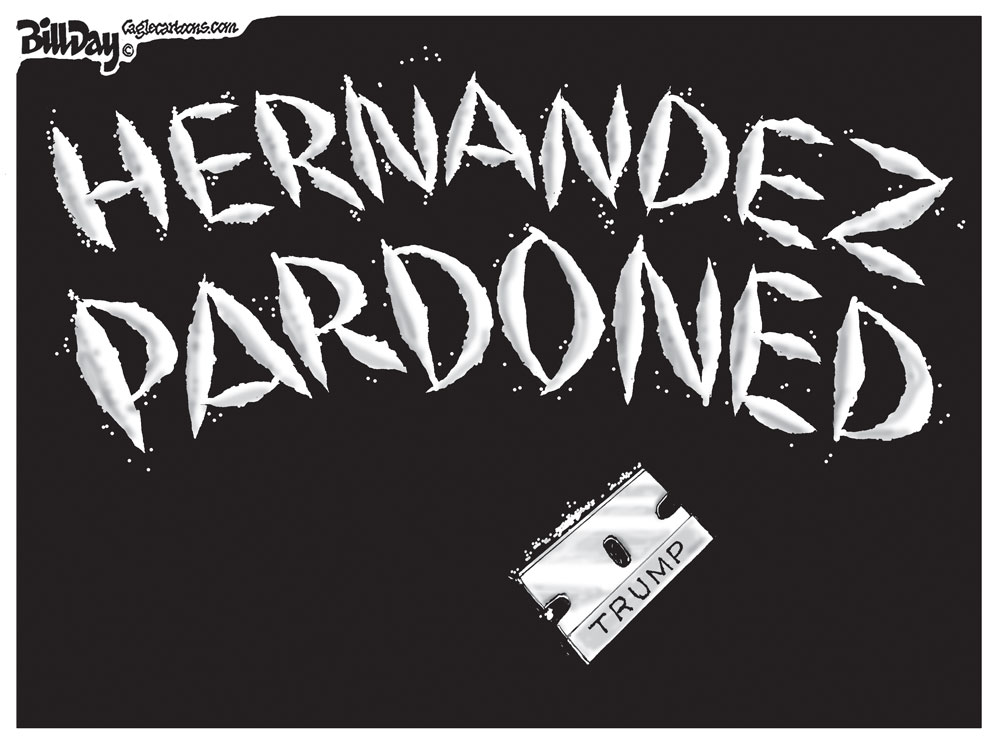
A president is charged with crimes by the US justice system. That person is given a trial and evidence is presented which leads to that president’s conviction. Then, as required by law, that president is placed in prison to serve his term for his crimes.
WAIT A MINUTE!!!! I think I understand why Trump pardoned this guy!!!!
Skibum says
Not only does this horrible occupier of the WH love the uneducated, he absolutely adores other criminals like himself who have been hauled before a court, prosecuted and convicted of criminal activity. Just sweep aside the evidence from federal drug investigators that documented the man’s culpability in trafficking an estimated 400 tons of illegal drugs to America. No big deal according to the worst president this country has ever had.
Then he goes about blowing boats and people out of the water without having our mighty military take them into custody or seize any suspected drug evidence, proving it NEVER was about illegal drug trafficking, just absolute lessons to other world leaders about power and control. If you are FOR him, he will forgive even poisoning American citizens with illegal drugs, he will forgive murderous and corrupt individuals of murdering and dismembering American citizens overseas, and he will back murderous dictators who invade other countries… all no biggies either.
But if you dare to defy him, you will be one of those unfortunates, no matter who you are, who he yells “KILL HIM!”
And the maga mush brains simply ignore the carnage, look the other way, saying, “Oh the sun is out today, what a beautiful day.”
Pogo says
@P.T.
Today’s musings were a gift, and a feast for thought. Thank you.
FWIW, I was introduced to Mr. Hawthorne in a 5th grade classroom of a Daytona Beach public school; my father had him as a guest in our home since it was home.
Mr. Hawthorne
https://www.google.com/search?q=nathaniel+hawthorne
@One, and all
Meet an ordinary great American:
VA Brings Thanksgiving to HUD-VASH Veteran Papa Wong
A plate full of thanks
https://news.va.gov/143681/va-brings-thanksgiving-to-hud-vash-veteran/
Sherry says
Follow the money!
Ray W. says
The Houston Chronicle recently published an opinion piece submitted by Senator John Cornyn (R) Texas.
The premise is straightforward:
Houston (the Bayou City), the energy capital of the world, is home to a high concentration of refineries, petrochemical plants, oil storage tanks, and energy infrastructure.
Should a Category 4 or 5 hurricane drive a wall of water before it up the Houston Ship Channel, the resulting flooding of these fixtures, including the flooding of associated chemical waste containment pools, would release “an unimaginable cascade of hazardous materials into the surrounding environment, threatening both public health and fragile ecosystems.”
Such a storm could wipe out billions of dollars in value of refineries and other energy facilities and “send the price of gasoline soaring nationwide.”
Sen. Cornyn’s solution?
The Coastal Texas Project, “often referred to as the Ike Dike”, a $34.4 billion connected series of dikes and barriers that will take two decades to build out.
Make of this what you will.
Me?
Two things.
Who should pay for all this?
Was this potentiality ever considered when all this infrastructure was being built?
To me, one of the reasons why we face unexpected costs is that we cannot seem to accept that externalities to business models occur.
Not that long ago, homeowners in locations all over Flagler County began to face neighboring new homes that are being built on sculpted foundations three and four feet higher than the surrounding homes, apparently to meet newly-imposed insurance requirements; existing homes are now being flooded in extreme rain events.
There are several good definitions of externality.
One is that an externality “is a side effect or consequence of an economic activity that affects a third party not involved in the transaction.”
Another is “a side effect or consequence of an industrial or commercial activity that affects other parties without this being reflected in the cost of goods or services involved, …”
By these two of several definitions, is it fair to argue that the energy industry built a vast interconnected economic engine on a flood plain and it never considered what might happen to parties external to the builds should future storms grow in intensity and effect, i.e., that 1 in 100 year storms might become commonplace?
Now that Houston has seen three such intense storms in the past decade, it looks like the government is going to bail out the capital of our nation’s energy industry.
I suppose I understand Senator Cornyn’s argument that the government should pay the entire cost of this project, but I also noticed that he did not include in his opinion piece any method by which the money to pay for the project is to be raised.
Is this to be yet another unfunded stimulus project?
Are there as yet unspent funds from the two pandemic era unfunded stimulus packages totaling $2.9 trillion that were signed into law by President Trump during his first term of office from which funds can be directed?
Are there as yet unspent funds from the two pandemic era unfunded stimulus packages totaling $3.0 trillion that former President Biden signed into law during his term of office from which funds can be directed?
I agree with Sen. Cornyn that, after we have allowed ourselves over decades to come to today’s potential of facing ecological and economic disaster should just one storm strike at the wrong time at the wrong heading at the wrong strength at the wrong place, now is the time to protect the American energy hub from disaster.
The vast and valuable infrastructure exists and cannot easily be moved. Better a dike and barrier to protect it than a slowly spreading toxic sludge into the large wetland bayou that will linger for decades.
And what of a storm of that magnitude that hits before the project is complete?
Call me skeptical, but, externalities being what they are, I am unconvinced that the project as he frames it will come in on budget and on time. New Orleans and Hurricane Katrina come to mind.
Sherry says
My “true” story about the tragic devastation surrounding Hurricane Katrina speaks volumes.
During a visit with a very wealthy (2 Mercedes and 3 huge mansions) single Republican (ex) friend of my hubby’s right after that terrible storm. . . she actually said “why didn’t everyone just get out of New Orleans and go North to a hotel a few days ahead of time?” “It’s an easy drive”. When I replied, what if they didn’t have a car? She said to me “don’t be stupid, EVERYONE has a car”! We were completely dumbfounded and said nothing in return.
Thus ended that relationship! To this day, however, our inside joke is: “Storm coming, just jump in your Mercedes and drive to the Hilton for a vaca”!
Skibum says
Exactly, Sherry. Another example of the same type of entitlement and total incomprehension of what so many Americans have to deal with was when the idiot occupier of the WH was talking shit about why people should have to present ID when going to the polls. He actually said to the press that Americans had to present ID when buying groceries! No words, jeez what an asinine and false statement from someone who has never in his life had to walk to a grocery store because he didn’t own a car, then had to re-check how much money was in his wallet and decide what he could, and more importantly, could NOT afford to buy that day.
The woman you spoke about obviously knows nothing about what it takes for many people on the low end of the economic scale to survive day-to-day, and that story reinforces for me the main reason why I disavowed the republican party many years ago, because their policies are designed to benefit themselves and the well to do at the expense of everyone else, particularly those who need the services of government the most.
Sherry says
Thank you Skibum for reading and appreciating my story. It always astonishes me when the average person doesn’t fully understand how wealthy people have “no idea” about that average person’s daily life. Many (not all) wealthy people actually have “contempt” for those who are less privileged.
I once served on a board of directors with a woman who actually said to me during a luxurious (business) lunch: “I wonder what the poor people are eating right now”! I didn’t get into it with her at that point, but it certainly left me avoiding her like the plague.
IMO. . .trump and his “oligarchs” are much like that. . . how tragic that they have duped millions into voting for/supporting them!
Laurel says
Correct me if I’m wrong, but wasn’t it George H. W. Bush who was fascinated by grocery store barcode scanners?
Yeah, it was him. He had never seen them before because he didn’t shop. It was at a grocers’ convention where he witnessed the common day miracle.
Sherry: You didn’t lose friends, you retained your senses.
Sherry says
Laurel. . . you’ve got that so right! Neither of those people were close friends of mine, and never would be. The Mercedes lady was just a neighbor of my hubby’s mother . . . in Trump Towers in West Palm Beach, no less. What does that tell you? LOL!
Ray W. says
Since 1998, the International Energy Agency (IEA) has published its annual World Energy Outlook (WEO) report, which it calls the “gold standard” long-term energy modeling report. This year’s report dropped on November 12th.
Here is how the IEA describes its process of preparing each year’s report:
“[T]he approach of the World Energy Outlook has never been to provide a single vision of the future but rather to view the world through different lenses or scenarios. All scenarios have the same starting point based on the latest data for energy supply and demand, markets, technology costs and policies, as well as the same assumptions for future population and economic growth. However, depending on the scenario, different assumptions on policies, end goals or the ability to overcome technological barriers can mean very different energy futures. This approach allows for a comparison of the effects and implications of different energy choices against a common backdrop.”
The 2025 World Energy Outlook itself is titled, “As risks multiply in a world thirsty for energy, diversification and cooperation are more urgent than ever”
Here are some bullet points from the publication:
– “Among the many trends common to all the scenarios in this year’s WEO is the world’s growing demand for energy services over the coming decades – with demand rising for mobility; for heating, cooling, lighting and other household and industrial uses; and increasingly for data and AI-related services.”
– China, which has “accounted for half of global oil and gas demand and 60% of electricity demand growth since 2010”, will continue to shape energy market dynamics, but a number of emerging economies around the world will “take the baton from China”. This number of nations with these emerging economies includes India and Southeast Asia and countries in the Middle East, Africa and Latin America.
– With China having an average 70% market share of 19 of the 20 “critical minerals” necessary for power grids, batteries and EVs, AI chips, jet engines, defense systems and other strategic industries, supply chain and energy security is at risk.
– On the subject of refining of these many “critical minerals”, and other materials, since 2020 a geographic concentration of refining capacity has occurred in China.
– “Electricity is at the heart of modern economies, and electricity demand grows much faster than overall energy use in all scenarios in WEO-2025. Investors are reacting to this trend: spending on electricity supply and end-use electrification already accounts for half of today’s global energy investment. For the moment, electricity accounts for only about 20% of final energy consumption globally, but it is the key source of energy for sectors accounting for over 40% of the global economy and the main source of energy for most households.”
– IEA executive director, Dr. Faith Birol wrote:
“Last year, we said the world was moving quickly into the Age of Electricity – and it’s clear today that it has already arrived. … In a break from the trend of the past decade, the increase in electricity consumption is no longer limited to emerging and developing economies. Breakneck demand growth from data centres and AI is helping drive up electricity use in advanced economies, too. Global investment in data centres is expected to reach $580 billion in 2025. Those who say that ‘data is the new oil’ will note that this surpasses the $540 billion being spent on global oil supply – a striking example of the changing nature of modern economies.”
– “Investments in electricity generation have charged ahead by almost 70% since 2015, but annual grid spending has risen at less than half that pace.”
– “In two critical areas of longstanding WEO analysis, the world is falling short on the goals it set for itself: universal energy access and climate change. Around 730 million people still live without electricity, and nearly 2 billion rely on cooking methods that are detrimental to human health.”
As for climate change, “energy systems around the world are contending with the impacts of climate change today, underscoring the urgent need to build greater resilience to rising weather-related risks (see my comment about John Cornyn’s warning), as well as to cyberattacks and other malicious activity.”
– Concerning natural gas, “[f]inal investment decisions for new LNG projects have surged in 2025, adding to the expected wage in natural gas supply in coming years. Around 300 billion cubic metres of new annual LNG export capacity is scheduled to start operation by 2030, leading to a 50% increase in available global LNG supply. Around half the new capacity is being built in the United States, and a further 20% in Qatar. Natural gas demand has been revised up in this year’s WEO, but questions still linger about where all the new LNG will go.”
– Concerning crude oil, “[g]lobal oil market balances as oil supply continues to rise well ahead of demand, raising concerns over a potential glut in 2025 and 2026. OPEC has opted for production increases as the Kingdom of Saudi Arabia (KSA) seeks to recapture some lost market share, which is already pushing prices down.”
– The IEA reports that global oil inventories increased by 77.7 million barrels in September, the highest levels since July 2021, with an annual increase of 313 million barrels so far this year [through September].
– The IEA projects a 2025 rise in global crude oil supply of 3.1 million barrels per day, with a 2026 projected rise in supply of 2.5 million barrels per day. On the other hand, global oil demand is projected to rise by 800,000 barrels of crude oil per day, a modest rise complicated by economic uncertainty and accelerating electrification of transport.
– Per the IEA, ‘[t]hese trends are creating bloated market balances. … The economic repercussions of the recent tariff turmoil and the impacts of new sanctions on Russia are yet to become fully clear.”
IEA executive director Faith Birol wrote:
“When we look at the history of the energy world in recent decades, there is no other time when energy security tensions have applied to so many fuels and technologies at once – a situation that calls for the same spirit and focus that governments showed when they created the IEA after the 1973 oil shock.”
Make of this what you will.
Me?
I remain attached to the idea that the international world energy marketplace is both extraordinarily complex and constantly changing. Innovation astounds.
I take the position that if my idea is accurate, i.e., that the energy sector is complex and ever changing, no one person, and certainly not me, can conceptualize the myriad emerging consumption patterns of 8 billion people. But I also believe in the invisible hand of the marketplace. We tend to act in our perceived economic selfish best interests. When we don’t do act in our perceived economic selfish best interests, economic inefficiencies arise. In the end, re: consumption of electricity, I argue that we all want as much electricity as we think we need whenever we want to have it at the lowest possible price. Helluva set of tradeoffs there, eh?
When newly constructed electricity plants last 40 or 60 years, depending on the form of generation, decisions made today on which type of plant to construct will lock us into forms of electricity generation that in the future may prove to be exorbitantly expensive over time. There was a time when coal was the most efficient form of electricity generation. Today, it is the most expensive form of electricity generation. Two decades ago, coal plants provided 50% of America’s demand for electricity. Now? 16% and dropping.
Hence the question!
Should we base our electricity future on political posturing aimed at the most gullible among us or should long-term economic efficiencies carry the day?
No one was seeking permits to build natural gas power plants in Texas until the legislature, in two different acts, gave the executive branch $9.4 billion in public money to loan out. Now, some 130 companies are lining up at the public trough hoping to get access to a share, any share, of that public money.
But if all 130 of the wannabes get a share of the money to build new powerplants in Texas, where will those natural gas turbines come from? Only three companies in the world make large-block gas turbines: Mitsubishi, GE and Siemens. All three are behind on filling existing orders for new gas turbines, with average wait times for delivery recently rising by several more years.
All three of the companies are expanding manufacturing capacity, but that too will take time. A senior program manager of gas turbine research and development at the Electric Power Research Institute told a Utility Dive reporter that an OEM “doubling production” might increase output by 15-40% “based on historic data”, but “it is likely not enough to drastically reduce [wait times].”
Here is a thought exercise.
If Lazard’s published Levelized Cost of Energy (LCOE) establishes that, today, solar and wind, when backed up by battery storage, is the cheapest available long-term form of electricity generation, and if costs per kilowatt-hour of solar and wind electricity, when backed up by battery storage, have been dropping and are continuing to drop, and if sunlight and wind are free, and if natural gas prices fluctuate up and down on a daily basis, should an energy company deciding on which type of plant to build choose natural gas over a 40- or 50-year plant lifetime?
Does any FlaglerLive reader argue that locking Florida Power and Light into paying more now and more far into the future for the electricity we consume is a good thing?
As an aside, across the U.S. power grid as December 31, 2022, there were 25,378 operating electric generators at 12,538 utility-scale plants, per the EIA. According to energycentral.com, of all the new electricity power plants being built in 2024, 96% were classified as “clean energy”, with solar at 58%, wind at 13%, nuclear at 2%, and battery storage at 23%. Natural gas was at 4%. Zero coal power plants were being built. The statistics on which energycentral.com relied for its reporting came from the EIA.
Globally, the EIA reports that total electricity demand grew by 4.3% over 2023. Clean energy (renewables plus nuclear) accounted for 80% of all new electricity supply, and clean energy grew at a rate of 8% over the previous year. Fossil fuel production accounted for 20% of the growing demand, and the fossil fuel sector grew by 1% year-over-year.
The worldwide existing electricity generating mix for fossil fuels was below 60% and dropping in 2024. Renewables, plus nuclear, broke 40% of the 2024 worldwide existing electricity generating mix for the first time and rising. For the 22nd straight year, renewable capacity additions broke records. Solar accounted for more than 75% of the renewable capacity additions in 2024, with installed capacity rising 30% over the previous year.
Can it be argued that the invisible hand of the marketplace is at work, and that coal is not king and that natural gas is not the heir apparent?
Ray W. says
Despite the government shutdown’s interruption of employees’ collecting data necessary to release a normal schedule of economic progression or regression, NBC NEWS is reporting on a late release of the Fed’s most favored economic inflation data, known as Personal Consumption Expenditures (PCE) “core inflation” for the month of September, 2025. Data was collected before the shutdown; it just wasn’t interpreted during the shutdown.
For that matter, because of other non-collected economic data during the shutdown, we have yet to see a third quarter GDP report. Neither have we seen October’s jobs report.
The Fed meets next week to consider whether to adjust lending rates or keep them the same. Traditionally, Fed committee members discuss among themselves the freshest economic data available. The first “fresh” jobs data collected after the shutdown, the monthly jobs report, is slated for release on December 16th, after the Fed meeting. The next fresh inflation data release is scheduled for December 18th.
As I repeatedly comment, all data is a “snapshot” of a particular facet of a particular segment of an economy. The PCE snapshot measures consumer spending on goods and services. PCE data measures “about two thirds of nationwide spending”; it is “a significant part of national economic output.”
Core inflation “strips out volatile food and energy categories.” As stated above, PCE data, stripped of the more volatile food and energy categories, is often referred as the Federal Reserve’s preferred economic data.
So, here we are. The stale data tells economists that, year-over-year, inflation remains at 3.0%. The available stale monthly, not year-over-year, inflation data is at 2.8%, which if it remained unchanged over 12 months would yield a 3.36% year-over-year inflation rate.
ADP data, which is interpreted through a statistical window different from Bureau of Labor Services data, shows a loss of 32,000 jobs in November. Layoffs calculated by Challenger, Gray & Christmas, not by government agency, shows announced layoffs at their highest level since the pandemic.
Make of this what you will.
Me?
The government shutdown still impacts the collection of all sorts of statistical economic data that is in more normal times considered all over the world as the “gold standard” of economic data. Some of this economic data is lost for all time; it will never be collected, so the statistical effects of the shutdown might last a long time.
What should the Fed do with lesser quality or stale data? Should it leap to a lending rate cut? Should its hold the course until better data is collected? Should it lean toward prioritizing inflation reduction by raising the lending rate?
I don’t know whether the Fed should wait to collect better data on which to base an important decision, and I suspect more that one Fed official thinks that way, too. As Randolph Churchill was reported to have said of his father’s great friend, Lord Birkenhead: “As the late Lord Birkenhead said of my father: Mr. Churchill is a man of very simple tastes. He is always prepared to put up with the best of everything.”
Give the Fed the best data available or wait until it becomes available.