


The Flagler County School Board is drafting a new policy to define the roles of its student school board members, who sit alongside board members on the dais at monthly meetings. But the four board members are divided over what the students’ role should be.
Lauren Ramirez and Janie Ruddy want the students to participate like board members, but without the power of a vote. Will Furry and Christy Chong don’t want them to participate at all in that regard.
Ramirez brought up the matter because until now the board has operated without a policy defining the students’ role. All board members agree that there should be a policy. The administration drafted one. It states clearly that students “are to participate in public discussions as permitted by the Chair,” “Represent the interests and perspectives of students enrolled in the District,” “Be encouraged to sit at the School Board table during regular open meetings and participate in discussions in the same manner as the public,” and “be invited to participate in School Board workshops, forums, or other public functions.” The board discussed the proposed policy at a workshop on Tuesday.
Ramirez likes to hear the perspective of the two student school board members who share the dais at monthly board meetings, and would favor involving them more in discussions on various items if it adds to board members’ understanding of students’ points of view. Ruddy leans in that direction, though she was concerned about contradictory wording in the policy: some of it puts the students on par with board members, at least as far as board discussions are concerned. Some of it relegates the students to the same role as the public.
“I really believe that the student should have a voice as a student school board member. A lot of other districts do that,” Ramirez said.
Furry and Chong consider the student board members nothing more than “liaisons” who bring news from their respective high schools, Flagler Palm Coast High School and Matanzas High School. Otherwise, they have no business contributing opinions on school board matters. If they want to do that, they’re welcome to step down and use their three minutes as members of the public.
“I do not believe that [the] student school board member should have the option to speak into agenda items from the dais in their role,” Furry said. “That’s not how our system of government works here. You know, they are, they’re teenagers, so bringing in that perspective at a board meeting when we’re discussing policy between [us], I believe can be problematic, not only to the process, but also to the student itself. So I am not an advocate for that.”
Furry had spoken in similarly condescending terms about Ramirez when he and Chong teamed up last fall to deny Ramirez the vice chair’s title, calling her inexperienced. To Chong, “calling on a student for their input, that’s something that could be weaponized against each other.”
“We did not want to put our students in a position where they were speaking on topics that the board is discussing that would cause the public to potentially target our students,” Superintendent LaShakia Moore said. “We mainly want to make sure that they’re representing really the student body, and having an opportunity to engage around those things.” The policy does not define those parameters.
Ruddy said when student representatives speak nowadays, they talk about events or recognitions at their schools, and little else. She noted that when her own daughter was a student representative on the same board, during the Covid years, “she used some of her time to actually speak about a particular item that was on the agenda to be voted on that evening.” She did not do so during board discussions, but during the time reserved for student board members. Ruddy was conflicted over that: student board members could be an additional voice and perspective on board matters, even though they do not vote. Limiting that leaves her uneasy.
She put her concerns in the form of two questions that the proposed policy muddles rather than clarifies: “Can a student liaison be recognized by the chair to or be called upon by a school board member to share their perspective when asked, and Part B, during their liaison updates, do we specifically state that they are not to express opinions or feelings about upcoming items to be voted on? That’s what I’m understanding is the concern of Mr. Furry, and then in that case, you’re restricting their speech.”
Furry said their speech was not restricted almost in the same breath as when he said student board members should not participate in a board discussions.
“There’s nothing that prevents a board member to step down from the dais and sign up for public comment,” he said. “We all share the data that we all build our policies off of in our workshops, when we have our discussion. They may come with data or support for their argument that has not been necessarily shared with the rest of us to have any context or validity of what supports their argument.” In other words, any information the student board members would bring up that has not been vetted by the board first is invalid, a standard Furry appears to apply to public speakers who, also, are not part of workshop discussions. Ruddy made that point. Furry bristled: “No one said that,” he said, moments after saying exactly that.
Furry also claimed that the board opens up the students to “potential Sunshine violations.” He did not say how. As appointees to the board–if they are, in fact, appointees–student board members unquestionably fall under the state’s Sunshine Law. Age is not relevant. But it’s not clear that they are appointees. The policy does not clarify the meaning of their designation, either.
Student board members have been serving on the board at least since 2002. Their role has never been clearly defined, and has shifted, depending on the quality of the board members and the quality of the student representatives. The more self-assured the board members were, the more room the student representatives had to express their opinions–if the students were so inclined. Most have kept to a minimal role. But some have taken the initiative and participated more fully.
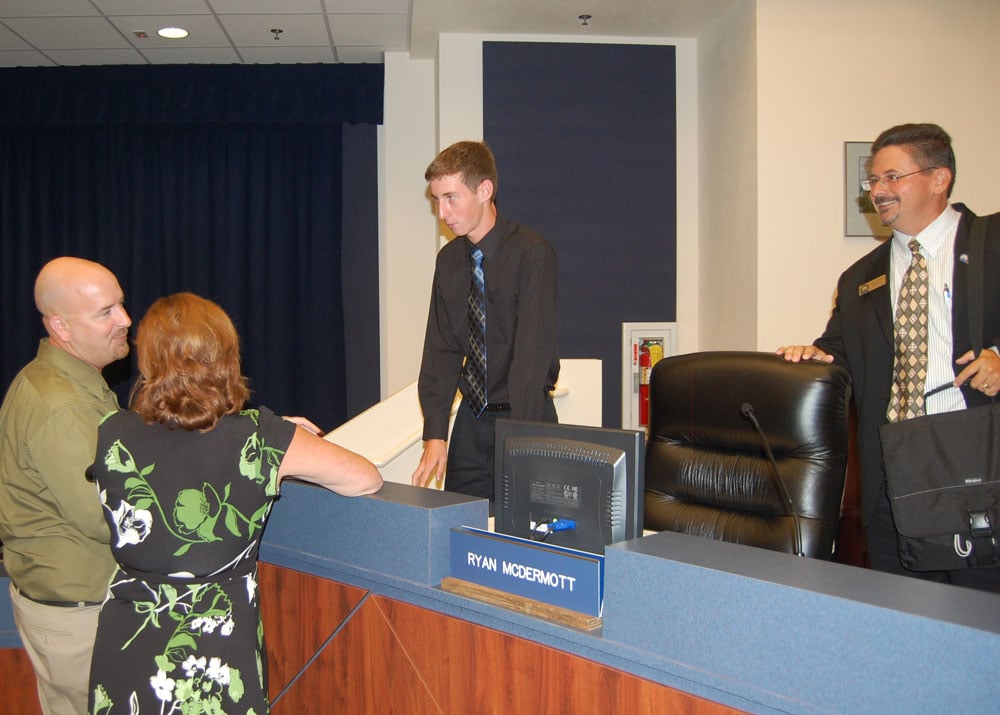
In 2010, FPC’s Ryan McDermott set a standard for student board members, taking the role as seriously as if he were nearly an equal of his colleagues on the dais, participating in discussions, providing input on agenda items and holding himself accountable to the student body he represented. In 2012, FPC representative Wes Adams “had no problem forcefully and repeatedly contradicting board members in several meetings that dealt with school uniforms,” as a report put it in these pages. That discussion was repeatedly on the agenda. In 2015, Student Board Member Michael Manning not only participated in debates over the dress code but initiated a policy to loosen the code and shepherded it to a successful conclusion.
In 2017, Kobi Kane, representing Matanzas High School, was almost single-handedly responsible for pushing the City of Palm Coast to install street lights and build a sidewalk on Lakeview Boulevard after the fatal car collision that killed fellow-student Michelle Taylor, who had been walking along the road at night. A speech Kane delivered from her board seat had been key. In 2018, Student School Board members Margaret O’Mahoney and Jessica Middleton, taking on an item on the agenda, were sharply probing in a discussion on the district’s adoption of an intrusive social media surveillance policy. In 2020, Hunter Perez, who was representing Matanzas High School, was even appointed to the advisory panel established to search for a superintendent.
Ramirez said a policy is essential. She’d been speaking to board members in other districts to hear ideas. “They should perform as if they were a board member, essentially, but not voting,” Ramirez said. “Obviously, there’s no debate happening, because it’s not a debate, it’s a business meeting. So that’s why I brought it up. Other districts do that.” For example, if there was discussion on an item and the chair called for any further discussion on that agenda item, “they could have an input as well. So that’s where I was coming from, because other districts do the same thing.”
Moore tried to find a middle way, saying the policy seeks to give the student board members a voice but not necessarily during discussions, which would preclude a board member from soliciting the student board members’ perspectives, though she is not dogmatic about that: she believes students’ opinions should be heard if board members want to hear them during discussions. Ramirez and Ruddy see no issue with asking the students what they think. There was no clarity on what the next policy draft will look like at the workshop, but Moore on Wednesday said it will “mirror what we have while also making sure we have the guardrails in place” to protect the students from difficult situations.
“We will bring additional language back to better codify the conversation that you guys are having today,” Moore said. “We want them to have a voice. We want them to be empowered, but we also want to make sure that we can protect them as much as we can, as far as their involvement in the official business of the board.”




























Bored with Board says
Both Furry and Chong have a lot of balls, when it comes to complaining that a student liaison would open the board to possible Sunshine Law violations, when it has been obvious that they have violated same laws in the past. They worry about politicizing topics, where that seems to be their only reason to be on the board. Neither should be on the board at all, as their own agendas is the only thing they represent, surely not the schools, students or the district.
Tired of it says
Flurry and Chong are afraid the students may be smarter than they are.
Koyote says
@Tired of it says:
“Flurry and Chong are afraid the students may be smarter than they are.”
No, They KNOW the students are smarter than they are …
They are afraid that WE will discover that.
Disagree says
This board couldn’t agree on the color of a piece of paper. 🤔 No wonder thet can’t agree on what to do on any policy
Skibum says
The whole purpose of having student representatives on the school board is to be able to have student involvement in board discussions and decisions, isn’t it? Why in the world would any of the other board members be trying to limit or prevent the student representatives from participating?
Any school board member who doesn’t value a student representative’s participation might as well just admit they don’t care at all what school students think, and any such board member should resign or face recall.
Dusty says
Well perhaps they don’t want to spend another hour in session the meetings are already long enough. How about a separate session with students?
Ed P says
Purely from a corporate perspective.
Any organization that try’s to manage via a top down approach vs a bottom up strategy is doomed to long term failure and jeopardizes the existence of the entity they manage.
Providing a platform for customer observations ( in this case the students) could provide valuable insights otherwise overlooked by the board. Similar to the military listening to the troops but ultimately allowing the officers to decide.
Maintaining the line between student input and strategic/tactical execution is the boards role.
The more informed and empowered employee usually proves to more valuable.
Sound Government says
The purpose of the school board is to represent taxpayers who fund the educational system. Taxpayers elect those board members, and if they don’t like the representation, they can vote them out. The students are not elected by the taxpayers, so why are they on the board? Because the high school principals appoint them. That means the administration that depends on the school board for funding can put students there that can support the principal’s agenda. It’s a good idea to encourage students to speak up, and they can do that simply by showing up in the audience at school board meetings, just like anyone else.
chris conklin says
Trevor please hurry. its the blind leading the blind on 95. it doesn’t end well.
Skibum says
Anyone who is deluded enough to think that a student representative will automatically agree with whatever a school principal wants does not know students very well! A student representative is much more likely to have the interest of STUDENTS uppermost in mind, not school administrators, should there be a conflict of thought.
Callmeishmael says
This is such a short-sighted perspective on your part.
Think about the civics experience the kids will get. Think about the fresh insights board members can consider.
Come on, even EdP disagrees with you.
Lance Alred says
The students chosen to represent their schools were selected because they have shown leadership, responsibility and academic excellence. These are bright, capable young people who would benefit from mentorship and real experience in governance and public policy.
Other districts already allow student representatives to take an active role, showing that meaningful participation is both possible and valuable. In this district, it seems their involvement would be up to the chair. Leaving it to one person creates inconsistency and undermines the purpose of having student representatives.
The argument about the Sunshine Law also does not hold up. School board meetings are public and Florida law encourages openness in government. Limiting student participation in this setting goes against the spirit of transparency.
If we trust these students to represent their peers, we should also trust them to contribute meaningfully. Supporting their involvement strengthens civic education, builds future leaders and shows that student voices matter.
Renee says
Why is republican leadership allowing these fools to run? They’re embarrassing. If a Democrat decides to run against furry, the school board will be lost.
Who can hardly blame them? When you have candidates as bad as furry, chong and woolbright you deserve to lose elections.
Mort says
@Renee
Allowing people to run? All are more than welcomed to run. I recommend you find out who is running and get behind one of the candidates, there are more than those mentioned here. That’s how local elections are supposed to happen.
You can go to the Supervisor of Elections website to see all candidates running.
A member of Republican leadership is running. His name is Ron Long.
Skibum says
These republi-con nitwits will be the first to heave an AR-15 into the hands of a teenager, telling them it is their 2nd amendment right to be able to venture outdoors with their gun an kill something to make a “man” out of them. They’ll be the first to send a teenager to war to “fight for your country”, that’ll make a “man” outa y’all for shure!
But HELL NO, we don’t wanna have any crybabby teen student representative to have a say at a school board meeting where the “real” adults who were elected ONLY get to open their mouths or vote. The “kids” should just sit back with their mouths closed and their eyes and ears open if they know what’s good for them because policy mak’in is for “grown ups” who know what’s best for school kids. Right, maga republi-cons?
I think the real concern is the maga idiots are worried that letting the student representatives speak and make decisions for their schools would reveal that the students have more brain cells than those who were elected in republi-con controled counties such as ours!
Tacklebox says
Do we have someone running against Furry yet? Needs to go…