



A month ago on first reading the Palm Coast City Council approved a shift from townhouses to 244 small single-family houses in the Sawmill development cluster off U.S. 1, on a 4-1 vote.
Today, the council finalized the approval on second reading, but on a 3-2 vote and a failed attempt by Vice Mayor Theresa Pontieri who, following up on the council’s discussion last week on the city’s (and the state’s) affordability crisis, tried to ensure that a percentage of the houses be set aside for workforce housing–that is, as more affordable houses.
The different vote was a remarkable display of how council presentations and discussions can move votes, but not always enough to move policy.
“I would approve this if there were some workforce set asides,” Pontieri said, “so that we are in fact addressing a problem that we know exists not in our community, in the state of Florida. Let me be very clear about that: This issue is not specific to Palm Coast.” She added, noting a recent oped she wrote on the subject, that “if we are going to be serious about addressing it, we need to think about opportunities like this to seize upon. Yes, I think government needs to get out of the way, but we need to make sure that a well-intentioned product actually comes to fruition in the way that we intended it to.”
By then Council member Charles Gambaro, who sits on the city-county Affordable Housing Committee, had already moved to approve the request as submitted. Pontieri asked him to withdraw it so it could be amended with her proposal. Gambaro declined, saying the council had taken a position against that sort of approach on infill lots in the older part of Palm Coast, and should not apply the approach in this case. “So I’m not, I’m not removing my motion,” he said.
Gambaro was accurate about the council’s stance on infill lots–the typical quarter-acre lots in the ITT-platted portion of Palm Coast. But Pontieri quickly noted that the council had made a distinction with newer developments that lend themselves to more land-use flexibility.
“I think we’re talking apples and oranges,” Pontieri said. “You don’t want to withdraw the motion, that’s fine, it’ll be a no for me today, and it would be a yes if we could do a workforce set aside for this. So that’s I guess, where I stand on it, and I think we may be throwing out the baby with the bathwater here.”
The council voted 3-2 to approve the request, with Sullivan and Pontieri opposed.
The measure before the council was an amendment to the Palm Coast Park Master Plan Development. Palm Coast Park is what used to be called a Development of Regional Impact, a planned, master development originally approved in 2004 for 3,600 housing units. There have been numerous amendments since, the last in 2023 to increase units by 750, bringing the total to 6,454 housing units over 4,677 acres at build-out. The development is to have 3.2 million square feet of non-residential uses such as commercial and retail.
The latest amendment request refers to two tracts in the subdivision known as Sawmill Branch, which had been approved for 320 townhouses in 2024. The developer, Robert Porter, requested a switch to 244 detached single family houses on lots with a minimum size of 2,550 square feet for houses that provide as little as 1,000 square feet of living space and a two-car garage. The rest of Palm Coast Park typically has 4,000-square-foot lots. The smaller houses are in keeping with a relatively recent trend as retirees or young families seek smaller houses to maintain.
“The goal is to allow a variety of lot sizes and housing types to meet the needs of the citizenry. Citizenry through all stages of life,” City Planner Estelle Lens said last month.
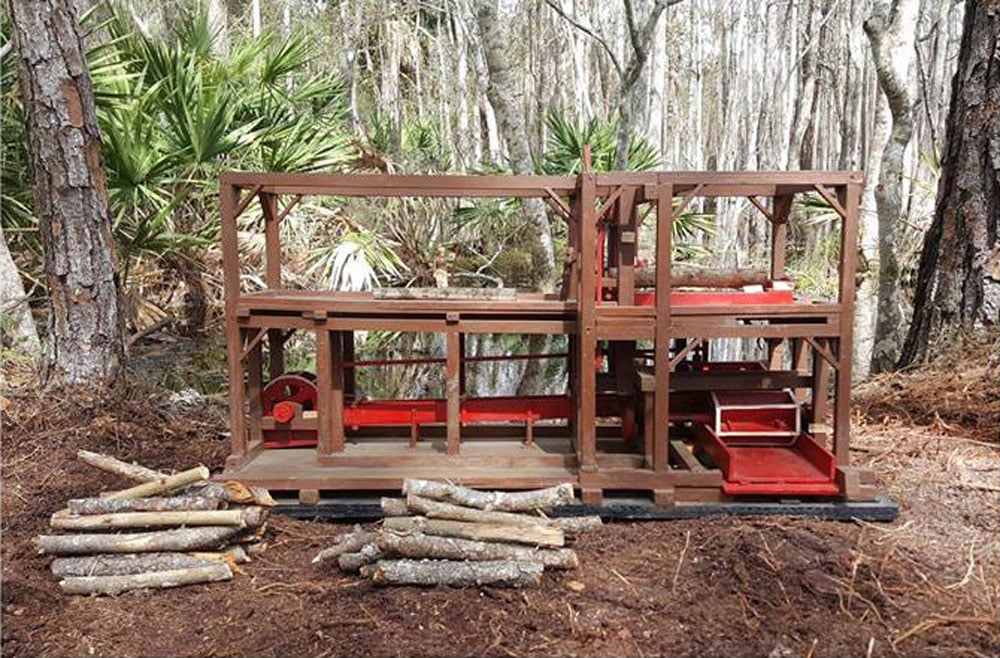
In April, Council member Dave Sullivan voted against the measure–not in opposition to the specifics of the development plan, but because he was displeased at what he said was the damage the developer caused to the Revolutionary-era Hewitt Sawmill historic site at the Florida Agricultural Museum. Sullivan claimed the developer felled trees to the edge of the mill, causing water to dump into the mill and damaging it. “It’s been ruined. There’s no way to save it now,” he said.
Today, Sullivan added the size of the lots to his reason for opposing the shift, fearing that “it’s going to turn into a blighted rental district far away from downtown.” He’d rather see the townhouses. Mayor Mike Norris disagreed about the possibility of blight in such a new neighborhood.
Lens today, relaying Porter’s words, described the facts on the ground differently. “The sawmill site was not damaged whatsoever by the adjacent development,” she said, quoting the developer’s response from April 22. “He personally toured the entire site and spoke to a member of the board of the Ag Museum, which owns the site, and verified that they did not damage it.”
Sullivan and Pontieri had issues with the developer’s statement for two different reasons.
“This particular section, it’s being done right now, I agree, has no impact on Hewett’s Mill,” Sullivan said. “The problem was the overall developments along the west side of Route One.” He said sometimes development may have “unintended consequences,” and while the particular development under review did not affect the historic site, “I don’t want to let anybody think that there wasn’t an impact on Hewett’s Mill from the other clearing that went on along in that series of projects along Sawmill Branch.” He considers the matter a cautionary example of what to not let happen in the coming expansion westward.
To Pontieri, an attorney, Porter’s statement was hearsay, and the council was in a quasi-judicial proceeding.
“The representative for D.R. Horton can certainly testify or state what he has personally viewed during his, I guess, walk of the property, but this statement is asking me to not believe what my own eyes have seen,” Pontieri said. “I’m with Councilman Sullivan in that I personally saw the damage that was done and what the runoff did. Now, I also agree that what we’re talking about today probably does not have a direct impact.”
The concern is conceptual to ensure that the development doesn’t impact the Agriculture Museum, which Pontieri hopes will protect its property in a stronger way. In the end, she said, the developer can move forward with the development regardless, since it is entitled to do so.
There have been revisions to the plan since the April meeting, providing an additional 20-foot wide landscape break every 12 lots, where there will be landscape buffer with enhanced landscaping, and providing a small amenity center for the residents, such as a playground or a park. Pontieri noted that the language regarding amenities’ special features–play equipment, seating areas, shade structures–was not strong enough to ensure that those details would be provided. (Michael Chiumento, the land-use attorney representing the developer, agreed to that concession, saying it was the intent all along.)
Pontieri had further concerns about the smaller lots, which she said “sets a bad precedent” that won’t necessarily lower prices in the absence of an affirmative overlay that would require affordability. “It’s truly going to be based on whatever the market will dictate as far as what these are sold for,” she said.
In April 2023, Sandra Shank, a member of the city’s planning board who also sits on the joint city-county Affordable Housing Committee, made a similar point when the developer was seeking to add 750 houses overall: “I think this is an opportunity for us to demonstrate to our citizens that we are concerned about the needs of the working class people.” Shank made a motion to include a requirement for an affordable housing component in the overall plan. The Planning Board denied the motion.
“I see both sides of this,” Pontieri said. “I’m struggling because I feel like we’re just not really attacking the issue and fixing what is a problem. We have an opportunity to do it, but are we exacerbating rather than helping?”
Carla Amaral, the vice chair of the Affordable Housing Committee, described the project as an “opportunity and potentially a missed opportunity” that did not ask an essential question: “What public benefit are we receiving in return?”
“This becomes a missed opportunity if we do not ask for workforce affordability in return” Amaral said, citing professions such as teachers, first responders and medical workers who have been priced out of a market where the median house price is $350,000. “So, if the city is creating substantial economic value through zoning changes, reduce lot sizes, reduced home sizes, and development flexibility, why would we not require some percentage of these homes to remain attainable for the Palm Coast workforce?
Council member Ty Miller was more amenable to the smaller lots, recalling last week’s two-hour council discussion on affordable housing, when council members agreed that housing subsidies aren’t the way, but applying land use regulations that could help bring down prices was an option. “I think this is exactly what we were talking about at that last meeting,” Miller said. The lower density was also an advantage, he said.



























Pogo says
All this selfishness will be overturned in a moment — by time and fortune; these decisions are a judgment on those whom make them.
NJ says
So WHERE is the drinking water for the New Developments??? Planning is a JOKE!!!
Rudy says
Am I missing something?
First, the councilwoman lambastes every residential development to come before her and proposes a moratorium on all single family home construction…
When that fails she votes to double impact fees on new homes.
Last week she pens a libertarian manifesto saying that government must get out of the way and allow free markets to solve the affordability crisis.
Now she vehemently supports imposing govt affordability standards?
Genuinely confused by these actions, please somebody help me understand.
x Rudy
Don't drive says
So 244 new homes
National avg 2 cars per house
Almost 500 more cars to help out our deteriorating roadway !
Perfect wortd
Ed Danko, former Vice-Mayor, PC says
Talk about a Pontieri “Kamala Harris Word Salad” and a “John Kerry Flip-Flop” all at the same time!
QUOTE: “I would approve this if there were some workforce set asides, so that we are in fact addressing a problem that we know exists not in our community, in the state of Florida. Let me be very clear about that, this issue is not specific to Palm Coast. if we are going to be serious about addressing it, we need to think about opportunities like this to seize upon. Yes, I think government needs to get out of the way, but we need to make sure that a well-intentioned product actually comes to fruition in the way that we intended it to.”
TRANSLATION: She insist that government must get out of the way and allow free markets to solve the affordability issue, while at the same time the expects the free markets do exactly what her and the government tells them to do!
Stop The Insanity says
Fact: if their lips are moving, they’re lying. I thought NY was corrupt but this place puts them to shame. I’ve never seen such blatant disregard for the environment, and our quality of life, etc., as I’ve seen here. I shudder to think about what it will look like in a few short years.