



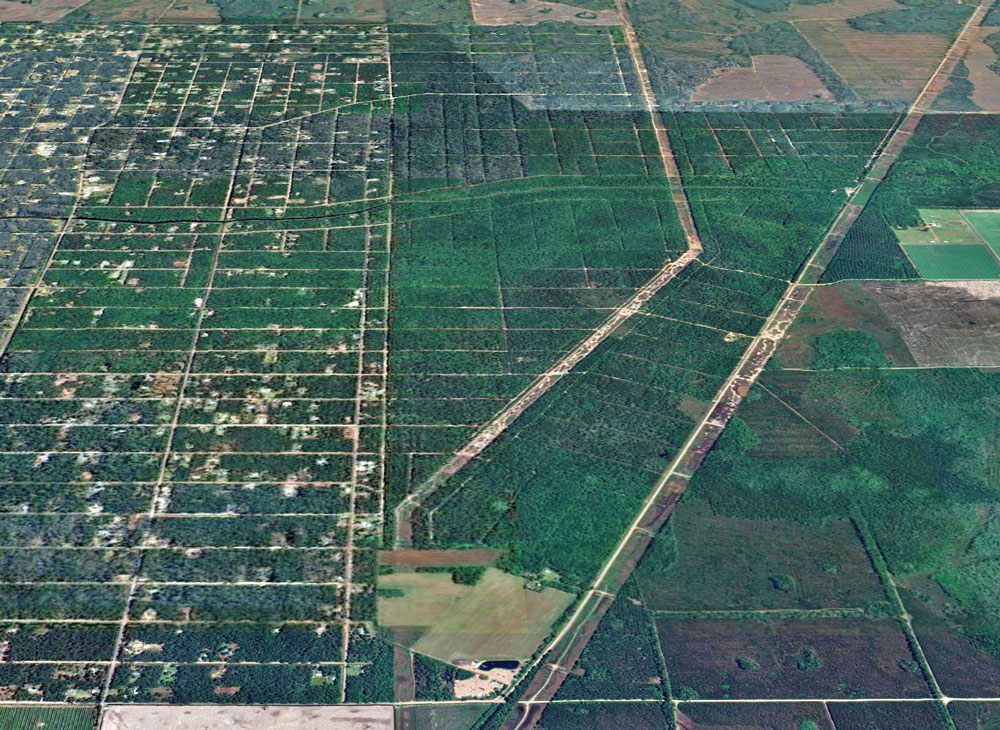
The Flagler County Commission today issued a hard No against developing or permitting any development in Flagler Estates. It’s not what some property owners there want to hear. But the commission is categorical. If there is ever to be development there, this is not the time.
Commissioners reached the unanimous decision during an hour-long update on that distant, inaccessible area of Flagler County, rejecting proposals to create a special taxing district there that could have paid for road and stormwater improvements.
They also denied a $200,000 offer by Ben Tilton, who owns 15 percent of the lots there, as a seed-money contribution to help mow what semblance of roads exist there, and rejected his plea to tell prospective property owners not to close the door on the possibility of development.
“When people call up asking if they can build, just tell them it’s under advisement right now, rather just tell them no,” Tilton asked. “There’s a lot of people that have properties, a lot of people want to build, but every time they call up, it’s just a flat No.”
It’s going to continue to be a flat no.
“This is entirely speculation. There’s no expectation here of anything, so there’s no expectations of building or road improvements or ditches. It’s speculation. It’s all it is,” an adamant Commissioner Andy Dance said, stressing that there are no obligations on the county’s side to provide services there.
“I’m for zero policy shift from the county,” he said. “I heard Mr. Tilton, but it’s a hard no for me, no ambiguity in there at all, that’s a hard no when somebody asks.”
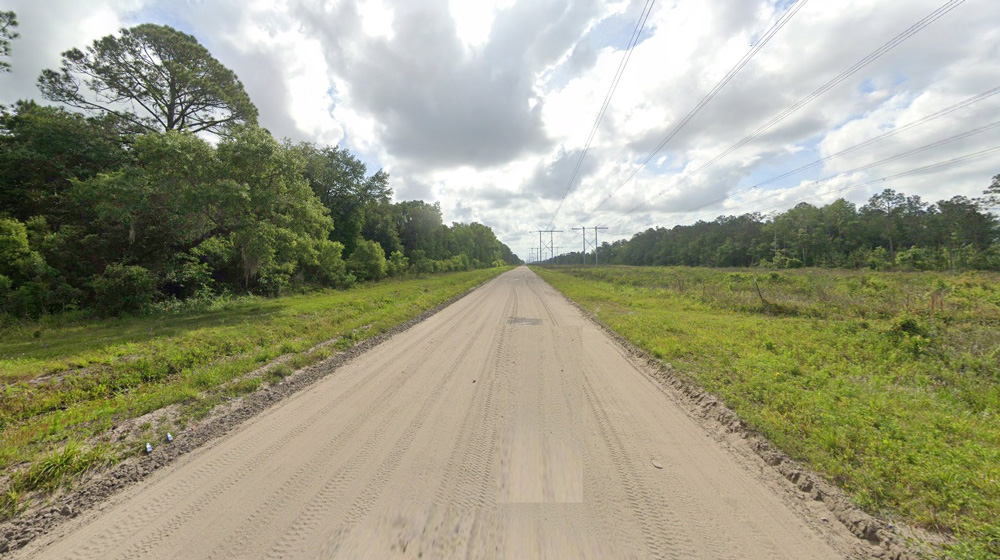
Commissioner Kim Carney, a Realtor, was just as adamant. “I’ve sold parcels out there. I will not not disclose to people when I sell property that they can build on there. I will not do that,” Carney said. “You cannot build in Flagler Estates on the Flagler County side.”
The discussion was prompted in part by an error. The county mistakenly permitted the development of a house on the Flagler County side of Division Street. Division Street delineates the St. Johns County side from the Flagler County side. There are more than 70 lots that could be developed on the Flagler County side of Division Street. But they would have to get their services–water, sewer, electricity, fire, police–through an agreement with St. Johns County. If there were children there, the school district would be obligated to send a bus to pick them up, driving in from St. Johns County.
“Flagler Estates, that soggy, sprawling subdivision of 6,400 acres in northwest Flagler County, is what the scam artistry of Florida real estate lore is all about–and there’s no lore about it: it’s all true.” So a 2007 News-Journal editorial described the subdivision platted in the 1960s on both sides of the St. Johns-Flagler County line, with the Flagler side accounting for 2,700 acres and 1,800 parcels.
The St. Johns side was lightly developed. Not so the Flagler side. It is today what it was in the 1960s and what it remained in 2007: uninhabited, inaccessible, without any utility or other services. It was platted before land regulations that could have stopped speculators from selling lots sight unseen, as most lots were, to gullible owners who thought then, as some still think today, that they could one day have houses there.
The typical lot on the Flagler side is 54,450 square feet and pays less than $4 a year in property taxes. As recently as 1990, some lots sold for $8,000, or $6,000 or $9,500 in 2005. As the housing boom was ramping up, the county administration surveyed property owners there and not only found interest in their paying a special tax for services, but provoked a renewal in speculation as new people bought lots. That ended with the housing crash.
“Safe to say that there has been no maintenance there, at least for the last 20 years, and likely even further back again,” Acting County Administrator Adam Mengel said.
Commission Chair Leann Pennington is not interested in enabling development, but she is interested in better policing there. The area makes news when it is used for criminal activity. It has also become a popular weekend partying spot and destination for ATVs and “mudding” at no cost.
“We have an area called the Waffles,” Pennington said, “I believe it’s a county-owned piece of property where people go to party every weekend. It is like a trash pit that’s on fire. It is a lot of ATVs, sometimes up to several hundreds will show up because they’ll advertise they’re having parties out there. They’ll shoot up the No Trespassing signs that we have.” She said it’s turned into a free-for-all party place, unnerving neighboring farms.
Commissioners agreed to direct the Sheriff’s Office to more strictly police the area and crack down on what Pennington described as parties advertised on social media.
But if there is to be an alternative to the no-development approach, Dance said, it’ll have to be up to a developer to cobble together a group of properties and design a planned unit development sort of proposal that would put much of the infrastructure requirement on the developer’s shoulders. Flagler County government, for its part, is not about to punch a road to Flagler Estates, nor service the area, other than with sheriff’s deputies.
The commission, in essence, adopted the conclusion of that 2007 News-Journal editorial: “The commission doesn’t owe any and every land-owner more than fair and feasible access to services. There’d be nothing fair or feasible about extending those services to Flagler Estates. Local governments shouldn’t be in the business of granting special favors for speculators, nor of underwriting developers’ designs, at most taxpayers’ expense. Let Flagler Estates finally be history.” The editorial was headlined “Flagler Estates, RIP.”



























Pogo says
A good decision.
Concerned Citizen says
This county will never hold against Developers.
Once a developer starts throwing money around you can say bye bye to all that greenery. For some reason this County became a slut to development.Appreciate the 60’s feel where you can. Won’t be around long.
Dom says
Time to Sue Flagler County.Ig u own property and they don’t allow building on it. Screw them who needs a permit or permission. What happened to Life , Liberty and the Pursuit of Happiness. People don’t need Government to Govern over them People need to Govern OURSELVES.
It's a swamp says
Incorporate this area into Palm Coast and see how fast they let developers bulldoze and build 😂
Not again says
“The county mistakenly permitted the development of a house on the Flagler County side of Division Street”
Wow, how much is this going to cost the county in litigation? You know a lawsuit is now going to be filed. Taxpayers always seem to end up footing the bill when political infighting, questionable decisions, or administrative failures spiral into legal battles. Whether the lawsuit has merit or not, the public usually pays the price in attorney fees, settlements, lost productivity, and damaged public trust.
Incredible Flagler says
“The county mistakenly permitted the development of a house on the Flagler County side of Division Street”
Wasn’t Adam Mengle in charge of the permitting office before Heidi Petito left ? Now he’s in charge of the whole county. So is this just the beginning ?
Not fair treatment for all says
Why are these lots singled out for no development when we send Flagler school buses,police,fire & road maintenance all the way thru Volusia county to service Rima Ridge (off Rt 40? And the opposite side of Lake Diston (through Seville) ?
This doesn’t seem fair to these landowners when there is precedent set contrary to what is happening in Flagler Estates.
Why would the Flagler sheriff office patrol an area the county is ignoring ?
Sounds like maybe this area should just annex out of Flagler & into St. johns county ?
The dude says
If you want these parcels developed, just promise you’ll only allow senior housing for retirees, and there will no development whatsoever for retail or commercial that could provide meaningful incomes to support middle class families.
But you might allow some restaurants, the olds love to go to restaurants and then go home and flame them online…
Good luck says
Per Florida statute 190.005- establishing a community development district:
(1)(a) file a petition with the Florida land and water adjudicatory commission (apparently a real thing)
County then has a hearing issues letter of support or objection.
Lawsuit ? says
You have my support .
Someone should rally the owners that have been paying property taxes on their property and nothing is done with this money.
Confused says
The county won’t allow this area development that they’ll fit 10,000 homes into a small area and make us deal with it and Bunnell
jay jay says
so the land owners pay taxes for what ? how do we start the petition to get this place developed ?
Rich says
They are increasing taxes this year