



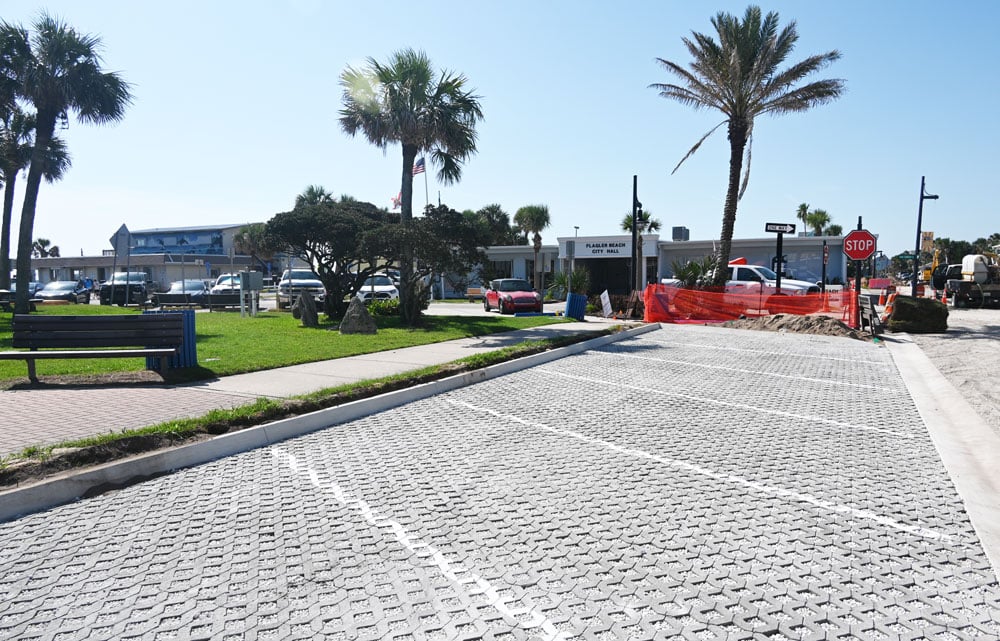
Brace yourself. It’s actually happening. After talking about it for three decades, and 11 years after a committee that had met for two years had recommended it, Flagler Beach is about to issue a request for qualified companies to propose a paid parking system for the city.
The request will be issued on June 1. Flagler Beach residents would be exempt. Palm Coast residents, who account for the majority of visitors to the island, would not be. (See the draft RFQ here.)
“It’s just the first step in a 13-to-15-year process,” City Manager Dale Martin said.
“Or longer,” Commission Chair Eric Cooley said.
Based on the timeline Martin submitted, paid parking could be in place in early 2027. But it’s not a done deal. In a reflection of the touchiness of the issue, the commission doesn’t want to frame the RFQ in those terms. “I want to make a statement to the public, because I know how this is going to get portrayed in the media,” Cooley said, anticipating that the public reaction to Thursday’s decision will be that the commission has already approved paid parking. Not the case, he said.
“You cannot make a decision until you have the data,” Cooley said. “So we can’t even decide if paid parking is the right thing for us until we get them in front of us. Have active, real discussions, cover the nuts and bolts, see if this is the right thing for the city, because I know how this is going to come off. It’s exactly what you said. ‘Commissioner Cooley said we’re going to have paid parking starting tomorrow.’”
“We’re starting our investigation into paid parking,” Mayor Patti King said.
Previous city commissions got cold feet when it came time to choose a system. This commission appears more intent on making it happen. It listed paid parking at or near the top of its priorities when it met for a day-long goal-setting session last month. And when fewer people were tuned into the session, which was not broadcast on YouTube, as regular commission meetings are.
Martin heard the message at the goal-setting session. On Thursday, he submitted a proposed “request for qualifications,” or RFQ, the formal document governments’ procurement divisions use to work toward selecting a qualified company to provide the service.
“I think it’s great that this is finally before us,” Commissioner Scott Spradley said. “I’ve been saying for several years that I was on that paid parking committee seven or eight years ago. But I looked at this thing. It was actually 13 years ago when that paid parking committee was formed, and it was a different ball game back then.” The committee was formed in 2013 and submitted its findings in 2015.
Back then, three companies visited the city to study the feasibility of a paid system. It was all based on “stick” or poled parking meters. That’s no longer necessary now that it takes little more than phone apps.
But something could give the commission and the lawsuit-averse Spradley–an attorney who’d rather sue than be sued–cold feet after all.
Kerry Lutz, a retired attorney, filed the lawsuit on March 3 in the Southern District of Florida against Palm Beach, Boca Raton, West Palm Beach, Riviera Beach, Delray Beach and Fort Lauderdale. He also named three companies: Parkmobile, Paybyphone US, and One Parking, plus “John Does 1-75,” signifying “additional Florida municipalities and third-party technology providers.”
Lutz claims the systems lack uniform signage, violate Florida’s Digital Bill of Rights, and violate due process, among other charges. Some of the arguments echo claims against red-light traffic cameras and third-party enforcement, which led many Florida cities to dismantle the cameras, Palm Coast among them. (See the Lutz lawsuit’s exhibits with numerous pictures illustrating his claims.)
Martin noted the lawsuit in his briefing to city commissioners. He’s following it “with interest.” But he’s been through paid parking implementation before, when he was a city manager in Fernandina Beach. “They finally did move forward to implement it. It’s been rough up there,” he said, but noted that paid parking is flexible enough that it can be suspended, and lends itself to flexible parking and surge pricing. The problem in Fernandina Beach is the forest of signs that have gone up, polluting the town’s historic neighborhoods. “There’s been some significant pushback in that community,” he said. “There’s some challenge. It’s not going to be, let’s roll this out and everything’s going to work perfectly.”
“Volusia has a very well done program. It’s polished, it works,” Cooley said. He is interested in the flexibility of the system.
The request for qualifications would be published on June 1. There would be an optional site visit for any interested companies on June 12. Any questions would be due by June 19, and the responses to the request due by July 2. The city administration’s evaluation committee would review the submissions on July 16 and rank the responses. On Aug. 11, the selected contractor would appear before the City Commission at a dedicated workshop. If the commission agrees, the administration would then enter into negotiations with the company for a contract.
“This is not their business plan. We are not even asking for their business plan,” Martin said. Not yet. The formal agreement will take 90 to 120 days, at a minimum, to flesh out the details, from employee parking to special events to other flexibility-demanding options.
“We are probably still six months out from the time that you tell staff to enter in discussions with them and whether discussions are fruitful or not,” Martin said. “But something would have to come back to you to formalize the agreement anyway before we move forward with that.”
The company would have an initial five-year term, although that’s negotiable. Commissioner R.J. Santore wanted to ensure that the scope of the RFQ includes a reference to the fact that Flagler Beach residents will not be charged for parking. The RFQ puts the private company in charge of issuing citations.
“I’m getting all kinds of phone calls and emails asking, what’s the status of the RFQ?” Martin said. “It hasn’t been published yet, but it will be.” He intends to send it to as many parking companies as he knows. If the RFQ doesn’t generate the sort of responses the commission is looking for, commissioners are prepared to re-issue it.
For all their caution about not wanting to appear as if they’d approved a paid-parking system, commissioners nevertheless sounded–as they had sounded at the goal-setting session–quite eager to get to that point.





















City Tim says
I for one will not pay for parking so I will not be going to Flagler beach too much anymore
Sherry says
@ city tim. . . good luck in finding a better beach without a bridge toll, a long drive, or a parking meter. You’ll certainly miss wonderful Flagler Beach! Joy! Peace! Love!
Eric says
Aside from Hammock Dunes bridge, the only other bridge in FL that has toll is Sanibel. Get off your high horse.
Koyote says
Once again, a little research on the magic information highway can reduce the embarrassment of unmitigated oral BS…..
“Copilot Search Branding
Florida has numerous toll bridges and causeways, most of which use electronic tolling with SunPass or Toll-By-Plate, offering convenient and discounted payment options for frequent users.
Overview of Florida Toll Bridges
Florida features 13 major toll bridges spanning key waterways, connecting cities, islands, and coastal regions. These bridges are part of the state’s extensive toll network, which includes over 700 miles of toll roads, express lanes, and bridges. Most bridges now operate cashless or electronic tolling, though a few still accept cash at select plazas.
Wikipedia
Major Toll Bridges
Mid-Bay Bridge: Connects U.S. Highway 98 in Destin to SR 20 in Niceville. Toll rates for a two-axle vehicle are $3.00 with SunPass and $4.00 for cash.
Bob Sikes Bridge (Pensacola Beach Bridge): Links Gulf Breeze to Pensacola Beach, with tolls charged southbound only, typically $1.00-$1.50.
Sanibel Causeway: Connects Sanibel Island to the mainland at Punta Rassa, with tolls ranging from $6.00-$9.00 for two-axle vehicles.
Rickenbacker Causeway: Connects Miami to Key Biscayne, with tolls around $2.25-$3.00.
Venetian Causeway: Links Miami mainland to the Venetian Islands and Miami Beach, tolls $2.25-$3.00.
Card Sound Bridge: Connects southern Miami-Dade County to northern Monroe County, tolls $2.08-$3.12.
Cape Coral Bridge: Connects Fort Myers to Cape Coral, tolls $2.00-$5.00.
Midpoint Memorial Bridge: Connects Fort Myers to Cape Coral, tolls $2.00-$5.00.
Garcon Point Bridge: Connects US 98 east of Gulf Breeze to I-10, tolls $2.30-$2.75.
Broad Causeway: Links Bay Harbor Islands, tolls $2.00-$3.25.
Hammock Dunes Parkway Bridge: Connects Palm Coast to private barrier island communities. “
Sherry says
Thank you Koyote! Geez, some people are just so combative. Is it any wonder local government leaders have such a difficult task with each and every decision they must make.
Laurel says
Great joust, Koyote! His horse ran off.
City Tim says
Sherry, it’s not hard to find one , just go south by high bridge, the sand is better, or go north to the inlet and the sand is better. The only thing Flagler has is the city of Flagler beach , the shops , bars and restaurants. But if you got to pay to park it’s not worth it
TR says
I’m sure a lot of locals won’t worry about it being they will either walk to the beach or take their golf carts. Flagler beach is looking at this for the people from other cities and states to pay to help pay for whatever excuse they want to use why they need to money.
Just go Away says
I am sure you will be missed. Oh well. That is just how things go. Please take good care of yourself and always remember we are all here for you should you change your mind.
Barbara says
City Tim, that’s what we’re hoping for. You’ll free up a parking space so I as a resident of Flagler Beach will be able to go to the beach again
ken says
THANK YOU !!City Tim
Mothersworry says
I for one will be ecstatic that this may happen as I am tired of subsidising out of towners day at the beach.
TR says
The beach doesn’t just belong to you or the residence of flagler beach.
Joe D says
You are 100% correct, the beach doesn’t “belong” to Flagler Beach. However lots of “non-Flagler Beach” residents feel they should have full use of the beach area, but have no responsibility towards paying for PUBLIC USE beach maintenance. PRIVATE BEACH access areas are another issue altogether.
A prior FlaglerLive report stated that using Cell phone tower data, 4 out of 5 Flagler Beach area users are from Palm Coast, but when the Flagler County Commission proposed alternatives for paying for beach maintenance,
there was a massive negative media outcry. I STILL don’t think area residents realize, NO BEACH= NO TOURISTS = NO TOURISTS’ TAX DOLLARS. Out of Towners are GENERALLY not coming to Flagler County to visit Palm Coast Town Park or Bunnell…although once in the area, they can be drawn (as I originally was) to other services and events in Palm Coast and Bunnell.
Paid parking won’t affect those people who say “I almost never use the beach area, why should my taxes pay for beach maintenance?” If you don’t frequent the beach area, then paid parking won’t affect you. I do agree that we need a 2-3 story PAID parking garage near the downtown area to relieve the parking pressure paid street parking is likely to create.
As a Flagler Beach retiree, I APPLAUD the Flagler Beach Commission for FINALLY tackling this issue as other local beach areas have in recent years. Although for street parking, I would suggest Flagler Beach property owners be charged 50% -75% discount off the regular parking fee, and not FREE (or some will park their cars and “never” move them).
PS: the beach across from our Townhouse development IS TECHNICALLY “OWNED” by the Development owners…however we have never felt the need to limit public access. But being able to actually access PARKING along the beach side (even during weekdays) is getting increasingly more difficult!
FlaglerLive says
The proportion of Palm Coast visitors to Flagler Beach is closer to a 60 percent ratio.
Joe D says
Thanks for the clarification (3 out of 5 Flagler Beach area users …using cell phone tower data, are from Palm Coast) I THINK I was originally repeating a quote by (?) Commissioner Eric Cooley on the 4 out of 5 Palm Coast beach area users ratio. But I stand corrected. Still… for 60% of the usage coming from Palm Coast but few ( if any) of those “users” feel they have ANY financial responsibility for maintaining those PUBLIC USE beach areas…that’s a fairly high percentage who expect FREE beach access and maintenance.
As an ASIDE for the commentator that was concerned about payment card only use: the parking kiosks covering an approximately 1 block of spaces each in my PRIOR home city accepted CASH (and I believe quarters too) as well as credit/ debit card access…(no additional fee) they also had direct connection to a security system/Alarm/ camera, if they were tampered with for the cash. You just had to remember to PROMINENTLY display your timed receipt print out VISIBLY on the driver side of the dash. The only downside to THAT system was, if you wanted to extend the parking time, you had to get a new timed receipt to display, rather than just going into a phone APP and using a payment card to extend the time on your existing parking space.
Joe D says
The company that supplied my former home City’s STRADA parking kiosks is FLOWBIRD…and the mobile phone parking apps that work with it are FLOWBIRD, Pay ByPhone, and Mobilepark
Me says
Palm Coast residents should be contributing and then also get a break on parking.
Sherry says
Thank you Joe D! As usual, the voice of educated, logical, reason!
JimboXYZ says
Not that it matters much, but as this grows, throw a dart at a city name, there won’t be enough parking anyway, paid or free.
I bicycle anyway. With the construction, residential, dune & A1A construction. It doesn’t matter when that construction is completed. There will be even more of a shortage of parking for the construction, growth, the spin of improvement for a quality of life. It will be the cosmetics of the “lipstick on a pig”, the “10 gallons of poop in the 5 gallon bucket”. We all, as Flagler County will not have affordable housing, there will not be adequate parking, regardless of the rate that a parking spot will eventually inflate to become. The direction of Bidenomics was loud & clear. create financial hardship, dealing with unaffordable for non-solutions that ever cure the unaffordable. It’s why the inflation continues, persists to this present day & will for the future. This is not a random sequence of solutions. It was carefully planned in the succession of the political figures that replaced those that were fighting for preserving a more affordable era in America. Westward Expansion, annexing into a larger city. As Marineland has gone bankrupt, victim of Bidenomics, how many businesses have bankrupted ? Marineland won’t be growing any time soon. The Developers that invested in Marineland’s growth potential didn’t count on the money running dry, the Marineland theme park bankrupting & being sold.
This evolution, I don’t think Volusia has the perfect solution either, they are only offering free parking (on the beach for driving) to residents because they are facing their own budget shortfalls. Volusia may have free parking, it was free parking masked as a beach toll for motorists. And Volusia beaches have no drive/park zones for resorts just the same. It’s not perfect, are they getting more commerce beachside in Daytona for it, from Ponce Inlet to Ormond Beach (Granada & North to Ormond by the Sea) ?
Anyone else see the solution as just relocating elsewhere & leaving all that misery behind. Learn to live in a place that lacks the Ocean and the problems of the natural landscape of planet Earth ? That or expiring as elderly and not having to be taxed for it, charged beyond the politics of “appropriations”. Parking in a way, like healthcare, from Government subsidies, to what the individual still has to pay for out of pocket for coverage(s) beyond basic. We read in this article, the term “business model” that is the “dog whistle” that the solution(s) won’t ever be affordable solution(s), it will always be a form of collecting revenues that will have surpluses of reserves that will be siphoned & leached off to something that was covertly cloaked in the parking rates. Overcharged is the only way to perceive that ? Parking is finite in Flagler Beach. With commercial growth there won’t be parking or that will become a new business as other businesses will fail & disappear. The land isn’t growing, it’s shrinking from erosion. The parking has to come from some existing land that has something else on it to be replaced with a parking lot with kiosks.
The Truth says
I enjoy visiting business is Flagler Beach but if I have to pay for parking when visiting I won’t be going anymore. Good luck to businesses in Flagler, I wish them well.
tumble weeds beach says
I will not pay to park there – to me it would just not be worth it. Personally, to me, the food in Flagler isn’t better than what I can make at home, and I’ve noticed portion sizes at some places have decreased substantially, and meal prices have increased. A diminutive and mediocre cheeseburger for $18, 30% tip, combo’d with $4 (estimated at $2/hr) isn’t doing it for me.
At least wear a mask says
So thier planning on implementing a paid parking system on a State Highway for a below mediocre beach community that floods every time it rains. An area that has again mediocre restaurants and a few retail businesses.
This is just another cash grab ! If I’m going to have to pay for parking to go Flagler Beach I think I would rather go to a BETTER BEACH !
Arthur Morgan Jr. says
If Palm Coast residents have to pay for parking, then it should be at a discount since we all live in Flagler county. I live about 12 min away from the beach, I do not think it is right to pay the same amount as somebody who is coming from St Augustine or Deland. I would not mind if all the revenue goes toward repairing the beach. There should also be a monthly pass implemented the same way the bridge has one. Full price parking should be for anyone who does not live in Flagler county.
Michael John says
Here’s a link to a Gemini response regarding establishing paid parking in Flagler Beach.
https://g.co/gemini/share/35c508758330
Sherry says
@ Michael John. . . Absolutely! The FB leaders should themselves study AI suggestions before paying $$$ for a company to study this situation. Especially when that company will likely use AI tools anyway!
Laurel says
It’s about time. Flagler Beach and A1A is choked up with cars on a common Wednesday. Forget weekends. Palm Coast will cry, which is interesting because they claim they don’t go to the beach anyway.
Don’t worry Flagler Beach, they’ll be back. There’s nothing to do in Palm Coast but shop at Dollar General, BJ’S and Walmart.
Jim H says
Laurel – “Dollar General, BJ’S, and Walmart” is the Las Olas Blvd (https://www.lasolasboulevard.com) of Palm Coast’s class act.
In the mid ’60s, I found this isolated place at the end of a road with no one here! I kept coming back and realizing that, in time, it would always remain the way I saw it. No so . . .
Now, Flagler County is on its long, long journey to make it a virtual money cow like Coney Island.
Nathan Hot Dogs, anyone?
Sherry says
@ jim h. . . why must it, in your mind, be one extreme or the other? Please consider the possibility that if done carefully, a compromise can be implemented that will be a net positive for the majority of “reasonable” people.
Jim H says
If a compromise is in the cards – so be it!
But my bet after following 50 years of the sordid stories of the development of Volusia’s “famous beach” southern sister city, Coney Island, is a certain possibility.
Go look!
Flagler leadership just can’t help itself.
BTW: You want chili on that Dog?
Laurel says
Jim H: I literally grew up on Los Olas, we had an upscale shop there in the 800 block. It’s really different now, mostly bars and restaurants. Kinda sad. Definitely crowded.
I don’t think Flagler Beach will get there for some time to come. It certainly won’t go through the same process. However, the Margaritaville nonsense surely bypasses the loveliness of the past Los Olas.
Sherry says
Dear Laurel, as usual. . . excellent points!
Republican Dave says
Palm Coast has repeatedly made it clear that they do not want to contribute to beach restoration, and Petito went along with it. They don’t want to pay to park, either. They want Flagler Beach residents to pay for it all, yet they are there every day the sun shines, and not all for shopping.
Sherry says
Thank you Republican Dave!
Richard Wielder says
Flagler Beach chose to incorporate as its own town. You don’t like paying for the things under your control, then give up control. Flagler Beach people conveniently want the rest of Flagler County. Please don’t bother us, but cut a check when we ask is the Flagler Beach mentality
Sayit'snotso says
Wait let me get this straight, if I live in flagler county. I’m not allowed to go to the beach ! First off volusia residents get to park for free! Look it up second ! Not all people use their phones for payment. If you’re smart, you don’t have apps. On your phone. Or credit cards on your phone. Flagler beach has no problems, taken money from the county. Who exactly do you think pays for these taxes 🤔 that the county then gives you money that you piss away.. I thought they were coming from Jacksonville. Because of voilence. So it’s park fees ! And the ones from volusia , is because their to dam lazy to get the free pass . You didn’t have parking problem until you bought that hotel in . No one is going to pay 20 bucks to park . Your high as Hell. And sad to say ,that sleep beach town ,that everyone loves. Has flown the coop. People need to start warning ⚠️ people don’t move here. These official’s are out of their dam minds! And what happen to home of the free and land of the brave. Something is seriously wrong when you can not even breathe 😒 that salt air. for free at the beach or watch a sun rises ! Don’t expect people to show up for your parades. Or any fund raising events . Why to divide ,a county!!! Shame on all you! I hope that everyone of you, look at those meters, and remember you did this. And the price ,it’s going to take on these small business .when their doors are shut because loss of business. Don’t believe me check out Daytona main drag !!!!( No one is there it’s Empty ). Take a little ride weekdays and weekends .
Laurel says
Ten people made sense out of that?
Wake up, folks. Today, if you stay in a hotel on the beach, you pay for the overnight parking besides your room, usually $20 and up each night. Taking a ferry to Cumberland Island is $18, plus state park entry fee. Metered parking is extremely common on the coast.
Those who threaten just want the residents of Flagler Beach to pick up the total tab. Whether it’s beach restoration or garbage clean up. If you don’t come, it’s okay. I’ve lived in Florida all my life, and people will still go to the beach. Don’t let these whiners scare you.
Charge me says
Great idea. About time. Just do it already !!
Reduce the crowds, limit the restaurant wait times. A win win for all !
PLUS an added bonus is more $$ to buy sand to keep dumping in the ocean
Ed P says
Nothing mentioned about if it’s going to improve the overall parking situation?
Exemption of Flagler Beach Residents makes it “acceptable” to them.
Will they exempt those who are staffing those retailers/restaurants?
So as a nonresident, I’m getting the same, except for more moneys?
Will I still need to park 4-6 blocks away from a restaurant on weekends but be paying for the parking to eat elevated bar food? Get tagged 3-4% for using a credit card too? Yippee…
Flagler Beach business owners unite, beware of the naked man giving you the shirt off his back.
The only thing it’s going impact is your overall business profits for first 6 months, until people surrender, if they surrender.
Married Dude says
Churches and businesses that have their own parking lots: pay attention to this. If/when they institute paid parking, regardless of the form, places that already have their own lots are going to have to deal with people using their lots, whether we want them to or not.
Pig Farmer says
What they need is a parking garage. Or three.
Lance Carroll says
Paying to park in Margaritaville… Searching for my lost shaker of salt…
John Stove says
And yet another reason to stay away from Myrtle Beach South with its tacky shops….most of us go to Matanzas Inlet beach and we pay the discounted toll so its cheap. The sand is nicer, the views are better, the ocean is nicer……friends meet us on their boat in the ICW side etc etc etc
Flagler Beach is one hurricane direct hit away from being erased and NO ONE will vote to tax ourselves to rebuild A1A AGAIN……
Good Luck to you
Beach Walker says
Flagler Beach continues the downward spiral since Covid. The true long term residents (15 years+) do not venture out because of the lack of quality restaurants and service. We go to St. Augustine or Ormond/ Daytona Beach for fine dinning. No tolls. Hell half the eateries are only open part time in Flagler Beach. The herd mentality does not work, your food is very disappointing.
Pierre Tristam says
I have no idea what the Beach Walker is referring to. Cheryl and I have lived in Palm Coast for 25 years. Beer aside (that untouchable honor goes to Brown Dog at St. Joe Plaza: our 9% Mecca, our our Lady of Tripel Lourdes) Flagler Beach has always been and will continue to be our our first destination for dining because of its restaurants, whether it’s the Anchor’s martinis and the best fries and mussels we’ve sampled from Jacksonville to Miami, Barnhill’s endlessly creative cuisine, Breakawayz when we want lighter fare and the Ocean breeze, the Winery/Distillery for its fabulous cheese and charcuterie boards and locally made wines and spirits, the Bistro when we qualify for an additional mortgage, Faro for end-of-night desserts, or Coquina Brewery for all sorts of locally made beers we don’t get at Brown Dog, and that’s only a partial list. We’ve tried the Margaritaville restaurant. Good food, not worth the ridiculously slow service and high prices, especially as the atmosphere in there is somewhere between a La Guardia Airport food court and a chain restaurant, with a beer selection to match. St. Augustine? Every time we go, the few times we do, we have to pay to park, or spend 45 minutes trying to land a free spot. There are more dining options but at the price of so many hassles that we usually age at twice the normal rate for the time we’re there, which is ironic considering its alleged fountain. Speaking of irony: we’ve not once, in our 25 years of going to Flagler Beach, had trouble parking within eyesight of wherever we go, which may not make the case for paid parking (though it may be time to fix the 6th Street parking lot near the Anchor, which is increasingly looking as if Israel bombed it). But if the city were to bring paid parking, we’ll pay. It’s the least we can do for our playground and dining room away from home, and to which Palm Coast has yet to hold a candle.
Me says
Pierre as a Palm Coast resident we should kick in funds to Flagler Beach and get free parking if it comes down to that.
Palm Coast lacks restaurants as you said don’t hold a candle to Flagler Beach, all we get are fast food restaurants on every corner and or a gas station.
Laurel says
Ocean Grill for breakfast! Eggs Benedict! The surfer breakfast with eggs, blueberry pancakes and a perfect slice of ham! Yeppers!
!!!
Reply says
We did not have this problem until you brought in the Margaritaville Compass hotel. Which if people look around it is alot better deal to rent a condo in Flagler Beach and most of the time walk down to the beach. If you start charging for parking then people will stop coming and the businesses will suffer. No one wants to pay to park. This will reduce the revenue for the City even more than the parking will bring in. We had plenty of parking before the motel was brought in. You are ruining our wonderful beach town. Took away our beautiful red sand. We haven’t even had a pier in a long time. You keep thinking of ways to change Flagler Beach and ruining the town. I pay full taxes, own a condo here and am here as a resident 5-6 months a year. I do not rent my condo. Are you now going to make me pay more when I already pay full property taxes and have seen my property taxes increase well over $1,000 in 6 years? Sure, have people pay for parking and ruin all the businesses in town and it becomes just a Dollar Store and a pizza place and a bar. Ruin the beautiful area we have. Just get the Pier done so all the people can go back to visiting and fishing on the pier that have been paying the property taxes. It used to be a nice place. Don’t ruin it even more. Keep our beach natural and beautiful, not full of boardwalks, hot dog stands and litter. No one wants to pay for parking to go to a restaurant, or a gift shop or experience the local art. They will go somewhere else and our nice local businesses that have been here forever will fall apart. Taking away our park to build a motel which was not needed has already affected Flagler Beach and the atmosphere and alot of visitors no longer come here. Please rethink this. Haven’t you done enough and still dragging your feet on the Pier.
Reply
Sherry says
@reply. . . the lack of parking and the “cost” of keeping the beach safe and clean has been an issue for well over 20 years. You are quite mistaken to blame it all on the new hotel.
If we do not continue to progress and evolve “CAREFULLY” our communities and civilization will die. Open your mind and get educated. . .
International and Canadian tourism is way down across the US, including Florida:
The Canadian Exodus: Canadian travelers, who make up the largest share of Florida’s international market, avoided the state en masse. Florida’s total Canadian visitation dropped by 14.7% for the year, with specific quarterly drops hitting as high as 15.1%. Regional Divergence: While Central Florida and Orlando recorded localized 5% international dips, South Florida hubs like Miami and Fort Lauderdale saw flight seat capacities from Canada slashed by over 20%.
Mothersworry says
I think we all can figure out why friends from Canada are selling their condo’s and aren’t visiting anymore.
Does anybody know how many parking spaces were eliminated due to the hotel?
Jaii Hein says
Maybe six on the block side of hotel. That was a hotel land in the sixties when I lived there. And when it was a 1900s hotel no parking in front.
Richard Wielder says
I love all these ppl that say the hotel isn’t needed, yet the hotel is always busy. If it wasn’t needed wouldn’t it go out of business?
Marcus Allen says
No matter what they do it will be the easiest thing to defeat for free. We Realtors share everything as I have unlimited access to any community in Flagler, gated or not. LOL!
Sherry says
Good for you marcus! Do you pull out your handicapped placard and use that as well? Way to go. . . not giving a care about anyone else. Ya know, we do have a “choice” in realtors. . . “you” sir, with that attitude. . . is the absolute “last’ one I would choose.
Joe D says
Wow Marcus, that’s both a self centered AND a DISCONCERTING comment from a SUPPOSED “trusted” Real Estate Professional !
Really makes me wonder what other LIBERTIES you feel you could take with private properties …especially those with general use key LOCK BOXES….
AGAIN…just WOW!
Dee says
You sit are not a Realtor that I would ever hire or recommend..very sad you have that attitude
Sherry says
Good Grief! While I’ve always advocated for a reasonable toll. . . say a buck. . . on the bridge instead. They haven’t even come up with the amount to pay in those parking meters, and “Palm Coasters” are getting all upset. They haven’t evaluated the idea of a discount for “county” residents.
While the beach doesn’t “belong” only to those living on the barrier island, the “cost” of keeping it safe clean and beautiful should not fall “entirely” on those who live on that island either. There is a reasonable compromise that will be OK with most “reasonable” people. Let’s just hope Flagler Beach leaders find it, and soon, without spending $$$ to “study” the options for another 10 years!
Richard Wielder says
You do realize the bridge is a state road. FB can’t just slap a toll on a road that is not theirs. The ignorance displayed by the comments in this section are unreal. No wonder FB is the way it is
Jaii Hein says
the Hammock Dunes Bridge is not a state road. It is a privately owned and operated toll facility managed by the Dunes Community Development District (CDD), serving as a connection between Palm Coast and the barrier island over the Intracoastal Waterway.
Mr. Bill says
Volusia County is $20 to park. $50 if not paid by 2 weeks. $100 thereafter and subject to arrest.
All this joy coming to a beach near you.
If it ain’t totally broke…….don’t fix it!
When will any educated people arrive here? says
Bill,
Volusia has free parking for THE ENTIRE county of homestead owner. No bull shit meters or failure phone apps. For FREE, Register your homestead address, vehicle registration, and tag. All Volusia law enforcement have tag readers. Drive thru a lot and you get a hit on non registered vehicles. They also have non homestead owners and rental car passes. Flagler traveling to do the multiple vendors answers to provide less $$’s to the county. Flagler county, the corrupt one. Just another FB bullshit execution of a simple solution.
Failure Again.
Laurel says
When: Volusia County also has many public county parking areas with crossovers between private buildings and homes. That county, and Daytona, have made the beach more accessible to the public. Flagler County has not. The county, and Daytona residents pay for maintenance through taxes. To expect one, small city, in Flagler County to take responsibility for all of Flagler County, and beyond, is unreasonable.
By the way, Flagler residents flood Matanzas Inlet, which belongs to St John’s County.
In Flagler County, even the north public roads do not allow parking at the public crossovers. There is the threat of being towed from the public right-of-ways!
Where is the county’s responsibility? Where is Palm Coast s responsibility?
Don’t expect to put it all on the City of Flagler Beach.
Smitty says
Will Someone please show me a beach with paid parking that nobody now goes to. People will always go to the beach, and pay for parking if they have to. People are really upset because they don’t like change. After a year or so no one will really care that they have to pay to park.
Bryon says
It’s hilarious, listening to the locals thinking the parking fees will help Flagler Beach do many things. Gullible people, flagler beach will never have any benefit from the parking fees. The money will be forgotten about and in somebody’s pocket before too long zero will be get done to help Flagler Beach residence.
Sherry says
Wow, just Wow byron. . . such a fear filled, negative perspective. Certainly, I don’t know what has happened to you to make you so bitter. Some “good” emotional counseling is highly recommended for you ASAP, please!
Bryon says
Palm Coast residents are suckers! They will pay 50.00 to park a car.
CPFL says
If there is paid parking I will continue to buy my St, Johns County beach pass and park on the beach. Park for free at one of their restaurants and eat there…not drive down A1A and stop at a Flagler restaurant. If it happens it will kill businesses in Flagler.
Why do people insist on bringing the weak cell phone stats up? Does this account for people working at these establishments? Does it define who is actually using the beach? What percentage of people from PC are actually at a restaurant or store versus on the beach? How many tax dollars would Flagler be missing if those stats are cut in half or worse? Can small business survive the off months with low tourism, without the people of PC visiting these businesses? How much tax revenue will be lost from the people of PC that decide to go elsewhere to eat and spend money? Who makes up for those losses in revenue?
It might just end up that a business is better off closing in the off season and you are stuck with a bunch of boarded up places. I remember a lot of Myrtle Beach used to close down seasonally back in the day…and it was a boring ghost town. I have seen many once booming towns, in the US, put in pay to park and end up with a bunch of empty buildings. Initially I am sure the number of people saying screw going to Flagler will be high and it will become less over time but there will still be a large number that decide to not go back.
Ted Raczynski says
Parking meters can have a little spray paint and coins coated in JB weld as a treat.
Jeremy Hambly says
My Wife’s son keeps stool in baby food jars in he car, if you push it into the keypad … good luck
Joe D says
The parking kiosks that my former home City uses, have connections to security services ( for theft attempts), cameras for vandalism ( like you are describing)just like regular ATM’s…so…. PS: Good LUCK to YOU TOO!
Sherry says
@ ted r. . . Do you realize just how “criminal” you sound? I hope FB police are paying attention to your posts. Where has your moral compass gone, and why?
Laurel says
Seems like people today want to live off of someone else. Doesn’t seem to matter their age or their wealth. Just blame someone else, and live off someone else.
T says
Trump is in epstein files more then anyone
Richard Wielder says
I know that. The poster is talking about slapping a toll on the 100 bridge. Please use some basic comprehension before putting your total ignorance on display
Beach Walker says
Pierre & Cheryl
To each their own. I have seen the decay in the food scene since Covid. Knot that it was great, but more fitting for the community. And I know Steph, Brian, and Mama at the Anchor. The owners of every place you listed. Been to each and still go to a few. I walk in with a beverage in front of me. Taking care of the employees.
Alexander’s
L’angolo
Hulls Seafood
SoNapa Grille
Rose Villa
Osteria Rustica
Mama Foo Foo
Chez Paul Epicurean
Hyde Park
Collage
Drunken Horse
Beach Walker says
Pierre,
Get a Limo/Uber and reservation.
No place in Flagler worth a 30 minute wait.
I can see every place on the list.
Our Priorities are much different.
Pierre Tristam says
An Uber to St. Augustine? It sounds like the perfect deal but I’d have to get a second job to afford it.
Beach Walker says
I get it. I know few people working or not in Flagler that aren’t struggling in some form. It is a shame.
But we all know “You reap what you sow”
24 hour work weeks will provide no return or retirement.
Yet look around!
T says
Trump is destroying America and Republicans are helping and trump is in epstein files more then anyone
Beach Walker says
Silence is golden. Those that wish and us that have. Shit Hole.
Beach Walker says
Citation 650 sitting in OMN hanger. Hanger at RYY. The ones that have built nothing. Hate us.
Beach Walker says
A good day at KSSI. Best seafood on the east coast. We don’t do Flagler poor food or service, kills the experience. We are Home.