



By Adam Kadlac
If you’ve ever expressed even a passing desire to visit Walt Disney World, you may have had friends who raised their eyebrows, groaned or even sneered.
The heart of their criticism isn’t just that they think Disney is for kids, or that it’s so expensive. It’s what I call the “authenticity objection” – the belief that there’s something fundamentally inferior about visits to theme parks like the Magic Kingdom because they occur in a wholly manufactured environment. The artificial mountains and rivers, the rides that provide nothing more than mindless distraction, the people dressed up as fictional characters …
It’s all so fake.
While people sometimes express this view in jest, others believe the fake environment borders on a cultural abomination. One online forum explicitly cites the manufactured nature of Disney World as a reason not to go, noting that the “smiling staff, the piped-in music, the perfect landscaping” can feel “creepy and overly controlled.”
Journalist EJ Dickson, herself a Disney fan, admits that visitors to Disney parks “willingly spend thousands of dollars on an authentic emotional experience that they know, at least on some level, isn’t really authentic at all.” And a representative Trip Advisor review dismisses Disney World as “a hot, commercialized, fake experience.”
If you’re anti-consumption and dislike warm weather, those criticisms of Disney World are fair enough: The weather in Florida is warm, and Disney is certainly trying to make money.
But as a philosopher who recently published a book, “The Magic Kingdom and the Meaning of Life,” I find criticisms of the parks as fake a bit more difficult to understand.
Disney isn’t shy about what it is
Marketing professors George Newman and Rosanna Smith note that philosophers have tended to think about authenticity through the lens of whether “entities are what they are purported to be.”
Apply that standard to Disney World: Does it represent itself as something other than a Disney-themed amusement park?
Earl Theisen/Getty Images
There are legitimate reasons to complain about the authenticity of some experiences. If you buy a ticket to a Van Gogh exhibition, you could rightfully complain if you discovered that only reproductions had been on display. The fact that you hadn’t been able to tell the difference while viewing the paintings wouldn’t matter – you hadn’t received the authentic experience of seeing Van Gogh’s original works.
By contrast, Disney attractions don’t pretend to be anything other than what they are.
When people at Disney’s Hollywood Studios ride Mickey and Minnie’s Runaway Railway, they know they are not actually on a runaway train being incompetently driven by a talking dog named Goofy. If Disney had marketed the attraction as something else – say, an Amtrak trip for kids – perhaps there would be grounds for complaining about its fakeness.
That clearly isn’t the expectation of anyone who waits in line for the experience. Riding the Runaway Railway might not be how you prefer to spend time, but there’s nothing fake about what it purports to be.
Who are you to judge?
If the initial form of the authenticity objection is relatively easy to handle, another concern lurks in the vicinity: the idea that Disney fans are somehow fake, due to their willingness to turn themselves over to the trappings of an artificial world.
The precise nature of this concern is a bit difficult to characterize. But it involves the belief that people who spend a lot of time in manufactured environments tend to delude themselves in ways that evade understanding and engaging with their true selves. Terms like “existential authenticity” or “self-authenticity” seem to capture what’s at stake.
Media scholar Idil Galip has pointed to the fact that the parks are highly “engineered and focus-grouped; there’s a whole lot of work that goes into selling this sort of experience.” This can, at a certain point, signal “a break from regular society or real life.”
This supposed connection between the fake world of Disney and the corruption of one’s authentic self is on full display in descriptions of so-called Disney Adults.
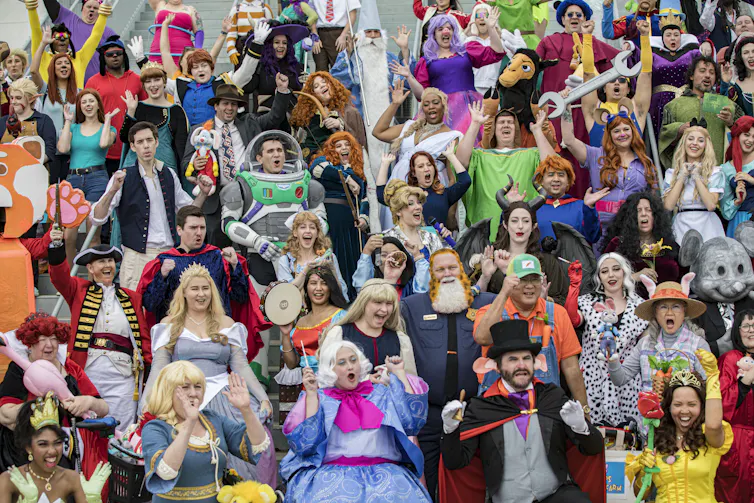
Dickson characterizes this view in her Rolling Stone article about Disney Adults: “Being a Disney fan in adulthood is to profess to being nothing less than an uncritical bubblehead ensconced in one’s own privilege, suspended in a state of permanent adolescence … refusing to acknowledge the grim reality that dreams really don’t come true.”
Daniel Knighton/FilmMagic via Getty Images
But I would strongly push back on the idea that a love of Disney World renders people fake or inauthentic in any meaningful way.
As journalist and blogger A.J. Wolfe argues in her 2025 book, “Disney Adults,” even the most passionate Disney devotees resist simple categorization. None of them, she explains, seem to be running from their true selves or even trying, in the slightest, to live in an imaginary world.
For example, Wolfe profiles Lady Chappelle, a British tattoo artist who relocated to San Diego, where she exclusively inks Disney-themed tattoos. Then there’s Brandon, a Hollywood drag queen who designed a Carousel of Progress-themed kitchen in honor of the attraction that now resides at Disney’s Magic Kingdom in Orlando, Florida.
These people are representative of pretty much all Disney Adults: They’re passionate about Disney, but they’re also passionate about tattooing and drag and myriad other pursuits.
For Disney Adults, Wolfe writes, an affection for Disney mostly adds “extra color and brightness – maybe definition, motivation, or inspiration if you’re lucky – to the complex and evolving masterpiece that is [their] life.”
And if that complexity applies to the most committed Disney fans, it’s that much harder to cast casual visitors in such a negative light.
The virtues of the Magic Kingdom
If theme parks aren’t your thing, that’s perfectly fine. You can have a wonderful life without setting foot in Epcot or the Animal Kingdom.
But as I point out in “The Magic Kingdom and the Meaning of Life,” Disney World has a number of virtues that its critics often miss.
I think it’s as good a place as any for people of all ages, backgrounds and abilities to come together and create valuable memories. When I ride Tiana’s Bayou Adventure with my wife and our intellectually disabled daughter, there is a little something for everyone: just enough thrill and storytelling for the adults, while not being overwhelming for my daughter. It’s a combination that can be difficult to find in many other places.
Moreover, because we are transported out of our daily routines, the parks can also present surprising opportunities for reflection. For example, I’ve thought a lot about cultural expectations around happiness while at Disney. Should I try to maximize my pleasure during this short trip? Or simply take each day as it comes? I’ve learned to embrace the latter.
I’ve also come to appreciate the value of anticipatory pleasure, which is the positive feeling you get from looking forward to something before it happens. This happened while reflecting on all the time people spend standing in line at theme parks.
Yes, there are many people who simply want to use the worlds of Disney – theme park, films or otherwise – to escape the grind of everyday life. But is seeking such an escape a greater threat to authenticity than checking out by playing video games, watching sports, reading smutty novels or using drugs and alcohol?
Is it possible for people to lose themselves in fantasy? Of course – just as it’s possible for anyone to lose themselves in their careers, relationships or hobbies. But in an age of curated social media accounts, influencer marketing and political doublespeak, the manufactured worlds of Disney might offer more authenticity than you would think.

Adam Kadlac is Teaching Professor of Philosophy at Wake Forest University.




























JimboXYZ says
Until this article, Disney was the last topic that was on my mind. I don’t care who goes there or not. But I do have an issue when everything I buy is up charged for inflation for someone to force me to pay for their Disney vacation. And if I had to sit on I-4 burning gasoline in relative highway gridlock traffic, that’s another thing that I take exception with. People have hobbies, theme parks is one of those. How they spend their lifetimes is their business, but know that it’s a cop out on accomplishing anything for yourself. I just think any day can be better spent doing something that is more challenging/enjoyable than wandering around Disney, just to end up in the next live to stand in, pulling out my cash/credit card/wallet for that privilege ? Does that make any sense ? That’s just me, I can’t be the only one ?
Skibum says
I have a lot of difficulty comprehending how your brain synapses got so miswired that you somehow believe you are paying for other people’s vacations. The same exact miswiring has previously caused your delusional thinking that you are somehow paying for immigrants who happen to be in the U.S., and I suppose as some mistaken logic you are kidding yourself into thinking that removing all immigrants from America will somehow make your life easier and more affordable. LOL!
Especially when the REAL problem is not and has never been immigrants… the ones taking money out of your pocket, and mine, are the wealthy, the corporations and CEOs with golden parachute retirements who make thousands of times more than their workers, and even when fired from their CEO positions leave with millions of dollars in pre-inked separation agreements even after doing a piss poor job!
The corrupt billionaires like our convicted felon prez and his idiot sons who are vacuuming in millions and millions of our taxpayer dollars into their own pockets, but tell us there is no money for healthcare for Americans, no money for our country’s education system. Falsely promising you tariff refunds… have you seen it yet? Falsely promising you he would finish the border wall, and that Mexico would pay for it! Hahaha! Falsely promising lower grocery prices. Have you been to the store lately? Falsely promising lower gasoline prices. We ALL know how much BS that was. Falsely promising “no more foreign wars”, after invading more countries than ANY other previous president in American history and starting an unhinged war with Iran. Go figure. False promises of a “big tax cut to middle class, lower class, upper class, business class… big tax cut”. Total BS again.
If this were Biden spouting all of these obvious lies, you would be foaming at the mouth! But your brain synapses are so messed up that your neurons somehow make you believe all of the BS from the most corrupt sex fiend lying con man to ever sit in the WH was sent by God himself to save America… how pitiful, and laughable. YOU, my friend, have been duped, defrauded, and made fun of… not by me, but by HIM, your dipshit daddy himself.
You may need to see a neurosurgeon to see if there is any medical treatment for your brain ailment.
oldtimer says
From Disney to politics……wow
JimboXYZ says
I think it’s pretty obvious to be able to connect dots when we live in a world that finds creative ways to pay for things. Fraud & abuse are perfect examples. Take the MN Day Care & Food Programs ? Bilking & milking programs for services never rendered. That money was stolen to pay for homes, cars & anything else under the guise of providing “affordable” day care & food for the underserved. PPP & BLM was even exposed for that. And the Bidenomics of it all ? Unaffordable/Affordable Housing doubled for the price of homes. Interest rates were raised. All that money ended up in the wrong hands. DC has a serious problem with insider trading. You don’t think that a Disney trip or few wasn’t that interwoven economic impact of inflation & Capitalism, Supply shortages & everything else unaffordable. Disney took the Covid Shutdown as the perfect opportunity to retool their machine, raised prices on theme park admissions, food & beverage, leaving the rest of us to stand around & scratch our heads that we have no clue as to how it happened ?
We’re watching it with oil today ? What happens on Wall Street, eventually hits Main Street.
https://oilprice.com/Energy/Crude-Oil/7-Billion-In-Perfectly-Timed-Oil-Bets-Sparks-Insider-Trading-Fears.html
Harry says
Jimbo is a few rocks short of a full set. I’ve been reading his comments for years. He’s the very definition of living in his own reality. That meme of a guy pointing toward the trees saying, “Them books over there hurt me,” is Jimbo. He’s got a kool-aid hat on sucking up the juice like it’s his identity…oh, wait, it is.
just saying says
I think, in the end, that the adults act like children and support the magic even though there is antisemitism from the founder.
Deborah Coffey says
It’s not hard to understand these days. The MAGA crowd hates everything, including themselves.
Sherry says
Personally, I had such a negative visceral reaction to my first visit to Epcot, I waited a year and went back for a second visit to more closely analyze their representations. For me, I found their presentations to be revoltingly “white/Western European” biased. The non-white cultures were wholly under represented, or portrayed as inferior or even subservient to “white” cultures and societies. Propaganda. . . You bet ya!
AI reports that I am not alone:
Many scholars, cultural critics, and visitors have spoken out about the way EPCOT and its World Showcase portray various cultures.
These criticisms generally center on three main themes:
1. Western-Centric Narratives- Critics argue that EPCOT often presents history and culture through a “Western lens” that can inadvertently imply superiority.The American Adventure: This attraction has been criticized for “glossing over” ugly details of U.S. history, such as the treatment of Native Americans, while romanticizing colonial figures.Musical Framing: Research has highlighted that the musical scores in shows like IllumiNations use Western musical conventions to signify “enlightenment” or “meaning,” while other cultures’ music is often relegated to “adventure” or “chaos” sections.
2. Lack of Representation-The selection of countries in the World Showcase is heavily skewed toward North America and Europe, which many feel marginalizes other parts of the world.Absence of Africa: There is a significant lack of predominantly Black nations. The “African Outpost” is often cited as a “cop-out” because it is a generic refreshment stand rather than a fully developed pavilion like those of Italy or France. Homogenization: Critics point out that while European countries get specific individual pavilions (Germany, Norway, etc.), entire continents like Africa are sometimes reduced to a single, over-generalized area filled with generic tropes.
3. Cultural Stereotyping and “Americanization”- Many guests and diversity professionals have accused the park of relying on “cultural hyperbole” and outdated stereotypes that cater to American tourist expectations rather than authentic heritage. Stereotypical Goods: Merchandise like maple syrup for Canada or conical hats in Asian sections has been criticized for being “cheesy” or “racially insensitive”. Diminished Authenticity: While pavilions were originally developed with input from their respective governments, critics argue that corporate sponsorship has led to an “Americanized” version of these cultures that prioritizes commercialism over accuracy.