



The debt will yield an immediate $283 million to help the city pay for a $599 million capital improvement plan as it expands and modernizes its water and sewer system. Most of the figures were already familiar to the council and the public except for the details, and the size of the overall debt.
The council took stock of the plan at a workshop on Tuesday, and appears ready to approve it at a meeting later this month. (See the bond presentation here.)
Last March the council approved a 31 percent water and sewer rate increase over three years as part of the anticipated spending plan to modernize and expand the city’s utility infrastructure. An 8 percent increase took effect last April, and another 8 percent increase took effect last October. A 4 percent increase is scheduled for Oct. 1.
Revenue from the rate increase alone could not come close to paying for the needed improvements, some of them required by a state consent order. The council also approved issuing $280 million in bonds–borrowed money to help pay for the improvements. That step was ahead.
On Tuesday, Joel Tindal, the managing director at Hilltop Securities and a city consultant, outlined for the council the mechanics and cost of the bond issue. It will be the equivalent of a 30-year mortgage, to be issued in April. The 2026 bonds will be secured by pledged revenue from utility customers.
The city also has $45 million in outstanding utility bonds. Tindal is proposing a refinancing scheme that would result in a net $1.7 million saving, or reduction, on the repayments the city would have had to make otherwise, the equivalent of 3.4 percent of the principal. “From a financing standpoint, you’re getting rid of old debt and you’re replacing it with new debt,” Tindal said.
But the refinancing of that $45 million is not yielding new money for the city to spend on utility improvements. “The new debt will have a lower payment, essentially, than your existing debt that you have right now,” Tindal said. The annual reduction in expenses–about $200,000–will not be enough to translate into lower utility rates for customers.
In the end, the city’s utility bonds will have a new principal of $330 million and incur interest of $276 million for a total debt load of $582 million, with a maximum annual debt service (essentially, a mortgage payment) of $24.2 million. Annual payments average out to just under $20 million over the next 30 years.
Of that principal, and accounting for the refinanced bonds, the city will have immediate net proceeds of $283 million to spend on the utility system. (It costs $2 million just to issue the bonds.) That’s less than half the overall debt.
There are 54,163 active utility accounts in the city, both residential and commercial. That means about $31 from each utility customer’s monthly bill, on average, will go toward repaying the debt. That share will decline as the number of accounts increases, but utility bills themselves will not decrease proportionately, as new customers mean yet more needed capital expansions.
Palm Coast’s utility capital improvement plan for 2026 to 2030 is a $599 million behemoth only partly financed by the new bonds. Impact fee revenue and ongoing revenue from customers account for the remaining dollars to be spent, with about 5 percent attributed to grants.
Brian Roche, the city’s relatively new utility director, outlined the five-year plan to the council. (See the plan here.)
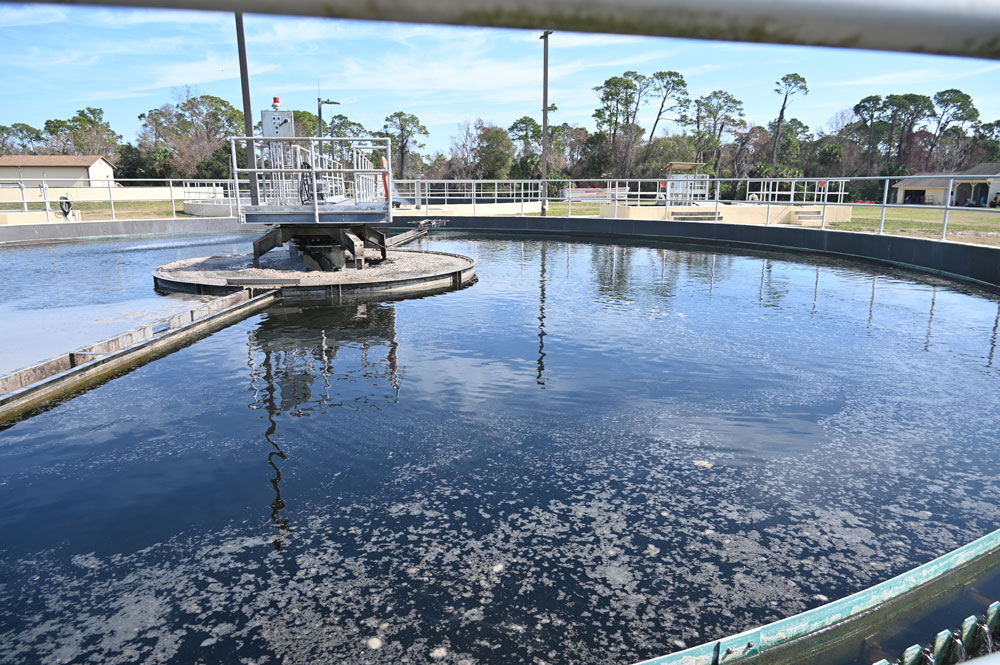
The expansion of Wastewater Treatment Plant #1 in the Woodlands, the city’s oldest and largest–and the plant under a consent order–will account for $200 million in modernization and expansion costs. It will be expanded from a capacity of 6.83 million gallons per day to 10.83 million gallons. The city’s three water treatment plants will see $80 million in investments. The city’s replacement and maintenance of 700 PEP tanks and 3,300 water meters a year will take another $50 million share of the money.
“I don’t envy you right now, Brian, I think out of all of the hires that we have made in the last several months, you came into the toughest job,” Council member Theresa Pontieri told the utility director when he was done. So I’ll preface my comments with that.”
She had another concern: “I am tired of hearing about our failure to get grants,” she said. “We have a failure to get grants in this department, period, whether it’s from state appropriations, federal monies. I know we had Rep. [Randy] Fine here, and I haven’t heard any updates. Obviously we don’t have money. I don’t know if we are consistently following up. I don’t know if we’re being aggressive enough. We’re missing something, whether that is hiring a consultant to say, find us money for water. I don’t know if that’s what that looks like. I don’t know if it looks like somebody in-house. I know that this council approved the position for a grant writer, and it was funded, and we don’t have one. I’m not happy about that. I want to see some movement in this department.”
Pontieri commended Roche for taking on the job, but she added, “I implore you and our new city manager to look at whether or not we are sufficiently staffed and or have consultants to go after grants” for water. “If I am wrong, then I want to know what we are doing. I think our residents deserve to know what we’re doing, because this, what we’re talking about, doesn’t exist without our residents. We don’t have a CIP without our residents and their money.” CIP is the acronym for capital improvement plan. City Manager Michael McGlothlin said the issue would be a topic of discussion with directors this week.
Pontieri was equally concerned about “tinged” water coming out of water pipes. She acknowledged the steps underway to improve matters. “Water has not been a priority in this city for many years,” she said. “Well, it is now. I think your actions show that, our actions show that, our residents, in paying their utility bills, are investing in the very system that they are getting their water from.”
The current council is by no means the first to focus on water and sewer infrastructure, though the size of its investment is unquestionably unprecedented. That may be less a reflection of negligence than the compound deterioration of age. The council raised utility rates 12.5 percent in 2008, at the height of the housing crash and as the city’s population stopped growing. In 2012, it refinanced utility bonds to finance $21 million in new utility projects. In 2013, still with a stagnant population, it raised water and sewer rates 17.6 percent. In 2018, the council approved a four-year, 21 percent rate increase.
All along, previous councils approved repeated and steeper stormwater rate increases that have paid for part of the city’s sewer infrastructure. Every rate increase was attributed to the city’s aging system. Like the current council, every time previous councils were faced with recommendations to raise rates more steeply, they scaled back a little to spare residents. The current council opted for a less ambitious bonding and spending plan when it adopted both last March. In sum, the current council has followed the same pattern as previous councils, adopting rate increases about every five years.























HayRide says
Well I expect to see a decline in my Utilities Bill with the cost spread across the Impact Fees and new residential Utilities collected due to the enormous growth going on in this town. No matter how you twist it. I’ll be fine with that.
CitizenZ says
They say the councils before didn’t increase fees but as this article states there have been increasing in fees. There has even been a population increase. When resident move out I hope the choices they’ve made makes them happy.
Marilyn says
1/14/2026 – the COPC cc have lost their ever living minds!
So now they want the COPC in $1T dollars of debt?!?
More infrastructure for where? The West end?!?
Get out while you still possibly can.
MAD says
This explains why the city is trying to hurry the Charter Revision so that this can all be done without the consent or vote from/by the residents who live in Palm Coast.
To quote a previous Flagler Live article from July 3, 2024, when their vague referendum attempt failed: “Shall Article VI of the charter be amended by removing provision 3 (e) related to fiscal contracting authority that limit the city’s ability to enter into public private partnerships, respond to emergencies and have the ability to address growth by having future residents contribute to infrastructure costs.”
Article VI of the charter states ” (e)Limitations to Council’s Contracting Authority. Unless authorized by the electors of the City at a duly held referendum election, the Council shall not enter into lease purchase contracts or any other unfunded multiyear contracts, the repayment of which: extends in excess of 36 months; or exceeds $15,000,000.00.”
We are, again, being manipulated and lied to AND they’re trying to remove our RIGHTS to speak up, out & hold our city government accountable to those of us who pay their salaries. Wake up, neighbors – their hands are in our pockets while many sleep!
Marilyn says
There should have not ever been any add’l bond debt to the COPC without first a full audit from inception of that Enterprise Fund!
Using Common Sense says
The current residents of Palm Coast should NOT be on the hook for costs of “westward expansion”. NO! NO! NO! Stop the madness. We the People do not want to be pay to fund what developers should be responsible for. Have city staff seek grant funding instead of bending over backwards and working for developers rather than Palm Coast residents!
CJ says
The City Council has failed to pre-plan for infrastructure upgrades for years. So, their poor planning and failures now falls on the taxes payers.
Too busy building parks, tennis centers, city hall, etc.
And, not addressing the failing and outdated waste water system or the storm water system.
Again, all because Past Mayors and Council Members wanted to make a name for themselves on useless and wasteful projects.
Great job!
Travis says
This is all needed for the data centers and ai that will take many employment opportunities from people. Over 1.1million in 2025. Rates will rise as they will need more money . But hey at least you’re paying more for groceries so masked military can terrorize communities. Remember to fight for Exxon and Shell, they own your representation.
John Stove says
Epic failures from the inept people running this City…….no grant writer? that means that there was money available somewhere to help offset these costs and thus reduce what taxpayers would have to pay.
But no, thats not important….
What a bunch of clowns
Gen. U.S. Grant says
Kudos to Theresa Pontieri for wanting to eliminate “tinged” water.
I hate taxes and rate increases as much as anyone, but on the subject of grants…
The way the system is set up, it’s a political game for local governments to seek federal or state money.
If you win the game, you succeed in getting taxpayers elsewhere to pay for your city’s improvements.
If we’re not getting “enough” grants, it just means we’re paying for what our own community needs.
So if we win the political shell game of getting grants, great, but just as well that we solve the problem.
I fully support the higher fees on new development that the construction syndicate is suing over.
That’s one way to make it fair.
TR says
Great something else the city can add to their resume of not being able to manage because they don’t have a clue as to money management.
Water boy says
Oh crap, pun intended.. cannot wait to see what our water bill rise to now.
Bill says
I’d be curious to know the interest rate of these latest bonds. Since interest rates have risen in the last few years, it appears Palm Coast taxpayers will bear the brunt of those higher rates. Kicking the can down the road in years past will cost taxpayers more. No politician wants to raise taxes, but improvements to infrastructure cost money. Randy Fine told the city a few months ago that we are on our own if we’re expecting any money from the state to pay for water treatment upgrades.
Morgan says
Maybe they should hire the grant writers that work for PC Parks and Recreation Department because those employees seem to have an exceptional talent for their successful ability to secure huge grants year after year. That’s why we have such beautiful new and updated public parks and facilities to enjoy! We need people who know how to successfully obtain State and Federal grants for utilities and infrastructure, especially when it comes to road widening and re-paving
Pig Farmer says
Remember all those developer impact fees that were waived or deferred? Sure would be great to have that money now!