



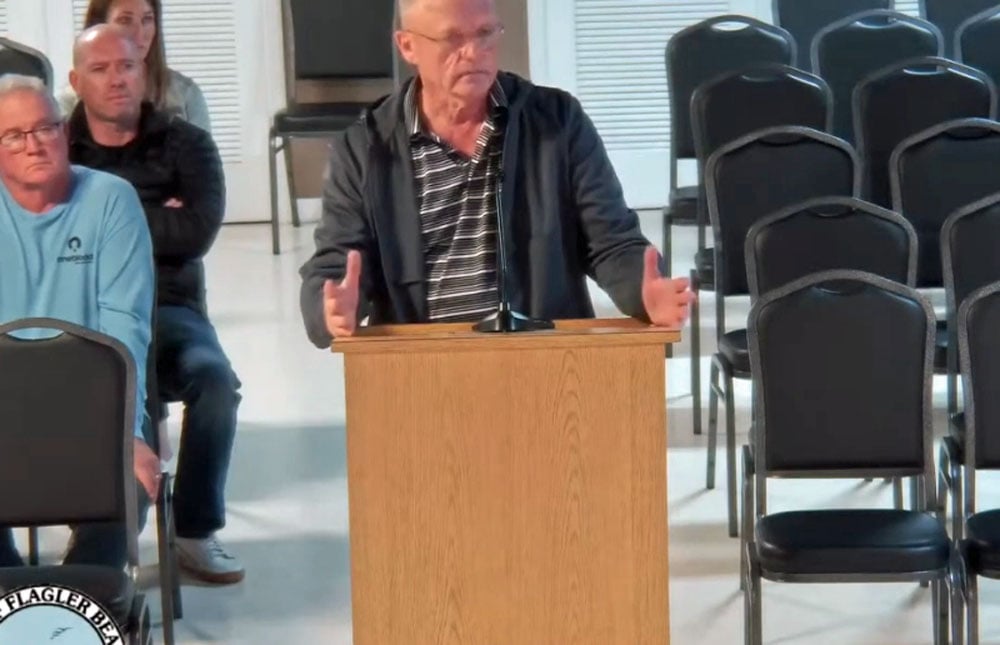
A year and a half ago, a brief exchange between a Flagler Beach Planning Board member and Roderick Palmer, the pastor of Coastal Family Church, all but anticipated the lawsuit Palmer has been battling since January.
The board member had asked Palmer explicitly, twice, if he had permission from the shopping center’s property association to run a church at Flagler Square. Roderick was non-committal, saying neither yes or no, even as the board member suggested that such permission would be required. It wasn’t enough that the city was granting a special exception to its zoning rules to allow the church to operate there. Property associations may and do set their own rules, as they had at Flagler Square.
The board member was right, though the Planning Board let the unanswered question slide: it ultimately wasn’t its problem. It became Palmer’s.
On Jan. 22, Flagler County Circuit Judge Sandra Upchurch granted a temporary injunction to Flagler Square Jax, the company that owns two of the three units at the Flagler Beach shopping center at the western foot of the bridge, halting services there by Coastal Family Church, which has about 400 members. Palmer appealed to the Fifth District Court of Appeal.
The church says its First Amendment rights to assembly and religious expression are being infringed. Flagler Square says it has nothing to do with that but with restrictive covenants that run with the property. One of those restrictions prohibits public assemblies.
On Friday, Palmer’s attorneys, the Orlando-based Liberty Counsel, filed their latest brief with the Fifth District, again arguing for the court to vacate the temporary injunction order on First Amendment grounds.
It is not uncommon for malls to have covenants that prohibit religious organizations–churches, mosques, temples–from holding services there as religious organizations can both significantly diminish customer traffic when not in session and jam parking lots the few times during the week when they are in session.
Coastal Family Church occupies an 18,000-square-foot space, the largest in the shopping center, with a capacity for 2,401 people, according to the Flagler Beach Fire Department. It used to be Badcock Furniture store, and before that–and many years when it stood empty–a Food Lion.
In pleadings to the trial court in Flagler County and to the Fifth District, Palmer has referred to the fact that “Prior to this lawsuit, the Flagler Beach City Commission approved a special exception allowing Coastal Family Church to operate as a church” at the unit, which is numbered 2501-A Moody Boulevard.
That is true. At the Dec. 12, 2024 City Commission meeting, Lupita McClenning, the city’s planning director, made the presentation about the church’s request and listed the conditions for the special exception. The commissioners had no discussion, no questions, no public comment. The vote was unanimous to approve.
The pleadings don’t mention the exchange that took place between Palmer and a Planning and Architecture Review Board member less than two weeks earlier, where the special exception had first sought approval in the regulatory process. The planning board granted it, also with unanimity. But unlike the City Commission, the Planning Board was more probing.
Brenda Wotherspoon, one of the board members at the time—she has since stepped down–repeatedly complimented the church as one of its favorite buildings on the barrier island, calling it “impeccably maintained.” But she had pointed questions for Palmer that now appear prescient, at least for Flagler Square’s case.
“The Flagler County Property Appraiser website shows that as a condo, the 2501A space,” Wotherspoon said. “Have you cleared that, has the church cleared [it] to be a meeting space in that condo association?”
At first Palmer thought Wotherspoon was referring to the church’s existing building on the island. Wotherspoon clarified and again asked: “Yes, the new one is in a condo association. I was just wondering if it’s been cleared, that the church as a meeting space is available or able to be within the condo, the shopping plaza.”
Palmer did not say it had. He had not checked. “I’m just presuming that the mailers and the–that it would draw attention to them to make comment,” he said. “And so I’ve leaned on that, that the mailer and the newspaper adverts is what I’ve kind of leant towards getting, giving them the information in that area, that we intend to go there.”
There had been no direct contact with Flagler Square. The minutes of the meeting said: “no contact with condo association at proposed new location.” (The meeting is incorrectly marked as a Dec. 14 meeting on the city’s YouTube channel. It took place on Dec. 3.) The church had not yet bought the Flagler Square property. It did so on July 25, 2025, though it held events there before that. A Dollar Tree Store leases and occupies Unit 2. Smaller businesses, including a Tax Collector branch, occupy the rest.
Wotherspoon’s questions dovetailed with arguments David Black, an attorney representing Flagler Square Jax, made to Upchurch, the judge, at the trial court hearing in January: “There exists a recorded declaration, which applies to the entirety of the property,” Black told the judge. All occupants of the units are bound by the declaration. “The declaration provides for a covenant that runs with the land, which we all know from going back to law school, that controls, and that controls regardless of who’s in possession, whether there’s a tenant, a subsequent tenant, et cetera. And the reason you have that is because you have an integrated use of these commercial properties that have certain restrictions within it. And it’s a binding document upon everybody, the entire association.”
One of those restrictions is a prohibition on public assemblies.
The church argues that the restriction was applied capriciously and discriminatorily, while the terms “public assemblies” were vague or poorly defined. Court documents nevertheless detail to what extent the church had been made aware of the restrictions before it bought the unit.
“We have a LOI with a local Church that is interested in buying the location,” Jason Pate wrote a real estate broker in late November 2024, days before Palmer’s appearance before the Planning Board. An LOI is a letter of intent. “Chuck wanted me to reach out and see what we needed to do from the association standpoint to facilitate that and make sure there were no issues if we move forward.”
“While we desire to have the financial obligation you guys have regarding the Flagler Square store removed from your portfolio,” Donald Rosenthal, the broker, replied, “unfortunately the documents that govern the center strictly prohibit the space to be used for a church or any type of public assembly.”
As Coastal Church started using the property before buying it in the spring of 2025, Black, who would end up appearing before Judge Upchurch, wrote the firm involved in the sale to Coastal: “Demand is hereby made that you immediately take all steps to have whoever you are allowing to use the Property, whether you have sold the Property to them, or allow them to use the Property under some sort of license or lease agreement, cease-and-desist from what they are doing. Not only is this a direct violation of the Declaration, but it also has serious consequences on the remainder of Flagler Square (the ‘Shopping Center’) and the future planned development of the adjacent [outparcel].”
The letter continues: “What is particularly disturbing to our client is the circumstances and deceit which has led to this situation. Specifically, your broker contacted our client on November 18, 2024 indicating that a church was interested in buying the property specifically stating we want ‘to make sure there were no issues if we move forward’. Our client specifically responded and advised your broker on November 20, 2024, that a church or place of public assembly was not permitted by the Declaration. That should have been the end of your attempt to allow the church to use Property.”























Eleanor Coyne says
I went to go in the church and felt a chill. They are not welcoming to the community. Also, we are losing tax revenue. The use of a large space that can hold 2,400 people to 400 people is not purposeful. I don’t blame the shopping center, they too, are probably going to lose revenue.
Bob says
I agree with you, they are not welcoming, and do not live what they preach. They are frauds and try to get away with breaking the law in the name of the church. They only care about taking money from their partitioners.
HayRide says
It’s a dead mall to begin with and does have an anchor store to attract business, you’d think they would welcome a client in the mall. How much activity could it generate to disturb the other stores? It’s better than empty, which it will be if you don’t allow them in there!
BMW says
Empty the County and City get substantial property taxes on the property. With a church = ZERO tax revenue, ZERO sales tax. That corridor is getting more valuable as time passes, wouldn’t be too worried about another owner not wanting to come in to serve the community.
Former Coastal Family Church member says
Pastor Rod can’t duck these accusations forever. As evidenced in the lawsuit, he had written notice that the building could NOT be used for a church gathering place. He deceived our congregation by continually asking for more money without revealing the truth. If Pastor Rod is an honest man, how did he fail to mention to hundreds of parishioners that he had received notice we couldn’t use the building BEFORE CLOSING? Ar one point he requested each of us to give $4,000. At another worship he asked each parishioner to lend as much as they could for the down payment and promised he would repay those loans.
To make the situation even worse, he misled the government of the City of Flagler Beach. He KNEW that we couldn’t meet/gather in that space and failed to mention this very pertinent fact to officials during the city council meeting and later with the ARC committee. Because of his omission, the city granted his wish to be rezoned as a church. This decision costs our little town the valuable tax dollars a business would have brought to our community.
So there are two glaring incidents of lies; to our congregation and to city government. The Bible addresses this: James 4:17 – If anyone, then, knows the good they ought to do and doesn’t do it, it is sin for them. The congregation and the City of Flagler Beach would have been informed if Pastor Rod had done the right thing. He cannot pretend he didn’t know. The facts prove him wrong.
He and his wife, Val, were absolutely driven to buy this property. This has been their dream since coming to Flagler County from South Africa. They wanted the entire strip mall to be made into a religious community including a school. They said that God had spoken to them about buying this property. Their zeal to accomplish this overshadowed good business decisions and honesty.
People say, “where there is smoke, there is fire”. Let’s mention here that Pastor Roderick Palmer has been named in two other lawsuits and is being sued for hundreds of thousands of dollars. Does this sound right to you?
I am very pleased that FlaglerLive is keeping this outrageous situation in the news.
Skibum says
The community at large already sees the extent of this man’s deception. What about other church members? I sincerely hope you are not alone in understanding the truth of what occurred, and the real estate fraud that has been perpetrated on the other members of your church congregation.
No ethical pastor would be so hell bent to deceive as many people as this man has deceived. I hope common sense prevailed within the congregation and that not one member of the church bought into his lies to give him the thousands of dollars he was asking for!
NJ says
Common Sense was NOT used when the Church purchased the property! Maybe a Christian Market ( a Food Lion was once operated on the property ) on Weekends with a “Blessing” of the Food on Sunday. Christians have to start thinking “out of the box”.
Skibum says
Are you a crazy person, NJ? That is NOT common sense or “thinking out of the box”… that is blatant deception! Exactly what that idiot pastor is accused of. What you are suggesting is unethical and would be just another fraud perpetrated on other people. So much for Christian-like behavior. Are you really so lacking in honesty that you would suggest with a straight face having a church masquerade as a grocery store, calling a church service “the blessing of the food” in an attempt to get around legally binding real estate covenants?
Unbelievable! I suggest you do a quick search for “The 10 Commandments” and read them thoroughly, because your immorality is on full display.
BobtheBuilder says
The evidence continues to pile up against the church “leader” in this matter. Members of this church should step away from their religious beliefs for a moment to take a hard look at the ethical and professional behavior of the leader(s) they are following. There are surely better alternatives available in the local area. Flagler Live is doing a great job of keeping this story alive and doing so in an unbiased way.
FlaglerLive says
While we appreciate the well-meaning comment, we are not trying to “keep this story alive,” but simply covering the court case, as we do many court cases, as it develops, this being potentially a very consequential case of contractual, commercial and constitutional law. The matter before the city’s regulatory boards was an important piece to fill in as it had not been previously reported, though it is referenced, not always with proper context, in court documents.
Wow says
This is exactly why so many “non-denominational pastors” exist. They answer to no one, they make their own rules, and they convince gullible people to hand over money for “God’s” plan. Take a 4 hour online class and you, too, can be a pastor.
Gail says
Amen to that comment!
Follow the teachings of the bible, there must be guidance and oversight.