



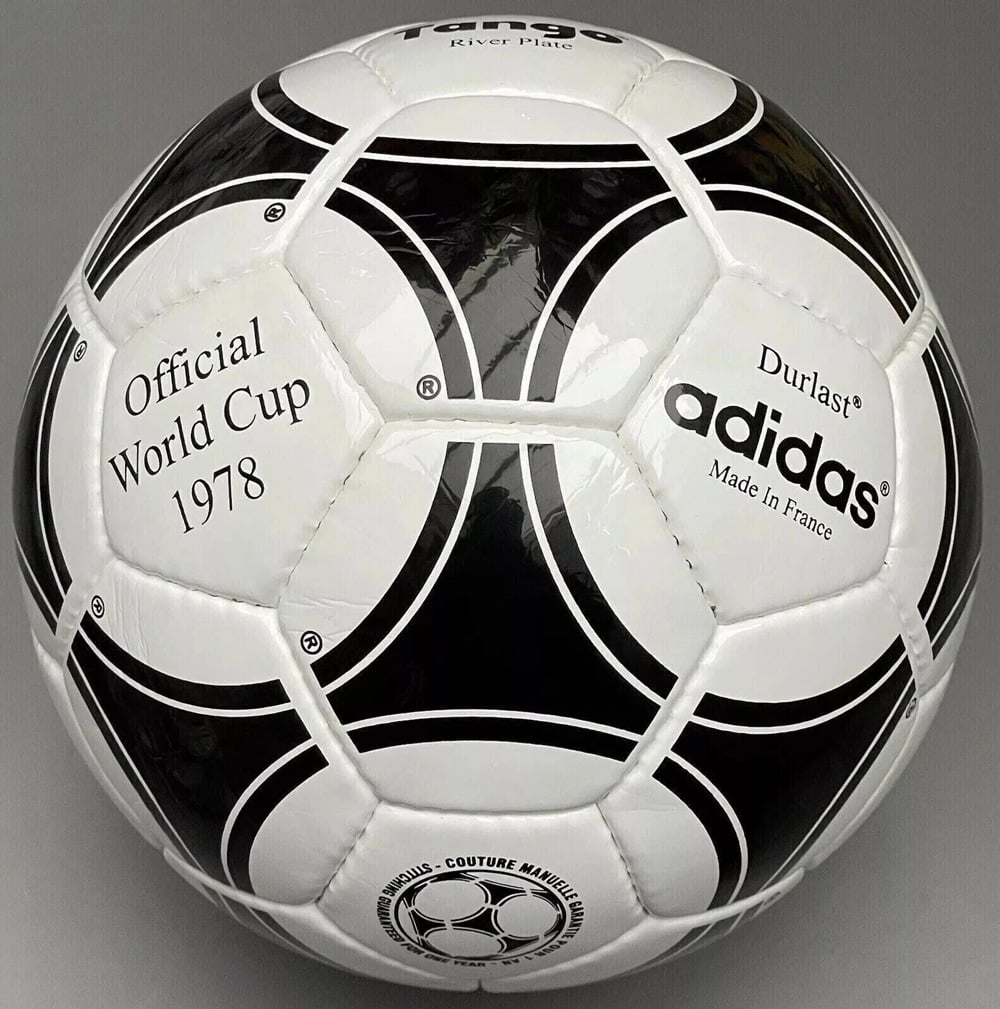
Simon Kuper is 56 now. His first memory of a World Cup, if not his first-ever vivid memory–for many of us who grew up outside the United States, the two are often the same–was the 1978 final between the Netherlands and Argentina. “I recall that night as vividly as almost anything else in my childhood,” he writes in World Cup Fever. “A World Cup is like Proust’s Madeleine. Each new World Cup reminds you of past World Cups, and the people you watched them with.” The book is a history of the World Cup through a few dozen madeleines.
 For Americans, it’s as good a guide as any to a tournament of paradoxes, this too-big-to-fail quadrennial festival of corruption, cheating, profiteering, nationalist chauvinism and mostly crappy soccer that nevertheless can hypnotize and transport to a utopia of competition as idealized and convincing as Pelé’s deification of the sport as “the beautiful game.” I think we watch not so much for the thrill–you have to admit that most games at this watered-down level are snoozfests (“such a party off the field but so dull on it,” as Kuper writes) but for the nostalgia of a game that never existed, but that we reimagine with every match.
“So much of a modern World Cup is repetition, especially as you grow older,” Kuper writes. “After decades of tournaments shown live on TV, each new France-Brazil or England-Argentina or Holland-Germany is just a repeat of earlier versions. Each victory or red card or controversy is a quotation of past ones. A match can never mean as much as it did the first time around. Win or lose this one, you know it isn’t the end of the story: at some point in the next few decades, there’ll be a replay. Repetition turns down the emotional dial of World Cups.”
He’s right, with a caveat: the World Cup is like Jorge Luis Borges’s idea that we rewrite every story every time we read one. The very same game will be remembered a billion different times in a way that the World Series or the Super Bowl or cricket’s World Cup never could be, because no other sport has the World Cup’s reach. No other event, short perhaps of a nuclear war or a comet strike, could bring the entire planet together.
So just as the tournament is a paradox of beauty and foulness, we all have paradoxical relationships with it, even those of us who don’t follow it. Our refusal to follow it is itself a statement, like the citizen who snubs the ballot box on election day. They, too, are making a statement. Like it or not, the World Cup reminds us that we are on the same planet, that we all share the same blood that kicks a ball the same way, but with a billion splendid variations.
No two soccer fans will see the same game the same way or ever agree about anything soccer, just as I had my differences with Kuper’s book and some of his interpretations: “And once your country has won the World Cup once or twice, it’s generally enough. The more you win, the less it matters.” Tell that to the winners. But he’s better placed than most to guide us. His lineage reads like a demographic World Cup. He was born in Uganda to South African parents, spent his early years in England as a British citizen, moved to the Netherlands when he was 7, studied in England and the United States (Oxford, Harvard), was naturalized a French citizen, now living in Paris with his French wife and raising French children who identified as French, and spent most of his career covering soccer for the London-based Financial Times.
The 1978 World Cup was the first of his innumerable crushing disappointments, as World Cups always must be for 95 percent of fans. Every four years there’s only one winner out of 195 nations. That one stung Kuper more because the Dutch lost the final for the second time in a row, having lost to Germany in 1974. This time they were playing in Argentina, whose team had blatantly cheated its way to the final. It wasn’t unusual for a tournament stitched in fraud and corruption since its first edition in 1930. It still is, fawning to authoritarian regimes, from Mussolini’s Italy to the junta’s Argentina, Putin’s Russia, dictatorial emirs’ Qatar the last time around, and now Trump’s diminished America. Thankfully Canada and Mexico are here to redeem this World Cup, which they also share.
The murderous military dictatorship of Jorge Rafael Videla showcased the 1978 World Cup the way Hitler showcased the 1936 Olympics, as a distraction masked in bogus legitimacy. Videla had the “disappearance” of some 30,000 dissidents to his name by the time he was done, and that night watched the final alongside Henry Kissinger, a fellow-criminal against humanity, who had also helped Videla rig a match to ensure Argentina’s appearance in the final.
I remember that final too. It was my second. My first was Germany-Holland in 1974, my one and only memory of watching with my dad, who died two years later. We watched Argentina-Holland live, my mother, my grandmother, our Dutch Catholic priest and me on our black-and-white TV in the dining room of our house in Hamlaya, a tiny village in the mountains of Lebanon where we thought we’d escaped the war and where the signal from Cyprus was always clear. Father Niederer didn’t have a TV. He spent the evening with us and his high hopes, especially after the Dutch managed to hold Argentina to a tie through the first 90 minutes. In the 90th minute a Dutch striker had almost won it, hitting the goal post instead. Extra time briefly ended Father Niederer’s faith as Argentina scored once, then again to take the title in a 3-1 match. The junta won. All those masses for nothing.

Wisely, Kuper is not interested in recounting matches. Football matches are like military battles and soap operas. “There’s nothing deader, for a writer, than a dead football match. I’m sorry, but you really had to be there,” he writes. Kuper is interested in the unexpected insights into national character that an improvised dance party might reveal, in the endemic corruption of a tournament that turns us all into addicts every four years, in the failed promise of economic booms that leaves the poor in host countries like Brazil, South Africa, Qatar and Mexico as exploited as in colonial times. The colonist is fifa, the dictatorial soccer federation expecting to reap $14 billion from this year’s tournament.
Kuper describes the exploitation in South Africa, Brazil and Qatar, the regressive, repressive American ally that spent more than $200 billion preparing for a 2022 tournament built on the graveyards of imported labor working in near-slave conditions and without rights. “Under Qatar’s traditional ‘kafala’ system, migrant workers were practically the property of their employers,” Kuper writes. “A boss could deport an employee for no reason, or hold their passport and keep them in Qatar against their will.” Qatar had promised to reform the kafala system. The moment Argentina hoisted the 2022 trophy at Lusail Stadium, all promises vanished. Now Saudi Arabia, an even more regressive, undemocratic country with its own kafala system, is set to host in 2034.
The book at first felt disheveled, jumping from one scant segment to another like so many rapid passes in a game, as if Kuper was eager to throw in every anecdote he could find in his notebooks. Kuper’s interview with Diego Maradona, one of the game’s greatest players and one of its most distasteful characters, is pointless other than to show Kuper scored the five-minute encounter.
European journalists have no problem buying access, either, or accepting lavish gifts: “I flew to the Chelsea-Manchester United Champions League final in Moscow as a guest of UEFA, the European football authority. I had a fabulous room in the five-star Marriott Grand Hotel. (Did UEFA corrupt me? I don’t think so.)” He never makes the connection between that sort of payola and the buying of referees and game-fixing he documents so well.
Some of his insights are no more penetrating than comparing Germany’s emerging prosperity on and off the pitch in 1990 to a bus driver’s “villa with a veranda in a spotless village,” or telling us that “A World Cup can’t change a country. But it can divert an individual’s life path,” as if there were anything comparable between France’s decline into riots, fading power and economic stagnation after the 1998 World Cup with his decision to quit the Financial Times and become a French citizen. As all World Cup books must, this one pays homage to cheaters like Maradona, biters like Uruguay’s Luis Suárez, criers like Portugal’s Cristiano Ronaldo, and charisma-challenged virtuosos like Messi, now hobbling through his last show.
Soon you get used to the Kuper style. It has the verve of 1970s Dutch football–total football, as they called it–placing every element of the game in service of the story without letting judgments necessarily mar the exuberance. Yes, the game is corrupt–there’s a hint that even Nelson Mandela had a part in the $10 million bribe disguised as a cultural gift that bought the World Cup for South Africa–but there was that priceless moment when the Japanese let loose on their own soil at the Japan-Belgium match in 2002 and showed the world a joy we’d rarely seen. There may have been hooliganism in the past, but in pubs and on trains fans from opposing teams typically drink and dance together. Kuper unfortunately doesn’t venture into calculating the demographics of World Cup-conceived babies every four years. I suspect the cross-fertilization is as rich as during the Crusades. But he documents an alarming incidence of heart attacks during every tournament.
Another paradox: World Cup play is inferior to anything you’ll see in club football in top leagues in England, Germany, Spain, Italy and France: any of those countries’ top clubs could beat all but the four or five highest ranked national teams at the World Cup, if not even them. Any league match is technically more proficient and cohesive than a World Cup match. Any league match lacks those ridiculous disparities we’re going to see when, say, Spain plays Cape Verde or Germany plays Curaçao, that Caribbean Dutch protectorate with the population of Flagler County (think Reagan’s Marines invading Grenada).
Just 16 countries traveled to Germany when I watched my first World Cup in 1974. The format went to 24 in 1982, then 32 in 1998, and now 48 countries–a quarter of the planet’s nations. There’s really nothing wrong with that. Elitism is over. We can’t democratize the world. We can democratize the World Cup, though there’s no doubt fifa expanded the thing to shake down more cash even as it dilutes and cheapens play. The federation’s mercantilism handed Mexico and Canada only 13 games each, compared to 78 in the United States, an imbalance as insulting as our president’s attempts to destroy both countries’ economies while ridiculing one and reducing the other to a mass of criminals, and getting a fifa “prize” for it.
Still, we look past the absurd. “Most football fans took it for granted that FIFA was corrupt,” Kuper writes, needlessly capitalizing the federation’s acronym the way some media still capitalize “covid.” Diseases should not so blithely be respected. “They’d heard the stories of officials stashing bribes in secret bank accounts. However, fans care more about what happens on the field. Once we start to doubt that the matches we are seeing are real, the emotion we invest in World Cups becomes pointless.” In the spirit of magic realism, why not give Curaçao and Cape Verde a chance on the same stage as the greats? It’s not as if the American team belongs there, either, if it’s quality we’re looking for. But there they are.
We’re mostly missing the point if we watch the World Cup for quality. Like the Olympics but without the frazzle of a zillion sports scattered like so many pixels on our screens, it’s our quadrennial dreamland on these simple, perfectly groomed fields where cubism and leaves of grass meet so the world’s teams kick around a planet-shaped sphere as luck and fate outscores the best of them.
“The World Cup exists to transform reality into illusion,” the Mexican novelist Juan Villoro wrote in an article for The New York Times this week. I think of it more in reverse: it exists to transform illusion into reality. The illusion is that we are one world playing the same game, speaking the same language, respecting the same rules, existing on a level playing field regardless of origin, race, religion, even fifa ranking. The reality is that for those five weeks, away from the dingbattery of dignitaries and fifa’s sycophantry, away from the tensions between Canada, Mexico and the United States–on the pitch, in pubs, in living rooms, in street parties, in the palmed stadiums of our smart-phoned hands and maybe even in our hearts, despairing as we are the rest of the time–that illusion may well be true.

Pierre Tristam is the editor of FlaglerLive. A version of this piece aired on WNZF.



























Mark says
I’ll watch when it’s the women’s World Cup. They’re more exciting and the US actually has a chance.
The dude says
The USWT just played two “friendlys” against Brazil last week.
It was two of the most physical games I’ve seen so far this year.
The ladies just don’t flop the way the dudes do…
Marek says
It all may be true, but it still is a beautiful game
R.S. says
I faintly remember the World Cup of 1954, when Germany socked it to the Hungarians with Helmut Rahn shooting the winning goal. Those guys were the heroes of my childhood. Yup, the Miracle of Berne happened and lifted spirits when Germany needed some spirit lifting.
David Ferguson says
Soccer can be viewed as more elegant and artistic sport than American football , but this is a view very few Americans share. The savvy American football team owners invest in European soccer league teams like their elite worldly peers and counterparts
HMMM says
Yeah no desire to watch any of his…..